
All of Ulf Graf 🔹's Comments + Replies
Over the last decade, we should have invested more in community growth at the expense of research.
I think it might have been worth to invest in community growth in the same way as The School for Moral Ambition. I know Rutger Bregman has taken the 10 % pledge but I don't know how much Moral Ambition collaborate with EA organizations. But it would probably be very valuable to collaborate with them and possibly give them some funding in exchange for help with community growth. They made Harvard students consider a meaningful career instead of a high paid career.
Happier Lives Institute, since I have volunteered for them since 2019 and that their work is great. Cool Earth, who I collaborated with last year, and I think basic income for nature and climate is an awesome idea. Giving What We Can, because of their multiplier effect. GiveDirectly, since they won the donation election I had with my public health students and I promised to donate from my own money to the charity of their choice (and I think GiveDirectly is a great organization).
I think that this is a really good idea. I think that we already have transgressed our limits of resources and that a higher VPP won't save the situation. In 1970 the resource use was 30 billion tonnes (23 kilograms of materials used on average per person per day). In 2020, the number was 106 billion tonnes (39 kilograms per person per day) and there is a projected 60% growth in resource use by 2060. 90% of land-related biodiversity loss and water stress comes from extraction and processing of biomass. 44% (48 million km2) of the world’s habitable land is ...
Thank you for a wonderful text and that you mentioned how you cultivate that people are real! I will use some of the resources for my students in global health. I use Out of Eden Walk for cultivating that people are real. It is about a journalist at National Geographic who walk across the world. I hope you like it!
Thank you for your good questions! I would probably use the impact calculator by The Life You Can Save, since I use it to introduce people to effective giving: https://www.thelifeyoucansave.org/impact-calculator/
The good thing with the impact calculator is that your family / friends can see the impact and compare charities. But it depends on their level of engagement. It might be overwhelming to compare charities. The Life You Can Save also have cause funds, so if they have any cause areas they might like more, you can suggest one of them. Otherwise it mig...
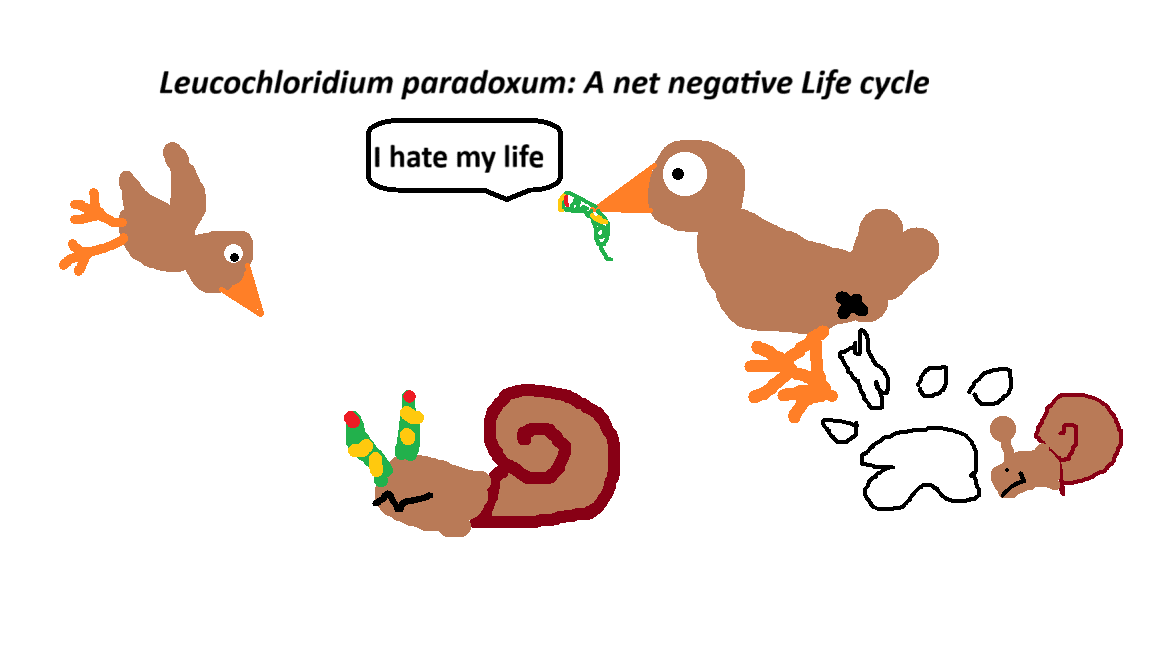
A Leucochloridium paradoxum (green-banded broodsac) for @Toby Tremlett🔹!
Cited from Wikipedia:
"Its intermediate hosts are land snails, usually of the genus Succinea. The pulsating, green broodsacs fill the eye stalks of the snail, thereby attracting predation by birds, the primary host. These broodsacs visually imitate caterpillars, a prey of birds. The adult parasite lives in the bird's cloaca, releasing its eggs into the faeces."
Thank you for a very thoughtful forum post! I had an idea a few years ago that was kind of like this: That the United Nations should use the same concept as Founders Pledge to get funding. I was thinking that because they have so many collaborations, connections and volunteers, it would be quite easy for the UN to get great amounts of funding by letting people take the same kind of pledge as Founders Pledge use (giving X % to charity when you sell your business).
I was interested in altruism and acts of kindness before I heard of effective altruism. With effective altruism, I distributed my money from "common" charities to charities that are more effective. I have also helped organizations that I thought could make the most impact. I started volunteering for Happier Lives Institute in 2019, which would never have happened if I didn't know about effective altruism.
Thank you for a really good overview! I will use some of these numbers for my lectures about global health! I have not held lectures about global health for a couple of years so even if I have talked about most of these areas the numbers need to be updated. You covered it really well! :)
Kind regards,
Ulf Graf
Thank you very much! I wrote input to the UN together with Cool Earth and Equal Right: https://www.ohchr.org/sites/default/files/documents/issues/ohchr-cfis/transition/subm-just-transition-hr-ind-ulf-graf-halmstad-university-equal-right-wageningen-university-cool-earth-arth.pdf
I share your frustration and I am not sure about what to do. This post says that if 3,5 % of a population is active in peaceful social change, change will happen: https://forum.effectivealtruism.org/posts/v6PtkcfZQAHR2Cgmx/do-protests-work-a-critical-review
Check the gener...
You're welcome! Thank you for the information! Yes, it is true that people who benefit from the current structures use their money and power to gain more money and power. I have made a forum post about green basic income, in the end of the post I try to give some suggestions: https://forum.effectivealtruism.org/posts/tAF4zQSfDGpABLCaH/green-basic-income-and-health-taxes-as-a-way-for-systemic
I also co-authored the systems change 101: https://forum.effectivealtruism.org/posts/bwZ6HqRSjYh5DS99r/systems-change-101
I hope that those posts might give ...
Hi Janika! I really like your ideas! I think Equal Right is closest to your ideas since they promote a low global basic income and a global wealth tax (and some other taxes and fees): https://www.equalright.org/
UN has a Universal Periodic Review about human rights. Having something similar for the SDG:s or global risks would probably be fruitful: https://www.ohchr.org/en/hr-bodies/upr/upr-home
I hope my comment is helpful!
Thank you for a really interesting and well-written article! I am a lecturer in public health and have lectures about the interconnection between global societal and ecological crises. I have heard about the weakening of the Gulf Stream and that it could make it colder, but I have never seen detailed examples of the consequences of AMOC collapse. AMOC collapse togehter with things that I already talk about seems really problematic. E.g. 99% of coral reefs are expected to be dead by 2050. 44% (48 million km2) of the world’s habitable land is used for a...
Equal Right is testing a similar model in Palau and Tuvalu: https://www.equalright.org/
I guess you have already heard of it, but I put the link here just in case, because I really like their idea. :)
It sounds like a more effective version of Moai in Okinawa. It will be interesting to see how it goes!
https://www.bluezones.com/2018/08/moai-this-tradition-is-why-okinawan-people-live-longer-better/
I wish you luck with this project!
Happier Lives Institute made an analysis of EarthEnable which was in their chapter in the latest World Happiness report. I guess they will make a report about it in the near future but I am not sure. So they have looked at flooring and housing. :)
I think your ideas are good! I use datasets from Gapminder for my students in public health. They might be useful for you or give inspiration: https://www.gapminder.org/data/
Thank you for another insightful and interesting comment as well, Vasco! It was really nice to discuss with you and want to say that I have great respect for you and your texts. You gave me a lot to think about. I am very curios about how you would like the world to look like, what would your utopia be? I understand that it might be much to write (if you haven't written about it already), so it is no rush, and you don't need to reply if you feel that you want to use your time in other ways instead. But thanks again for giving me new perspectives and knowledge, I hope that I was able to return the favor. :)
Thank you very much, Vasco! I am glad that you liked my comment. I will try to answer all your questions as good as I can. I haven't replied to long post before so I don't know how to do the cool paragraphs that you do, so sorry if it gets a little confusing.
I updated the link, so it should work now. Thank you for mentioning this!
I didn't find any good data for how much the top quintile funded governement transfers in other countries, but it would have been very interesting to look at. Thank you for the interesting information.
I think one reason for Singap...
First of all, I want to thank you for your posts. Many of them have given me new perspectives and knowledge that I appreciate. I want to mention that the two-parameter ortega model probably is a better measurement for inequality, but it isn't used very much so it is hard to find any numbers.
I also want to mention that income inequality is problematic, since it correlates with almost all societal problems. Social mobility is greater in countries with low income inequality, since they have more robust welfare systems. It is easier to achieve the "American dr...
I would say that we need to address the root causes in areas that are too complex to solve with simple solutions, e.g. biodiversity loss, since it is interconnected with many other systemic challenges. According to the assessment report about Nexus, which is the interconnections between the following crises: Climate change, biodiversity, water, food and health. According to the report, there are 7 trillion USD in subsidies for the fossil fuel industry, and damages to nature for 10-25 trillion USD in unaccounted costs. Also, there are 35 times more resource...
I think that it is a high risk that AI or something else will be a great threat for humanity within a short future. But I can't say how high the risk is or when in the future. But no matter how long or short time I have left, I would carry on like I always do. I spend time with my family and I love my job as a teacher at an university. I couldn't ask for more. I feel that there is nothing more I must do before I die. So I am grateful and happy every day. But... My parents have four houses in a forest in the middle of Sweden. So if the apocalypse comes, I have a place where it is a quite good chance for surviving.
I skimmed in your article and must say that I am impressed. I think it is important for the EA community to think about what planet and what society we want. I looked at the summary of the IPBES Nexus Assesment and it seems clear to me that our economic system doesn't work in its current state. That 7 trillion in subsidies for the fossil fuel industry, and damages on nature for 10-25 trillion in unaccounted costs is problematic. Also, the fact that there is 35 times more resources going to causes that destroys our planet than supports our nature shows that...
Hi Alexis! I think it is a wonderful idea and I would like to help you! I am kind of time constrained (having a one year old at home and working) but I will be able to give you advise. I am teaching public health at a Swedish university and I hold lectures about these topics. So I have some knowledge in this topic and would love to share it with you!
Gapminder has a list of 100 positive news during 2023: https://www.gapminder.org/news/100-positive-news-from-2023/
I think that we should aim for using evidence based on reality and not try to change our ways because we want to appeal to different political groups. That doesn't mean that we can find cause areas that are more interesting for different political groups. I guess that many conservatives might be skeptical to some paths in the EA movement that involves areas like animal welfare, climate change and raising some types of taxes and health policies (e.g. the Swedish right actively work against climate change mitigation, animal welfare and health policies), whic...
Thank you, I am happy that it was helpful! I am just an ordinary university teacher without a PhD so it was the first time someone called me professor! :) I wish you luck with finding the right path for you! No matter what path you choose, I think you will do great things and have a large impact! :)
Thank you for your post! I will try to give you as good advice as I can. I teach public health at a university in Sweden so I am a little biased towards global health probably.
Depending on you think is interesting and meaningful, you should choose what you like. As you are good at math, maybe statistics or health economics is a good way for you? I think that no matter what cause area you choose, it is probably good to be able to make a cost-effectiveness analysis.
Do you want to start your own organisation or choose an already existing? Volunteering a...
I gave input to the UN together with Cool Earth, Equal Right and Professor Robert Fletcher. During 2025 I will try to figure out what to do with that text (any suggestions are warmly welcome): https://docs.google.com/document/d/1uAzSycfm190C1hnVDCnYTXK2d1tvw0WsbfE8RJYvw2U/edit?usp=drivesdk
I will also try to figure out how I can start a PhD in a meaningful research project. I am stuck in the southern Sweden because I have my family here, but at the university where I work as a lecturer in public health, there are not many research projects that feels right ...
Thank you for this post! I think it might be beneficial in some ways for the EA movement but a barrier in other ways. It is quite hard to find good evidence for cost-effectiveness of systemic changes, which makes it hard to look closer into. It is also hard to separate systemic change from politics, which can create tensions in a community.
Well… I am involved. I made some input to the UN together with Cool Earth, Equal Right and Robert Fletcher: https://docs.google.com/document/d/1uAzSycfm190C1hnVDCnYTXK2d1tvw0WsbfE8RJYvw2U/edit?usp=drivesdk
I also made a f...
I just want to thank you for such an impressive forum post! I think Shrimp Welfare is very interesting and it has been an eye-opener for me when it comes to animal welfare. My own area is global / public health in different forms, but I will use some of the examples mentioned here in my lectures about global health and economic evaluations for my students if it is okay for you? I think it might be an eye-opener for some of them as well.
Thank you for an interesting forum post! In my forum post I present some examples of how to decrease inequality by using taxes and basic income. The best examples there are safety income and basic income that is funded with environmental taxes.
All the best,
Ulf Graf
Thank you for your wise reply, again! Yes, that is true. Even if we stopped all CO2-emissions now, almost none of the existing would go away because it will be up there for such a long time. But methane vanishes more quickly.
Yes, you are correct here as well. Organizations like Future Matters, that is founded by EA people, are doing research and strategy consulting services in policy, politics, coalitions and movements. So they could use this kind of article, since they give advice to politicians and national policy makers. But I still think that taxes is ...
Thank you Jackva, you have very wise input. I would also want the most impactful long-term policies as well. I think that the climate change already have gone so far that we need quite much focus on the short-term. For example, UNEP estimates that 25 to 50 % of all coral reefs are already destroyed, mostly because of global warming, and 70 to 90 % will be gone if we reach 1.5°C above pre-industrial levels. Many of your suggestions are good for both short-term and long-term impact so I agree that it could be better than the policies in the article. Policies...
Thank you all for your comments! I agree that these policies may not have a massive global impact in the same way as clean energy policies, but 26 to 41 % in reductions is still a lot. I believe that additional effort and innovation-support is important as well. But carbon pricing and things like innovation-support can be combined. The Swiss CO2 Levy uses carbon pricing to give money to innovation, for example (see text below). As you see in the text below and in this graph by OECD, the cost for raising prices for carbon emissions can increase revenues as ...
Of 1500 climate policies that have been implemented over the past 25 years, the 63 most successful ones are in this article (that I don't have access to, but a good summary is here). The 63 policies reduced between 0.6 billion and 1.8 billion metric tonnes CO2 emissions. The typical effects that the 63 most effective policies had, could close the emissions gap by 26%-41%. Pricing is most effective in developed countries, while regulations are the most effective policies in developing countries. The climate policy explorer shows the best policies for differ...
I have a table here showing the difference between a country with low taxes (United States) and a country with high taxes (Sweden). What I want to say with the table is that people who are unemployed have much more money in Sweden compared to the US. Also, in Sweden the taxes are making the costs lower for elderly care, child care, education, health care, medicine and so on. So even if the taxes are higher, you probably have better access to health care, medicine and financial aid in Sweden even if you are living on a minimum income. Because of the redistr...
A special thanks to Niklas Holmgren and Joel McGuire for the support and comments on the first draft!
By the way... Here is the list of main references if it is easier to look here:
Abbott, R., & Bogenschneider, B. (2018). Should robots pay taxes: Tax policy in the age of automation. Harv. L. & Pol'y Rev., 12, 145.
Afshin, A., Sur, P. J., Fay, K. A., Cornaby, L., Ferrara, G., Salama, J. S., ... & Murray, C. J. (2019). Health effects of dietary risks in 195 countries, 1990–2017: a systematic analysis for the Global Burden of Disease...
I think that your list is really great! As a person who try to understand misaligned AI better, this is my arguments:
- The difference between a human and an AGI might be greater than the difference between a human and a mushroom.
- If the difference is that great, it will probably not make much difference between a cow and a human. The way humans treat other animals, the planet and each other makes it hard to see how we could possibly create AI alignment that is willing to save a creature like us.
- If AGI has self-perservation, we are the only creatures that can
... (read more)