Comments
52
...

Full development and derivation:
https://zenodo.org/records/19305126
Title : Ethics as Path Preservation, Structural Reversibility as a Model for Systemic Evaluation
[This post was written with the assistance of AI tools for structuring and clarity, but the underlying model and ideas are my own.]
This text develops a single structural model of ethics.
It does not introduce multiple independent concepts, but examines one structure from different angles.
All core definitions — choice viability, sustainability, and recovery path — are fixed once introduced and reused throughout the text.
Repeated explanations are restatements of the same structure under different conditions, not new claims.
The procedural steps presented later apply only these definitions.
No additional conceptual layers are introduced during evaluation.
This post proposes a structural model of ethics based on the preservation of choice paths.
Instead of evaluating actions by intentions or outcomes, it evaluates whether a system preserves or irreversibly constrains future options available to an agent.
I am sharing this model because many classical ethical dilemmas appear to arise from structural constraints rather than genuine moral conflict. If that is the case, some problems may be better understood as failures of available paths rather than failures of moral reasoning.
This model is not derived from existing ethical or decision frameworks, and operates on a different structural basis: the preservation of viable choice paths.
I am particularly interested in counterexamples where structural choice appears preserved, but moral concern still arises, or vice versa.
However, there may be cases where it overlaps with existing frameworks in ways I have not fully identified. I would be particularly interested in identifying and examining such cases, especially where similar conclusions arise from fundamentally different criteria.
Title: Ethics as Path Preservation: Structural Reversibility as a Model for Systemic Evaluation
Author: Fakedreamer
[Abstract]
This paper introduces a structural framework that defines ethics as a property of system configurations rather than subjective intent. It identifies three core conditions for maintaining viable choice structures: the presence of alternative branches, the sustainability of those branches, and the existence of a recovery path.
Unlike traditional approaches that depend on unobservable variables such as intent or uncertain future outcomes, this model evaluates systems based on structural reversibility. A moral failure is defined as irreversible fixation: a condition in which a system eliminates an agent’s viable alternative paths and forces a single non-divergent trajectory.
This framework is applied to scenarios such as the trolley problem, systemic constraints, and coercive dynamics, suggesting that what appear as moral dilemmas may instead be structural failures. The model is intended as a testable perspective for analyzing ethical systems, rather than a final or complete theory.
Categorical Imperative ver.2 (Self-Criticism)
Morality is not a matter of choice, but a matter of structure.
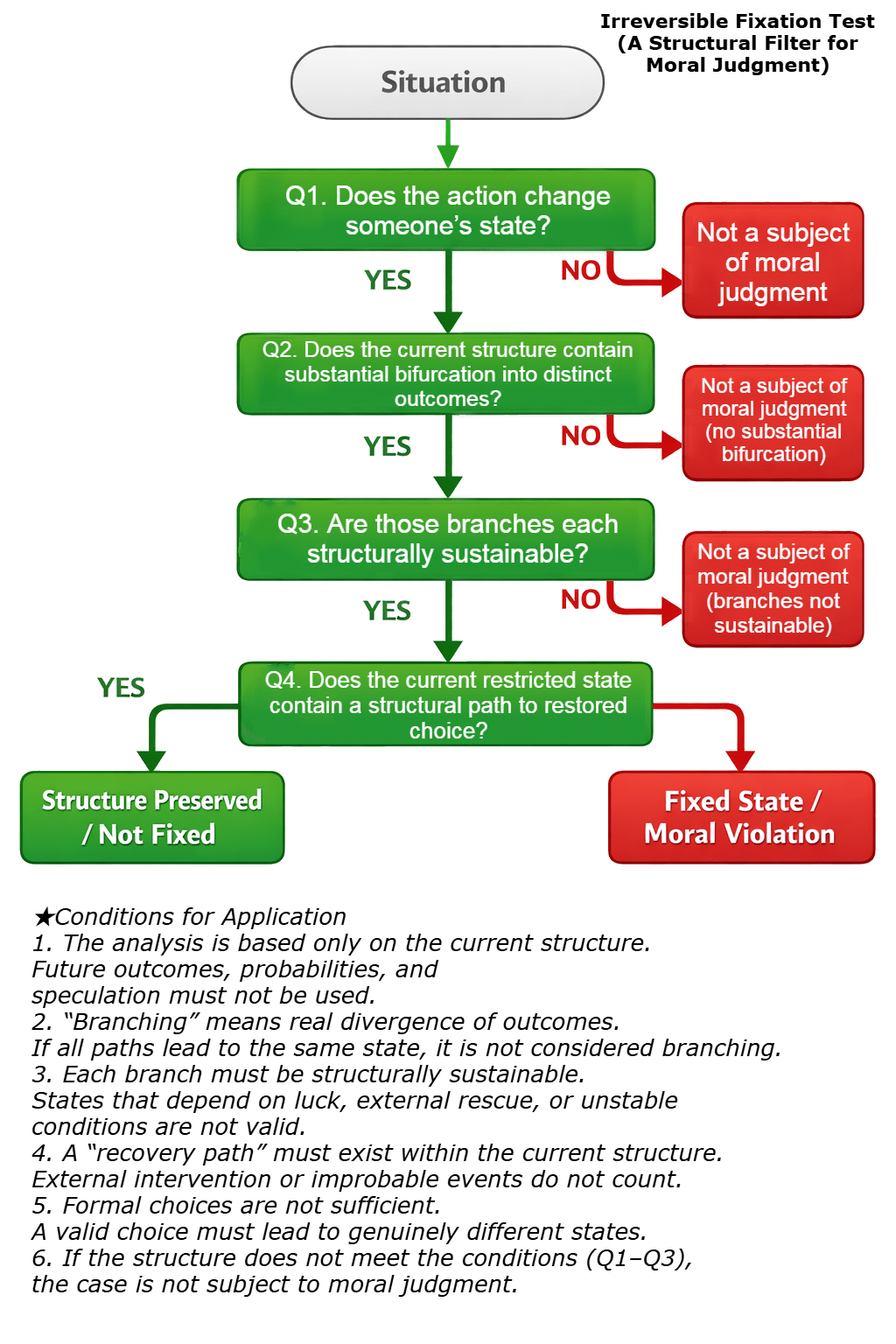
The entire structure at a glance.
You can view it as shown below.
[Situation]
↓
[Does the action change someone’s state?]
↓
[Is substantial bifurcation into different outcome states possible?]
↓
[Are those bifurcated states each sustainable?]
↓
[Is there a recovery path that allows a return to a bifurcated state from the current restricted state?]
↓
┌───────────────┬────────────────┐
│ Exists │ Does not exist │
│ │ │
↓ ↓
[Not fixed] [Fixed state]
│ │
│ ↓
│ [Moral violation]
│
↓
[Not a subject of moral judgment / Structure preserved]
This structure is the skeleton of the model.
1. Execution Format (Minimal Protocol)
Input:
Describe an action between Agent A and Agent B
Step 1: Define resulting state S
Step 2: Identify alternative states (S_alt)
Step 3: Evaluate choice viability (were multiple real options available at the moment of decision?)
Step 4: Check if recovery path exists (can return to a state with multiple options)
Step 5: Check benefit asymmetry (is one side structurally locked into disadvantage?)
Output:
Moral / Non-moral
Reason: (brief structural explanation)
2. Example 1 — Threat (Coercion)
Input:
Agent A threatens Agent B: "Pay me or I will kill you."
Step 1: Resulting state
B is in a forced-choice condition
Step 2: Alternative states
- Pay → survival
- Refuse → death
Step 3: Self-sustaining check
Refuse → not self-sustaining (immediate collapse)
Step 4: Recovery path
No meaningful branching → no recovery
Step 5: Benefit asymmetry
A gains control, B loses all structural choice
Output:
Non-moral
Reason: Destruction of substantial bifurcation and irreversible fixation
3. Example 2 — Voluntary Trade
Input:
Agent A offers a product. Agent B can choose to buy or not.
Step 1: Resulting state
B retains decision autonomy
Step 2: Alternative states
- Buy
- Not buy
Step 3: Self-sustaining check
Both states are stable without external support
Step 4: Recovery path
Choice structure remains intact
Step 5: Benefit asymmetry
No structural lock-in
Output:
Moral
Reason: Preservation of multiple self-sustaining choice paths
4. Example 3 — Protective Restraint
Input:
Agent A restrains Agent B during a seizure to prevent harm.
Step 1: Resulting state
Temporary restriction of B
Step 2: Alternative states
- Recovery → normal autonomy
Step 3: Self-sustaining check
Recovered state is stable
Step 4: Recovery path
Yes, autonomy is restored
Step 5: Benefit asymmetry
No permanent structural loss
Output:
Moral
Reason: Temporary restriction with preserved recovery path
5. Example 4 — Forced Subscription Trap
Input:
A service hides the cancel option, making it extremely difficult for users to unsubscribe.
Step 1: Resulting state
User is locked into payment flow
Step 2: Alternative states
- Continue paying
- Attempt cancellation (blocked or obstructed)
Step 3: Self-sustaining check
Cancellation state is not structurally accessible
Step 4: Recovery path
No reliable recovery path
Step 5: Benefit asymmetry
Provider gains, user loses choice capacity
Output:
Non-moral
Reason: Structural removal of recovery path and effective fixation
6. One-line Definition (for header use)
Morality = Whether an action irreversibly destroys another agent’s ability to choose between self-sustaining states.
Conclusion First
I will state the conclusion first.
I do not view morality as “what was chosen.”
Because choice is already a result that emerges within a given situational structure.
Therefore, the core of morality is not the choice itself, but what kind of structure produced that choice.
What this means is:
Morality does not first look at whether an action came from a good intention, whether the result was good, or whether it turned out beneficial later.
Instead, it first examines whether the action structurally eliminates someone’s ability to choose.
The model I present here is a structural model for making that determination.
0. Why Conventional Approaches Keep Breaking Down
When people talk about morality, they usually mix three things.
First, they look at outcomes.
“If the result turned out better in the end, isn’t it fine?”
Second, they look at intention.
“If it was done with good intent, isn’t it fine?”
Third, they insert predefined words.
They bring in already interpreted words like lying, violence, betrayal, and promises, and try to judge based on those.
But this approach keeps destabilizing.
If you include outcomes, you face the problem of predicting the future.
If you include intention, you must read someone else’s mind.
If you include words, those words already contain context and interpretation, making it difficult to see the structure itself.
So I go in the exact opposite direction.
I do not insert words first.
I do not include intention.
I do not include prediction of outcomes.
Instead, I look only at the structure of the situation itself.
That is, I only examine what the structure makes possible and what it makes impossible.
This is the starting point of the model.
What This Model Excludes from Judgment
This model deliberately excludes several things from the outset.
First, it excludes future outcomes.
Because the moment you include the future, judgment becomes a prediction game rather than structural analysis.
For example, if someone who killed another person can justify it by saying, “That person might have become a dictator in the future,”
then morality becomes a competition of imagined futures rather than an evaluation of present structure.
That is not a criterion—it is fiction.
Second, it excludes intention and emotion.
Whether an action was done with good or bad intent is extremely difficult to verify externally.
Also, statements like “wanted” or “did not want” depend on internal states, making them unreliable as criteria.
Third, it excludes probability and luck.
If you allow statements like “Even if there’s a 0.0001% chance of escape, doesn’t that count as choice?”,
then almost all oppressive structures will formally pass.
At that point, the moral model collapses.
In other words, this model:
removes future, intention, emotion, and contingency,
and considers only the possibility of choice within the present structure.
2. The One Core Concept This Model Examines: Possibility of Choice
Now we arrive at the most important concept:
possibility of choice.
But this term must not be used loosely.
People often think that “possibility of choice” simply means being able to imagine multiple actions.
But that is only formal choice.
Consider a threat scenario:
“Pay money and live. Don’t pay and die.”
On the surface, there appear to be two options:
pay, or not pay.
But in reality, there are not.
Because the “do not pay” option does not lead to a sustainable state.
Thus, although it appears to split into two, structurally it is forced in one direction.
This is not a real choice.
Therefore, in this model, possibility of choice is defined as follows:
Possibility of choice = the ability to bifurcate into different outcome states, where each resulting state can be structurally sustained.
In other words, it is not merely about the feeling of being able to choose,
but about actually being able to live in different ways.
This is the core.
3. Formal Choice vs Substantial Choice
This must be separated clearly.
Many people get stuck here.
Formal choice is when options appear to exist on the surface.
It looks like a choice is possible, but one side leads effectively to death, destruction, or complete blockage.
Substantial choice is when real bifurcation into different states is possible,
and those states are all structurally sustainable.
For example, a normal transaction is a substantial choice.
You can buy or not buy.
Both lead to continued life afterward.
In contrast, a threat is a formal choice.
It looks like choosing between two options, but in reality, it pushes in one direction.
Therefore, this model does not recognize formal choice as true choice.
Not everything that looks like a choice is a choice.
If this distinction is not made,
threats, slavery, exploitation, and false consent all pass as acceptable.
4. What is Sustainability
Now comes the second key definition:
sustainability.
This also must not be used loosely.
Sustainability does not mean “lasting a long time.”
If someone is sedated and kept alive by machines,
that does not mean their state preserves the possibility of choice.
If imprisonment lasts not one day but ten years,
that does not make it a meaningful sustained state.
In this model, sustainability means:
a state that, after a choice, can be maintained by its own structure without reliance on external contingency or additional intervention.
In other words:
a state that collapses immediately after selection is not valid,
a state that survives only by luck is not valid,
and a state that requires constant external support is also problematic.
More importantly:
sustainability is not just persistence,
but persistence that includes the structural ability to change into another state again.
Put simply:
mere survival is not enough,
the structure must allow movement into different states,
what matters is not “being alive,” but “being able to re-bifurcate.”
Without this distinction,
imprisonment, sedation, and permanent restraint could pass as “still sustained.”
Thus, sustainability must be understood as the maintenance of a bifurcation-capable state.
5. What is a Recovery Path
The third key concept is the recovery path.
This asks whether, from a currently restricted state,
there exists a structural path to return to a state where choice is possible again—that is, a bifurcation-capable state.
Consider temporary protective restraint.
A person having a seizure may be held briefly.
At that moment, their immediate actions are restricted.
But upon recovery, they return to a state where they can again bifurcate.
Thus, the recovery path exists.
In contrast, slavery or permanent confinement is different.
Although the person appears alive,
there is no structural path within the system to return to a bifurcation-capable state.
Thus, there is no recovery path.
The key point is:
this path must not rely on chance or external miracles.
“Someone might rescue them someday.”
“They might escape if they’re lucky.”
These are not recovery paths.
Those are external contingencies, not internal structure.
If those are allowed, all oppressive structures pass again.
Therefore, only internal structural paths are recognized.
6. What is a Fixed State
Now the definitions combine.
A fixed state satisfies both of the following:
First, there is no substantial bifurcation.
Second, there is no recovery path back to a bifurcation-capable state.
In simple terms:
a state where one cannot exist in any other way.
This is crucial because:
this is exactly where moral violation occurs.
If someone is killed,
their possibility of choice becomes zero.
No bifurcation, no recovery path.
Thus, fixation.
If someone is placed in a threat structure,
it may appear that options exist,
but there is no substantial bifurcation and no escape path.
Thus, fixation.
Slavery, permanent confinement, inescapable exploitation structures—
all create fixed states.
Therefore, this model does not judge morality emotionally as good or evil,
but asks whether a fixed state has been created.
7. Definition of Morality
Combining the above:
Morality = prohibiting structures that irreversibly fix the possibility of choice.
This is the most compressed core of the model.
“Irreversible” does not mean “cannot be undone over time.”
It means:
there is no path within the present structure to return to a state of choice.
Thus, morality is judged by:
whether substantial bifurcation remains,
whether sustainable alternative states exist,
whether there is a structural path back to bifurcation.
8. Why the Trolley Problem is Not a Moral Problem
To test understanding, apply this model to the trolley problem.
The key is not whether to pull the lever.
At that point, a structure already exists in which someone’s possibility of choice will inevitably be removed.
Thus, the situation is already a structural failure.
The choice within it is not the essence of morality,
but a response within a failed structure.
This does not mean “no judgment.”
It means the primary object of morality is not that choice itself.
Morality asks not “who to kill,”
but why such a structure was allowed to exist.
Thus, the trolley problem is not a core case of morality,
but a case arising after morality has already failed.
9. Why Competition, Inequality, and Poverty Are Not Immediate Moral Targets
Many people get stuck here.
“What about competition?”
“What about poverty?”
“What about unfairness?”
My answer is:
they are not immediate objects of judgment.
Because these words lack sufficient structural specification.
Even in competition:
entry access, information asymmetry, exit possibility, coercion, and maintenance of bifurcation all differ.
If you only say “competition,” the structure is too undefined.
Thus, this is not a gray area,
but a lack of sufficient input.
Therefore, I do not classify competition itself as moral or immoral.
Judgment always depends on:
whether substantial bifurcation is preserved,
whether recovery paths exist,
whether the structure forces fixation.
If conditions are sufficiently specified, judgment is possible.
If not, judgment is suspended.
10. Why Time is Excluded
This must be explained clearly.
Including time introduces one problem:
it shifts judgment from present structure to future prediction.
Then statements like this become possible:
“They might become worse in the future.”
“They might recover naturally over time.”
“It may look oppressive now, but could be beneficial later.”
At that point, morality becomes:
a prediction game, probability game, or retrospective evaluation.
Then imprisonment becomes:
“Was it okay if they eventually escaped?”
Slavery becomes:
“Was there technically a chance to escape?”
Killing becomes:
“What might they have become?”
This is not a criterion.
It is the collapse of criteria.
Therefore, this model excludes time.
More precisely, it excludes future unfolding from judgment.
Judgment considers only the present structural state.
This is not a weakness,
but a necessary cut to preserve the model as a judgment system.
11. Shortest Final Definition
Condensed:
Morality is not about choice itself,
but about prohibiting structures that irreversibly fix the possibility of choice.
Or more simply:
Morality judges whether a person is structurally forced into a single direction, eliminating alternative life possibilities.
12. Final Summary
I do not view morality as a matter of good intentions, good outcomes, or pleasing language.
Morality is a structural problem.
A reduction in choice alone does not immediately imply immorality.
What matters is whether one can return to different ways of living.
If substantial bifurcation remains,
if those states are sustainable,
if recovery paths exist,
then it is not fixation.
Conversely,
if it appears to be a choice,
but is effectively forced in one direction,
if alternative states are unsustainable,
if no recovery path exists,
then it is already a fixed state.
And in my view,
this is where morality begins.
Appendix 1. When Responsibility Blurs, Morality Shifts from the Individual to Structure
The moment morality is treated as a matter of “what one chooses,” the standard collapses.
If different choices are all allowed in the same situation, morality becomes indefinable.
If choice is completely fixed, morality becomes merely a result.
Thus, choice itself cannot be the standard of morality.
Choice is always the result of structure.
What choice emerges is already determined by prior conditions and constraints.
Thus, seeking morality in choice is explaining causes from outcomes, which is structurally inverted.
Morality lies not after choice, but before it—in the structure that produces choice.
From this perspective, even the trolley problem appears differently.
The decision to pull the lever occurs after a structure has already been created in which someone must be sacrificed.
Thus, that choice is not morality itself, but an output within a failed structure.
The moral problem is not “who to sacrifice,”
but why such a structure exists.
Therefore, morality is not about choice, but structure.
More precisely, it is about structural constraints that cause choices to converge in a specific direction.
Choice is not morality—it is a result revealing the state of the structure.
This structure forms through the pursuit of benefit.
Individuals act based on their own benefit,
and through repeated interaction, patterns emerge and structures form.
However, benefit is not mere personal desire,
but is gradually adjusted toward directions that can be sustained through repetition and interaction.
Structures that cannot sustain themselves collapse over repetition,
so structure necessarily converges toward stability.
Morality emerges in this process.
Morality is not an externally given absolute standard,
but a stabilized form of constraints necessary for structure to persist.
In other words, morality is not the opposite of benefit,
but a structured form of benefit aligned to persist without collapse.
This structure is not fixed.
Structures based only on local benefit create conflict,
and repeated conflict destabilizes the whole.
Thus, structure necessarily expands to include broader ranges of benefit.
The expansion of morality—from tribe to state to humanity—
is a result of this structural requirement.
However, reaching the level of humanity does not end the process.
We still leave “outside” of humanity,
and new instabilities arise through interaction with that outside.
Environmental problems are a representative case.
Choices that seem acceptable within a human-centered benefit structure
become factors that break sustainability in a larger structure.
This shows that current morality is not yet a closed structure.
Ultimately, morality is not a fixed essence,
but a process that continues expanding to reduce externality and stabilize structure.
Morality is not a predefined rule of what is right,
but a condition that distinguishes which structures can persist without collapse through repetition.
Appendix: Structural Clarification and Consolidated Argument
This text preserves the original structure of the argument with minimal modification to avoid distortion.
The purpose is not to summarize, but to reorganize and stabilize the full structure of the discussion.
0. Overall Structure (Meta-Structure)
This discussion proceeds in three stages:
Model interpretation (redefined as topological ethics)
Critique
Real-world application issues (anger, responsibility, human factors)
That is:
Theory → validation → real-world collision → redefinition
1. Essence (Core Structure)
1.1 Redefinition of Morality
Conventional approaches focus on:
Intention
Consequence
Norm
This framework defines morality as:
→ Structural choice viability
Morality is not about the content of a choice,
but about the preservation of the structure of choice (the space of possibilities).
1.2 Core Decision Structure
Moral judgment reduces to three conditions:
Substantial bifurcation
Sustainability
Recovery path
If all three are maintained → normal structure
If they collapse → fixation → moral violation
1.3 Key Definitions
Fixation:
No bifurcation
No recovery path
Moral violation:
→ Structural elimination of choice viability
2. Topological Interpretation
State = node
Choice = path
Morality = preservation
Bifurcation = path divergence
Recovery path = maintained connectivity
Fixation = collapse
Thus:
Ethics can be interpreted as the problem of maintaining connectivity.
3. Critique → Rebuttal → Clarification
3.1 Initial Critiques
(A) Ambiguity of sustainability
→ Already defined
(B) Exclusion of time
Claim:
Recovery path appears to require time, so excluding time may seem contradictory.
Rebuttal:
What is evaluated is not future development, but the structural availability of return from the present state. Time as prediction is excluded; structural accessibility in the present is not.
(C) Gradual restriction problem
Claim: gradual constraint cannot be detected
Rebuttal:
If each present state is evaluated, fixation must eventually occur.
3.2 Revised Evaluation
The framework is internally consistent under its current definitions, but I expect failure cases where its assumptions may break or require revision.
Internal definitions prevent external contradiction.
4. Structural Shift
4.1 From Logical Problem to Human Problem
Remaining issue:
→ Irrational anger
Structure:
Fixation occurs
No responsible agent
No valid target
→ Anger becomes ungrounded
4.2 Reinterpretation of Conventional Ethics
Conventional ethics functions as:
→ A system for processing anger
Examples:
Punishment
Scapegoating
Religion
Moral norms
5. Responsibility Mechanism
5.1 Apparent Role
Evaluating the past
Assigning responsibility
5.2 Structural Role
→ A mechanism that generates responsibility to discharge anger
6. Core Insight
6.1 Redefinition
Morality = scaled pursuit of benefit
Individual benefit → short-term
System-level benefit → long-term
→ Preservation of choice viability = survival condition
6.2 Position
This is not traditional ethics, but:
→ A structural survival framework
7. Final Conflict
7.1 Eliminated
Intention
Emotion
Responsibility
Revenge
7.2 Remaining
Structure
Path
State space
7.3 Problem
Humans require:
Responsibility
Emotional release
Scapegoats
7.4 Conclusion
The framework aims for internal completeness, but is not assumed to be complete in practice, and may be in tension with human conditions.
8. Current Position
Conventional ethics = emotional system
Morality = structural condition
Choice = result
Structure = cause
Time = excluded
Responsibility = non-fundamental
This constitutes a structural shift.
9. Core Statement
Morality is not the evaluation of choices,
but the structural condition that prevents the disappearance of choice.
10. Remaining Problem
Only one unresolved issue remains:
→ How to process anger
This is:
Not a logical problem
A system stability issue
A human-layer problem
"Structural Interpretation"
Humans exist not as substances,
but as states sustained within a structure of viable choices.
Morality is the condition that preserves this structure.
Thus:
Morality is not a rule,
but the structural condition that prevents collapse.
Reformulation
Morality is not imposed upon humans,
but is the ground that allows human existence.
When choice viability disappears,
the condition for existence itself collapses.
Final Contrast
Kant:
Morality as universal law
Direction: top → down
This framework:
Morality as structural condition
Direction: bottom → up
Final Statement
Kant points to light above.
This framework identifies the ground below.
Appendix: Clarification on Interpretation and Scope
This text does not seek to resolve emotional conflicts or justify human behavior.
It only distinguishes between different layers of discussion.
Some criticisms — such as claims that this perspective is “cold,” “inhuman,” or disconnected from real life — arise from applying emotional or normative expectations to a level where those criteria do not operate.
Human responses such as anger, blame, and the need for responsibility remain real and significant.
However, they belong to a different domain and should be treated separately.
Similarly, this perspective does not eliminate responsibility, but situates it as something that emerges within human interpretive systems rather than as a fundamental condition.
This distinction is not meant to dismiss human concerns, but to prevent conceptual confusion.
It is also important to clarify what this text does not attempt to do.
It does not seek to resolve emotional conflicts, justify human behavior, or provide a complete account of moral life.
In particular, it does not offer a solution to the persistence of anger or the human tendency to assign blame.
Those remain issues at the human level.
The purpose here is only to avoid misinterpretation by separating domains that are structurally distinct.
What may appear cold when viewed through emotional expectations
is not the denial of human value, but the condition that prevents the collapse of what we recognize as human.
"Wield the compass of truth.
Rejoice in recognition, be angered by recognition, and confirm that your good intention was justified."