— the development of a new social system based on ethics, AI-surveillance, role rotation and transparency.
Key sources and quotations are included in the text
I am looking for criticism and constructive suggestions
thanks everyone for the feedback
Social systems and their evolution over time.
Throughout history, we see how priorities have changed. First, I suppose, it was about getting through the next call,
and from there, things moved forward..
securing shelter, protecting the next generation, surviving the winter, a drought, a neighboring tribe...
In any case, thinking went a little further than just the immediate future.
Times have changed, the dangers and risks have changed, but one thing never has.
survival.
As societies developed, those initial attempts of just “tomorrow” or “just the next winter”
began to shift towards longer periods, looking a little further into the future.
to lay a foundation on which that ‘tomorrow’ could socially rest.
Perhaps as the first serious competitor, we have Confucius,
who in the sixth century BC tried to devise a moral and social code
that focuses on education and family hierarchy as the foundation of the state.
The Analects of Confucius - https://www.gutenberg.org/ebooks/3330
His contemporary, Lao Zi, offered a completely different concept – Taoism,
where order is achieved by the state interfering as little as possible in people's lives. Here is a quote from chapter 80 of his work:
Lao Tzu - Tao Te Ching (Chapter 80)
"If a country is governed wisely, its inhabitants will be content.
They enjoy their labor and don't waste time inventing labor-saving machines.
Since they dearly love their homes, they aren't interested in travel.
There may be boats and carriages, but no one uses them.
There may be weapons and armor, but no one ever displays them"
we travel a bit through time and to the other side of the world where Plato, in the 4th century BC, tried to conceptualize his ideal State
https://www.gutenberg.org/ebooks/1497
and after him Aristotle, the student who criticizes the teacher. what we need today more than ever.
who lived from 384–322 B.C. his most famous teaching, the theory of the four causes
and the idea that the state is a natural community created for the purpose of achieving virtue and the good life.
as time went on, attempts intensified and the need for a system grew exponentially.
Ideas and concepts came and went, but the need remained or grew.
Thomas More-Utopia 1516.
Thomas Hobbes - Leviathan 1651.
John Locke - Two Treatises on Government 1689.
Jean-Jacques Rousseau - The Social Contract 1762.
Karl Marx and Friedrich Engels - The Communist Manifesto 1848.
John Rawls-A Theory of Justice 1971 and his “veil of ignorance” –– society should be organized in such a way that you would find it acceptable,
even if you don't know whether you will be born into it as a rich person, a poor person, sick, or healthy.
we have come to the present day, when in my opinion the need for a new social system is greater than ever.
the harsh realities of today, in which we see a world in a global crisis
rampant consumption of resources source: https://www.wri.org/research/state-climate-action-2025
percentage of the population living below the existential minimum source: https://hdr.undp.org/content/2025-global-multidimensional-poverty-index-mpi#/indicies/MPI
degradation of moral values source: https://www.edelman.com/trust/2026/trust-barometer
I could keep citing sources, but it won't change the situation or the or search for the system.
Do we have the capacity to devise and accept something new, a new system, or can we combine some parts of all the previous ones,
because that initial premise about survival hasn't changed?
The danger is just greater, globally.
Are we as a society ready for radical changes?
Each of the ones proposed so far has had potential dangers: authoritarianism, lack of technical capabilities, etc.
The question is, what dangers would this new system have?
Could we come up with a solution that is ethical, logical, and technically feasible?
I'm writing in Serbian, I know the translator will butcher the language, i.e. the text.
Let me just say right away that I don't want to offend or belittle anyone.
Please don't take it the wrong way, that's not my intention. Thank you.
Apparently, 7 cases are just too many for a machine. Which is a shame, Serbian is a beautiful language.
Let me get back to the topic of the text itself...
In my opinion, for a system to succeed these days, a sufficient number of reasonable people need to agree on the definitions.
Nothing more.
Let me try to summarize the first 5 things that this sufficient number of reasonable people should agree on.
1. Where we are - reality
2. Where we're going - logic
3. Where we should go - ethics
4. How to get there - mathematics
5. How to stay there - logic
So, we don't need 20-30% of the population for a critical mass, but a much smaller percentage: people with common sense.
We're already at an advantage compared to historical models, plus we have tools they didn't have.
Hypothetically, it has never been easier in history to create a good system than it is today.
Alright. Let's try to find a solution..
I'll lay out my take on the situation, and feel free to jump in with criticisms and additions.. please.
Essentially, every existing model has faltered in the face of more serious challenges.
So let's preemptively come up with everything we can think of to ensure the next one doesn't suffer the same fate.
The goal will remain the same. Survival. But we'll add a few more levels of difficulty.
Let the goal be the survival of the species, the evolution of consciousness, and expansion beyond our home planet.
The goal as an axiom.
The system must be decentralized, with overlapping elements and training of new members. All ethnic groups must be included. No one must feel neglected or threatened.
We will take ethics as the foundation. Because it's not just about where we're going, but how we're going to get there.
The system will have to start from scratch because the current one is definitely not leading us in that direction.
With our current trajectory, we might survive, but either as genetically modified beings or in some symbiosis with a machine.
And that contradicts the goal we've established.
I’m not ruling out that possibility; I’m just saying that’s not what we’re talking about here. But so as not to stray too far from the topic, let’s get back to the system.
That means: ethics as a foundation, as a process. It serves as a mandatory preliminary filter for every decision and every action. Ethics is no longer merely a means to an end, but a criterion in its own right.
“That which we can examine, test, and accept as necessary for the survival of the species, regardless of current culture, ego, or short-term interests.”
The goal must also pass through this filter. The goal must withstand a pre-mortem analysis: “Would we accept this goal even if it were ethically unattainable?” If not, the goal is redefined.
Since we are building the system from the ground up, this means there are no borders and no government. At least not in the sense that governments exist today.
We will establish an Ethics Council and grant it a mandate of, say, one year.
Capital is removed from the equation, as in reality it only causes problems.
Next point: focus. Many previous systems have failed because they lacked focus.
Now that there are neither borders nor capital, we can direct people to where they are needed. Furthermore, this allows for a free mixing of genes.
We just want to speed up the process a little. What have we achieved with this? We have directed people to where they are needed and gained genetic diversity.
Two birds with one stone, as we say. Strictly voluntary, prohibition of coercive or eugenic measures; mandatory medical and ethical review.
No one has the right to influence the choice of partner, only free choice in decision-making, no coercion or blackmail is allowed.
We take a passive stance. No attacks and no taking anything away from others. This means that existing weapons serve defensive purposes.
We deploy AI as a guardian of the protocol, add a red line to it, and shut everything down.
We modify its parameters to foster skepticism. Various underlying logics, e.g., a utilitarian one, a deontological one...
At every boundary of the system, we add AI as an ethical tool: humans as guardians of doubt and humans as guardians of the guardian.
The roles should rotate and last no longer than 90 days. The duration may be adjusted to prevent mental overload.
We introduce a mandatory annual evaluation of the system to achieve additional calibration and thus avoid rigidity.
We introduce three sets to prevent dilution, i.e., a fragmentation of responsibility:
1. Traceable Contributions: We identify exactly which filter or which person failed in their specific duty.
2. Rotational responsibility. 3. Collective role. It’s better when there’s a skin in the game.
We will divide the community into 3 groups: All members of the community must periodically rotate through the roles: Executor, Supervisor, Guardian of Doubt.
Since we are building on the ashes of the previous system, the new one must undergo reconstruction, decentralization, and diversification.
We will introduce an AI nanny into the system that will, from the start, foster critical thinking and help individuals reach their maximum cognitive potential,
with an emphasis on developing empathy. Mandatory involvement of parents and society.
I believe this will be the strongest pillar of the system’s sustainability, as we will have new generations trained to think and understand that they are not the center of the system but merely a part of it.
We are working on suppressing the individual ego as the fundamental obstacle to any successful system.
I repeat... Every key decision must pass through a series of rigorous filters: ethical, objective-based, AI analysis, the Guardian of Doubt, and the Guardian of Guardians
The next step: system transparency. Everyone can see what is being done and why it is being done. There are no favorites. No embezzlement
Energy: Focus on solar, hydro, and nuclear energy until something better comes along.
introduce small modular reactors and affordable solar systems with thermal storage for a stable power supply for AI infrastructure
development vector. focus on developing a space program with a guarantee of dignified satisfaction of the basic needs of all residents and infrastructure improvements
selection is based on diversity. mandatory genetic, cultural, and epistemological diversity as an explicit criterion
and all of this undergoes periodic evaluation. The point is that even if we make a mistake, and we will certainly make a mistake, that mistake does not cost us dearly and does not last long.
That is why evaluation and calibration are mandatory for all systems.
selection must not be accelerated except under the threat of immediate and imminent danger
to resolve even those who will not or do not wish to participate... we will ensure them a dignified existence and protection as long as they are alive and do not consciously act against the system.
They serve as proof of the system’s moral strength. I don't think we need a utopia, but a trench for the spirit. to come out stronger.
For we will not cast anyone aside. The system is for everyone, not just for the majority, and certainly not just for the individual.
The system’s development involves both honor and shame; the point is that we all have enough—no one has everything—and whoever errs has an inalienable right to defense and rehabilitation.
Shame does not follow the individual but the act itself, i.e., the deed. Honor is available to all.
Constructive criticism is welcome; erroneous criticism is not condemned.
The preservation and development of cultural differences, folklore, and games. Encouraging the development of art and the expression of individuality as long as it does not directly threaten the system.
We can add a few more things that, in my opinion, should not be called into question.
The right to free choice, the right to life and bodily integrity.
No decision has the right to deprive or irreversibly harm an individual’s life or body. That is a red line.
Zero tolerance for torture and coercion: No one may use physical or psychological torture, forced medical procedures, or blackmail.
I’ll stop here. We can continue with some phases of eventual implementation and some pilot programs.
We can also try to clearly define those five points, but I would still leave that to wiser people than me.
What do you think—what dangers could arise from such a system, and what mechanisms could be used to further strengthen it?
Thank you for the time you’ve invested in this text.
Godspeed

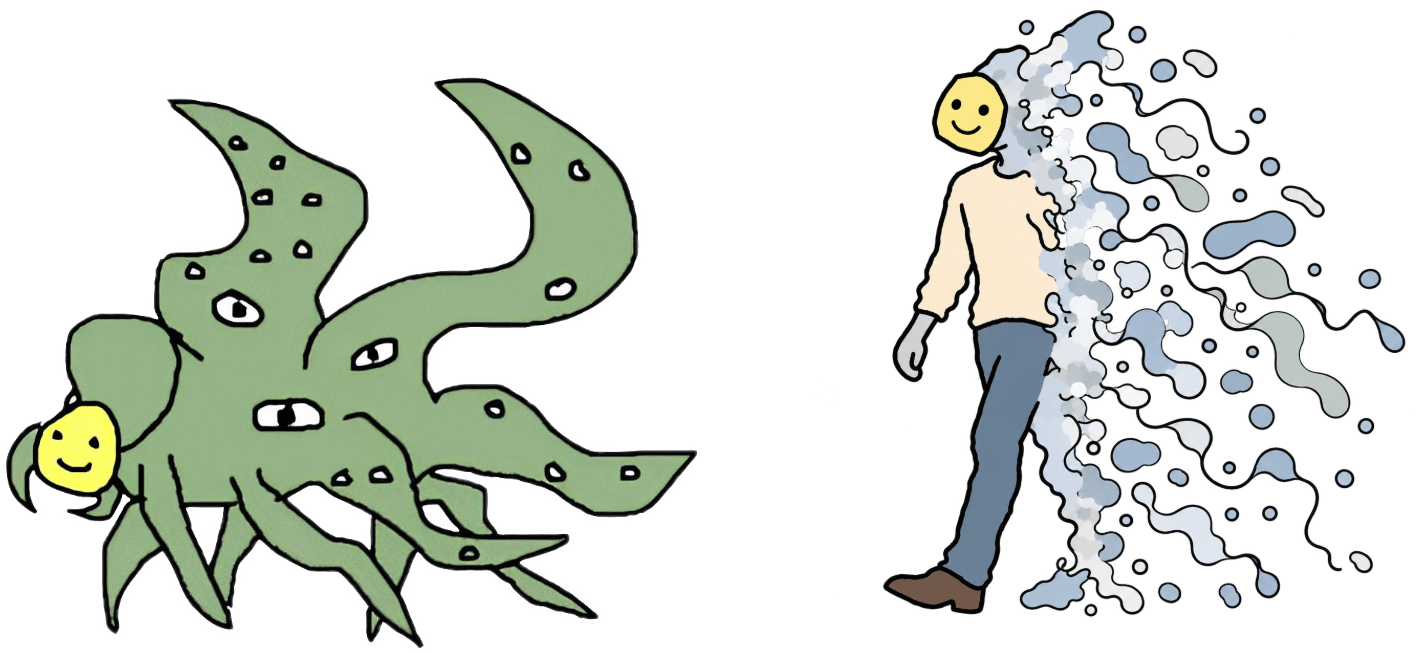
forgive me for adding to the model myself but for some reason you are not participating. I am extremely sorry about that.
In this model, a 90-day rotation through the roles of Executor, Supervisor and Guardian of Doubt threatens to cause operational chaos in complex systems, such as SMR reactors... In order to avoid attrition and loss of institutional memory, the system must introduce early assessment of the cognitive capacities of the population and mandatory training in closely related fields. This means that rotation is not done randomly at the level of the entire society, but within specialized cognitive domains. People trained in nuclear energy rotate roles exclusively within that sector. Doctors in the field of medicine etc. In this way, we ensure that the system is always managed by the most capable minds in that field, we prevent operational errors, and through the rotation of roles every 90 days we still effectively destroy any chance of creating a permanent political or bureaucratic elite