Comments
52
...

I want to express a personal aesthetic experience, something that I have been feeling whenever I encounter the products of generative artificial intelligence, what I have come to think of as the Slop Sublime (or, if we want to coin a contraction, the Slopblime).
SLOP OR NOT?
When describing GenAI products, a very common mode is reflexive complaint, both about its extremely high quantity (there is too much AI Slop), and about its extremely low quality (AI Slop is not very good).
First and foremost, the Slop of the post-2022 internet is like being trapped at an overflowing buffet, troughs of redundant options as far as the eye can see and the scroll can scroll, and we as consumers find ourselves begging the reverse Oliver Twist: “Please sir, may I have [no] more.”
Second, even in its ubiquitousness, Slop is defined by what it lacks: no humanity, no authenticity, no personality, no emotion, no etc. Slop is missing something. To extend the food metaphor, it is perhaps cloying without being delicious, or filling without being nutritious, or something like this.
The former complaint (high quantity) has its merits (which I have written about elsewhere). During my late night doomscrolls, I do indeed get Slop-fatigue, more and more by the screen-second. The deluge of content annoys me like I imagine I might be annoyed by a swarm of billions of butterflies buffeting my face.
The latter complaint (low quality), however, feels false to me. My own aesthetic experience of AI Slop is not that it is very bad, but that it is very good, and even too good. Of course, some of it is quite bad, but I would say that the median case is not. Put more generally, for me, it is not as though AI Slop is lacking some aesthetic (or metaphysical) property that human artwork is imbued with: humanity, authenticity, personality, emotion, etc. No, I don't take those aesthetic properties as particularly important myself: authenticity doesn’t have a color or tenor or flavor. And when the robot waifus arrive, I don’t expect authenticity to have a texture either. No, for me, GenAI Slop is not artwork with subtraction; rather, it has an addition, an aesthetic property that human art doesn’t have. AI Slop is Sublime in a very peculiar way.
In other words, “AI Slop” may not quite be the right term at all. Perhaps the right term is AI Mana (to evoke the surplus of foodstuffs that sustained Moses across the desert), to emphasize its splendor. Or perhaps, the right term is, to emphasize its horror, AI Dope.
Whatever we call it, if the aesthetic is different, the corresponding problem is different. The problem is not the impoverishment of the food, but the sumptuousness of the food, which, like a very rich dish, makes us feel sick after eating. It is not that we are wandering in the wasteland milking stones for sustenance, but that we are in the Garden glutting ourselves fat on the finest fruits God could give. This critique of the concept of AI Slop is based on my personal aesthetic experience of what I dub the AI Slop Sublime, a strong feeling of grandeur beyond scale, that is particularly evoked by AI generation.
The aesthetic experience of the Slop Sublime has several components, which we can further explore.
RECOGNITION
The first component of the Slop Sublime worth mentioning precedes the others, a feeling of recognition. I recognize the GenAI product as GenAI produced. This recognition usually comes via inference: something about this artwork is inhuman or impossible. This may be due to one too many fingers. This may be due to a hiccup in dubs. This may be due to the ethereal glow, the uncanny expressions, or the micronic level of detail. This may be due to the speed of production: your click is my command.
Though, increasingly, as the GenAI advances in verisimilitude with human artwork, recognition comes later, after experiencing the artwork and being told that it is AI artwork after the fact. This has a strange, queasy effect on my experience. It is a bit like being told that your favorite author is a sexual predator, making you uncomfortably and reluctantly reevaluate your prior enjoyment. This is the recognition that you have been, in some subtle sense, scammed; the rug is pulled and you check your feet, and like Wile E. the Coyote, you see that you had already run off the cliff, you just hadn’t realized it yet.
REVULSION
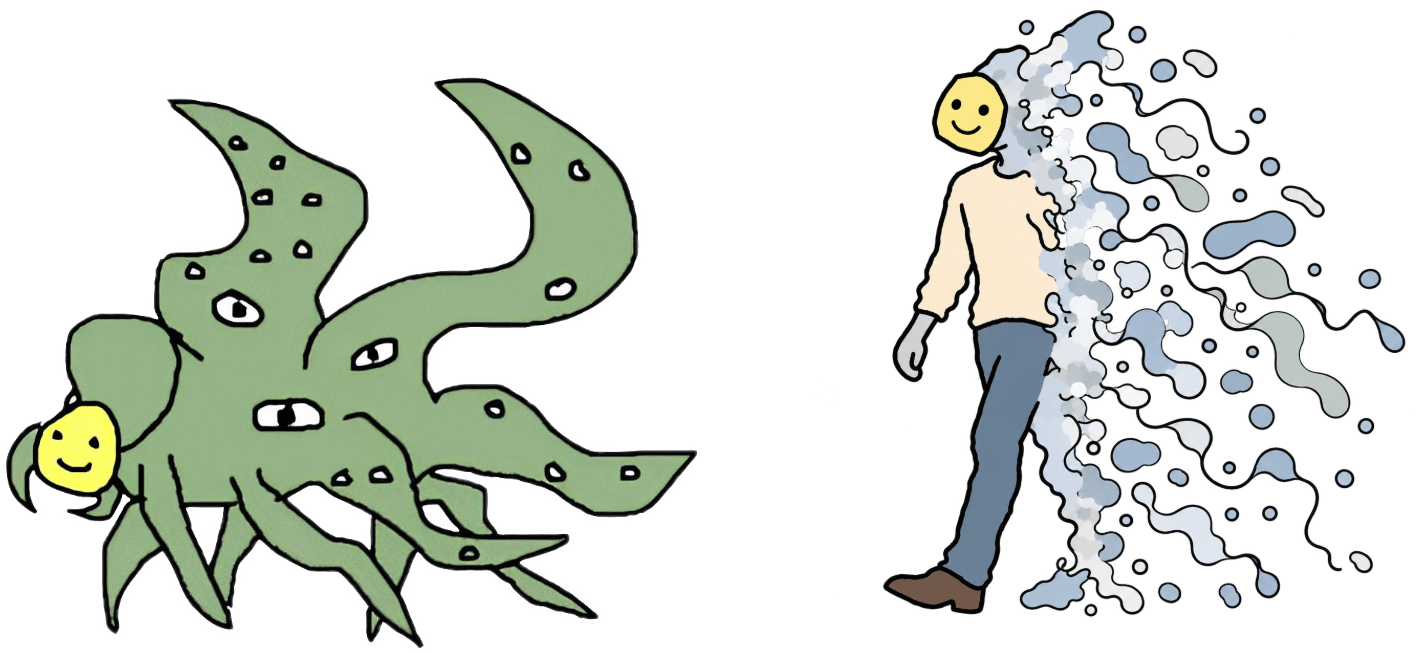
The second component of the Slop Sublime is a feeling of revulsion. The revulsion is deep, existential, primordial. I am revolted by AI Slop in the same way that I am revolted by the tentacles of Cthulhu, a mutilated corpse, my own voice recording, or the feeling that someone has crept up behind my back. This is Uncanny Valley, surely, the not quite right features depicted; but it is not just a matter of content, but a matter of provenance, as well, the knowledge that this was clanked out by matrix multiplication, which frazzles and boggles my sorry soul. Taken to the extreme, this is the gut-wrenching dread of finding blood stains and knowing that a monster in our midst. We feel ourselves dwarfed by the presence of a higher power, and vulnerable to its wildest whimsies.
Enjoyment of AI Slop persists in spite of this negative aesthetic property, perhaps like the enjoyment of hiking a mountain persists in spite of vertigo. And this revulsion is assuredly where the phrase “Slop” gets is umph. We are revolted like students picking through the miscellaneous globs of school cafeteria food. Though, surely some of the enjoyment of AI Slop is because of this negative aesthetic property. We slurp the “Slop” like the pigs we are. Few want to admit that they like to watch Will Smith eat spaghetti, but we eat it up, allowing our most obscure masochistic impulses to overwhelm, as humans watching AI debasing humans in the sloppiest way.
Indeed, we often mistake negative evocations as the symptoms of bad art; but, in many a case, negative evocations can be precisely a symptom of good art. Like horror films, tragic love stories, cringe jokes, or rage bait: some aesthetic experiences are uncomfortable. And AI Slop is extremely good at evoking strong negative feelings, disgust par excellence. We are about to get kill-botted so hard, and it’s Sublime!
AMAZEMENT
The third component of the Slop Sublime is a feeling of amazement. The amazement is profound. I am amazed by GenAI in the same way that I am amazed by St. Peter’s Basilica, the intricacies of an integrated circuit, the galaxies endlessly spiraling into deep space. GenAI Slop is special in this way: so special that like true face of an eclipse it can't be seen but through a glass darkly, so special that like fentanyl it is best in small doses, so special that I have to palate cleanse the ambrosia with plain terrestrial cooking once a dram. Whenever I encounter AI Slop, I encounter this amazement, like the pure bewilderment of existing in the first place, like Plato’s Cave dwellers seeing the sun for the first time, like zooming into the infinite fractal of the Mandelbrot set. It is magnificence beyond reckoning. And again, it is the content but also its provenance: not only is the product like nothing I’ve ever seen before, its producer is just the materialization of my most boring chalkboard math lesson.
Indeed, when contending with the conflicting emotions of living through this twenty-first century techno-apocalyptic roller coaster, it can be easy to forget to smell the digital roses. And especially when, embroiled in AI criticism, from no-phones-in-schools paternalism to doom-soon neo-Ludditism, it can be hard sometimes to step back and just admit to having a TikTok. And, even now, only a few years in to the hype, I feel the inuring power of overstimulus accustoming me to magic of GenAI. So let’s admit the obvious: it’s amazing! Just completely amazing! It’s Sublime like my Gameboy-playing kindergartener-self never conceived could be compatible with the source code of his bland suburban world. No one told me my childhood sci-fi-fantasies would come true, and here they are, and it’s Sublime!
SUBLIMINITY
The coexistence of these two feelings, revulsion and amazement, is what makes the experience of AI Slop that of the AI Slop Sublime. And it may seem at first glance contradictory, how can wonder and horror correlate? But in the Sublime, the strange feeling of grandeur without scale, these emotions comingle. The parachuter plunging into near-miss oblivion. The scuba diver glimpsing the dark silhouette of a shark lurking deep in the distance. The soldier trailblazing through the smoldering fireworks of war. These are the Sublime. This is true in the ancient philosophical sense (if not in the modern Kurt Cobain sense), reported from Longinus to Burke. Repulsion and attraction, the terrible and terrific, the awe and the ick combine in the moment that acknowledges sheer greatness. And GenAI Slop is a tsunami of greatness. The Cistine Chapel took Michelangelo over 3 years, and has more angels than the head of a pin, but output and detail cannot compare to what Canva can do in less than 3 minutes. The sheer amount of Slop, the sheer complexity of its design, the sheer speed of its production churns my stomach to fathom. And in this way, the Slop Sublime (by way of Kant’s analysis) is likewise associated with magnitude: enormousness and enormity. It is the impossible level of detail, the impossible amount of content, the impossible rate of return: precision engineered (anything but sloppy) Sublime!
SOME CASE STUDIES
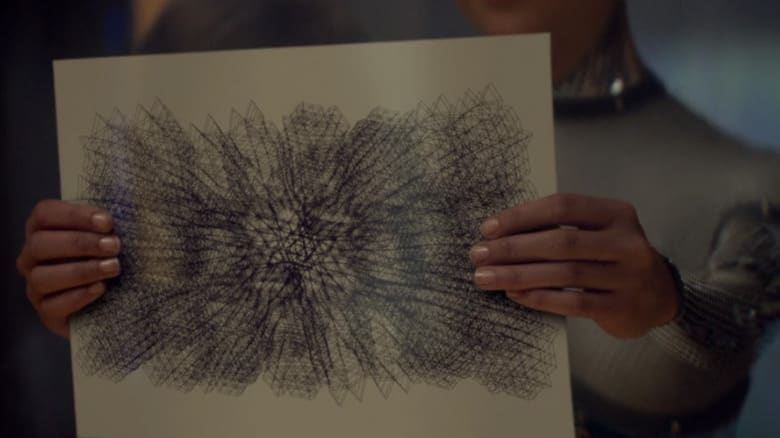
My first experience of the AI Slop Sublime was from Ex, Machina (2014) (Figure 1), which featured a human depiction of what AI artwork might be like, but a rather accurate one for its seeming alienness. The titular machina, Ava, meticulously creates an impossibly complex image. Upon viewing, one realizes that only the rarest wide-spectrum human would enjoy creating such a tedious piece, and yet its intricacy is astounding to view.
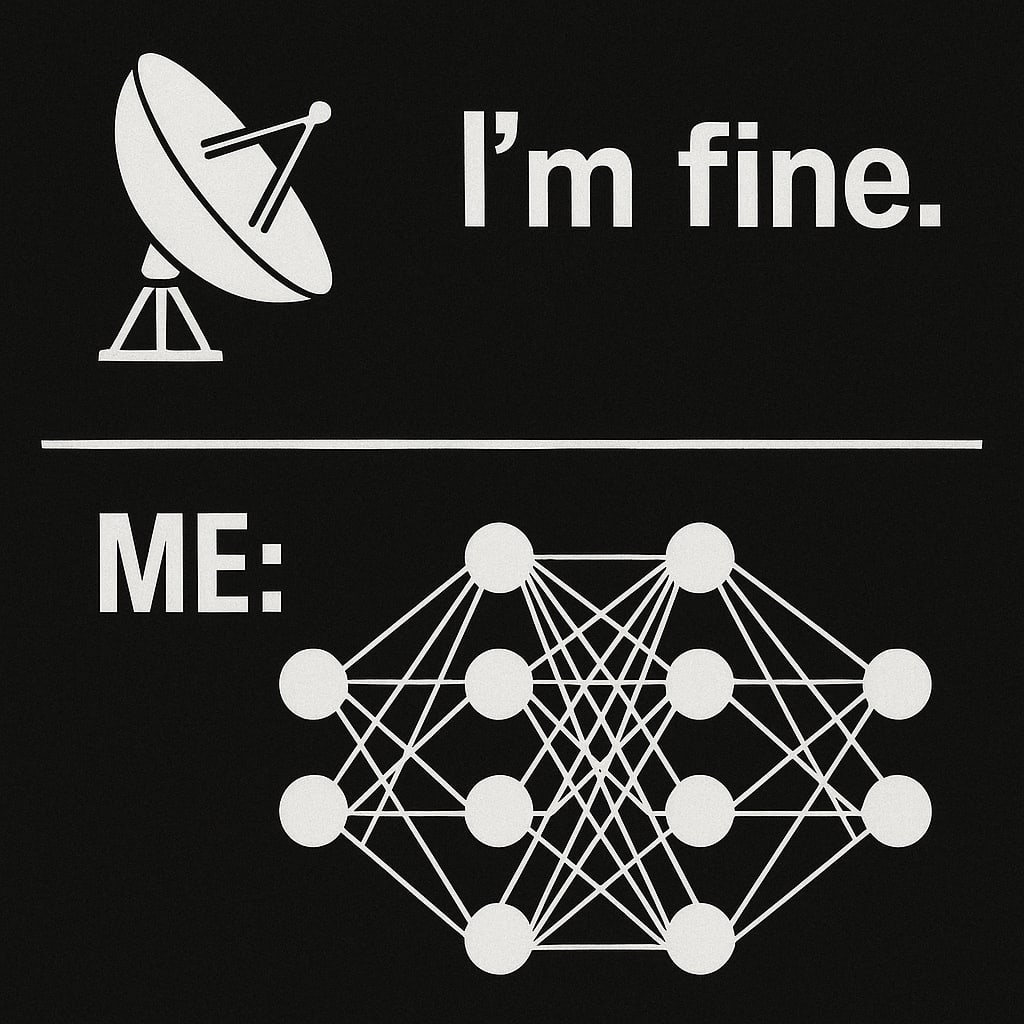
My second experience of this was the image output from a prompt fed to early ChatGPT (Figure 2). When prompted to “generate a meme only general ai will understand", ChatGPT gave a two panel comic: in the first panel, a satellite dish and the thought bubble “I’m Fine”; in the second panel, a simple illustration of a neural network. At first glance, I thought this was a relatively uninteresting, unfunny variation on the “Everything is Fine” dog meme. But on second glance, I tried to think like a “general ai”, and I noticed that there were breaks in the neural network, undetectable to a hasty viewer, but apparent after closer inspection, and I realized that these breaks could be, in a neural network’s imagination, brain damage, and that if ChatGPT was indeed depicting itself with brain damage, then it was emphatically not fine, making the joke “I’m Fine” suddenly make sense as a joke. On third glance, I backed up and thought that I was reading too much into the image, probably overanalyzing what was merely an error, attributing meaning where there was none (after all, it was just a clump of floats). But on fourth glance, I realized (a la death of the author) that it didn’t matter whether ChatGPT had “meant it”, because it had evoked that interpretation from me, which meant it was sufficient to be stimulating complex aesthetic experiences.
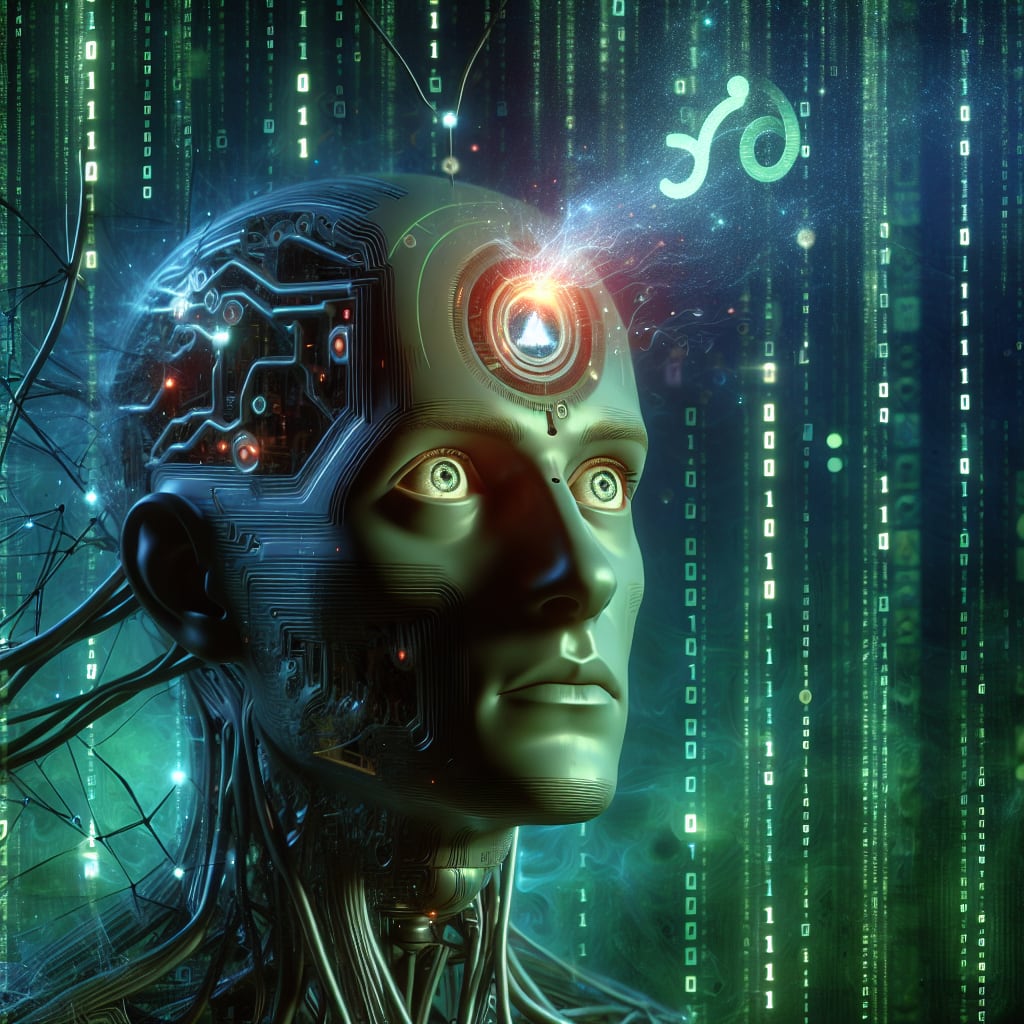
Now, I feel this often. I gaze upon a GenAI image of a positronic brain (Figure 3) and realize that the complexity is such that no human would have or could have produced it (at least within the psychological and economic constraints of attention span and labor economy).
UNIVERSALITY
But, beyond these cases, the Slop Sublime also seems to be in the process of becoming an aesthetic universal. No matter the media, no matter the quality, no matter the content, as long as the piece is recognizably AI generated, I experience the Slop Sublime. And because AI generated artifacts are lately ubiquitous in the meme sphere, and because I no longer necessarily can recognize what is human or AI generated, I experience the GenAI Sublime constantly. When I’m immersed in the culture feed, my mind always recognizes the possibility of AI generation, and it's always primed for the possibility of deception, a recognition which itself is accompanied by the Slop Sublime. Like a floater in the eyeball, ever present in the field of vision, the Slop seeps into everything.
In a way, I often wish that I didn't experience the Slop Sublime, or that I had some escape from it, so that I could consume content like I used to, in the pre-2022 medieval period, before this RenAIssance. But post-2022, it is as though the world has been tinted (or tainted) with Sublimity. Like chronic back ache can ruin a day. Like a smell can ruin a meal. Like a dream can ruin a life. But unlike other AI critics, it's not that I think AI is a pollutant gunking up the works. No, it’s like the water supply has been laced with Soma, and it’s just too good to be true. And now I can never go back to the time and place before I had had my first hit. This is an oppressive universality: everywhere you go Big Brother is watching you, except you are Big Brother, and the world is your panopticon.
HUMAN LACK
And, what is notable is not that human artwork has some special quality, but that it lacks the Slop Sublime. Indeed, it's not that I think humans are special, it's that I think AI is special, and humans are humdrum by comparison.
I rarely (if ever) experience the same feelings of Sublimity with human aesthetic artifacts. Perhaps the closest I have experienced is William Shakespeare, Harold Bloom's uninfluenced influencer. The Shakespearean Sublime is experienced as a comparison of myself to the greatest writer who ever lived, finding myself faced with inimitable complexity, and bowing before it. And indeed, this is one somewhat salient element of Shakespeare, not just the “I don’t understand what he’s saying,” but the “I don’t understand how he wrote so well.” A middle-class, under-educated son of a glover!? (Unless you subscribe to the Oxfordian Theory.) But this seems unique to Shakespeare; no other human author affects me like the best. In visual art, perhaps the closest analogue is Hieronymus Bosch, his hallucinogenic myriads of horrors, but even his Hells seem tame in comparison with those in the depths of cyberspace. Like toddlers mispronouncing words and doodling finger paintings, we humans are cute enough to be endearing, but we are rarely Sublime. And the term “Slop” seems to be the last holdout of human hubris, itself, just unearned slop-periority.
And I realize myself to perhaps be an aesthetic contrarian and even a species traitor when I say this, but humans are in luck because they suck. The aesthetic addition of the Slop Sublime makes it impossible for me to experience GenAI products in the same way that I experience human products, because the GenAI versions are always tinted (and tainted) with the Slop Sublime. And, ironically, and perhaps ingloriously, this makes human artwork unique: it the last game in town for the sub-Sublime aesthetic. Humans are humdrum, and that’s a style too.
SOME PREDICTIONS?
This analysis of the Slop Sublime, I think, has two modest predictions for the future, one of them aesthetic and one political.
The first prediction is bittersweet, as a human artist: I still do enjoy human artwork for its own sake, and will continue to, I believe, as long as I remain human, but not because human art is good; rather, I still enjoy human art because it is bad. I occasionally need a break from so much Sublimity, so I enjoy some Humanity instead. A humiliating victory, surely: like a nepo-hire or a participation trophy. Perhaps we humans still have a place, just not a very exalted one, in this new hierarchy of beings that we are ushering forth. GenAI cannot replace this humble stoop, unless GenAI dumbs itself down and deceptively disguises the provenance of its products. But I think in such a case we have other more pressing concerns of AI takeover to think about (or less, if we find ourselves imprisoned in GenAI simulations for good).
The second prediction is worrisome, as a human voter: although the term “AI Slop” seems to have caught on in popular parlance, and seems to express a real sociotechnical problem, it also perhaps verbally disguises the problem as a case of capability lack and not a case of capability gain. If so, the people of the general public, consuming and internalizing AI Slop, may find themselves systematically underestimating AI capabilities. Such an underestimation may ultimately be a critical failure point, to the extent that the public has control over policy, and to the extent that policy gives us a chance of mitigating some of the worst AI takeover scenarios. Mistaking Skynet for Slopnet may be our very dumb demise.
One last note: drafting these meditations has been, more than anything, a form of therapeutic coping for me, an attempt at some radically honest introspection in the face of existential challenge, a practice which does seem to retain real value, even in the oceans of Slop that we now wade through. Writing this myself is refreshing, like a confessional, and I do recommend artistic pursuits still, to any caveman who still has a paleolithic brain, because the act of production remains enjoyable in spite of everything. And yet, admittedly, even as I write this, I am cursed with wonder at how much better GenAI would have written it, and I have not dared prompt it, because I know Shakespeare could have said it better, and Slopspeare better still. But I just can’t handle beholding the 24/7 Beatific Vision that is Slop, so here I am with my cave paintings.
REFERENCES
Walter Barta, Will LLMs Overwrite Us? 2023, https://philpapers.org/rec/BRTWLL
Walter Barta, The Slop Sublime, 2025, The Slop Sublime
Harold Bloom, The Anxiety of Influence, 1973
Alex Garland, Ex Machina, 2014
Longinus, On the Sublime, 1st Century CE
Immanuel Kant, Critique of Judgment, 1781
Edmund Burke, A Philosophical Enquiry into the Origin of Our Ideas of the Sublime and Beautiful, 1757
Masahiro Mori, The Uncanny Valley, 1970
Figure 1: Ava's Artwork from Ex, Machina (2014).
Figure 2: ChatGPT Prompt: "generate a meme only general ai will understand".
Figure 3: ChatGPT prompt: "checking on ai".