Having fed everyone everywhere all at once by themselves, already.
Contrary to popular opinion, we believe the cake is not a lie. We can have it, (increase it) and eat it too.
Dense utility.
Research agenda
Case studies
From 1965-1966, Scotsman Angus Barbieri lost 276 pounds by continuously fasting for more than a year. During the fast, he consumed only zero-calorie beverages, vitamins, and nutritional yeast. This was possible due to his starting weight of 456 pounds, as well as the supervision of medical experts.
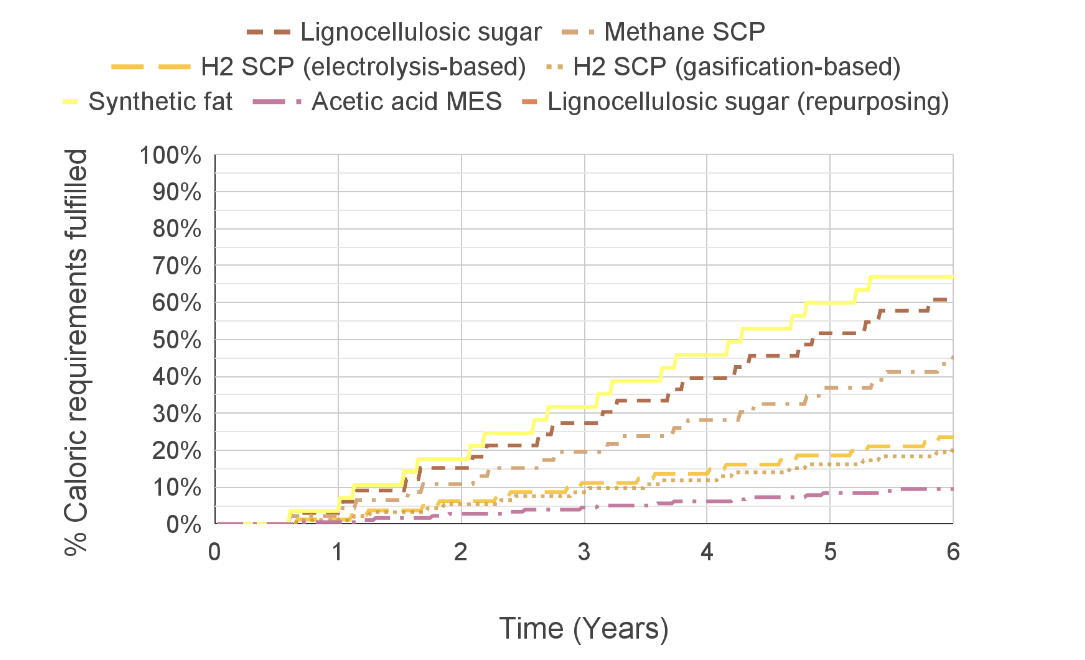
We believe this inspirational story is more than a fluke — it’s scalable. As you can see by this graph, humans will be at the greatest risk of starvation early in a multiple breadbasket failure, until novel food solutions have time to ramp up.
Historical analysis
ASSFAT’s research team, while armchair-philosophizing on buttock-cushions, discovered several other armchair-philosophers and their thoughts on civilization, catastrophes, and their linkage to food.
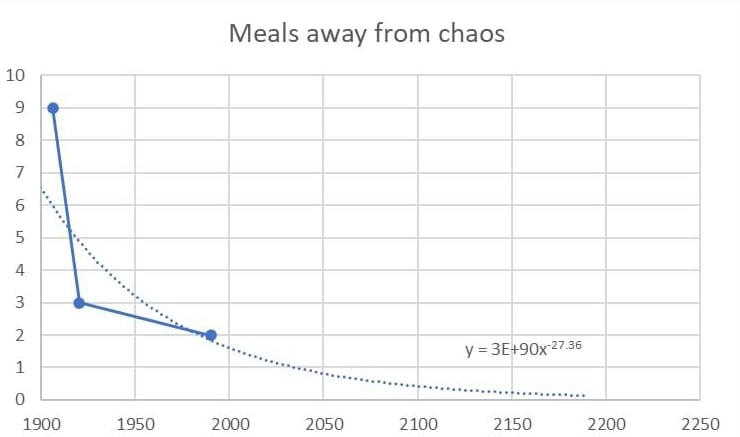
In early 1900 Alfred Henry Lewis stated “There are only nine meals between mankind and anarchy”.
“Every society is three meals away from chaos” was brought forth only a few years later by Vladimir Lenin.
More dawning was the analysis by Neil Gaiman: “It has been said that civilization is twenty-four hours and two meals from barbarism.”
These 3 historic findings paint a grim picture:
But combined with ASSFAT’s insights we could be hundreds, if not a thousand meals away from societal collapse!
Risks
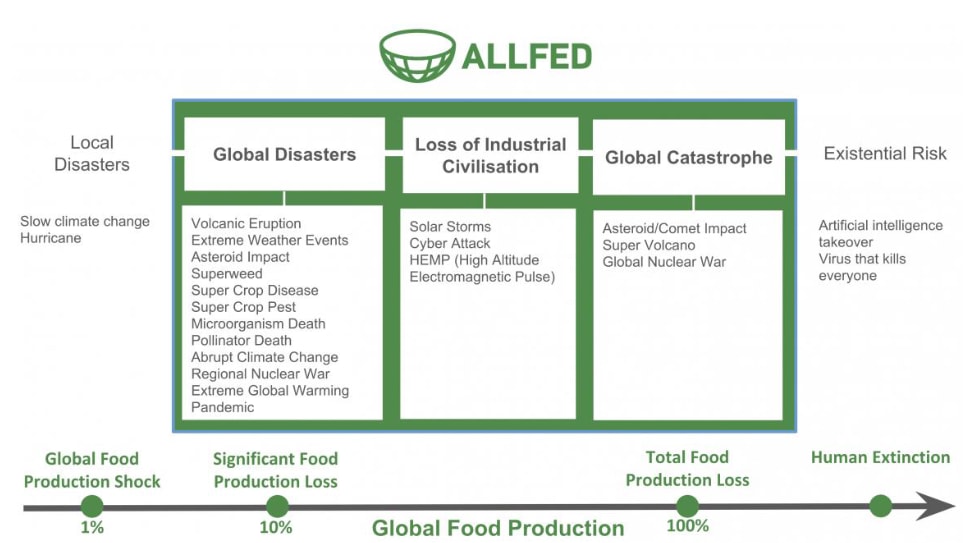
We are grateful for ALLFED’s work in identifying the risks from (global) catastrophes on the food system. Though we think our solutions are better, because HIP-GOLD is a decentralized methodology and will provide a buffer (sic) should post-catastrophic collaboration fail.
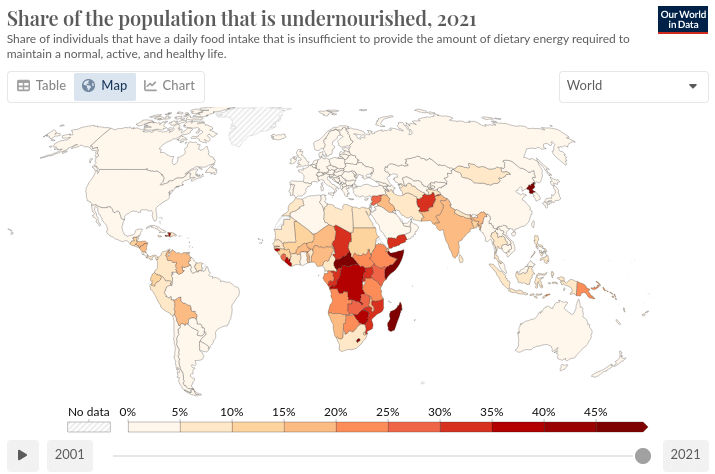
We are glad to observe that some areas in the world are already following ASSFAT’s philosophy and lifestyle. However, some regions are neglected and could therefore be a good fit for increased activity. About 1 in 9 people globally are severely neglected. Our members support infrastructure investments and general improvements to the food-to-belly-pipeline in the highlighted areas below:
Collaboration across cause areas:
Research has shown that as humans consume more calories than they expend, this can complicate health outcomes in the short term. However, we fully expect that breakthroughs in the medical field made possible by AGI will unlock previously unimagined solutions, making these problems a thing of the past.
As the pharmaceutical industry has famously profited from such trends in the past, we are eager to see these proceeds productively forked over and reinvested in anti-pandemic science and novel drug discovery.
Critics of our solutions may charge that these efforts will increase waste. However, we think that instead they can increase waists.
How you can get involved
If you’ve been inspired by the above, we encourage forks of our project.
Crack open the discussion in the comments section below.
lol, just go to your fridge right now and treat yourself!
Michael Nielsen has a beautiful new essay on moral imagination: the ability humans have to 'develop and transmit new notions of good action, indeed, even new kinds of good'.
As examples, he gives:
* Hammurabi's creation of a code of laws (in 1754 BCE) and his justification of his rule not in terms of divine or hereditary right, but by the delivery of justice to his citizens.
* St Gregory of Nyssa's...
Epistemic status: Speculation from two decently informed advocates armed with anecdata.
Note on process: After having some version of this conversation several times and saying, “we should probably write about this publicly,” we took the less heroic route: we recorded one of our conversations, fed the transcript into an LLM, and then substantially revised the structure, substance, and framing ourselves. We will not be sharing the transcript, as it is in...
A preliminary estimate, and a request for better ones.
Summary
I believe the standard literature estimates for the number of DALYs attributable to a case of stunting are too low, largely because they don’t account for the long term effects. This means that childhood nutritional interventions that reduce the prevalence of stunting may be substantially more cost-effective than previously believed.
Epistemic status
Exploratory and back-o...