
Animal farming is expanding rapidly across many African countries. In our previous research on Nigeria, we showed how rising demand and increasing industrialisation are driving a sharp increase in the number of farmed animals — and why this creates an urgent need for early intervention.
Ethiopia presents a different, but equally important, case. Projections suggest that farmed animal numbers will grow substantially over the coming decades, making Ethiopia one of the largest producers on the continent. At the same time, the sector remains less industrialised and more dominated by smallholder systems. This combination — large scale and an earlier stage of industrialisation — makes Ethiopia a particularly important country to study.
This report is part of Animal Advocacy Africa’s broader effort to identify high-impact opportunities for farmed animal advocacy across the continent. In Nigeria, this research has already informed more targeted work, including our Nigeria Fellowship, which supports individuals to pursue impactful career paths and interventions. Ethiopia is one of several countries we are now exploring as part of this strategy.
You can read the full report here.
Why Ethiopia?
Ethiopia is one of Africa’s most populous countries and has a large and growing livestock sector. Projections indicate that it will become one of the largest countries on the continent in terms of farmed land animal populations.
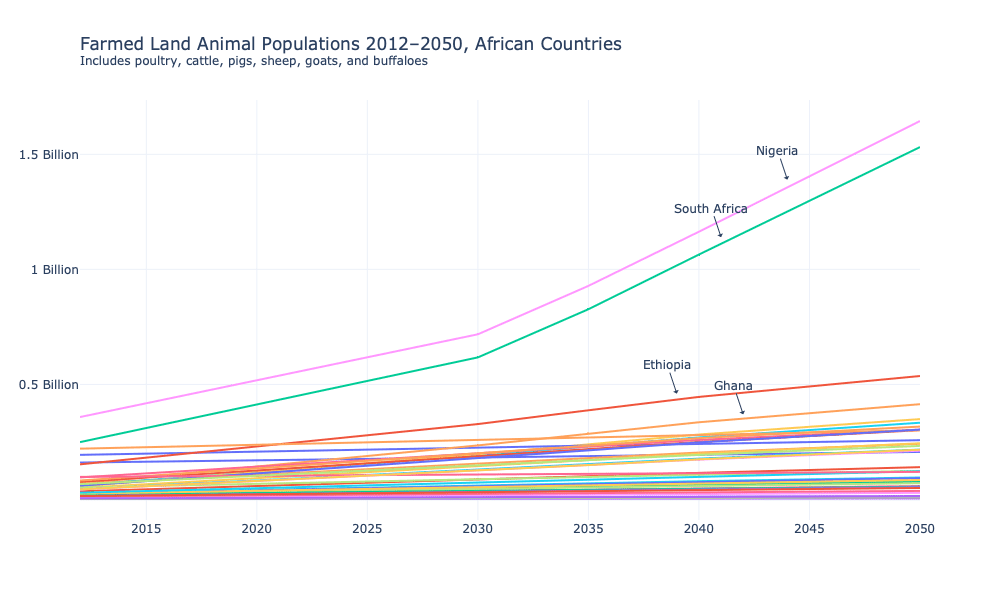
Source: Animal Advocacy Africa (2023)
Unlike Nigeria, Ethiopia appears to be earlier in its industrialisation trajectory. While animal numbers are increasing, production systems remain largely extensive and smallholder-based, with less widespread adoption of intensive industrial models.
This makes Ethiopia a compelling case: the sector is large and growing, but its future development path may not yet be locked in.
What does animal farming in Ethiopia look like today?
Ethiopia’s livestock sector is characterised by a high number of animals kept in relatively extensive systems. Cows, goats, and sheep play a particularly prominent role, reflecting pastoral and agro-pastoral production systems.
At the same time, some sectors are expanding rapidly. In particular, chicken production has grown significantly in recent decades and will continue to do so as demand increases and production systems evolve.
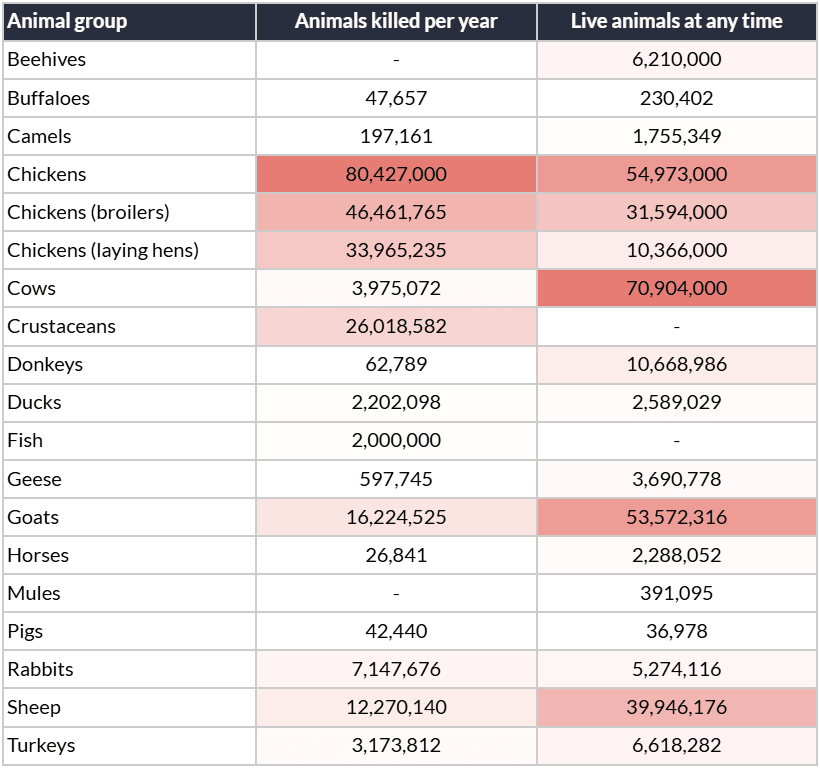
Overall, the sector remains less industrialised than in some other countries, and awareness of animal welfare is limited. Cultural and religious practices also shape consumption patterns. For example, fasting periods associated with the Ethiopian Orthodox Church involve extended periods of plant-based eating.
A different kind of window of opportunity
In Nigeria, we highlighted how rapid industrialisation creates an urgent need to intervene before intensive systems become entrenched.
In Ethiopia, the situation is somewhat different. While animal numbers are expected to grow substantially, the sector remains more open and less locked into intensive production models.
This may create a different kind of window of opportunity: rather than responding to already advancing industrialisation, there may still be scope to influence how production systems develop in the first place — including the potential to support more extensive systems and plant-forward consumption patterns.
At the same time, this opportunity comes with uncertainty. It is not yet clear how quickly industrial systems may expand or which pathways will dominate as the sector grows.
What should we do?
Based on our analysis, we identified three priority interventions that advocates could pursue in Ethiopia, as well as two additional areas that may be promising but are more uncertain.
1. Chicken welfare regulations
Drafting and advocating for the adoption of chicken welfare regulations could help pre-empt the entrenchment of low-welfare practices as the country moves toward greater intensification.
This approach could build on the recently enacted animal health and welfare bill and aim to shape standards before intensive systems become widespread. However, it would require navigating the challenges typically associated with law and policy interventions, including enforcement and political feasibility.
2. Implementation of OIE standards (World Organisation for Animal Health)
Given the large populations of cattle and small ruminants in Ethiopia, supporting the implementation of OIE standards could address welfare concerns across multiple species.
This would likely involve training producers on existing guidelines and improving practices across livestock value chains. A key challenge is ensuring uptake and sustained implementation in predominantly smallholder systems.
3. Cage-free directory
A cage-free directory could help prevent a shift from cage-free to caged systems, particularly among urban and peri-urban producers.
By identifying and supporting producers who use cage-free systems, this intervention could help maintain higher-welfare practices as the sector develops. It may also require additional incentives or support mechanisms to encourage producers to remain cage-free over time.
Additional, more uncertain interventions
In addition to these core recommendations, the report identifies two further areas that may be promising but are characterised by greater uncertainty.
Radio campaigns could offer a low-cost, high-reach form of public outreach. Potential approaches include diet advocacy and messaging focused on the ethical treatment of animals. Given Ethiopia’s high radio penetration, this may be a useful channel for shaping norms early, though its impact is uncertain.
Alternative proteins represent a longer-term strategy aimed at slowing future growth in animal-product demand. This could involve improving access to existing products in urban markets and supporting local development over time. However, their counterfactual impact remains unclear in a context where diets are already relatively plant-forward.
What’s next?
This report is intended as a starting point for identifying high-impact opportunities for farmed animal advocacy in Ethiopia.
In Nigeria, similar research has already translated into concrete programmes, including the Nigeria Fellowship. Ethiopia may represent a future area for more targeted work, although we have not yet committed to a specific programme.
If you are interested in working on any of these interventions — or related approaches — in Ethiopia, we would be very interested to hear from you. We also welcome feedback, questions, and collaboration opportunities!
Animal Advocacy Africa supports advocates across the continent working to prevent the spread of factory farming and promote higher-welfare or plant-based food systems. Learn more at animaladvocacyafrica.org.