Cross-posted from Good Structures.
COI note: This piece touches on some aspects of Wild Animal Initiative’s work, and why I am excited about it. I co-founded Wild Animal Initiative, and while I no longer have any affiliation, my spouse works there.
Doing wild animal welfare at scale, in a way we are confident is robustly good, is currently not possible. The primary bottleneck is scientific: we don't have the knowledge to predict what our interventions will do, or to measure whether they work. For this reason, the wild animal welfare community has heavily focused on scientific field building. To get the science to a point to make wild animal welfare viable, we need enough motivated people working on it.
This is a long theory of change, and to ensure it is impactful, it needs to aim for specific targets. I want to give a picture of what I think wild animal welfare science, as a field, needs to build toward, and why it's worth paying for. I believe these goals should be the core objectives for the field, and hope they make the purpose of field building more concrete.
To do wild animal welfare at scale (and to work on any other cause area with confidence that it isn’t doing more harm to wild animals than good to others), we need:
- Useful welfare measures: Measures and proxies for measuring the wellbeing of animals that can be applied across species, or at least enough knowledge of how to measure welfare that we know which techniques to apply in which contexts.
- Remote monitoring: Ways to actually observe what our interventions are doing to populations and to the welfare of individuals within them, especially for animals we can't capture or tag.
- Good ecological modeling: The ability to predict what an intervention will do before we deploy it, and to make sense of the monitoring data we collect.
With these tools, wild animal welfare becomes a massive opportunity for effective animal advocates. There are many interventions that could affect quadrillions of animals (including trillions of vertebrates). Humans already affect wild animals at this scale — through farming, road building, cities, resource extraction, and our other day-to-day activities — but we do so mostly without any idea whether the effects are good or bad for the animals impacted. If we could make progress on these challenges, land use policy, which likely impacts the lives of quadrillions of animals in the US alone, would suddenly have knowable wild animal welfare consequences. But to get there, we have to do a ton of science, and to do a ton of science, we need a ton of scientists.
This will be really difficult, will take time, and will be expensive. It might not work — we might fail to catalyze interest, or get the scientists interested that are needed to accomplish this. But to fail to try means that everything we do, for animals or otherwise, will be stuck with massive uncertainty about our impacts on wild animals. And, putting aside the benefits for other charitable work, I argue that even just given the benefit of potential direct interventions to help wild animals, this investment is worth making.
The three pillars
1. Useful welfare measures
The first step to understanding the lives of wild animals is to figure out what their lives are actually like — specifically, what their welfare is like. Welfare here means something fairly specific: the valenced affective states an animal experiences, positive or negative, over some period of time. It's not "health" or "fitness" or "ecosystem role." It's how the animal is doing, from its perspective.
Welfare can't be measured directly. Instead, researchers use indicators to infer the subjective state, and metrics to infer welfare. Some potential measures, indicators, and proxies might include:
- Behavior assessments: Does an animal change its behavior in response to stimuli?
- Activity budgets: How animals spend their energy.
- Cognitive bias tests: whether an animal treats ambiguous stimuli as likely-good or likely-bad.
- Telomere attrition rate: a crude proxy for cumulative lifetime stress accumulation.
- DNA methylation patterns: can track long-run stress exposure.
- Disease, injury, and parasitism: Presumably these are sometimes bad for animals experiencing them.
- Hormonal markers: Animals might have different hormones in response to stress, etc.
- Physiological stress responses: We might be able to measure acute stress through heart rate, oxidative status, etc. in animals.
But many of these proxies and indicators are barely validated in a few species, or not validated at all. Even in farmed animals, when we use multiple promising indicators, they don’t always agree. We need a lot more research here.
It seems quite unlikely that the end state of this research is a single thing we can measure in any animal to get a direct welfare readout. More likely, we'll land on minimal sets of indicators that work in specific contexts — behavioral proxies that are most useful in some species, physiological measures that are best in others, and aggregating metrics that combine them.
As an analogy for the challenge, conservation pursued a long and ultimately futile search for a single metric of ecosystem health or biodiversity — keystone species, extinction rates, various composite indices, and more. You can't walk into a forest and quickly evaluate its "health" from a conservation perspective, despite decades of effort. Similarly, finding good measures of welfare will take a lot of work.
Making progress on welfare measures is the pillar that is most distinctly a wild animal welfare project. The other two pillars — monitoring and modeling — have obvious scientific interest outside our field (conservation, agriculture, climate science, etc.). But measuring the welfare of wild animals, specifically, is something only we are going to do. If we're building a field for any reason, it's to answer this question.
To validate even a single measure, we'd want to test it on dozens or hundreds of species across taxa. Many proxies will be species- or family-specific. We'll probably need hundreds of measures and proxies before we have broad coverage. Without a massive AI-driven speedup in the pace of empirical biology, this will take decades. AI will likely help with analysis and with meta-analysis across existing studies, but most of this work requires physically handling animals and observing their responses — and we'd need significant advances in robotics to speed up the capture-and-study loop. Wild Animal Initiative reports that validating welfare indicators is already their largest grantmaking area, which seems right to me.
2. Remote monitoring
Having good welfare measures is necessary but not sufficient for running interventions. We also need to go out and measure them, at scale, to figure out whether our interventions are actually affecting the welfare and population outcomes we care about.
For large animals, this can be pretty easy. We know exactly how many northern white rhinos there are (only 2), and we can predict their future population perfectly (0, since the last male, Sudan, died in 2018). But most animals aren't large and easily spotted. We live in a world dominated by small animals, and the populations of the small species dwarf the populations of the large species by many orders of magnitude.
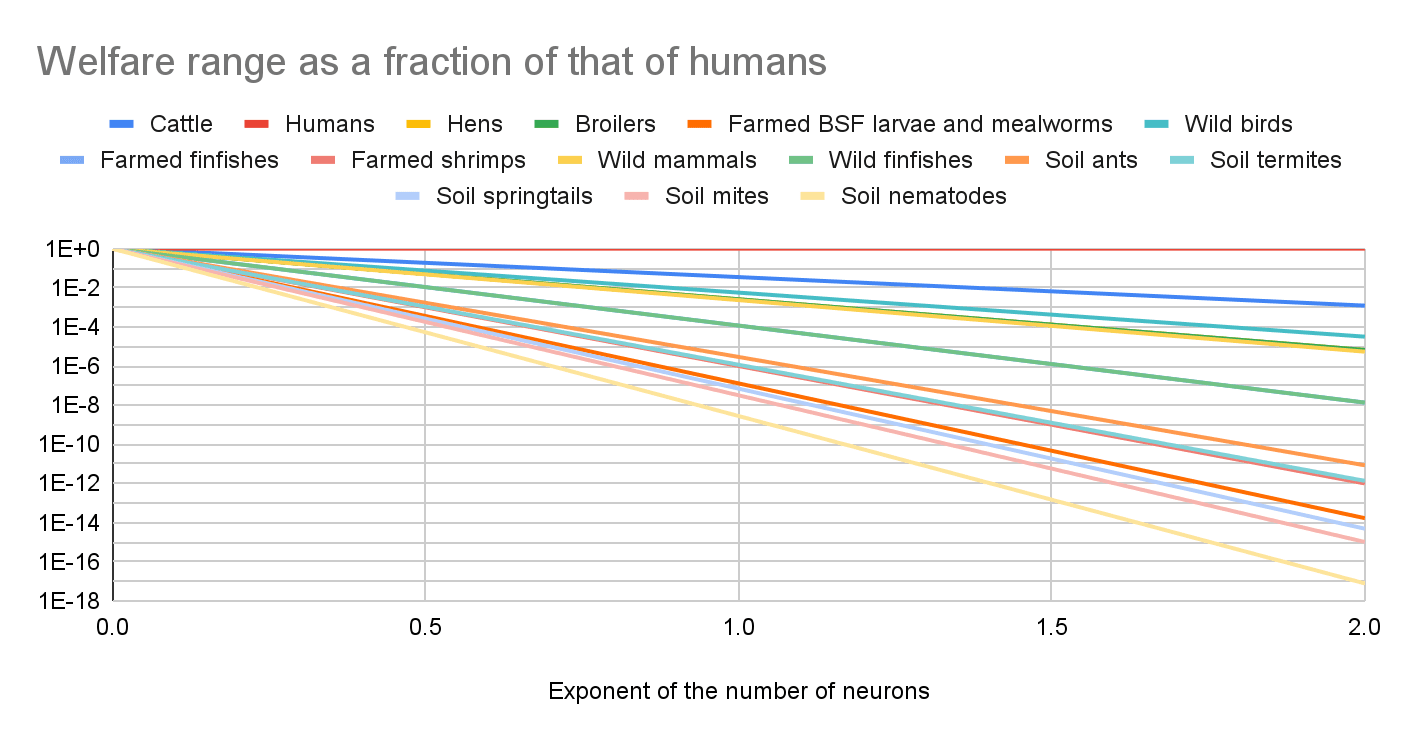
Putting aside nematodes (which I believe we should do), to a first approximation, even when adjusting for the best guesses we have on welfare ranges, wild animal welfare is a question about insects, small invertebrates, small fish, and to a lesser extent rodents, birds, and reptiles. Big charismatic animals are a rounding error.
And monitoring these animals is very hard. Take insects: we can barely tell at the highest level whether their populations are declining or not. One estimate put the total number of insect species at roughly 5.5 million, of which only about 1 million are described (yes, that means we've basically not written down anything in detail about roughly 80% of insect species). Most of these animals live in soil, many species have generation times of days to weeks, populations fluctuate by orders of magnitude between seasons, and there's no standardized method for counting them.
The insect decline debate is a useful illustration of how limited our data actually is. In 2017, a paper made global news by reporting a 76% decline in flying insect biomass in German nature reserves over 27 years, which they found using traps, a method that hasn't changed meaningfully in decades. The observation that drivers used to have to clean their windshields after long trips and no longer do became a meme and seemed to be anecdotal evidence to support insect declines. But a larger meta-analysis found a more mixed picture: terrestrial insect abundance is declining at roughly 9% per decade, but freshwater insects are increasing at around 11% per decade, and patterns vary a lot by region and taxon. Others have pointed out that insect monitoring sites are systematically biased toward protected or relatively stable habitats, which may understate declines at the landscape level (the "life raft" effect). The methodological picture is messy enough that even a question as basic as "are insects declining globally?" remains live, more than fifty years into modern entomology.
The current frontier in remote animal monitoring is more promising than it used to be, but still rudimentary for small animals. The main tools currently:
- Camera traps with ML classifiers: Platforms like Wildlife Insights are now able to handle millions of images automatically. These are great for medium-to-large mammals and some birds, but are useless below a certain body size.
- Passive acoustic monitoring (PAM): Low-cost recorders like AudioMoth deployed en masse, with data analyzed by models like BirdNET (which supposedly covers ~6,000 species including some frogs and primates) for species ID. Acoustic monitoring has increased detection rates substantially.
- Environmental DNA (eDNA) metabarcoding: Identifying species from DNA in water, soil, or air samples. These methods are also becoming increasingly quantitative rather than just detecting presence/absence, and getting rapidly cheaper.
- Biologgers and GPS collars: Standard for large animals. Miniaturization is advancing but still size-limited, and obviously insects are probably not a good fit for these tools.
- Automated Malaise traps and insect radar: Not yet widespread, but improving. Vision-based insect counting on trap images is an active area of research.
For vertebrates, we can now do things like deploy an AudioMoth for $90, leave it for weeks, and get moderately reliable automatic species ID from the recordings. For invertebrates, the frontier is much further behind — we're still mostly counting insects in traps, or counting dead ones on windshields via citizen science.
What we need is substantially more ambitious than that. We need the equivalent of AudioMoth, but for insect welfare indicators, across taxa, across biomes, deployable at the scale of thousands of units, with data streams that can be processed without armies of graduate students. This is the project I expect to benefit most from AI. We can capture enormous amounts of potentially welfare-relevant data in the field — acoustics, video, chemical and hormonal signatures, eDNA, etc., and improved ML will let us make better welfare inferences from raw sensor data than humans can currently manage.
3. Good ecological modeling
Good ecological modeling is the ultimate goal of wild animal welfare science. If we can accurately predict how an intervention will affect populations and welfare measures, we can design, iterate on, and deploy new interventions much faster than if we have to test each intervention to find out what its effects are.
The current most ambitious attempt at a "general ecosystem model" is probably Madingley, which attempts to simulate all heterotrophic life on Earth across a grid of ~100-square-kilometer chunks (big enough to lump an entire agricultural region into a single output). Madingley also doesn't model individual species; it groups organisms into nine functional categories by trophic level, metabolic type, and reproduction strategy (and note that organism in this context means not only animals, but also plants, fungi, etc.). So, our best models are basically at the level of: "we can sort of say what will happen to 9 varieties of quasi-organisms at ~100-square-kilometer resolution,” an area that contains approximately 10 trillion arthropods.
For marine systems, Atlantis can handle 30–60 functional groups of organisms. Ecopath with Ecosim, the most widely used food web tool, works at similar scales. None of these models resolves individual species; none can be reliably validated against the real ecosystems they claim to represent; and none is remotely fine-grained enough to predict the ecological effect of, say, changing a farm from traditional pesticide-use to organic farming.
Why is this hard? The binding constraint is data:
- We need to know how different populations of organisms interact with each other when ecosystems change. The Mangal database — the most comprehensive compilation of species interaction data — contains roughly 120,000 interactions across 7,000 taxa. For context, a community of just 500 species has 125,000 possible pairwise interactions. A square mile can have thousands of species. We have orders of magnitude too little data to actually model realistic food webs.
- For demographic data, the COMPADRE/COMADRE databases — the best global compilation of animal population models — cover around 1,100 species, or less than 0.05% of described species. And remember, we've described less than 20% of the total estimated number of insect species.
- Geographic coverage is heavily biased toward North America and Western Europe. Biodiversity hotspots in the tropics are systematically undersampled, and are presumably places where these interactions are more complicated.
- Interaction strengths, rather than just presence/absence of interactions, are quantified in a tiny fraction of cases — often, the granularity of our knowledge is that an interaction between species has some effect, not the size or nature of the effect.
But, there are also challenges in ecological modeling that no amount of data resolves — our current approaches have theoretical and mathematical limitations that need to be overcome for this data to be used effectively.
To solve the data gap, remote monitoring is the best thing we can do. If we can collect enormous amounts of information on how populations and welfare measures respond to natural and human-driven changes in ecosystems, we can build much better models.
This pillar is probably the most amenable to AI speedup of the three — both to make progress on conceptual challenges in modeling, and to analyze the massive amount of data needed to build those models. But the data collection that makes the speedup useful has to happen in the world, and it takes time. Ecosystem responses to interventions play out over years to decades, so it will be difficult for this to happen quickly.
These things will be expensive to achieve, but are worth paying for
To address these three giant gaps in our knowledge, we need to pay for a lot of research. Is this worth paying for? There hasn't been much published on this, but the one existing public model suggests that the answer is very much yes. I independently created a separate model and reached similar conclusions.
- Mal Graham's model estimates what happens if we invest funds in field building which draw in supplementary funding from traditional science funders, and then pay for implementation of subsequently discovered interventions. The model can be adjusted depending on what you find believable, but to illustrate one possibility: it suggests that spending $900M for 35 years of research followed by spending $2.2B over 70 years on a suite of interventions impacting a wild population with an annual stable population size of ~1 billion animals results in ~ 41 billion animal-years of benefit. This is cost-effectiveness comparable to cage-free cost-effectiveness estimates from 2019.
- My model took the following inputs:
- Spending ~$240M (90% CI: $89M to $464M) to make sufficient progress on these three pillars and then develop and run a single intervention.
- The intervention has 1-5 years of effect.
- The intervention impacts ~1.9 million acres (or just 1% of the land managed by the US Forest Service).
- The average total welfare improvement for the animals impacted is only 1% (e.g. their lives would be 1% better).
- All of this working has only a 0.5%, or 1-in-200, chance of success.
- And found that doing this would still be 10x (in expectation) as cost-effective as corporate cage-free campaigns (90% CI: 0.2x to 40x; ~27% chance of being worse), though note that I used a cost-effectiveness bar that was 5x lower than Mal's, so a comparable figure might be more like 2x effective.
Both of these approaches assume that we will spend massive amounts of money on field building, and then do a limited intervention. In Mal's case, the entire cost of field building is amortized into managing a single, fairly small population over a long period of time. In mine, it’s amortized into doing a single intervention over 5 years on a fairly small piece of land. In reality, spending hundreds of millions of dollars would massively reduce the cost of doing interventions everywhere, so I suspect the expected cost-effectiveness of field building is likely at least dozens or potentially hundreds of times better than the best current animal welfare interventions we have, not including the value of information that we would get for non-animal welfare interventions.
These models are both simple, and are unlikely to map onto reality. But, they are also both very pessimistic in important ways, which suggests that the potential value is real. In reality, doing this successfully will be much messier, but the upside is knowing what the impact of charitable interventions actually is, because so much impact goes through wild animals.
Some of this work will be exciting to non-animal welfare scientists
Of course, cost-effectiveness shouldn’t be looked at in isolation. An essential question is who is paying for the work. As outlined above, I think these costs are worth paying for animal-motivated donors. But, some of these costs might not be paid by animal-motivated donors, which makes this area more cost-effective.
Remote monitoring and ecological modeling are directly relevant for conservation work, and past progress has already seen significant investment from universities and governments funding conservation work.
So, should animal welfare motivated donors still fund this work? I think the answer is yes in places where animal funding will accelerate this work, or where welfare relevant considerations wouldn’t be included otherwise. Some places this might happen:
- Good welfare measures seem basically unlikely to be developed at the scale needed without animal welfare funding.
- Remote monitoring will likely continue to focus on charismatic animals, and not more numerous animals, without some level of push from animal advocates.
- Ecological modeling will need to not only model populations, but welfare impacts, and animal-welfare motivated science makes this more likely.
- New, large-scale efforts, like ECHO, a focused research organization working to improve ecological modeling, seem likely to model some welfare-relevant features, but not animal welfare measures themselves.
- Additionally, until the field establishes itself as scientifically meritorious in its own right, it might be difficult to generally get momentum without animal-based funding, so early work might be especially valuable to pay for.
Overall, I think that the fastest route to this science advancing is raising the profile of this work such that large public basic science funders are willing to fund it. To do that, we need to build a large community of scientists working on this. And, if we successfully bring in outside funding, the cost-effectiveness of money from animal-motivated donors will be higher, because their dollars are leveraging a larger pool of science funding.
Long theories of change and field building
Wild animal welfare field building relies on a long theory of change. What I just described will be hard. It will take decades (my model estimated 30 to 120 years on average to develop good ecological models, though I didn't really make these forecasts in a sophisticated way, and I expect AI progress to reduce this significantly). It might not work (my model above assumes a 0.5% chance of it working, though I think this is too pessimistic). I don't think this is the only approach we should take. But I think long theories of change are pretty necessary to actually start helping animals at scale. The problem of everything we do, charitably or selfishly, primarily impacting wild animals does not go away because we don't do the research to figure out what to do about it.
But, I believe we shouldn’t only do long and risky theories of change. We should probably diversify our bets — I hope that with more funding, the animal movement makes lots of uncorrelated bets, some with long payoffs and some with quick payoffs, instead of going down its current trajectory, which to me looks like doubling down on strategies that don't seem to be working well. To get there, I think we should make a giant risky bet on wild animal welfare field building. And I think we should make a giant risky bet on cage-free eggs. And a giant risky bet on shrimp. And insecticides (talk to me if you're interested in this). And we should try multiple ways of making progress on all of these issues. The upside of a diversity of strategies is information, but we won't get the most fundamental information (how does anything we do actually impact wild animals) without a giant risky bet on field building.
Why have people opposed field building?
Field building for wild animal welfare sometimes faces pushback in the animal welfare community. It is sometimes met with skepticism by people who want to help animals sooner. Occasionally, calls go out for action and intervention in the wild animal welfare space. But, as has been pointed out, I'm not sure the alternative, where we primarily focus on interventions, is actually viable.
Critics have suggested that:
- Field building doesn’t directly translate into helping animals.
- I agree that field building doesn’t immediately and directly result in us, say, having an intervention that helps animals. But, it does:
- Increase our ability to actually verify that future interventions are helping animals, which today is impossible unless we are highly confident our intervention is ecologically inert.
- Improve our ability to develop interventions for wild animals.
- In reality, unless we want a high risk of accidentally causing large amounts of harm, the interventions on the table today are limited in scope and ecologically inert. The interventions that help the most animals, like land use policy, are completely off the table without significantly more research, and to get that research we need field building.
- Field building progress takes a long time, and there are animals we could help now.
- I believe that it will take decades for us to get our science to a state where we can do large scale interventions. I agree with those who find this to be too slow — wild animal suffering is morally urgent.
- But, acting without the science to support the interventions poses a huge risk. Just because we are capable of, say, treating a disease, does not mean that the potential impacts on animal populations, and therefore animal welfare, aren’t present.
- I don’t think this means we shouldn’t try reasonable interventions — the best ways to advance some science might be trying small-scale, reversible interventions, and studying their impacts on animals. I’m personally betting on this strategy myself, and pivoting to work on insecticide impacts on animals through this lens. But these interventions operate in an extremely narrow window of success. Without the research and the field, we can’t broaden that window, and try large scale changes necessary to actually realize the promise of wild animal welfare.
So build the field
So we should build the field of wild animal welfare science. That means we should:
- Maximize the amount of grantmaking to normal scientists working on these problems through coordinated grant programs (like Wild Animal Initiative’s work), and targeted research agendas.
- Create pathways for highly value-aligned ecologists, biologists, entomologists, and others to move into critical research roles.
- Have a presence at every conference, event, or seminar remotely related to wild animal welfare.
Of course, there is risk here — ecology and biology as fields don't exactly hold the values of the wild animal welfare community, and we risk alienating those who might be our greatest allies in the research. Luckily the people working on these issues are thoughtful and strategic.
This science alone won’t solve every issue in wild animal welfare. Even with the scientific knowledge necessary to make progress, there might be tricky philosophical questions that can’t be answered empirically (When is a life worth living? How do we make decisions about tradeoffs between different species of animals?). But we can’t even begin to answer the question “is anything we do that impacts wild animals good for them” without making progress on these pillars, and to get these pillars, we need a robust research field.
Ultimately, if you acknowledge that wild animals matter, and feel like wild animal welfare is intractable because we don't know how our actions impact nature, then the best thing you can do is support efforts to change that, because the problem won't go away without the field.
Acknowledgements
Thank you to Mal Graham and Michael St. Jules for helpful comments on this piece, and to Mal for many ideas that informed it.
I'm really excited to see this. I'm optimistic that ecologists and conservation professionals will want to help with this. They WILL be excited to have an ally that cares about non-charismatic species. They are begging for more attention to the smaller foundational participants in the ecosystem. The field is also gradually becoming more pro-intervention. I am also optimistic that AI will contribute, and want to emphasize that a simple but important step is deploying far more field data loggers. The sooner you collect data, the sooner you have years of data to work with.