
Moral-licensing or self-licensing is the idea that after you do your good deed for the day the resulting warm glow of self-righteousness makes you feel entitled A utilitarian saves a kid from a dirty pond on his morning stroll and then chows down on a shrimp sandwich for lunch.
But I don’t believe in it.
I don’t mean I don’t believe in moral licensing in that I don't support moral licensing. (Telling yourself you can be a little naughty if you do a bunch of good doesn't obviously seem like the worst idea in the world.)
It’s that I don’t believe the phenomenon even exists.
First, it comes from social psychology which is famous for generating fake yet memorable claims. Two, it doesn’t appear to exist in the real world. The people I know personally who tend to be unusually virtuous on one dimension tend to be great on the others as well.
We love stories about villains with good PR, or the philanthropist who’s secretly a cannibal, but it’s hard to come up with real-world examples other than the extremely half-hearted utilitarianism of Sam Bankman-Fried. I’m unaware of any major religion that thinks morality operates in this way– Christians don’t believe that becoming more loving involves becoming less faithful.
I also think the evidence for it is quite bad and the concept can mislead people into not doing the right thing out of fear that moral licensing will end up maintaining some sort of cosmic balance between Good and Evil, and their good deeds will backfire.
I used to be quite active on organ transplant policy and multiple people asked me “I would like to donate my kidney but what if moral licensing makes me more evil in other ways?” (This is of course an extremely niche fear but I 100% believe everyone who has ever brought this up is completely sincere. I cannot even begin to imagine the psychology of someone who invokes a finding like this from social psychology to justify holding onto their spare kidney, since only the very altruistic feel the need to justify having a spare organ in the first place.)
Why I Think The Evidence for Moral Licensing is Bad
It’s probably publication bias. An early line of evidence for moral licensing came from claims that writing about good things made people less likely to donate to charity. But it didn’t replicate.
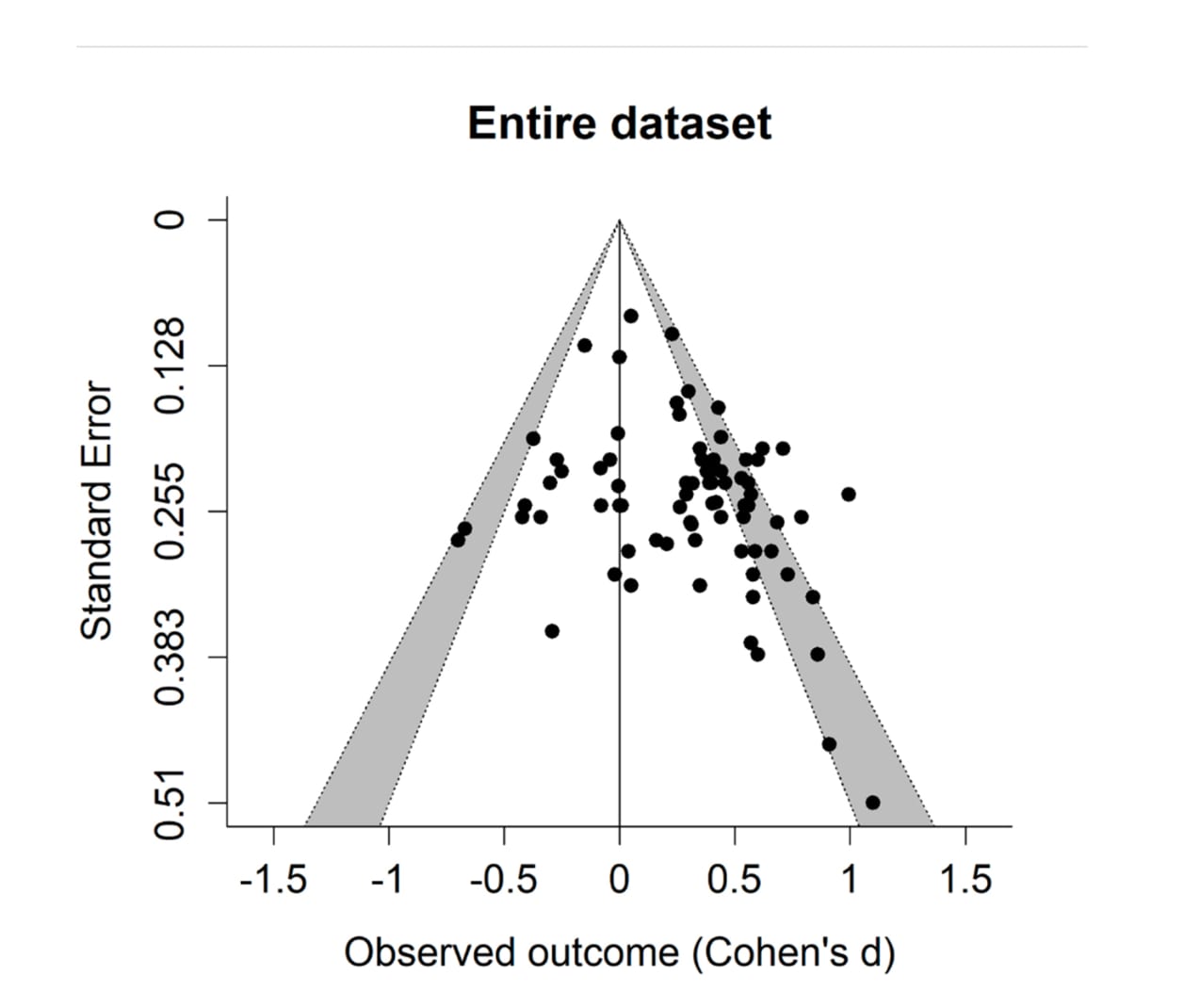
Further, Kuper and Bott carried out a meta-analysis to see if the results could be explained by publication bias. For instance, they found the literature showing the effects of moral licensing was made of “smaller studies yielding large effects and larger studies showing smaller effect sizes” which can be caused by low-powered studies with unimpressive results (small effect sizes) not getting published. Here’s their funnel plot.
More subjectively, I also find the individual studies within the literature unconvincing, even ones from journals like Science. Hofmann et al (2014) got over 1,000 people to get randomly pinged 5 times a day and asked about whether they observed, performed, or were told of a good or bad deed in the last hour. People who reported doing a good day in response to one of those ping were much less likely (p<0.01) to report a subsequent good deed.
At first I thought this might be just a time-of-day effect because people supposedly become immoral later in the day (my grandma says nothing good happens after 10 PM) but that can’t be the driver because witnessing moral or immoral actions doesn't predict worse moral behavior later in the day. I think this effect can plausibly be explained away if you think good deeds tend to be planned rather than spontaneous. For instance, if you plan out good deeds, whether church attendance or donations or volunteer hours or visits to a lonely but unpleasant relative, it wouldn’t be surprising if fewer good deeds followed the first as they weren’t on your daily schedule.
But I admit this is ad hoc so maybe I should just accept the moral licensing interpretation. But even if the moral licensing interpretation is correct, the effect size is tiny as reporting doing one good deed predicts you’re only 5% less likely to report committing a second good deed so even if we accept the moral licensing interpretation, the expected value of the good is perhaps slightly discounted, but not offset. (The effect size of being the target of a good deed is larger and positive so if you find this study convincing, you could think of your goodness as being passed on.)
I’m also doubtful that this study captured many of the most consequential moral actions (or at least what I assume my readers view as the most consequential moral actions) such as dietary choices, charitable contributions, religious conversion, and political activism. I think this study is pretty interesting but not that persuasive regarding the existence of the effect.
Maybe in the future, large pre-registered trials will show the moral licensing effect exists. If it does, I will be shocked and also proven wrong on this issue. But I don’t think the evidence, such as it is, is strong enough to influence any of your choices.
Some good deeds might not be worth doing when it comes to opportunity costs or emotional costs or energy demanded. But I encourage you to not worry about moral licensing.
If you want to do something good, I would simply encourage you to do it.