Comments
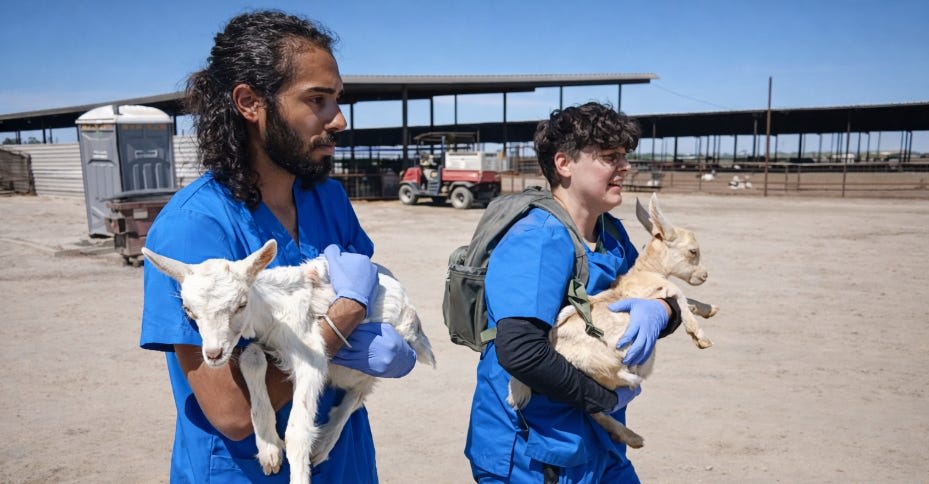
Today, I was supposed to start as a second-year associate at a large law firm. Instead, I am a multi-felony defendant in a criminal case, facing over six years in prison. California prosecutors allege that I am guilty of “Grand Theft of Livestock” for rescuing an emaciated baby goat I found suffering on a nearly 10,000-animal factory farm.
These circumstances are difficult to accept, but also, they’re not so bad. My felony charges will likely resolve, and I can always find another job. Even in the worst case scenario, where I am convicted and incarcerated, I know I’ll be okay. Quite simply, that is because my relationships are too strong for me to ever truly fail. Dozens of friends and family members are ready to catch me if I fall.
That privilege also comes with a certain guilt, though, especially when it comes to family. I know they didn’t sign up for this. My Nana didn’t immigrate to America for me to risk jail-time; my mom didn’t raise me to become a felony defendant. Her question, “Why must you take such risks?” is still ringing in my ears.
I wish I could insulate her from the fallout, but I can’t. For me, that is easily the most regrettable part of all this.
Still, I can’t say that I regret my actions on the whole. My impulse to alleviate the suffering of others is, without a doubt, my best quality. I won’t allow anyone to take that from me. Whether it be an animal, a stranger, or a family member, I will always try to help. That is a promise.
Here, it is my impulse to help the billions of creatures suffering on America’s factory farms that has gotten me into trouble. I want to discuss the ramifications of that trouble-making in more detail, and, by doing so, I hope to answer my mother’s question.
SACRIFICE GENERATES DIALOGUE.
I’ve been an animal activist for six years. I’ve organized student groups, spearheaded pressure campaigns, and disrupted stadiums. Without a doubt, none of that advocacy has come close to generating the dialogue spawned by my arrest. On the days after that event, my communications were flooded by more than 100 friends reaching out to offer support. This included people who never previously engaged with my advocacy… people I hadn’t spoken to since high school. This trend remained in the months after, with dozens of people regularly asking for details.
I found this quite astounding. Somehow, the events of a single day generated more dialogue than my many years of advocacy… I suppose that is the power of sacrifice. As Dr. King once wrote, “It seeks so to dramatize the issue that it can no longer be ignored.”
My personal experience is also consistent with the history of social movements. When arrests like mine are scaled-up into collective acts of sacrifice, they generate enormous amounts of dialogue. Dr. King’s Birmingham campaign, where 2,500 people accepted arrest, is perhaps the most iconic example of such collective sacrifice… but we need not look so far back in history. Just two years ago, I watched as 3,000 of my University peers accepted arrest in furtherance of a free Palestine, sacrificing their comforts to transform a niche, foreign policy issue into a national reckoning. We can—we will—do the same for animals.
SACRIFICE ENHANCES CREDIBILITY.
Sacrifice also greatly enhances credibility. I noticed this most vividly last year when I was invited to speak at Berkeley Law. While the first-years seemed somewhat uninterested during my introduction, by the time I got around to my third slide—the photo of my arrest—everyone in the room was suddenly alert. From there, I easily held everyone’s attention for the next 30 minutes.
Establishing this credibility is essential to make the bold claims that our movement requires. Factory farming is quite literally the most evil machine humanity has ever constructed. We can talk endlessly about this, but until we truly act like an atrocity is unfolding, the public has little reason to believe our sincerity. Sacrifice is thus the ultimate proof that we mean what we say.
SACRIFICE IS SPIRITUAL.
Finally, sacrifice serves a deep spiritual purpose. Although the consequences I’ve suffered are unpleasant, I know they serve a greater purpose. My sacrifice—albeit a small one—is for a just cause, honoring the nonviolent tradition of many great leaders who came before me: Dr. King, Gandhi Ji, and Guru Tegh Bahadur of my Sikh faith. I will never be as great as these leaders, but I aspire to live by their example.
I hope to share this feeling with everyone who crosses my path. Looking out, I see so many of us who have been led astray, taught to chase the meaningless pursuits of money and prestige. There is an another way. Together, we can join forces to overcome what is truly humanity’s greatest moral test: our treatment of earth’s most vulnerable. Do we choose to be their tormentors, or their stewards?[1]
At present, humanity is failing this test, with our food system abusing these creatures on an unfathomable scale. That is more tragic than I will ever have the words to describe. But I know there is hope. While our species is capable of exacting great evil, we are also capable of organizing its resistance. I have seen this with my own eyes—I personally know hundreds of people who’ve risked their freedoms for the animals. Their sacrifices are the living proof that compassion transcends the boundary of species. Together, we will unlock this compassion to its fullest potential, becoming the stewardly species we were always meant to be.
- ^
This moral test doesn’t require everyone to quit their day jobs and join the resistance; it just means that we reorient our pursuits. For example, rather than chasing prestige for prestige’s sake, chase prestige so that it can be leveraged for a more noble purpose.
