In memory of Fernando Avalos. His memory remains present in everything we do.
A note on AI use: AI was heavily used to edit the text of this post.
TL;DR
I led the Bogotá hub for Apart Research's first Global South AI Safety Hackathon, designed to bring talent from the Global South into AI safety.
Colombia won all the Latin American prizes, with the Bogotá hub securing two of them and 2 of the 7 global honorable mentions.
At the hub, we got an average recommendation score of 9.3 out of 10, and 14 of 16 participants who responded to the survey say they are now trying to move into AI safety work (though take this with a pinch of salt).
To make this happen, I had to lean hard on AI agents: they built our website, researched and drafted our outreach, and carried much of the operations work.
I'd be excited to keep building this community, and would consider working on this full-time with additional funding. Please reach out at [email protected] if you can make that happen.
What we ran
Apart's hackathon had 17 physical hubs across Latin America, Africa, and Asia-Pacific. Teams had 48 hours to produce a 4 to 8 page report on technical AI safety, AI security, responsible AI, or AI governance (including a lethal autonomous weapons track I proposed).
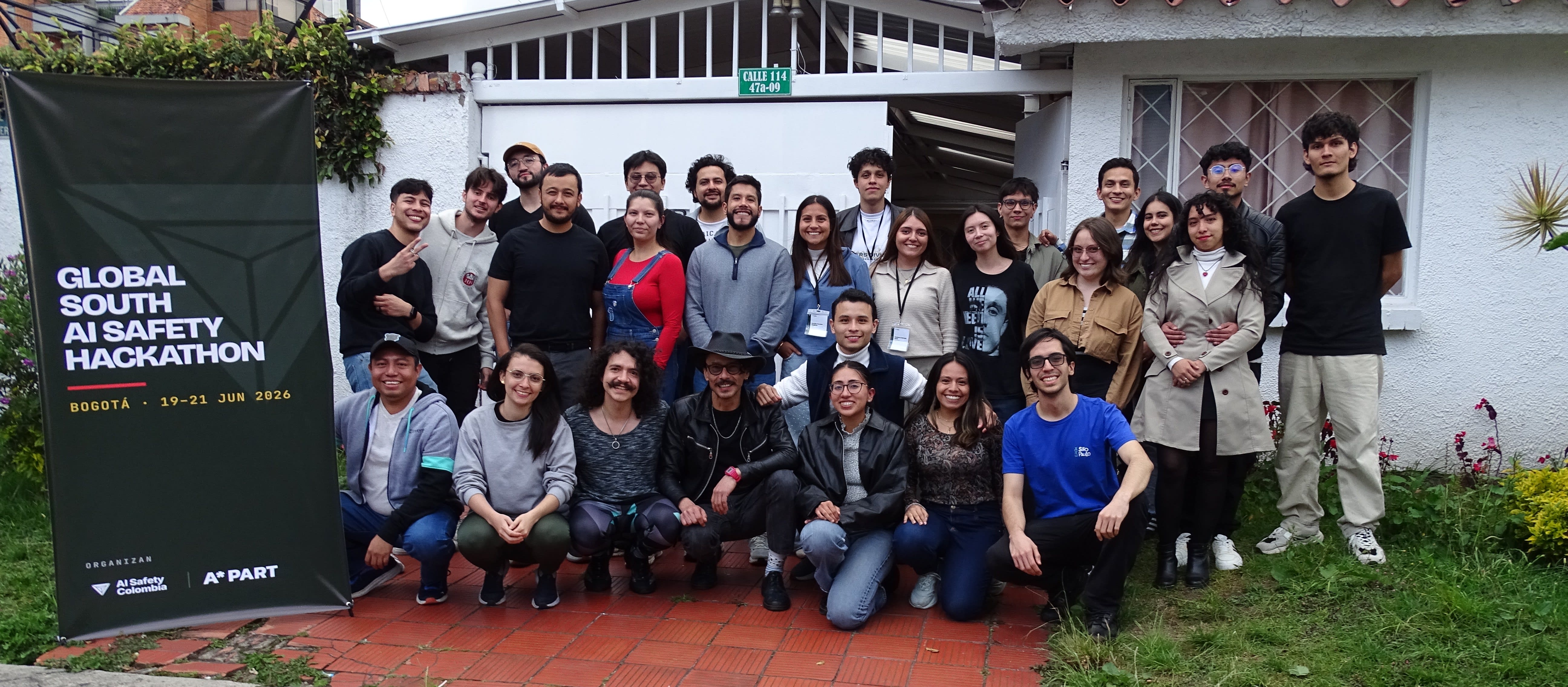
We rented a large Airbnb house. On Friday, 33 people showed up.
We had six external speakers: Steve Hege (ILAPS, former UN arms-embargo investigator) on autonomous weapons, German Lopez-Ardila (CCIT) on Colombia AI regulation, Camila Beltrán (independent AI governance consultant) on AI control governance, Catalina Bernal (BIP Colombia) and Melissa Robles (Quantil) on their LLM bias evaluation SESGO, and Maria Paula Mujica (UNDP, co-author of Colombia's Ethical Framework for AI) on the regional AI landscape. Juan Felipe Ceron, Colombian alignment research engineer at OpenAI, closed with a remote keynote. Talks ran around lunch to avoid distracting from the research.
The final day was a national election Sunday, an obstacle I had not thought to plan for (more on that below). Even so, 24 people were still working on Sunday, around 15 presented at the 8 pm showcase, and 12 stayed until 5 am finishing their submissions on midnight snacks and Red Bull. Watching exhausted people insist on presenting Sunday night was when I became confident the hub had worked.
Results
Our hub earned 4 of the 13 recognitions announced across all 216 submissions (2 winners and 2 honorable mentions).
The four recognized projects from our hub were:
Coldron (Latin America winner, $1,000): an open dataset and governance analysis of modified commercial drone attacks by illegal armed groups in Colombia. Authors: Leonardo Parraga, Angie Giraldo, and Victor Gelves.
Thought Anchors for Social Bias (Latin America winner, $1,000): which reasoning steps anchor social bias in model outputs. Author: Andres Mosquera.
Por que los agentes obedecen (honorable mention): why LLM refusal directions weaken in agentic formats. Authors: Helen Penagos and Juan Esteban Leiva.
JusticIA (honorable mention): a counterfactual benchmark for auditing contextual bias in transitional justice settings. Authors: Lina Gomez, Brenda Barahona, and Ernesto Duarte.
Colombia overall contributed 17 of the 216 submissions (7.9%) and took 3 of the 6 winner slots. The slots were split by region: three for Latin America, two for Asia-Pacific, and one for Africa, and Colombian teams took all three Latin America slots. Two of those teams worked at our hub; the third, Probing Latent Colombian Identity Inferences, participated remotely from Cali, Colombia.
Of the 33 people who showed up the first day, 25 submitted a report, and most had never done AI safety research before. Neither had I; I had never even attended a hackathon before organizing this one.
What participants said
Of the 13 hub attendees who answered the pre-event survey, only 2 had ever published AI safety work and 9 had at most taken a course or read about the field (2 of them had no exposure at all).
From the two post-event surveys Apart ran, counting only people physically at the hub (16 answered Apart's post-sprint survey; 9 answered the shorter hub impact survey):
16 of 16 satisfied or very satisfied; average likelihood of recommending it 9.3 out of 10, with 9 perfect 10s and zero detractors (all 31 Colombian respondents: 100% satisfied, average 9.4).
10 of 16 called the weekend 5-10x or 10x+ more valuable than their alternative use of the time.
15 of 16 came out significantly more interested in AI safety; 14 of 16 are now actively trying to transition into the field, and 1 more already works in it.
9 of 16 are continuing their project or starting related work and 5 more plan to when resources allow; 8 of 9 hub-survey respondents plan to keep collaborating with people they met, and all 9 rated the organizing team helpful or extremely helpful.
Asked about the best part of the hackathon, in participants' own words:
"Being able to work on an impactful project with amazing people in a collaborative space!"
"Working together with a new team, particularly people with different backgrounds who can complement my skillset, was very exciting, as well as discovering a topic I never thought would be my interest but I ended up engaging with."
Asked to leave feedback for the organizers:
"Organizers, although not technical, provided as much help as possible. Always being helpful and friendly."
"The Bogotá hub team was key to creating a safe and stimulating space." (translated from Spanish)
How I did this as a non-technical, first-time organizer
I am a political scientist, not an ML engineer, and I began organizing the event just six weeks before it took place. While I did most of the hands-on work myself, I received frequent advice from Alejandro Acelas, and lots of support with on-site logistics from Deiver Romero and Santiago Ramírez, as well as several participants who volunteered informally during the event.
Some other things were critical, and many of them involved lots of AI help:
The website, built with AI agents: I rebuilt aisafetycolombia.org from scratch with Claude Code, bilingual, with real judge and speaker profiles. A professional site bought credibility with everyone who checked us out, and may have helped applications: other hubs, to my knowledge, ran Apart's default Luma-plus-registration setup, while our whole process lived on one website. I spent around $330 on Claude Code and Codex subscriptions plus a few other tools.
Outreach via AI agents: Codex found the WhatsApp groups of Colombia's tech and AI communities and drafted outreach for each; Apify handled research on judges, speakers, and amplifiers; automated personalized direct emails went to around 50 professors at Bogotá’s top universities. Together with LinkedIn posts they drew over 3,000 people to our website. I also spent $180 on LinkedIn ads, which bought 10,000 impressions but only one application.
A judge and speaker roster far above our weight: Congressman Alejandro Toro, co-author of Colombia's autonomous weapons bill, was announced and may have drawn applicants, though he canceled. We got judges from OpenAI, UC Berkeley, UC Santa Cruz, Google, UNDP, UNESCO, ILAPS, Quantil, BIP, and CCIT, almost all Colombian or based in Colombia, which mattered to me: participants could see people from here doing this work at the highest level, and every expert recruited strengthens the local network. I think this is what made the biggest difference in getting a strong applicant pool.
A selective application with one extra question: on top of Apart's registration we asked every applicant “What specific AI safety or governance problem would you like to work on during the hackathon, and what would your initial approach be? We're not looking for a fully developed proposal—just whether you can envision something concrete and feasible to tackle over a weekend.” 179 people applied for roughly 40 spots; we accepted around 60, planning for drop-off. That one question let us weigh preparation on top of credentials, and we prioritized applicants who had already engaged with AI safety.
A great Airbnb: most hub-survey respondents cited the venue as part of why the weekend worked, and their most common reasons for coming in person (meeting people, finding teammates, better focus, on-site mentorship) were exactly what the house was chosen to make easy.
The six in-person speakers doubled as weekend mentors, with Alejandro Acelas (now helping others use AI as well!), Monica Ulloa (Carreras con Impacto, IDB Lab), and Diego Gomez (Google) mentoring online from Europe on Saturday and Sunday. To my knowledge, ours was the only hub with expert mentors available throughout the weekend.
What it cost
Item
USD (approx.)
Catering and snacks (7 full meals)
1,594
Venue (Airbnb house, 3 nights, also housed out-of-city participants)
528
Furniture and AV rental, power, materials, signage
411
Travel support for out-of-city participants
306
AI tooling (Claude Code, Codex, Apify)
329
Marketing (LinkedIn ads)
177
Local transport, currency conversion, misc.
84
Total
~3,430
Converted at 3,500 COP per USD. Funding: about $3,030 from Apart Research, about $400 from AI Safety Colombia's own budget.
That is about $104 per in-person participant, $310 per finished research report, and $860 per globally recognized project. This is the marginal cost of adding a physical hub to a global hackathon whose prizes, judging, and platform Apart Research covered centrally. Everything but the organizer time (which was unpaid) is in the table above.
Some things went wrong
The opening block underperformed: After the most intense week of preparation and too little sleep, I handed the opening remarks to an early-career volunteer without reviewing his material. His introduction and AI-generated governance talk fell flat. The recorded technical AI safety introduction that followed also failed to engage the room, and together the sessions may have contributed to lower attendance for the rest of weekend. I took over facilitation that evening. The experience reinforced the importance of deliberate delegation: running the hub largely alone made the project fragile, and AI Safety Colombia still needs the experienced co-director I have yet to find.
No pre-published participant list: we never published who was coming or what they wanted to build, so Friday team formation was confusing and it cost us people: a top participant told another one he dropped out partly because he had no way to identify top talent to collaborate with. Next time, a public participant and project board before day one.
No credits, weak internet: the venue internet was unreliable and we secured no API or compute credits, so participants worked on their own mobile data and paid their own GPU bills.
Food logistics failed twice: the high-quality vegan catering was appreciated, but we prepaid for 40 people through Sunday without anticipating drop-off: more food than people, and Sunday's lunch was lackluster.
Mentor mix imbalance: excellent governance mentors were physically present, but our strongest technical mentors were online only, and technical teams told us they deserved more in-person support. That makes sense: Colombia's top technical AI safety talent is scarce and mostly lives abroad.
The national election cost us people before it started: several participants told me they had considered not applying because of it, and one of the strongest accepted applicants could not come at all, required to serve at the polls that Sunday. On the day itself: late arrivals, early departures, and the final showcase didn't include everyone who submitted.
What is next
The impact of a weekend event comes mostly from what happens afterward. Since then we've had a picnic reunion, a small LinkedIn contest for the best post about the hackathon experience, 1-on-1s to get to know participants and motivate them to contribute, daily entry-level opportunities in the community WhatsApp, and a push toward BlueDot courses, EAG New York, and GCP workshops, among others. Selection for Apart's researcher pipeline is pending, and Camila Beltrán is in talks with us to set up a research group on AI control.
I'd be very keen to build something similar to what BAISH is doing in Buenos Aires: a self-sustaining local pipeline, run from a Global South country, that reliably moves talented people into AI safety careers.
If you want to run one of these
What I would tell any Global South organizer to copy:
Rent a house, not a conference room. Continuous access, beds, and a kitchen change the character of the event.
Add one application question: "what do you want to build?" It predicts submission quality better than credentials and surfaces real motivation.
Over-accept by about 50%. Drop-off is the default, not the exception.
Recruit a judge and speaker roster above your weight before marketing; nothing draws strong applicants better. You can use our Canva outreach deck if helpful.
Leverage AI for everything: website, outreach research, operations. It lets a small team run an event this size, especially when you're short on time for organizing.
Skip paid social ads; direct outreach to communities and professors is where practically all our applicants came from.
And avoid our failures above; every one of them is a checklist item in itself.
Final thoughts
The clearest lesson I take from all of this is about constraints. The binding one was never talent: 179 people applied, and newcomers produced globally recognized research in a weekend. It was not money either; the hub cost $104 per participant. What limited everything was organizer time. Every hour of outreach, mentoring, and follow-up came out of nights and weekends around a full-time job, and the momentum from the event now runs into the same ceiling: people want to keep working, and a part-time volunteer is not enough to sustain that.
That is the constraint I want to remove. The format is tested and the playbook is in this post; what is missing is someone whose job it is to keep the community working between events. With funding to do this full-time I would run research sprints on a regular cadence, support the projects and study groups that come out of them, and take on larger regional projects.
If you fund AI safety field-building, run programs in Latin America, or want to adapt this hub model to your city, write to me: [email protected].
Acknowledgments
Fernando Avalos, always. Alejandro Acelas for weekly advice. Deiver Romero and Santiago Ramirez for impeccable weekend logistics and support. All our mentors and judges; Juan Felipe Ceron for the keynote; the Apart Research team (Jaime Raldúa and Kamil Alaa) for backing a first-time organizer; and participants who showed up on an election weekend and submitted.
Locations are self-reported, and the Bogotá row counts only teams physically at the hub. Counted by self-reported location like the other rows, Bogotá has 12 projects, the same 2 winners and 2 honorable mentions, and the same counts in every percentile column.
Winners and honorable mentions as announced by Apart Research; team locations and project placements from their internal co-organizer catalog. The Top 5%, 10%, and 20% columns count the projects each hub placed in that slice of the 216 scored submissions. All 17 hub cities are shown.
Note: This post was crossposted from the Coefficient Giving Farm Animal Welfare Research Newsletter by the Forum team, with the author's permission. The author may not see or respond to comments on this post.
Subtitle: On vegan advocacy, effective altruism, and FIFA
I turn 40 today. Here are some hot takes.
On factory farming
1. Our biggest challenge is salience. If factory farming led the evening news, it wouldn’t last lo...
When speaking to candidates who are considering working with us at 80,000 Hours, I often hear people worry about replaceability.
The familiar version of the worry is about whether the organisation will hire someone else in your place. If it will, then the difference you make by taking the job is only the difference between you and them.
There are a couple of well-known answers to that. The person hired in your place probably cares about the world too, and would go on to do somethi...
> TL;DR: No, but you might, if you leave it too late: We’re hiring for seven roles, and the people who join now will shape what a much bigger AIM becomes. The first step is cheap -- an expression of interest form.
My worry
I rejoined...