Comments

55
...

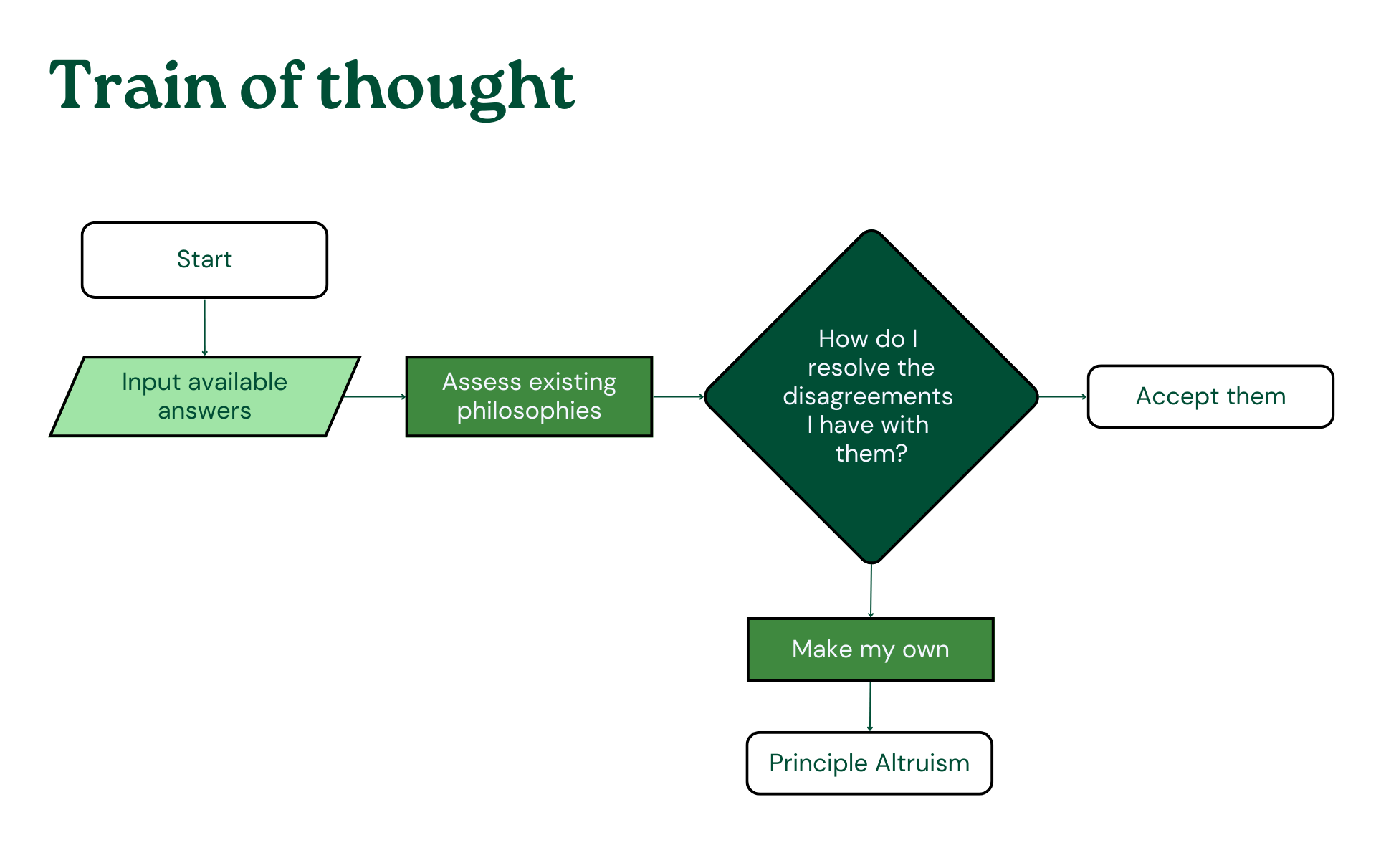
This was the question I attempted to address in a recent essay I wrote on Substack. The answer being in the form of a framework, namely Principle Altruism. Which isn't supposed to be in opposition to Effective Altruism in any way. Instead, it serves as a kind of revision that just goes a little further and shifts the focus a bit, akin to the difference between Vegetarianism and Veganism.
Admittedly I did intentionally skim over defining Effective Altruism in the essay itself because I thought that adding a link and referring back to this community for more information would be a safer bet. While also, the word limit was getting a bit tight too.
Without further adieu, here is the essay I published, and here is Principle Altruism.
We all want to do good and live an ethical life, but how do we do that? I think it starts with self, even though a lot of what seems to be held up as ideals to strive for with regard to ethics is based on the thinking that we must be selfless. Rather than subscribing to the conventional ideas of altruism, we need to acknowledge our deepest underlying self-interest to be able to do the most good we can in the world.
What do I mean by that? Well, that’s what this essay is about. Some parts might get a bit heavy, but trust me, it'll be worth sticking around till the end. So, grab your go-to beverage and maybe your notes app because this’ll be a long one.
From Mill's Utilitarianism to Kant's Deontology, Aristotle's Virtue Ethics, Camus' Existentialism, Zeno's Stoicism, and the teachings of religious figures like Jesus, Mohammed, and Buddha - they've all given their two cents on how to live a good life. Each has left a mark on the world, some more than others.
Now, I'm not saying I'm on their level. Far from it. But I've been searching for answers that resonate with me, and while I see the value in all these philosophies, none of them were quite as satisfying as I’d hoped.
It may simply be that sometimes we need to hear the same message in different ways before it truly clicks. What speaks to one person might not to another after all.
One philosophy that caught my attention was Effective Altruism. Its core idea? "Do good better." And while it’s not just a repackaging of Utilitarianism, it does lean heavily on it. And this heavy focus on number crunching made me hesitate. It felt like something was missing. But, the community around Effective Altruism is knowledgeable and supportive, so if you're curious to know more, they'd be the ones to chat with over at forum.effectivealtruism.org.
This journey of encountering these different sets of ideas made me wonder: what would it take for me to fully embrace a philosophy? But before I knew it, the question began to answer itself.
Queue the light bulbs.
I came to notice something interesting in the Effective Altruism community. There seemed to be a growing group of folks who were pushing to make bigger lifestyle changes, especially when it came to our relationship with non-human animals. Most of the discussion seemed to centre around talking about going vegan instead of just vegetarian or being omnivorous, let alone carnivorous. But, not everyone was on board. Some seemed to think it's asking too much and that compared to top-down societal changes the impacts of bottom-up individual changes would be almost irrelevant.
This whole debate made me think more about why we make the choices we do, especially when it comes to other animals. It's not just about the environment for me; there's a deeper ethical question here. And so I started to see how our choices fall into three broad categories or circles.
I’ve excluded the circle for carnivores because that’s already enough of a joke as it is.
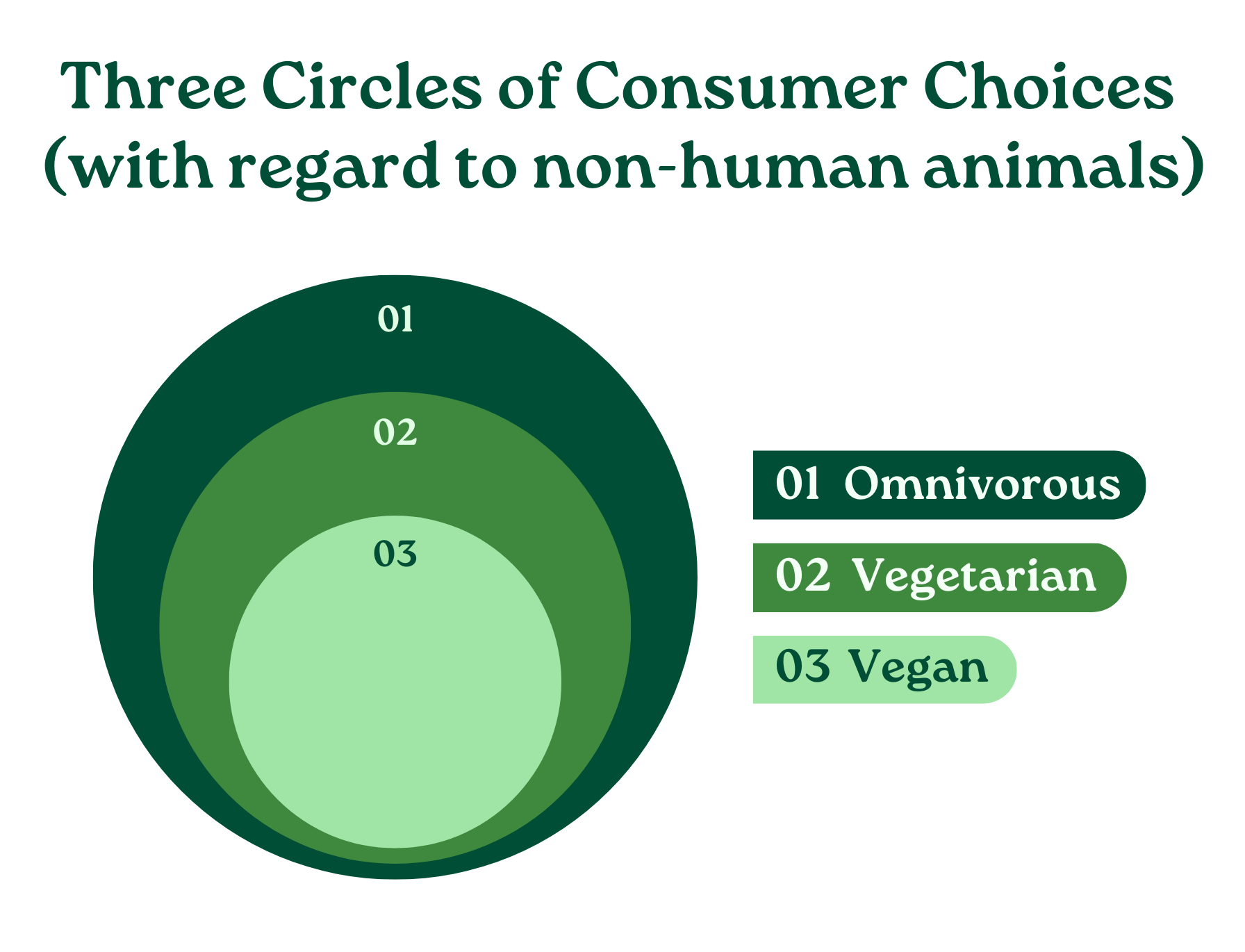
We can see that as we move inward, the impact of our choices increases, but the range of our options decreases. The trade-off here is more ethical effectiveness at the expense of convenience.
This got me thinking, if we were to draw a parallel with altruism, what would the equivalent circles look like? What then would be the proportional veganism of altruism? What would be able to resonate more rather than settling for something that didn’t feel quite right?
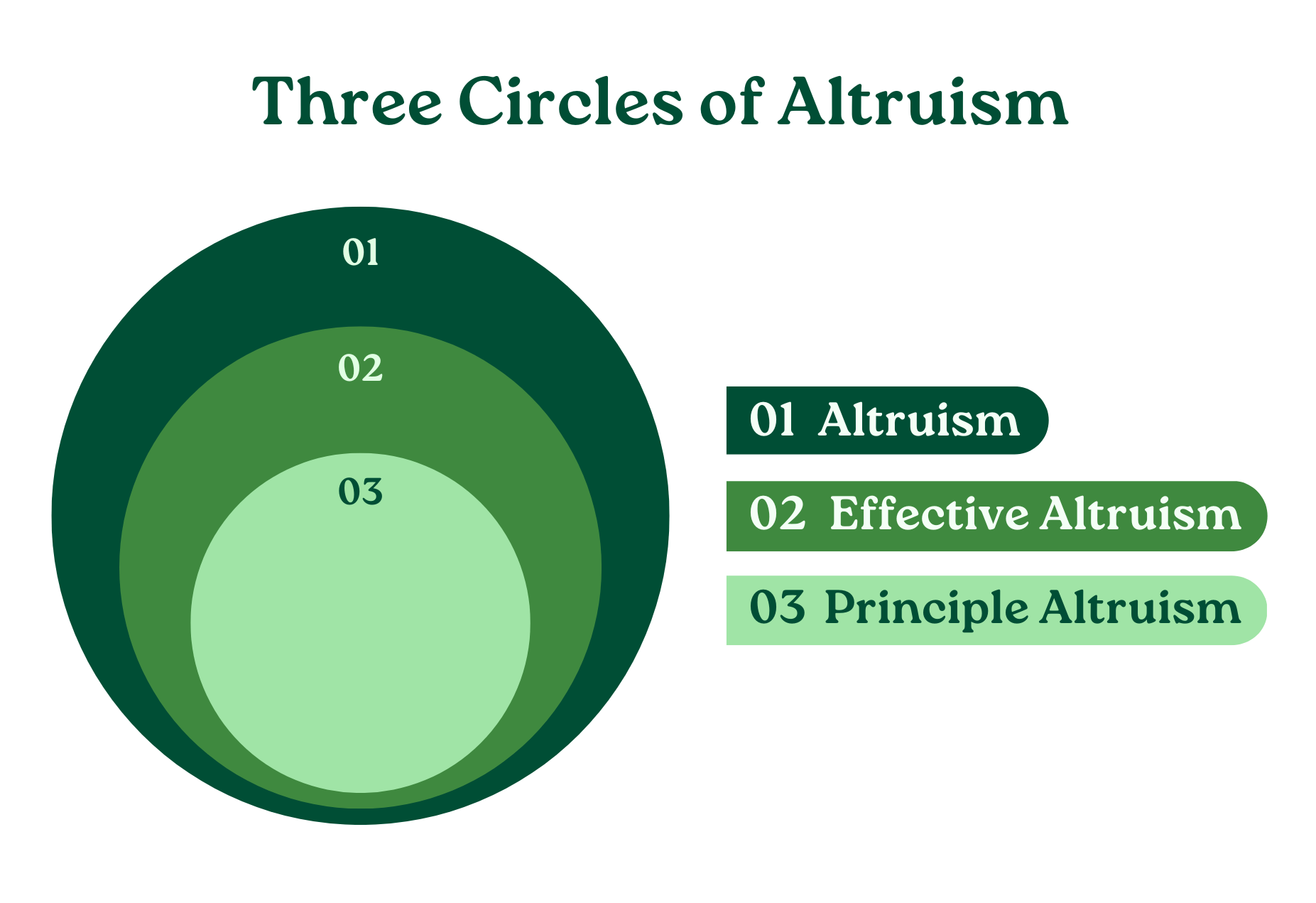
As with the circles of consumer choices, as we delve deeper into the circles of altruism, the commitment intensifies, but the breadth of easy choices diminishes. The challenge is to align actions with deeply held principles, even when it demands more effort or sacrifice.

The foundational component of this framework is self-discovery. It provides the grounding and support to enact the subsequent layers, even though to a certain extent progress between the layers can be made simultaneously. Through increased self-awareness, we approach our naturally generous, virtuous, and loving core, as a function of it being the most rewarding for our inherent self-interested nature. However, the issue comes up that it’s scary to confront ourselves, to attempt to answer the questions we ask ourselves. We’re frightened of what we may find, of what’s lurking beneath the surface. It’ll always be easier to deny ourselves until we’re “better” rather than to accept ourselves as we are.
If we agree that humans are fundamentally self-interested, at the deepest level, then we begin to question what would be best to fulfil said self-interest. I propose that the best returns come from a life filled with kindness, compassion, and most importantly, love. This journey unlocks our potential to do good in the world, revealing the latent capacities within our unconscious. Without such an endeavour we would continue to hold, in reserve, potential that's been stored in our unconscious. This goes to further say that we have a responsibility to be our truest selves not only for us but for others as well.
Only once we are able to get to a place of true self-acceptance, self-compassion, and self-love, then, as a natural by-product, do those interactions with ourselves spread into our interactions with the external world. This is why prioritising internal validation is much more useful than external validation because the more we begin to opt for these internal sources of validation, the less we'll need validation from external sources.
Self-discovery is essential for a few important reasons:
It lays the foundation for moral education, shaping our character and enabling us to navigate the world ethically and responsibly. By prioritising self-discovery, we actively combat self-deception. In a world where it's easy to unconsciously or passively deceive ourselves, this journey keeps us grounded in reality and truth. Every experience gains depth and significance on the path of self-discovery. It assures us that as long as we continue this introspective journey, every step forward enriches our lives with purpose and understanding.
But how do we go about this journey of self-discovery?
At this stage, while it may be tricky, surrounding ourselves with people who are also taking on this journey, as kind of mountain buddies, walking up together, can have synergistic improvements to our progress. Although, the reason why it’s tricky, isn’t just that these people are harder to find, but that it’s easy to lose ourselves in others sometimes too. So we need to do our best to stay grounded and remember what Emerson said, that “envy is ignorance; imitation is suicide”.
I personally, have found Kyudo, due to how much it focuses on using the practice as a mirror for oneself, to be a phenomenal help in this regard, especially as it seems to attract these kinds of people I’m talking about too.
The point is, if you can, find a group of people, or more likely, slowly cultivate a group of people to climb this mountain of self-discovery together.
While everyone’s individual path is different and no one is going to walk it for us, even if we have our mountain buddies with us we still have to take the steps ourselves, there are a few signposts that can help to guide the way. These are the moments when we catch an insight into a feeling that triggers us or we recognise that we’ve been working off a flawed assumption all along. They’re a kind of roadmap leading us back to the core self that we may have lost touch with a while ago.
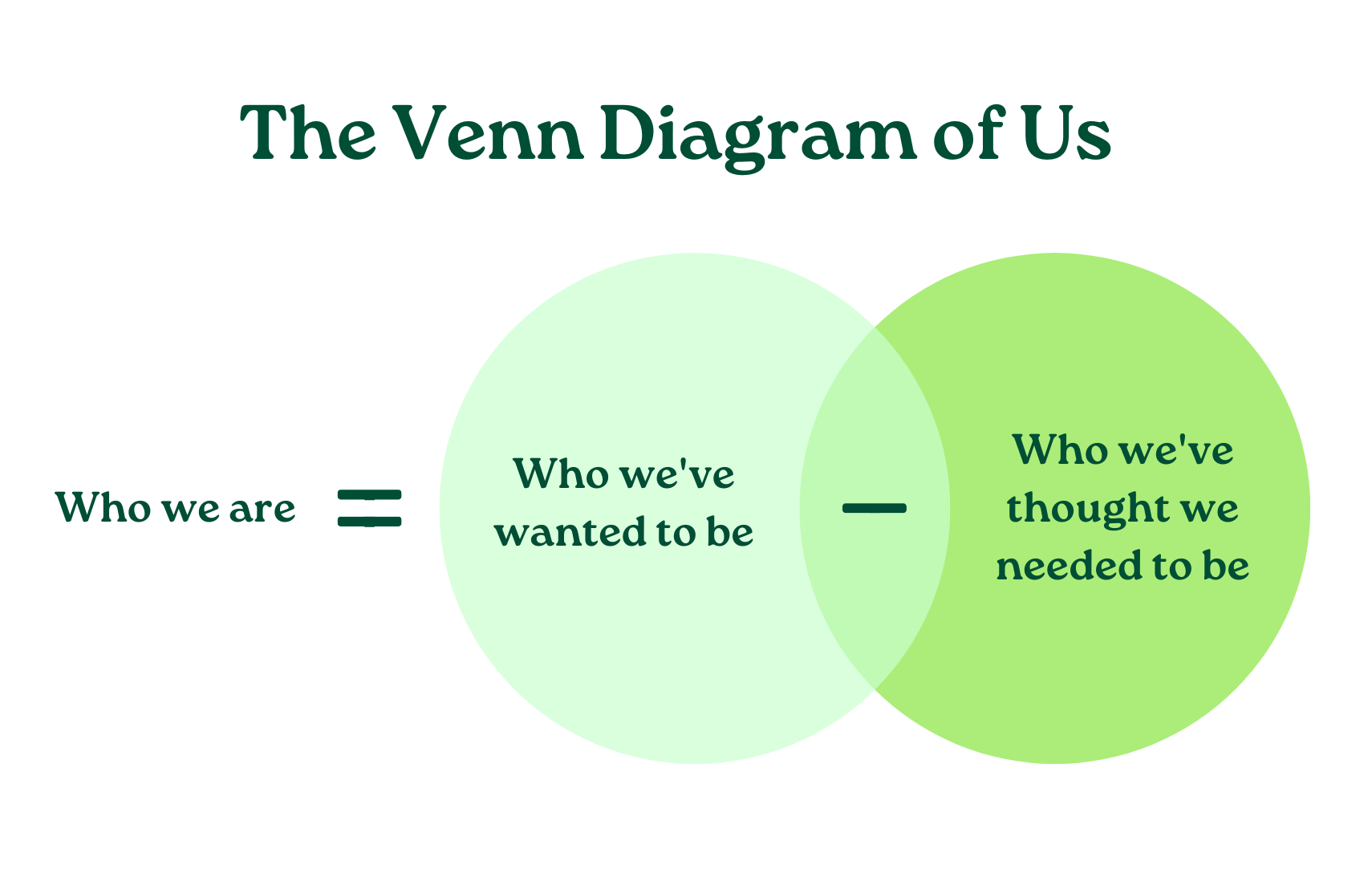
We must remember that we only know self in the context of other, so trying to disconnect from everybody and everything on this journey of self-discovery is not only ultimately unhelpful but also impossible, as we will always find ourselves in some relation to people and places. It’s like how the idea of hot is only relevant when anchored by a proportional idea of cold. The important part is the awareness we gain from understanding the distinction but also the connection we have from and to everything.
Once we get a grip on who we are, it's like having a personal roadmap. This helps us better connect with those in our local environment, be it family, friends, colleagues, and even strangers.
Life is a series of situations, each with its own set of challenges. Have you ever noticed how easy it is to act out of character when faced with unexpected pressures or temptations? It's like trying to stick to a diet but caving in when someone offers you your favourite dessert.
By being conscious of how different situations can sway our actions, we can better prepare ourselves. This isn't about being rigid or inflexible but about understanding our values and ensuring they shine through, no matter the circumstance. It's about building resilience and consistency in our character, so we don't waver when things get tough.
Now, imagine if life came with a manual, a set of hard and fast rules to follow. It might seem easier at first, but life's complexities don't always fit neatly into boxes. That's why it's more effective to have guiding principles rather than strict rules. Think of them as the North Star for your moral compass.
These principles are best framed as questions, helping us reflect and make decisions that align with our core values. But here's the catch: to genuinely answer these questions, we need to know ourselves deeply first to be able to mitigate as much self-delusion as possible. We may never be able to be completely devoid of self-delusion, but we can certainly be more or less deluded with respect to ourselves. It's like trying to choose the best book for a friend; you can only do it if you truly understand their tastes and interests. Similarly, the journey of self-discovery is crucial to making choices that reflect our true selves. This allows us to cultivate our own critical thinking as compared to simply relying on specific definitions of virtues that we’ve acquired from someone else.
In essence, life doesn't come with a playbook. But with introspection, awareness, and the right guiding questions, we can navigate its challenges with integrity and authenticity.
Here’s a handful of questions to go out into the world with.
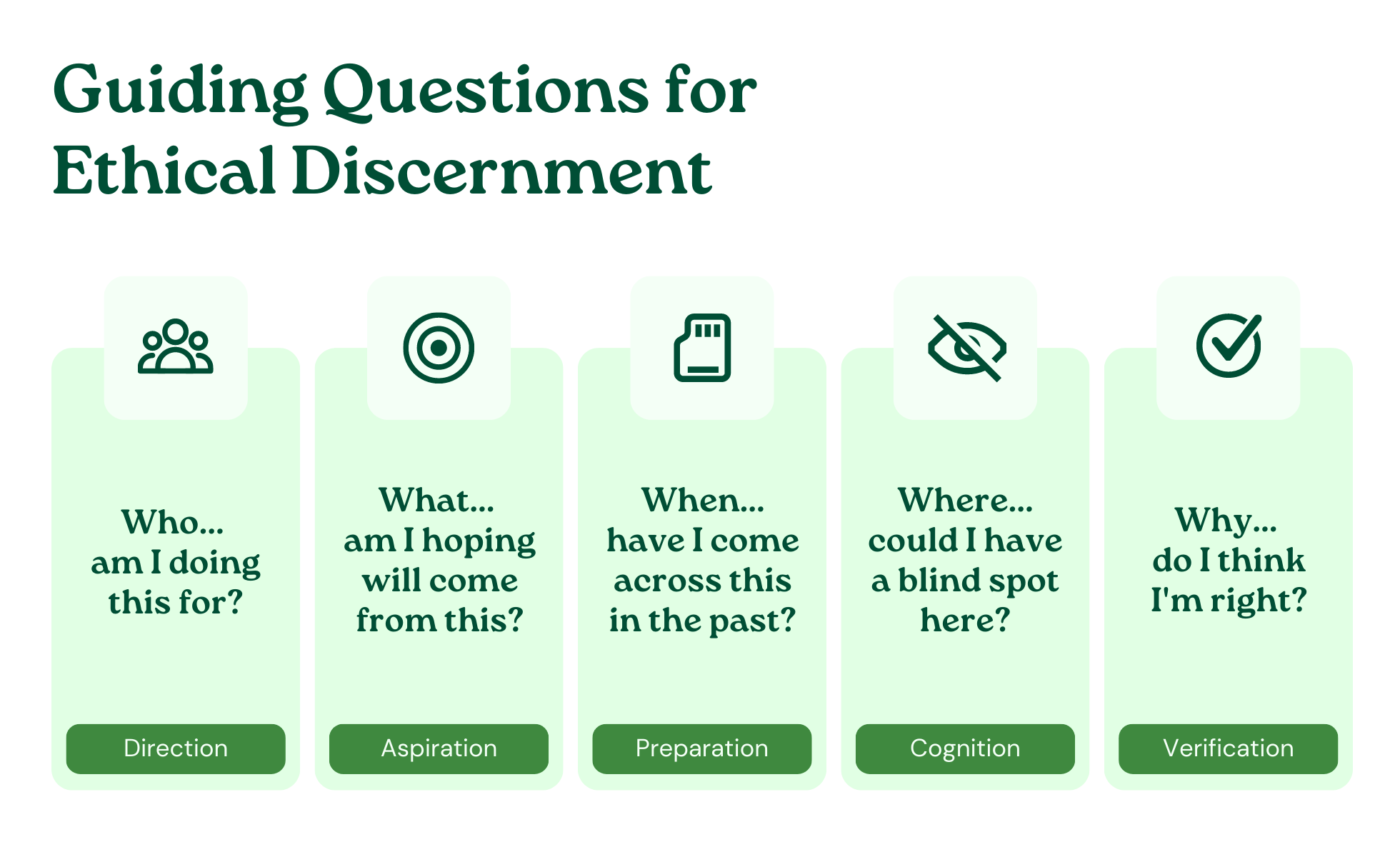
This approach is all about personal responsibility. It's about each of us finding our own moral compass from within through understanding ourselves better. Instead of just accepting what others tell us is right or wrong, we need to be able to figure things out for ourselves.
Sure, there are some universal values and principles we should follow. But just reading or hearing about them isn't enough. We need to truly understand and feel them to make them work in real life. Think of these questions as tools. We don't need every tool for every job, but they're handy to have. If something doesn't feel right, these questions can help us rethink our choices.
So, the next time you're faced with a tough decision, big or small, keep these questions in mind. They might just help you see things a little more clearly.
Once we begin to engage with our local communities a little differently, we may then begin to consider how we are engaging with our broader global community.
Think of it like this: we all have this internal "pipe" of understanding and love. Over time, due to life's pressures and challenges, this pipe can get clogged. It's like when we haven't turned on a tap in a long time, and the water doesn't flow smoothly or at all. When this happens and we’re wanting a drink of water, we might turn to taps in other people or things to try and fill up our cup, because our own is clogged. But as we all know, this doesn’t usually turn out too well.
The process of self-discovery is like reaching in and clearing out those blockages. As we get to know ourselves better, we start to turn that valve, letting more of our genuine feelings flow. At first, it's just a drip – a renewed sense of self-worth and self-love. But as we keep working on ourselves, that drip becomes a steady flow.
And here's the thing: once we've cleared out our own blockages and fully opened our valve, that love and understanding doesn't just benefit us. It starts to overflow, impacting those around us. It's not about seeking external validation or love to fill up our cup; it's about tapping into the source we've always had inside and letting it benefit not just ourselves, but all our fellow animals, human and non-human.
The accumulation of the work we've done in the two previous layers culminates into what we can do on a larger scale, how we guide the overflow into our contributions to society more broadly. This contribution is threefold and constitutes the largest areas of ethical impact we can have in our lives.
Imagine these three contributions as signposts on a road trip. They help us gauge if we're on the right path, and while each milestone might be a bit tougher to reach than the last, they're all part of the journey.
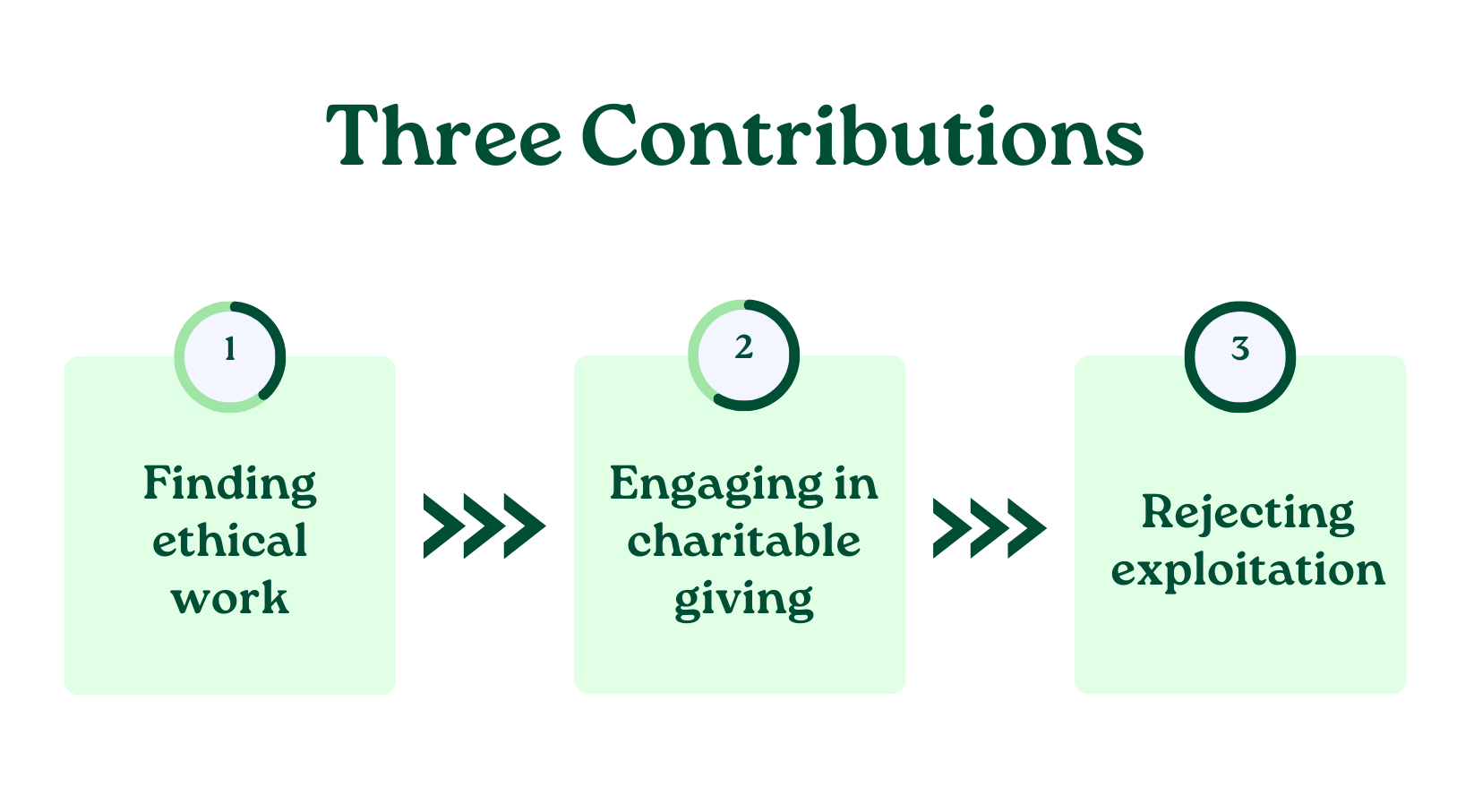
It may be easy to dismiss this third circle because of the perceived inconvenience or the belief that individual actions don't make a significant impact. However, it's essential to recognise that every choice we make sends a message about the kind of world we want to live in. By opting to work in ethically run companies, donating what we can, and rejecting exploitation, we not only alleviate immediate suffering but also contribute to a broader cultural shift towards empathy, compassion, and ultimately, love.
This circle challenges us to align our daily actions with our deepest ethical intuitions, even when it's uncomfortable or goes against the grain. It's not just about personal purity but about collectively shaping a more just and compassionate society. Every time we choose to support ethical practices, we cast a vote for the kind of world we believe in. That’s why these three contributions are certain kinds of milestones towards a world that benefits us all.
Now I know of at least a dozen potential criticisms of Principle Altruism. As seen here.
I intend to make a follow-up essay that has the sole purpose of addressing these potential criticisms in a detailed and in-depth way that can also serve as a kind of FAQ. I’ll give it a bit of time before I do though, to make sure each person who wants to have a say has the chance.
I’m always open to feedback and further discussion, so if you have any criticisms in particular, either already on this list or not, that you’d like to discuss, then feel free to leave a comment or send me an email/message. Any additional perspectives I can take into account will only help further develop this set of ideas in one way or another.
Principle Altruism is not just another philosophy on doing good; it's a holistic approach to ethical living that acknowledges our human nature. While Traditional Altruism focuses on selfless acts and Effective Altruism emphasises quantifiable impact, Principle Altruism integrates both and aims to go a step further. It's about making choices that align with deeply-held ethical principles that stem from an innate and powerful self-interest, encompassing not just charitable actions but also our daily lifestyle decisions. It’s the understanding that doing what’s ultimately best for us, is also the best we can do for those around us, which is to be kind, compassionate, and loving.
An important thing to note here is to highlight the difference between egoism and egotism, as they are often confused.
Egoism is, as the Oxford Dictionary defines it, “an ethical theory that treats self-interest as the foundation of morality”, whereas Egotism is, also as the Oxford Dictionary defines it, “the fact of being excessively conceited or absorbed in oneself.”
This is where people conflate egoism to be egotism, as colloquially they can mean the same thing. But when we use the precise definitions it’s clear how they differ. It seems the main difference is that one is a way of looking at the world and the other is based on self-delusion. We can all agree that being egotistic isn’t the ideal we should be striving for, but it is to say that being egoistic should get some more air time.
At its core, Principle Altruism emphasises:
In essence, Principle Altruism is a call to live authentically with our self-interest in mind, making choices that resonate with our core values, and recognising the ripple effect of our actions on the broader world.
Everything is taken care of along the way when we take care of ourselves along the way.
This also isn’t about being perfect, but about doing as much as we practicably can to align with the kindest, most compassionate, and loving choices we are capable of. We should dive deep into these ideas and give them a real shot, instead of just saying, "Well, it's too hard, so why bother?" For those who might not know, this "why bother" attitude is called an "appeal to futility." It's like saying, "We all want world peace, but since we can't make it perfect, why even try?" Clearly, that's not the mindset we want. Let's aim high and do our best!
Some say that mixing self-interest with doing good for others makes the good deed less genuine. But let's look at it differently.
Remember the videos where I talked about self-improvement and self-discovery? Think of self-improvement as trying to "fix" ourselves out of fear of not being good enough. In contrast, self-discovery is like embracing who we are with love, knowing we're already good enough. It's about getting to know ourselves better and getting to a place of self-acceptance, self-compassion, and self-love.
That’s where I think a lot of these philosophies go wrong, they try to take a shortcut to the finish line without running the race. Love has to start from within us, otherwise, it becomes a kind of attachment or addiction. We have to focus on gradually expanding that circle of love further and further as time goes on using the love we’ve been able to show to ourselves as a source for the love we show to others. So then, as long as we are prioritising love, it has to start from a place of self-interest. We’re kidding ourselves if we don’t acknowledge this.
Imagine starting with a blurry selfie of who you are. Every experience, whether a setback or a win, adds clarity to that picture. Over time, with each lesson learned, the image becomes crystal clear. Every high and low just adds more detail to our self-portrait.
Now, about Principle Altruism: it's not about judging someone else’s journey. This is about focusing on what we are doing, as individuals, and the standards we hold for ourselves while also recognising that the path taken by others is not only different from our own but also isn’t ours to control. Mistakes today might be tomorrow's wisdom. People do what they think is best in the moment. Instead of pointing fingers, let's uplift each other to make kinder choices that are based in the love we find on our journey through self-discovery as a result of our fundamental self-interest. Stay true to yourself, choose kindness, and if you trip up? Again, remember, it's just a learning moment to shape your journey.
It’s just the beginning of this ethical framework, version 1.0. I hope it sparks some interesting thoughts and plants a seed for further discussions.
Thanks for reading, and take care!

Great post