
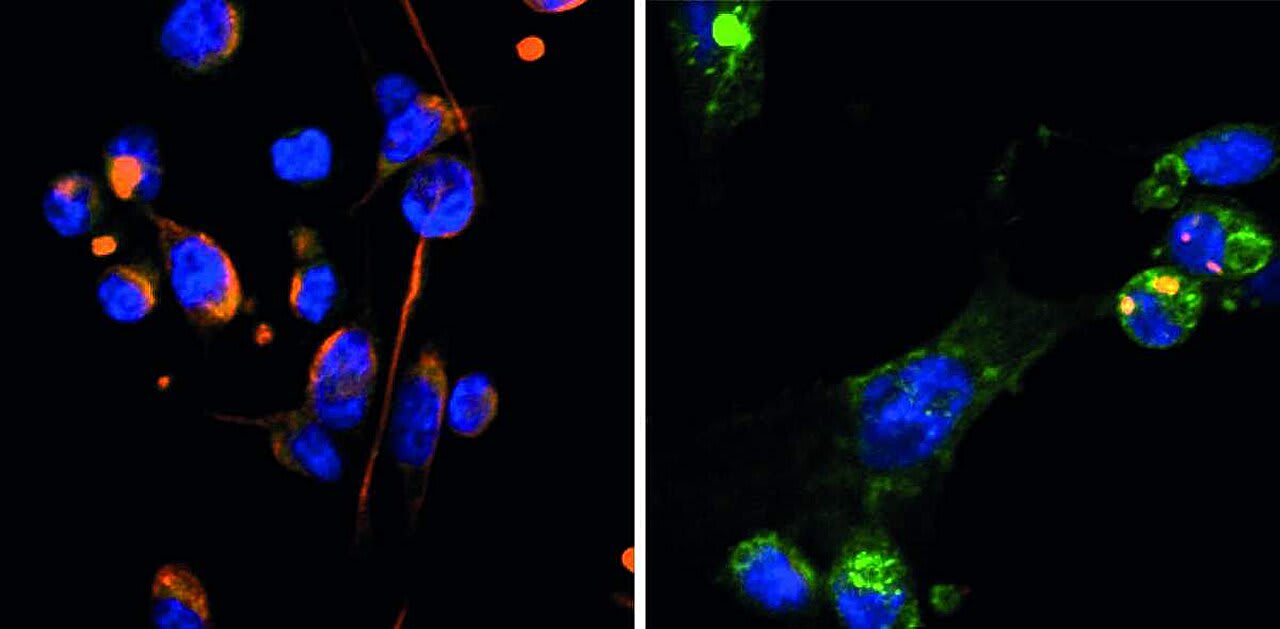
Typical breast cancer cells (highlighted by orange markers) exhibit high mobility and rapid division. Right: Breast cancer cells (indicated by green markers) that have transitioned into a dormant state due to the overproduction of the OVOL1 protein. Cell nuclei are depicted in blue. Credit: Weizmann Institute of Science.
Breast cancer is becoming progressively manageable; however, in certain instances, the illness can reemerge even years after a patient has been declared cancer-free. This phenomenon occurs because cells detach from the initial tumor and conceal themselves in a dormant state within the breast or other organs.
Limited understanding exists regarding the mechanisms that facilitate dormancy in cancer cells, and even less is known about the triggers that cause these cells to abruptly awaken. A recent study conducted by Prof. Yosef Yarden's laboratory, a recipient of the Israel Prize at the Weizmann Institute of Science, published in Science Signaling, uncovers the mechanism that induces dormancy in breast cancer cells and elucidates why these cells emerge from dormancy with increased aggressiveness compared to their pre-dormant state.
From the initial phases of embryonic development, through sexual maturation, and into the production of breast milk during pregnancy and postpartum, breast tissue undergoes significant transformations throughout a woman's life. These alterations are facilitated by the transformation that breast tissue cells experience, transitioning from the early developmental stage, known as mesenchymal, characterized by round, highly mobile, and rapidly dividing cells, to the more advanced, epithelial stage, where they appear somewhat cuboidal, exhibit reduced activity, and divide at a slower rate.
The cells oscillate between these stages in a controlled and gradual manner; however, there are instances when this process spirals out of control, leading to rapid division and malignancy. The cancer development process initiates when mature cells revert to their earlier developmental stage, which permits them to divide swiftly, generate tumor tissue, and even migrate to other tissues. Subsequently, the cancer can exploit the opposite process: cells that have disseminated throughout the body can revert to their mature state, becoming immobile and sluggish. Essentially, they enter a state of dormancy.
Due to the significant parallels between the onset of dormancy and the maturation process of epithelial cells, scientists in Yarden's laboratory within Weizmann's Immunology and Regenerative Biology Department theorized that they could induce a dormant state in breast cancer cells by mimicking the natural process.
Utilizing a three-dimensional model of a cancerous tumor environment created by Dr. Dalit Barkan from Haifa University, the researchers, led by Dr. Diana Drago-Garcia from Yarden's team, genetically modified human breast cancer cells of the most aggressive subtype, known as triple-negative breast cancer, to produce elevated levels of OVOL proteins, which are recognized for their role in the natural maturation of epithelial cells.
The model demonstrated that enhancing the expression of two OVOL proteins halts the life cycle of aggressive cancer cells and induces dormancy. Concurrently, the researchers observed in female mice implanted with human tumor tissue that the overexpression of OVOL inhibits cancer growth.
While stopping the life cycle of cancer cells and decelerating tumor growth may seem promising and potentially form the basis for future treatments, it is known that breast tissue in cancer patients contains elevated levels of one of the OVOL proteins.
Consequently, the scientists proposed that while this protein, OVOL1, may inhibit cancer growth in the short term, it could ultimately benefit cancerous cells in the long run, allowing them to enter a dormant state and persist undetected for years. When conditions within the body fluctuate and OVOL1 levels decrease, the cancer reawakens and becomes more aggressive than it was prior to dormancy.
Equipped with these revelations, the researchers began investigating how cancer influences the expression levels of OVOL proteins, determining how tumor cells are either put to sleep or awakened. A crucial finding was that certain growth factors enhance OVOL1 expression, whereas the steroid hormone estrogen suppresses it. The scientists further demonstrated that patients exhibiting low levels of estrogen receptors alongside high levels of OVOL1 typically develop more aggressive cancer and possess diminished survival rates.
"These discoveries could pave the way for preventing cancer cells from entering dormancy or stopping dormant cells from reawakening," Yarden states. "We know, for instance, that adipose tissue regulates estrogen production during menopause. Thus, it can be inferred that weight gain in older women who previously had cancer may elevate the risk of dormant cancer re-emerging due to increased estrogen production and the corresponding decline in OVOL1 expression. In the future, these hypotheses can be tested in animal models and human patients."
Changing in Their Sleep
One lingering question was why breast cancer tends to exhibit increased aggressiveness upon reawakening from dormancy. To uncover the underlying mechanisms, the researchers traced the molecular signaling pathway through which OVOL1 induces dormancy. They found that this pathway incites the accumulation of unstable molecules referred to as free radicals, leading to extensive cellular damage, cell cycle arrest, and dormancy. This accumulation was unexpected, as these molecules had not previously been associated with dormancy in cancer cells.
Subsequently, the researchers, collaborating with Prof. Emeritus Yosef Shiloh of Tel Aviv University, demonstrated that the chronic cellular stress experienced by dormant cells, stemming from the buildup of free radicals, alters the expression and function of proteins in the cells' nuclei, which contain their genetic material. As a result, the genetic material becomes oxidized, compromising its integrity, along with the functionality of three pivotal proteins involved in DNA repair mechanisms.
The scientists contend that the extensive damage to the genetic material and the failure of repair mechanisms elucidate why, upon awakening, a cancer cell carries numerous mutations, rendering it more aggressive and resistant to treatment.
"The prevailing assumption is that dormant cancer cells exist in a suspended state, but we have demonstrated that during their so-called slumber, they accumulate DNA mutations due to the oxidative process, undergoing significant changes," Yarden clarifies.
"This discovery aligns with the analysis of tissue samples from aggressive breast cancer tumors. Importantly, breast cancer is not the sole malignancy that enters a dormant state; thus, comprehending the mechanisms of dormancy could lead to novel treatments for various other cancer types as well."
More information:
Diana Drago-Garcia et al, Re-epithelialization of cancer cells increases autophagy and DNA damage: Implications for breast cancer dormancy and relapse, Science Signaling (2025). DOI: 10.1126/scisignal.ado3473
How breast cancer cells become dormant and remain undetected for years, and why they later wake up and metastasize (2025, April 22) retrieved 22 April 2025 from https://medicalxpress.com/news/2025-04-breast-cancer-cells-dormant-undetected.html
This is very technical and specific. I have trouble understanding why this has been posted on the EA forum ?
I believe it was AI-generated. This author runs a service that appears to be a custom LLM for writing medical articles and they've posted a dozen AI-generated articles to the EA Forum, none of which were relevant or good. Profile picture appears to be AI-generated as well. Should probably be banned IMO, I just reported the profile.
What does this have to do with effective altruism?