This newsletter was originally shared on 03/04/2026 by AWASH. The original format can be found here. To subscribe and get future newsletters emailed to you, please share your details here.
Hi everyone, it’s Naveeth.
Over the past few months, we’ve focused on three main areas: publishing our initial research, continuing implementation of our pilot, and strengthening our funding and organisational capacity.
Here’s a summary of what we’ve been working on and what we’re learning so far.
Published research reports
We’ve published two reports that summarise our initial research and reasoning. Together, these reports aim to provide a clearer picture of where the main welfare challenges occur and which interventions are likely to be most practical.
While the research is focused on Ghana, many of the challenges observed are likely to be relevant in other contexts. We hope that publishing these reports allows others working on fish welfare, including practitioners, researchers, and funders, to build on the evidence, adapt insights to their own settings, and avoid duplicating early-stage research and mistakes.
A consistent finding across both reports was that mortality is substantially higher at early life stages, where survival is often around 40–70%, compared to higher survival rates at later life stages. This has informed our current focus on interventions that target early-life survival.
Pilot progress
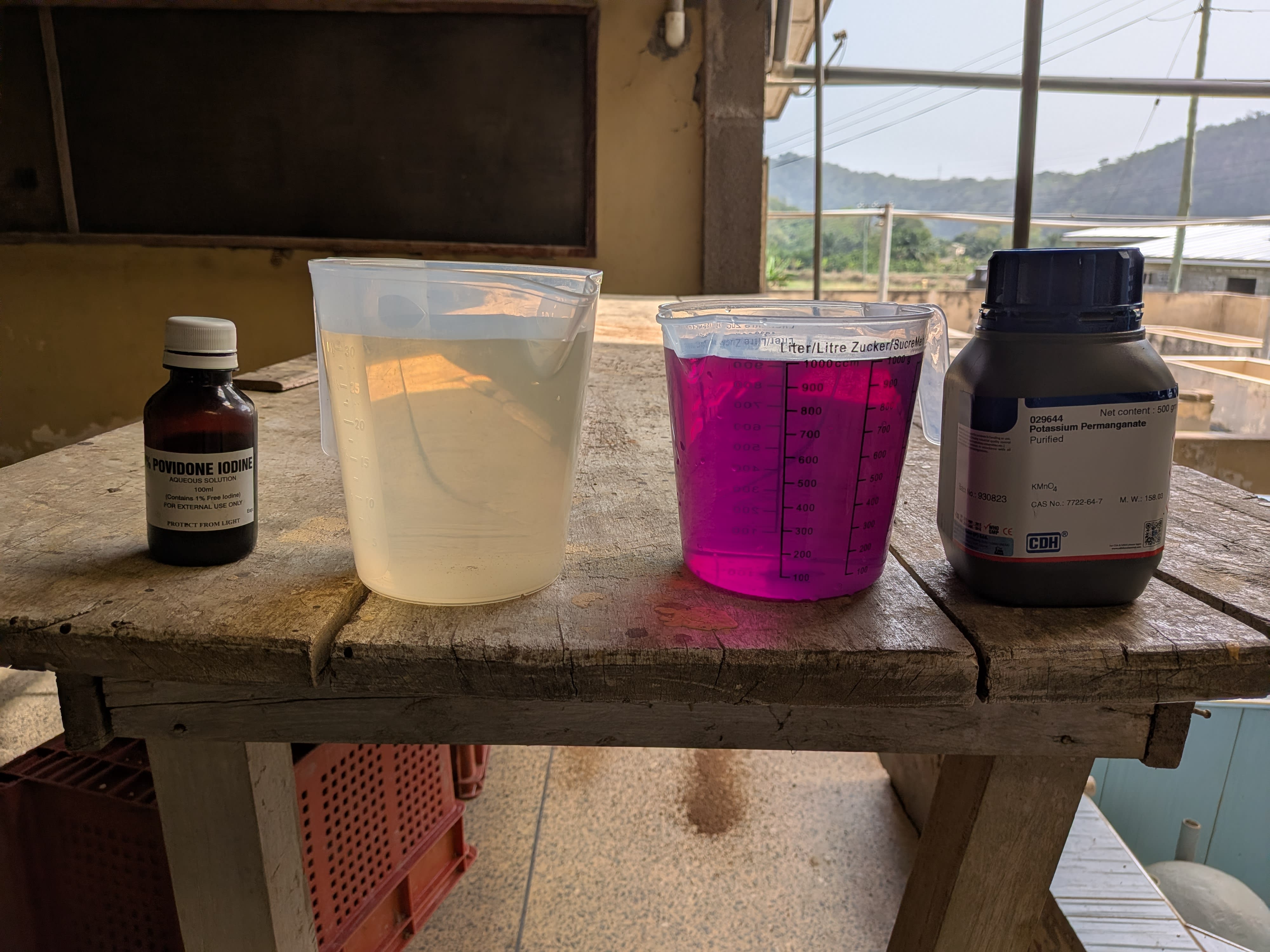
We have continued running our pilot on tilapia egg disinfection across two sites, to test whether it increases hatching and juvenile survival rates.
Due to delays outside our control and on-site implementation challenges, the data is still inconclusive. In practice, adapting the protocol to commercial farm settings has been more difficult than expected.
However, early results suggest sufficient potential positive impact to justify continuing the pilot. We will continue until we have enough high-quality data to draw more reliable conclusions about its effect on survival and welfare.
We initially restricted the pilot to two sites where we had the most confidence in consistent implementation and data quality. They were also large enough that success and expansion at these sites alone would result in significant welfare impact. However, this has meant that delays at one or both sites significantly slow the rate of learning. Therefore, we will visit additional farms to potentially expand the pilot, whilst still maintaining data quality.
Funding secured to continue and expand the work
We’re excited to share that AWASH has been selected as a grant recipient of Animal Charity Evaluators (ACE) Movement Grants!
This will allow us to:
Continue the current pilot and extend the data collection period.
Expand the pilot across more of the existing sites, and to additional sites if results remain promising.
Explore additional intervention ideas identified during the scoping phase.
Strengthen monitoring and evaluation.
We’re very grateful to ACE for giving us the opportunity to continue our work.
Building the local effective altruism community
Alongside AWASH, we’ve helped launch EA Ghana alongside Randy Boaitey, Ewura Ama Sam and Maxwell Asampana.
The aim is to build a local community focused on evidence-based approaches to doing good. Over time, we hope this contributes to:
Increased awareness of high-impact problem areas
More people developing relevant skills and pursuing impactful careers
A stronger local network for collaboration and knowledge-sharing
While this is separate from AWASH’s core work, it supports the broader ecosystem needed for sustained impact.
What we’ve learned
Early-life stages remain a key leverage point. Both the research and pilot work continue to suggest that juvenile mortality is a major driver of poor welfare outcomes, reinforcing our focus on hatchery-stage interventions.
Implementation is a major constraint. Even relatively simple interventions can be difficult to apply consistently on-site.Therefore, it’s worth allocating time at the start of a pilot for process calibration, before expecting to see any meaningful results.
Balancing implementation quality and sample size. Running pilots on sites with strong implementation capacity improves data quality, but too few sites can slow the rate of learning. Expanding to additional sites may help balance these trade-offs.
Over-optimising for efficiency can slow progress. Linking activities to save time or cost can create dependencies that delay multiple workstreams when one is disrupted. Greater operational flexibility may improve overall progress. For example, we wanted to visit new farms, and tried to coordinate these visits with our pilot visits. But the pilot visits would often change at the last minute, meaning we’d have to cancel the new farm visit.
Key goals for the next 3 months
Continue and strengthen the pilot
We will continue running the egg disinfection pilot, with a focus on improving implementation consistency and data quality. This includes refining the protocol where needed.
We will also assess whether and how to expand the pilot to additional farms, balancing the need for reliable implementation with the benefits of a larger sample size.
Analyse results to inform next decisions
As more data becomes available, we will begin analysing results to assess whether egg disinfection appears to have a meaningful effect on survival and welfare.
This will inform whether to:
Continue the pilot for longer
Expand on the existing sites to cover more of their operations
Expand to additional sites
Adapt the intervention
Or deprioritise it in favour of other interventions
Connect with the wider movement at two conferences
Epistemic status: Speculation from two decently informed advocates armed with anecdata.
Note on process: After having some version of this conversation several times and saying, “we should probably write about this publicly,” we took the less heroic route: we recorded one of our conversations, fed the transcript into an LLM, and then substantially revised the structure, substance, and framing ourselves. We will not be sharing the transcript, as it is in...
I want to start by noting that I am amazed and somewhat in awe of what's been accomplished by the EA animal welfare movement. I am enthusiastically supportive of all campaigns that make living and dying conditions less bad for farmed animals.
I worked on such campaigns for almost 20 years, and I'm proud of that work.
That said, I do think it's a strategic error that the EA animal movement has so thoroughly moved on from advocacy for animal liberation and diet change.&n...
The swarm has made me feel AI risk in my bones for the first time
Until the Hugging Face / OpenAI swarm thing, I think I deep down felt pretty skeptical that extinction or serious loss of control scenarios were plausible in the next few years.
I’ve been lurking on LessWrong for years, and I remember being freaked out by Yudkowsky’s ‘List of Lethalities’ in 2022, and thinking that this did seem intellectually convincing, and maybe I should do something about it. But it didn...