TLDR: I'm leaving San Francisco to do policy in DC within a few months. As the lead organizer of EA SF, it's likely the group will go dormant if no one takes on this role. However, EA SF is uniquely situated to be a potentially very high impact city group, due to its location in an AI development hub with a high concentration of EA-adjacent people. Thus, becoming lead organizer would be extremely counterfactually impactful - no one else would do it if not you. Furthermore, this role doesn't require much work (a minimal version can be done with less than 5h/wk). If you're located in San Francisco, Berkeley, or the Peninsula, and you're interested in helping out, please reach out.
EA SF's Theory of Change
Attention from within the EA community itself has shifted away from EA qua EA and towards pure AI safety. So why run an EA group in 2026?
There are a few reasons (which I partially borrow from https://forum.effectivealtruism.org/posts/R8AAG4QBZi5puvogR/effective-altruism-in-the-age-of-agi):
- You can incentivize work on neglected topics. There are several that would be ignored by pure AI safety groups trying to be legible and respectable to the broader public, and don't really have a home elsewhere. I'm talking about things like AI welfare, space governance, and utilitarian philosophy.
- You can incentivize cross-disciplinary work. Because EA lies at the intersection of several other groups like rationality, animal welfare, AI safety, and global health and development, there is a lot of room to engage people from all of those spheres and promote cross-disciplinary collaborations which otherwise wouldn't have happened.
- You can cultivate EA virtues (truth seeking, scope sensitivity, and altruism) in people who will be impactful in the future. People are naturally incentivized to follow their peers. By bringing together people who are high in these traits, you incentivize virtuous behavior through the example of others, in a way that wouldn't happen in a pure AI safety group.
The question now becomes: is it tractable to achieve this through a city group? I think so. Some of our pathways to impact are shared with other EA city groups, but we also have pathways largely unavailable to other groups.
The two standard pathways to impact that I think EA SF executes on are:
- We aim to engage and eventually recruit promising people to work on the world's most pressing problems. We have a publicly accessible website and post our events on public forums like EA Forum and Lesswrong to engage people who might be interested in attending events. We do 1:1s with people who are interested.
- We connect people trying to work on important problems to people and opportunities that might be able to help them, and thus amplifying their impact. I do this on a case by case basis once I meet them. This has proven fruitful in many cases.
However, EA SF can also leverage opportunities not available to comparable EA groups in other cities:
- EA SF can directly market towards lab employees. This isn't something I've heavily specced into, but we've had many Anthropic and a few OpenAI employees attend our meetings. It might be disproportionately valuable to target this audience, as they are well-situated to either earn to give (as they are wealthy) or pivot their career to work on AI safety within the company itself.
- SF has an extremely strong startup culture, which shares much of its ethos with EA. Indeed, 80,000 hours was once a YC startup. Either convincing even a single founder of EA principles or convincing an EA to found a startup would be very impactful, either through earning to give, or by choosing an impactful startup direction.
- EA SF has access to Mox, a broadly "EA-Adjacent" coworking space located in SF. It was founded by Austin Chen of Manifund, and is designed to cater towards the EA and Rationalist community. Mox has kindly allowed us to host events in a high quality venue for free. This greatly simplifies hosting events, and is a win-win for both the Mox community and EA SF.
Challenges
However, there are challenges specific to EA SF too. The biggest one is that the "competition" is very strong. By this, I mean that our target audience of EA-adjacent people have a plethora of events to choose from. There are robot boxing matches and ACX meetups and group house dinners to choose from. Many EAs have friend groups that satisfy their need for EA interactions as well. EA SF events have to be worthwhile enough for these people to choose attending our events as opposed to their next best option. You have to be constantly choosing to put on novel and high quality events in order to retain attendance, which I suspect is less of an issue in other cities where less is going on.
Another challenge is that we don't have a consistent audience. If you run an AI safety event, you'll attract a subset of the crowd. If you run an animal welfare event, you'll get another, largely disjoint crowd. The same goes for global health and welfare. This is somewhat of a challenge to attracting a consistent group of regulars. It's possible to do
What The Role Entails
If you're located in SF, Berkeley, or the peninsula, running EA SF might be for you. I'll describe two versions of what the lead organizer could do, a minimal version and a maximal version.
Minimal
Each month, you would send out a Partiful or Luma invitation to eat Chipotle on top of Salesforce Park. This would be broadcasted on the mailing list, EA Forum, and LessWrong. Here's an example:
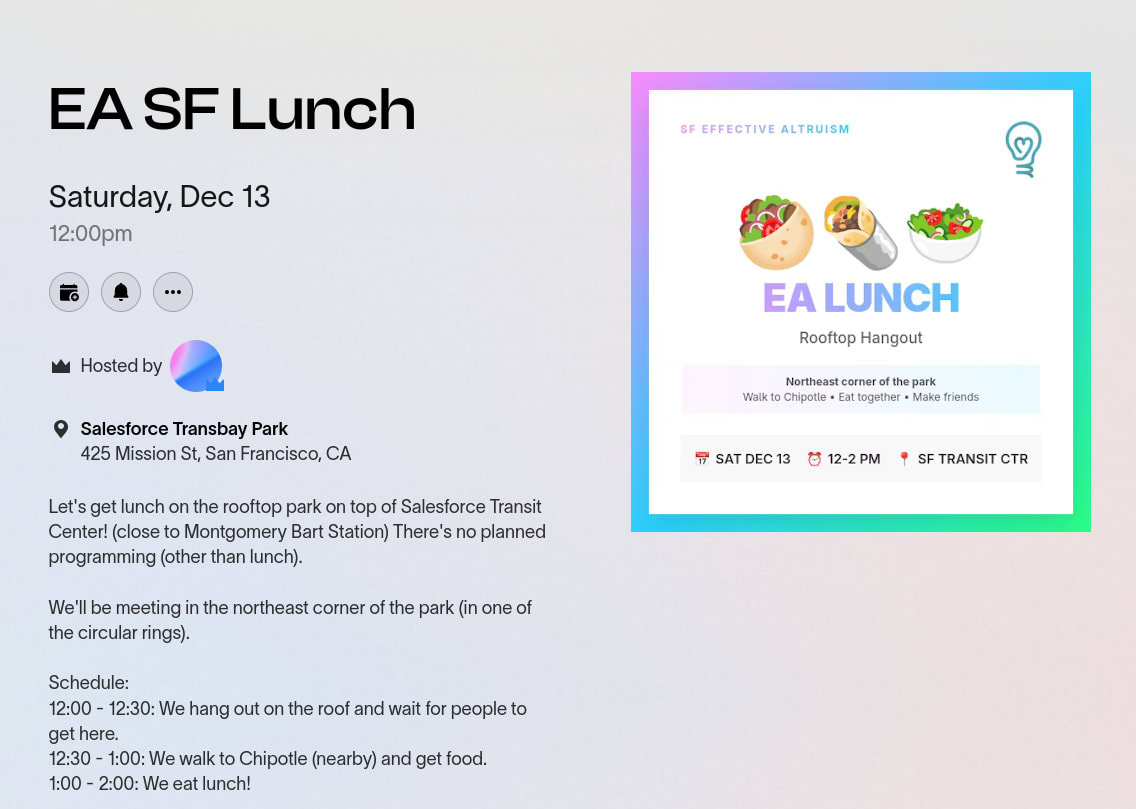
On the day of the event, you'd go there, and eat lunch with the attendees.
Total Time cost: 1 hr / wk (amortized)
Maximal
You run one event every single week. Two events a month are more high effort. They could be either speaker events or workshops where we read and discuss a particular topic.
A typical monthly schedule might look like:
- Weekend 1: A talk from an AI safety researcher (doesn't have to be famous!)
- Weekend 2: Chipotle lunch
- Weekend 3: Workshop where do some readings about space governance and discuss what reasonable approaches would look like.
- Weekend 4: Pizza lunch
Total Time cost: 5-6 hr / wk (largely from the speaker talk)
Interested?
Sign up for a 1:1 here, and mention you're interested in helping to lead the group: https://docs.google.com/forms/d/e/1FAIpQLSf2E11F97QwjniQjbrLrI0juZnMXUYo9yrP0QtImKdc4mrY7w/viewform?usp=dialog
Even if you're not interested in leading, but are based in SF or the nearby vicinity, I'd encourage you to sign up for our newsletter, which is the main method of communication: https://effectivealtruismsf.org/get-involved.html

What's been your experience so far running this group? What has worked? What has not worked? Why was there no one on the bench ready to take over?
I am in South Bay, and been wondering why there is no active South Bay EA community. I was about to start asking questions about it and saw this. I am curious to get answers to these questions because I am trying to understand the benefit (or not) of starting or re-starting an EA group.
Thank you!
There's no active South Bay group that I know of. There was one a few years ago (maybe in 2022 or 2023), but it hasn't been active recently. I'd definitely recommend going for it!
What works:
What doesn't work:
Why wasn't there someone ready to immediately take over:
If you have more questions, feel free to DM, and we can get on a call. I'd be super excited to help you start a South Bay group!