Comments
Scrappiness is a means, not an end

6 min readMar 27
Reposted from my The Fielduilder's Blog
EXECUTIVE SUMMARY
AIS has its roots in “getting shit done” with organisations being highly effective at executing on ideas well enough to get important things off the ground. This is an absolute strength of many orgs and individuals in the field and something to be celebrated! However, I worry it goes too far as a romanticised virtue rather than a useful instrumental tool for impact leading to a miscalibration of when we need to build and ship scrappily and when it is actually worth it to step back and build the systems that create the 10x version.
INTRODUCTION
Many orgs in the AIS space have the crazily ambitious and insanely hard mission of making AI go well while the world seems to be racing off a cliff. The goal feels uncertain and very imminent and when many of these orgs started they were filled with uncertainty and constrained resources. As such, scrappiness and getting things done just well enough to work was the default mode.
That context has changed. The field looks meaningfully different now than it did five years ago. Funding and interest has grown substantially, the Anthropic IPO and increasing institutional investment mean that resource scarcity is no longer the universal condition it once was. But more importantly, many orgs have simply matured past the activation energy stage regardless of funding. They’re running their third or fourth cohort rather than their first, have established relationships with funders and partners, proven programme models, and grown teams that have grown beyond one or two people scrappily holding everything together. The proof of concept for many orgs has been made successfully.
The conditions that originally made scrappiness necessary are no longer universal, but the culture hasn’t caught up with that reality.
ROMANTICISATION
In my experience of AIS spaces there’s a very real romanticisation of the “you can just do things” mindset where action and output are put at the forefront. This comes from a great place, agency is fantastic and underdeveloped and doing good things is good! However, this romanticisation leads to scrappy doing becoming the default mode.
The feeling of momentum and having a “bias for action” become celebrated norms. Shipping things feels like caring about and acting on the mission. In lots of contexts 80/20 is a great framing. Efficiency is great to strive for and when resources are constrained can be necessary for the org to exist at all.
This isn’t purely an abstract argument for this being possible in theory. I have explicitly been told that scrappily shipping things from 0% to 100% without thinking or infrastructure is a valued skill in certain orgs, not as a context specific note, but as a general virtue.
With all of this bias for action, good actors can lose sight of the impact they are actually aiming for and instead target building and shipping things over having an impact. The “just do things” rhetoric is all over the place. As other posts point out, doing things for the sake of doing them is not inherently good. This is an example of Goodhart’s Law, demonstrated by XKCD below:
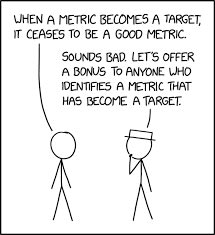
When the measure of success of raw actions per minute becomes the target, the focus is no longer on impactful outputs. The issue is that while it is often necessary to do tons of stuff to launch something, doing a bunch of things scrappily should not be the end goal. It is an instrumental mechanism when the resources available (time, money, expertise, etc.) are constrained.
Momentum and concrete actions and outputs are immediately rewarding. They make people feel like they are doing “impact” and I totally empathise with people wanting this. I do think there are many good actors in this space who really care about the work they do and it makes sense that they want to feel the impact.
However, actual impact can be lagging, diffuse and hard to attribute. The romanticised “just do things” culture can optimise for easy to see things that are a local minima of impact rather than being truly important. The 10x version of the thing exists, but is harder to achieve by just hammering away at the thing without taking a step back and building systems to support it.
THE COST
As a concrete example of where romanticised scrappiness limits organisations, consider the recent trend of many AIS orgs realising how crucial ops roles are. While ops are important in any field, I think this one area where AIS has amplified the problem through its cultural norms of shipping fast. Org after org struggles with broken systems, processes that live in someone’s head and programmes running on last-minute heroics. The current diagnosis is usually a resourcing problem that there needs to be more focused people working on ops.
But I think that’s the wrong frame. The ops problem in AIS would benefit from more operations roles, however, operations headcount alone doesn’t solve the deeper rooted culture problem. When scrappy shipping is the default, ops people get absorbed into that culture. Their job becomes duct-taping broken systems together just well enough to survive the next deadline. They’re not building infrastructure, they’re patching it repeatedly under pressure. The role gets defined by the culture rather than changing it.
So the cycle continues: scrappy culture produces brittle systems, brittle systems produce ops chaos, ops chaos produces the feeling that we need more ops people, more ops people get hired into a scrappy culture. The investment doesn’t fix things because it’s being consumed almost as fast as it’s put in. We’re not just moving fast. We’re moving fast in circles.
Hiring more is a tangible action that feels like progress. However, this is precisely an example of the default shipping mode I have been writing about. By hiring, an organisation feels like they’ve taken a real step towards progress without actually taking a step back to reflect on the real root cause of the culture.
CALIBRATION
This isn’t an argument for slowing momentum. Instead it is a plea to people to consider a more global framing for impact and intentionally choosing when to ship scrappily and when to take a more thoughtful approach rather than just defaulting to one.
As mentioned, scrappy solutions can miss the 10x version of different outputs. As a concrete example, this Winter, I focused most of my attention as Head of Courses at Leaf designing systems and automations that will allow Leaf to scale.
For a long time, Leaf has focused on scrappy 80/20 solutions to problems to help get us off the ground. However, when I entered the role, I recognised that this sort of reliance on manual, messy work severely blocked our ability to scale our impact by reaching more people around the world!
Only by stepping back and thoughtfully designing systems to enable our scaling are we now in a position of getting proven results and preparing to scale our working model for the Summer and beyond!
Relying on duct taped processes and manual effort can only go so far!
Orgs can make concrete steps towards a more judgement oriented approach to execution. By acknowledging the default cultural norms for what they are and then working to change them for a more nuanced, context dependent approach, orgs can move away from the inefficiencies and counterfactual lost impact of scrappiness.
OVERCORRECTING
Applying this message poorly is its own failure mode. I’ve seen orgs invest real care into polishing things that don’t necessitate it, while leaving high-leverage systems scrappy in ways that actually harm the work. That’s not the 10x version of anything. It’s goodharting on carefulness rather than impact, which is almost worse because it looks like the right behaviour from the outside.
The skill isn’t “do things more carefully.” It’s knowing which things warrant careful design and which things genuinely just need to be done well enough once. That distinction is what I want to see more orgs internalise and act on!
CALL TO ACTION
Most people reading this will agree that context-dependent approaches are good in abstract. The problem is the gap between what leaders nominally believe and what their org culture actually selects for day to day.
Reflecting and being self-aware that your org is no longer working out of a bedroom with weeks of runway, but has the resources to enable a wider range of approaches than the scrappy fixes that have become the norm is necessary for your org to actually leverage all of the resources at its disposable to have as much impact as possible!
The floor to shipping has never been lower. The need for impact has never been more important. The gap between the two is judgment-driven execution, and that’s what the field needs to develop next.