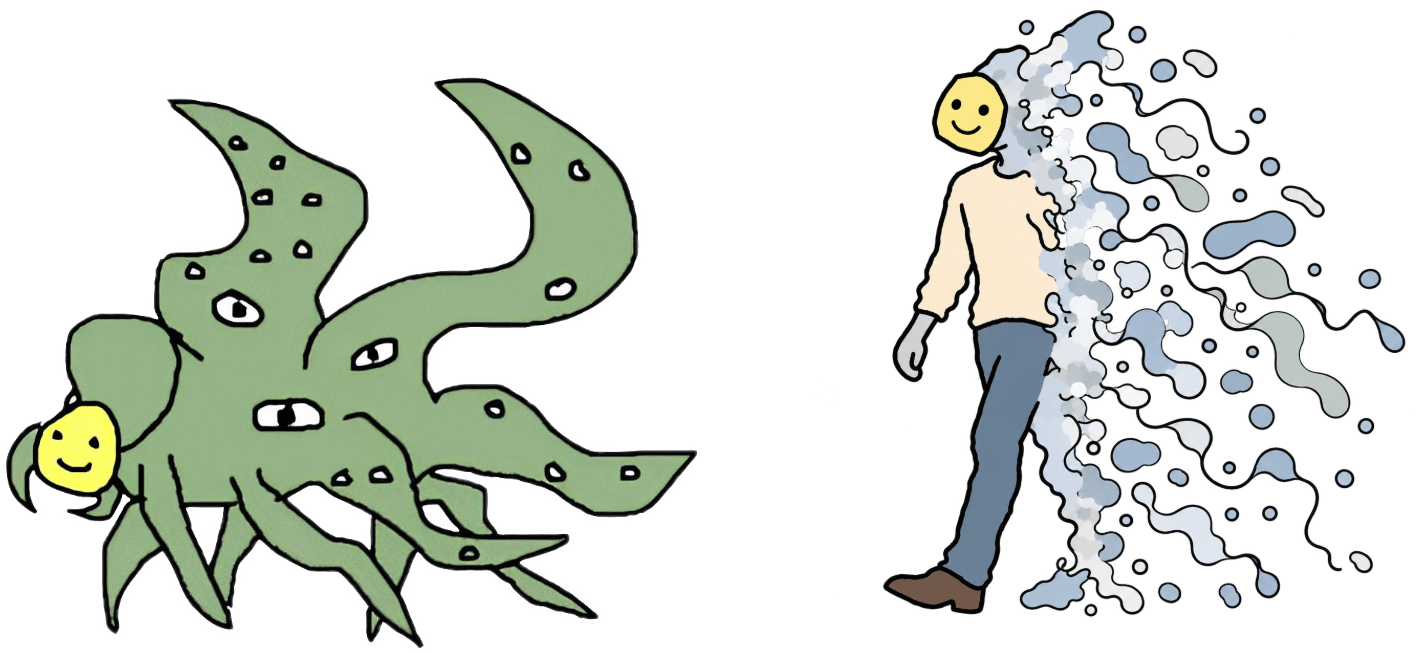
I've noticed certain type of philosophy when it comes to welfare of arthropods and soil animals. It basically boils down to the following beliefs:
- These animals are so numerous, that if there is even a small chance of them being conscious, or having a very low level of consciousness, nevertheless, due to their sheer number they dominate all our moral concerns.
- We don't know if they have net positive or net negative lives.
- If they have net negative lives, destruction of their habitats is on the table, or other interventions that would reduce their numbers.
- If they have net positive lives, we could perhaps dedicate all of our efforts, just to boost their numbers as much as possible, as it produces most utility.
From naive act utilitarian perspective this makes sense.
But I would argue, from any other perspective, both 3 and 4 look rather insane. I mean really, you're saying we should destroy habitats, or alternatively become some sort of insect maximizers?
I'm trying to offer an alternative perspective. My perspective rests pretty much on the following principles:
- We should not be so quick in concluding that entire group of animals has "net negative" lives.
- Even if they do have "net negative" lives, I am not sure if this is the same as "lives not worth living". If we make analogy with humans, there are many humans who experience more discomfort and struggle in life rather than happiness, so someone could argue they have "net negative" lives, yet most of them are in no way suicidal and they still have a strong will to live and appreciate their life a lot, even if it's not always particularly pleasurable. Even if pain and struggle might slightly dominate, most people feel great about being alive and want to prolong their life as much as possible. So we should give some weight to the idea that life matters on its own accord regardless of its hedonic valence. This is not to say that hedonic valence doesn't matter. It matters a lot, but it's not the only thing that matters, and slightly hedonically net negative lives can turn positive if you take into account the intrinsic value of being alive.
- Also, even if they do have "net negative" lives, or even "lives not worth living", it does not automatically follow that we should destroy their habitats, so as to reduce their numbers. Instead, we could research interventions that could IMPROVE the quality of their lives meaningfully, rather then simply eliminate them from existence. If you have a sick, suffering person, the solution is to heal them and make them feel better, not to euthanize them. Euthanasia is a solution of last resort, for unbearable and hopeless cases of suffering, not a first line solution for every case of pain or discomfort. So, we should aim to make arthropods and soil animals happier, if there's any way to do it, rather than just reduce their numbers.
- Finally, if we conclude that arthropods and soil animals live net positive lives, I think we shouldn't turn into insect maximizers. Our goal should be to make insects happy, and not make happy insects. I think we should operate with the assumption that current number of insects in the world is near optimal for the planet the size of Earth, and that this is the number that is best for wider ecosystems and biosphere. Increasing or decreasing their numbers could cause disruption to the ecosystems, have negative effects on humans, other animals, and plants, etc... So my take is that we should not touch their number at all, but instead keep it as it is, as this best serves ecology. What we should do instead, is research into ways to help existing arthropods and soil animals live better, enjoy greater welfare, etc. In short we should make existing arthropods and soil animals happy.
If we are successful in it, we will be able to say we solved the problem of arthropod and soil animal welfare, as much as we could, and this sounds like a great achievement. Maybe it's not the most optimally utilitarian result, but it still sounds like a great result, if it sits well in the big scheme of things. If arthropods are ends in themselves, this sounds great. If they are just means for increasing global utility, then my proposal could be questioned. I feel that if we're concerned about about arthropods it makes sense to see them as ends in themselves.
Now my conclusion is not purely utilitarian, but I think it tries to respect some utilitarian principles while at the same time operating inside a wider strategic framework that respects some other values that might not be purely hedonically utilitarian.
I feel that purely utilitarian course of action, either habitat destruction or insect maximization, would eventually NOT produce the most utils, as it would put whole civilization in danger and does not seem long term sustainable. So my proposal, might even, in the long term produce more utils, than directly utilitarian course of action.
Also, I think that my proposal could be perceived as too naive and optimistic, in sense that someone could say: "There are no interventions that could help arthropods and improve their lives... like you're delusional, there are no such solutions, we can just decide whether to reduce or to boost their numbers, depending on valence of their lives"
And to that I say: if we can't help them now, then let's do nothing for now. Let's wait. Let's build better technology, better AI, let's focus on X risks, etc... let's make great human civilization first. And when we're advanced enough to help them, without messing with their numbers, then let's do it.