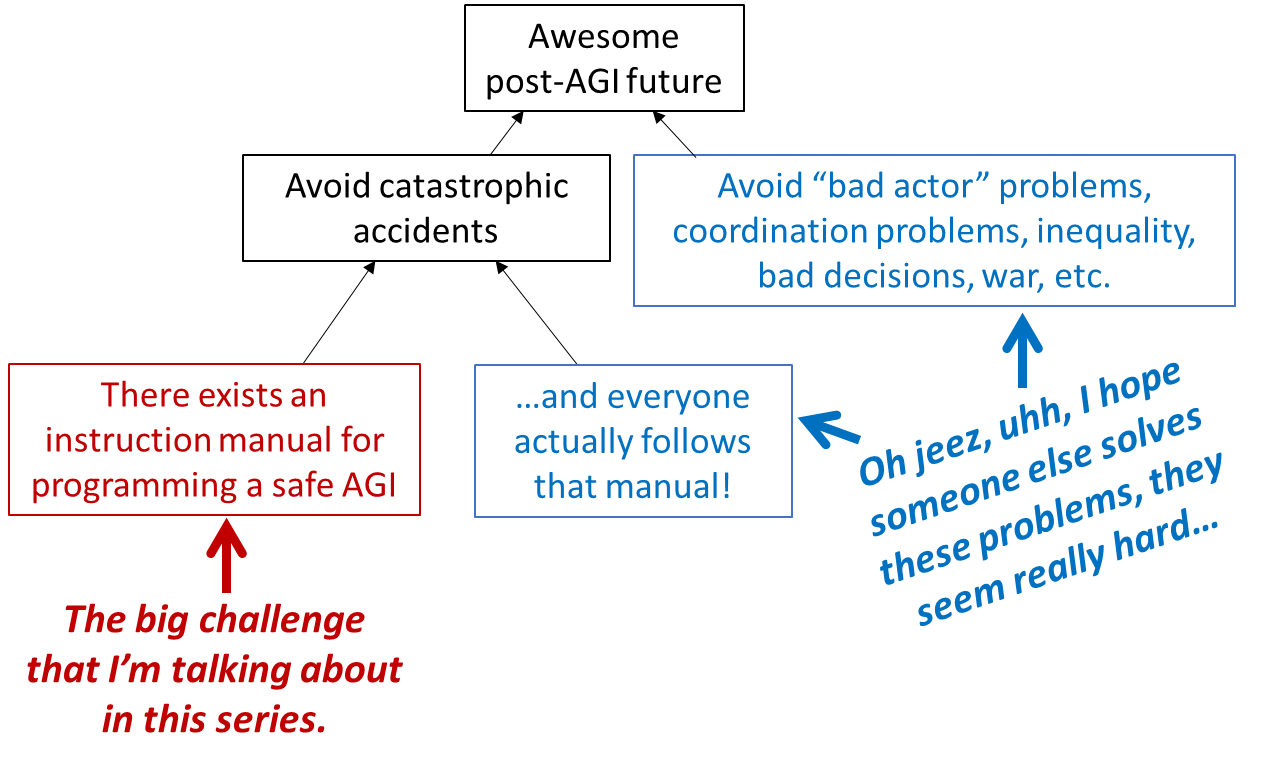
For those who aren't regular readers of alignmentforum or lesswrong, I’ve been writing a 15-part post series “Intro to Brain-Like-AGI Safety”. And the final post is now posted! 🥳🎉🎊
We know enough neuroscience to say concrete things about what “brain-like AGI” would look like (Posts #1–#9);
In particular, while “brain-like AGI” would be different from any known algorithm, its safety-relevant aspects would have much in common with actor-critic model-based reinforcement learning with a multi-dimensional value function (Posts #6, #8, #9);
“Understanding the brain well enough to make brain-like AGI” is a dramatically easier task than “understanding the brain” full stop—if the former is loosely analogous to knowing how to train a ConvNet, then the latter would be loosely analogous to knowing how to train a ConvNet, and achieving full mechanistic interpretability of the resulting trained model, and understanding every aspect of integrated circuit physics and engineering, etc. Indeed, making brain-like AGI should not be thought of as a far-off sci-fi hypothetical, but rather as an ongoing project which may well reach completion within the next decade or two (Posts #2–#3);
In the absence of a good technical plan for avoiding accidents, researchers experimenting with brain-like AGI algorithms will probably accidentally create out-of-control AGIs, with catastrophic consequences up to and including human extinction (Posts #1, #3, #10, #11);
Right now, we don’t have any good technical plan for avoiding out-of-control AGI accidents (Posts #10–#14);
Creating such a plan seems neither to be straightforward, nor to be a necessary step on the path to creating powerful brain-like AGIs—and therefore we shouldn’t assume that such a plan will be created in the future “by default” (Post #3);
There’s a lot of work that we can do right now to help make progress towards such a plan (Posts #12–#15).
General notes
The series has a total length comparable to a 300-page book. But I tried to make to easy to skim and skip around. In particular, every post starts with a summary and table of contents.
The last post lists seven open problems / projects that I think would help with brain-like-AGI safety. I’d be delighted to discuss these more and flesh them out with potential researchers, potential funders, people who think they’re stupid or counterproductive, etc.
General discussion is welcome here, or at the last post, or you can reach out to me by email. :-)
TL;DR
* GOAL 3 is a social enterprise that created IMPALA, a patient monitoring and digital platform system for low-resource settings. There is also a GOAL 3 foundation that raises funds to ensure underserved communities will be reached.
* A recently completed report from Rethink Priorities calculated IMPALA to have a cost per DALY averted of $7–17 in paediatr...
This month effective altruism has gotten lots of attention, including a cover story in The Economist. It feels pretty surreal to be on the receiving end of it. But I feel grateful these ideas have caught on, and even more grateful for the drive, earnestness, and compassion of so many people who took strange but well-argued ideas seriously and then actually acted on them....
Impressions from the 21st Annual U.S. Cluster Headache Patient Conference, organized by Clusterbusters.
On the morning of the last day of the conference, E. was hanging out with other “clusterheads” outside the conference hotel when he started having a cluster headache attack. Before he could go back to his hotel room, J. offered E. his DMT v...