What do you all think? Is this evolutionary, 'small steps' approach a robust way to handle the future, or am I missing a crucial piece of the puzzle?
Thank you very much for raising this question. If we consider that in conventional society, altruistic behavior seems extreme and very risky, then it is essential to consider social reality in a somewhat radical way... since the pretensions of objectivity and impartiality always lead to radical conclusions regarding the conventional wisdom of the time.
My suggestion—very briefly—has to do with what appears to be evidence of moral evolution, which seems to more or less coincide with the idea of the "Civilizing Process."
I always start with the simplest example: why did the oppressing class of the 19th century tolerate the gradual emancipation of the disadvantaged classes, as evidenced by the labor movement and the democratization of Western society in general? Why, on the other hand, did the oppressors of ancient Rome have no tolerance whatsoever for rebellious slaves, like Spartacus?
I can't find any explanation for this in the realm of politics, economics, or technology. The only explanation I can think of is that a moral evolution occurred among the oppressing classes. Is this proof that "moral evolution" exists?
And if it has existed and exists, why shouldn't it continue to exist in the future? If so, this should be the primary question: how to promote it.
Thank you for your reply. Maybe we understand the term 'evolution' not entirely in the same way. It seems that you take it as a similar term to progressivism, regarding that modern morals are definitely better than those brutal ones in ancient times. Although I agree with modern values as most modern people do, what I argue is that we need to be very caustious when considering 'promoting' those values.
Put simply, the reason is that moral values survive because they fit the current environment, but the environment may change at any time, anywhere. While we instinctly want to implement our own morals, we must be aware that the same morals may not survive in dissimilar environments. Meanwhile, we also have to adapt ourselves to new changes that are significant enough. So it is not easy to find a fixed moral system to promote.
However, it doesn't mean that we can do nothing. My proposal here is that if we lower our expectation, no longer pursuing something universally long-termly good, we may find it eaiser to practice something locally, mid-termly good. This may be a better strategy for us to finally achieve long-term goodness.
moral values survive because they fit the current environment, but the environment may change at any time, anywhere
Don't you think that the primary environmental determinant of moral evolution is prior moral evolution itself?
Social change cannot be advanced unless we extract some understandable guidelines for long-term human development. There is a linear moral evolution, it's evident, in the sense of controlling aggression and developing social strategies for effective cooperation. The first step must be to recognize this evidence, as is the case with Darwinian evolution or heliocentrism.
Short-term pragmatism will never be the long-term solution.
The fact that there is today an apolitical movement for social progress centered on individual commitment to a behavioral trait (altruism) can be interpreted as a milestone in moral evolution. What is missing is for that single behavioral trait ("effective" altruism) to be linked to a set of related behavioral traits (all of them consequences of controlling aggression) to give rise to a cultural alternative.
We are close, it seems to me, to achieving an "ideology of behavior," which would perhaps be the decisive step in the progress of civilization. To deny this possibility seems irrational and a consequence of the weight of prejudice.
If I understand correctly, your argument is that moral evolution is determined by specific environmental factors, and these factors can be generalized into some simple, linear rules by clear evidence as in natural science.
As I mentioned above, I'm afraid almost half of the book, the Essays on Longtermism, stands on the opposite side of this idea. Evidence discussed in this book seems suggesting that moral evolution is a dynamic process, not simply determined by specific environmental factors. Plus, although we may find some simple rules that are able to explain moral evolution, they are rarely possible to be as simple as linear progressivism.
I do agree with you that we need to avoid short-sightedness, only that we need to do this very carefully, reducing our long-term goals as little as possible. Therefore, we can focus our energy on those few but really imporatant goals more effectively. Hope this clarify my opinion.
How to act wisely in the long term if we rarely know what is right to do? — EA Forum
How to act wisely in the long term if we rarely know what is right to do?
A long-term goal widely held as beneficial to most people may end in disaster. This pattern reappears throughout human history, from the French Revolution to modern totalitarianism, as a fundamental challenge that any longtermist must confront.
The Essays on Longtermism discusses two major reasons for this phenomenon:
Methodology. We struggle to predict the outcomes of long-term interventions. [See Chapter 10, 11, 12, 15, 17, 19]
Values. We don't know precisely what will benefit the greatest number of people, or what serves ‘the greatest happiness of the greatest number’, particularly in the long run. [See Chapter 3, 5, 6, 7, 9, 14, 17, 19]
However, I would argue that practicing longtermism is not doomed to failure if we can find a way to navigate these two limitations.
Step 1: Polish our tools
Undoubtedly our ability to predict is flawed, but it is less imperfect in specific issues. For example, while it is hard to predict when the Ukraine War will end and who will finally win, it is more certain that the better-equipped side is more likely to prevail. The latter kind of prediction, a ‘causal forecast’, is more likely to be accurate than the former kind, a ‘state forecast’, if we understand the causal chain correctly. (Chapter 10)
Nevertheless, pursuing the causal chain is not the elixir for complicated issues, where one input can lead to very dissimilar outputs in different contexts, and the same result can be caused by very different factors. Furthermore, it cannot explain emergence: phenomena like democracy, populism, and polarization are not directly caused by intervention, they just silently emerge long before being widely observed.
To predict potential long-term tendencies such as these from their inception, an evolutionary perspective is inevitable.[1]
The fundamental argument of evolutionary theory is that only traits that are adaptive to environmental changes survive. Here the focus is no longer a static phenomenon, but how it adapts itself to the environment, a dynamic process that any longtermism design must be always involved in.[2]
Since the 1980s, this approach has been practiced in social sciences by the name of ‘cultural evolution’. It proposes a two-level stratification: distinguishing cultural traits from genetic traits, making it possible to analyze long-term behavior evolution beyond the age-old individual-based view. (Chapter 14)
Yet this stratification remains simplistic. Current research mainly focuses on cultural terms that already exist in primitive societies, such as marriage, religion, and hierarchy. Little attention is paid to modern phenomena, contributing little to solving real-world challenges.
This limitation is understandable. Our society is much bigger than primitive hunter-gathering groups, with much more diversities. But this does not mean that there is no way to solve the enigma. We can implement stratification further.
Take the case of mass democracy. Every long-term design considering this topic must answer one question: ‘How could democracy contribute to long-lasting thriving?’
First let us check how prestigious scholars respond to this question. Acemoglu and Robinson, two Nobel Prize winners, think liberal democracy ensures a balance between society and state (usually also a balance between the masses and the elite), thus creates a soil encouraging inclusive institutions. Furthermore, to achieve this balance, they suggest to mobilize the masses to make them threatening enough so that the elite have no choice but to hand over some of their power to them.
Their plausible theory actually contradicts what really happens in history. Mobilizing the masses to threaten usually leads to disasters, rather than thriving, as the English Civil War and the French Revolution prove repeatedly. The balance between society and state usually precedes liberal democracy and cannot be artificially created. Moreover, the quality of democracy is strongly determined by primary schooling and per capita income levels.[3] It is economic flourishing makes successful democracy possible, rather than the opposite.
Acemoglu and Robinson fail to explain this largely because of their methodological lack of stratification. They treat human behavior only on institutional level, refusing to take environmental factors, particularly geography and culture, into account.[4]
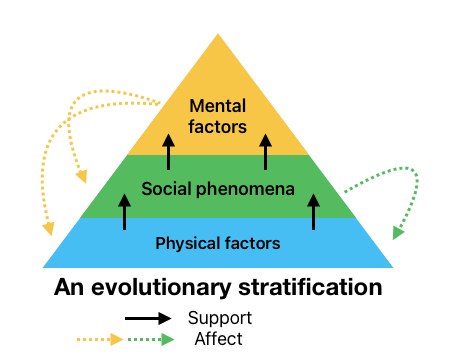
To avoid this defect, I suggest an advanced analytical framework—a three-level stratification—to understand social behavior more comprehensively:
As the diagram above shows, the stratification consists of three levels: physical, societal, and mental. Social phenomena that we are interested in always belong to the middle level. They always exist in specific physical conditions, like geography and genetics, or say they are supported by these physical factors. Meanwhile, social phenomena support mental activities like philosophy and literature. In short, lower levels support higher levels, while higher levels affect lower levels. Higher levels contain human activities that exert influence, while lower levels provide environments in which they exist.
Using this framework, we can deal with democracy crisis more systematically and accurately. As Jared Diamond and Eric Jones previously argued, geography plays a key role in shaping Western democracy.[5] Liberal democracy emerges from North America and West Europe largely due to their decentralized nature. And cultural background like Protestantism also contribute to this process in early centuries as Max Weber denotes.
Furthermore, it can not only explain past events, but also provide solutions and predictions in the long run. Given that this framework is an evolutionary tool, focusing on dynamic social process, we can also use it to analyze existing and potential crisis (like polarization). Even related physical and mental factors change significantly, this approach will still work.
Its advantage is so great that you may immediately wonder why we rarely see research regarding modern issues along this direction. The major difficulty is the extreme complexity of mental factors, particularly culture. Traditional research prefers essentialist categorization, attributing rigid traits to cultures, ignoring their own development. Post-modernism deconstructs this without providing more effective tools, turning over us to merely personal feelings to understand cultural diversity.
This challenge can be overcome. It is actually the subject of my current research and I would like to share more details of it in another post (maybe a series of posts if you are interested in). In this essay I would now turn to the second part, regarding values.
2. Set Priorities
Even if we can explain and predict almost correctly, deciding what to do first remains a problem, particularly on a long-term basis.
First, it is difficult to argue that any single issue will remain the top priority for everyone over long periods(Chapter 15). Second, from the evolutionary perspective, moral priorities change over time. Believing in any of them as the most valuable risks fundamental error (Chapter 9, 14, 17, 19). And the third, making the task more difficult, is that we are ourselves inevitably shortsighted (Chapter 17).
Based on these prerequisites, a minimal approach (Chapter 8, 18) is required. While increasing welfare may be hard to achieve consensus across society, it is much easier to persuade people to mitigate existential risks.
However, this is insufficient. When talking about risks such as climate change or nuclear weapon, many people remain skeptical. Not only do culture and personal world view play a role here, but peoples’ metacognition regarding specific issues also matters. [6]Beyond these personal factors are organizational ones. In different social structures people tend to conclude variously from the same evidence, even when they are well educated and rational.[7]
Due to these types of limitation, we need to reduce our priority list tremendously, choosing only those that can be least affected by personal and organizational bias.
To achieve this goal, two things should be considered. The first is that our priority list, even extremely reduced, will change from time to time. And therefore we have the second thing to do, to design an institution to cope with this plasticity.
Here I propose a strategy I call ‘the sway of a drunkard’. Imagine a drunkard, who tends to walk right or left. He can only roughly adjust his step and has a vague sense that the cliff is not far away. Nevertheless, he has no knowledge of where the cliff is. In this case, the best way for him to survive is to walk back and forth in small steps again and again until he gets sober.
To walk in small steps as a key rule is supported by chapter 9 and chapter 19 from two aspects: (1) We cannot authentically know what people in far-future want, so we should not decide for them. (2) Short-term benefits should not be excessively sacrificed in the name of long-term benefits, or the long-term design will not work.[8]
Beyond those insights, I would complement an evolutionary thought. If traits that we truly valued are what adapt to social environment most successfully, they could hardly be thought as good before related social changes happened. The crucial part is not their own goodness, but their ability to survive before desirable social changes happen. Therefore, the first priority is to avoid extinction. While human beings become increasingly powerful and destructive, taking each step in a small pace, with extreme caution, is a guarantee to minimize the risk of artificial catastrophe.
The most inspiring part of this approach is that although every step is small, something long-term wonderful may emerge unexpectedly. Preparing the soil for these potential miracles may be a much better choice than directly regulating personal behavior to cause them. One paragon of this is individualism, the foundation of modern society. It is not designed by church authorities[9], but emerges naturally in specific medieval contexts, from the periphery of Europe.[10]
Step 3: Keep Iterating
The overriding rule of any real evolutionary perspective is that things change over time and we need to adapt ourselves to these changes. So both analytic framework and priority-setting strategy always need to adapt themselves to new evidence and challenges. Keep iterating.
Conclusion
Briefly, this essay responds to two fundamental difficulties any longtermist must consider. The first is we cannot effectively predict, and the second is even we can predict accurately, we cannot persuade those with different values to wholeheartedly adopt our goals.
To ease those difficulties, I offer two proposals. One is to implement an evolutionary stratification to analyze human behavior more comprehensively and accurately, the other is to slow down, to minimize each step we take, enabling wonderful change emerge naturally in the long run.
—
What do you all think? Is this evolutionary, 'small steps' approach a robust way to handle the future, or am I missing a crucial piece of the puzzle? Looking forward to your response.
The word ‘evolutionary’ does come from Charles Darwin, but should not be confused with Herbert Spencer’s Social Darwinism, which actually contradicts Darwin’s theory. Darwin never proposed any public policy for people to become ‘survival of the fittest’, let alone to hurt other people for one’s own survival. Natural selection for him is always a process held by nature, not by human beings. And there is no universally fittest trait because any fittest trait in one context can be much less fit if the environment changes.
The origin of inequality is a paragon in this regard. Rousseau’s attributing it to private property is overwhelmingly influential but rarely convincing. His imagination that the consciousness of private property spread naturally after this idea first came into one’s mind is widely criticized as oversimplified. A 2021 article discusses this issue more convincingly by analyzing 89 indigenous hunter-gathering societies and finds that the inequality level of a society is strongly correlated to the dispersion mode of natural resources the society relies on. See Smith, Eric Alden, and Brian F. Codding. “Ecological Variation and Institutionalized Inequality in Hunter-Gatherer Societies.” Proceedings of the National Academy of Sciences of the United States of America 118, no. 13 (2021): e2016134118. https://doi.org/10.1073/pnas.2016134118.
Acemoglu, Daron, and James A. Robinson. Why Nations Fail: The Origins of Power, Prosperity and Poverty. Profile Books, 2012. Ibid. The Narrow Corridor: States, Societies, and the Fate of Liberty. Penguin, 2019.
Fischer, Helen, Stefan Herzog, Felix Rebitschek, Moritz Ketzer, and Nadine Fleischhut. “Metacognitive and Cultural Cognition Accounts Jointly Explain Believing, and Spreading of Contested Information.” Preprint, OSF, December 15, 2022. https://doi.org/10.31234/osf.io/2n75x.
Zollman, K. J. S. “The communication structure of epistemic communities” (2007). Philosophy of Science, 74.(5). “The epistemic benefit of transient diversity” (2010). Erkenntnis, 72(1).
Someone may question this strategy as relativist, but it is clearly not. Although the society should be able to change direction, every society member prioritizes things that they really feel important.
Henrich, Joseph. The Secret of Our Success: How Culture Is Driving Human Evolution, Domesticating Our Species, and Making Us Smarter. Princeton Univ Pr, 2015.
Note: This post was crossposted from the Coefficient Giving Farm Animal Welfare Research Newsletter by the Forum team, with the author's permission. The author may not see or respond to comments on this post.
Subtitle: On vegan advocacy, effective altruism, and FIFA
I turn 40 today. Here are some hot takes.
On factory farming
1. Our biggest challenge is salience. If factory farming led the evening news, it wouldn’t last lo...
Impressions from the 21st Annual U.S. Cluster Headache Patient Conference, organized by Clusterbusters.
On the morning of the last day of the conference, E. was hanging out with other “clusterheads” outside the conference hotel when he started having a cluster headache attack. Before he could go back to his hotel room, J. offered E. his DMT v...
TL;DR:
The movement has an evidence problem. To solve it, for each intervention we need to know:
* What types of evidence that intervention needs
* What types of evidence different sources can give us
In this post, we outline a framework for evidencing an intervention through five stages:
...


Thank you very much for raising this question. If we consider that in conventional society, altruistic behavior seems extreme and very risky, then it is essential to consider social reality in a somewhat radical way... since the pretensions of objectivity and impartiality always lead to radical conclusions regarding the conventional wisdom of the time.
My suggestion—very briefly—has to do with what appears to be evidence of moral evolution, which seems to more or less coincide with the idea of the "Civilizing Process."
I always start with the simplest example: why did the oppressing class of the 19th century tolerate the gradual emancipation of the disadvantaged classes, as evidenced by the labor movement and the democratization of Western society in general? Why, on the other hand, did the oppressors of ancient Rome have no tolerance whatsoever for rebellious slaves, like Spartacus?
I can't find any explanation for this in the realm of politics, economics, or technology. The only explanation I can think of is that a moral evolution occurred among the oppressing classes. Is this proof that "moral evolution" exists?
And if it has existed and exists, why shouldn't it continue to exist in the future? If so, this should be the primary question: how to promote it.
Thank you for your reply. Maybe we understand the term 'evolution' not entirely in the same way. It seems that you take it as a similar term to progressivism, regarding that modern morals are definitely better than those brutal ones in ancient times. Although I agree with modern values as most modern people do, what I argue is that we need to be very caustious when considering 'promoting' those values.
Put simply, the reason is that moral values survive because they fit the current environment, but the environment may change at any time, anywhere. While we instinctly want to implement our own morals, we must be aware that the same morals may not survive in dissimilar environments. Meanwhile, we also have to adapt ourselves to new changes that are significant enough. So it is not easy to find a fixed moral system to promote.
However, it doesn't mean that we can do nothing. My proposal here is that if we lower our expectation, no longer pursuing something universally long-termly good, we may find it eaiser to practice something locally, mid-termly good. This may be a better strategy for us to finally achieve long-term goodness.
Don't you think that the primary environmental determinant of moral evolution is prior moral evolution itself?
Social change cannot be advanced unless we extract some understandable guidelines for long-term human development. There is a linear moral evolution, it's evident, in the sense of controlling aggression and developing social strategies for effective cooperation. The first step must be to recognize this evidence, as is the case with Darwinian evolution or heliocentrism.
Short-term pragmatism will never be the long-term solution.
The fact that there is today an apolitical movement for social progress centered on individual commitment to a behavioral trait (altruism) can be interpreted as a milestone in moral evolution. What is missing is for that single behavioral trait ("effective" altruism) to be linked to a set of related behavioral traits (all of them consequences of controlling aggression) to give rise to a cultural alternative.
We are close, it seems to me, to achieving an "ideology of behavior," which would perhaps be the decisive step in the progress of civilization. To deny this possibility seems irrational and a consequence of the weight of prejudice.
If I understand correctly, your argument is that moral evolution is determined by specific environmental factors, and these factors can be generalized into some simple, linear rules by clear evidence as in natural science.
As I mentioned above, I'm afraid almost half of the book, the Essays on Longtermism, stands on the opposite side of this idea. Evidence discussed in this book seems suggesting that moral evolution is a dynamic process, not simply determined by specific environmental factors. Plus, although we may find some simple rules that are able to explain moral evolution, they are rarely possible to be as simple as linear progressivism.
I do agree with you that we need to avoid short-sightedness, only that we need to do this very carefully, reducing our long-term goals as little as possible. Therefore, we can focus our energy on those few but really imporatant goals more effectively. Hope this clarify my opinion.