Introduction
Animal welfare demands ethical consideration grounded in the prevention of suffering. At Crustacean Compassion we work in a difficult space, representing decapod crustaceans like crabs, lobsters, and shrimp. A group of species which is perhaps less considered simply because of its less “anthropomorphic attributes” and resultant species egalitarianism.
In challenging this mindset, one of our approaches (in promoting their welfare as sentient animals) is in holding that humane treatment cannot be reduced to a net zero framework where human interests are pitted competitively against the interests of animals. In other words, where one benefits, or can only benefit, at the expense of another.
Instead, we argue that both decapod and animal welfare broadly is fundamentally qualitative and morally imperative, incompatible with net zero concepts often applied to environmental or economic issues. Indeed, demonstrating that high welfare doesn’t just equate with human beneficence but leads human benefit.
Ethical and scientific foundations contra net zero thinking
The core ethical argument against net zero framing of animal welfare lies in the recognition that suffering is intrinsically bad and cannot be justified or cancelled out by other benefits.
Unlike quantifiable environmental impacts like greenhouse gas emissions, animal welfare concerns the subjective experiences of sentient beings (Eichner, 2025; van der Staay et al., 2025). Pain, distress, and deprivation are not mutually interchangeable and morally significant states that resist equivalence modelling. Barnhill (2022) discusses moral reasons why causing suffering or killing animals is impermissible, irrespective of any compensatory factors.
Decapod crustaceans exhibit physiological and behavioural indicators of pain and sentience—ethical guidelines and scientific assessments emphasise their need for protection (Crump et al., 2022; Birch et al., 2021). Welfare frameworks such as Fraser’s multidimensional model explicitly highlight that welfare dimensions like health, behaviour, and emotional state cannot compensate for each other, reinforcing the inadequacy of net zero approaches (van der Staay et al., 2025).
Following these principles Crustacean Compassion have integrated for example arguments for goals such as achieving net zero greenhouse gas emissions with the established principles of animal welfare. The organisation evidences that crustacean health (as wild animals and as a group of species treated humanely within a food producing industry) is demonstrably aligned to environmental health, climate change reversal strategies, food security and disease reduction, and ultimately human health.
This means that farm-level strategies (i.e. aquafarming practices, capture approaches, and processing policies) are lobbied for change. Addressing how the animals are utilised to minimise environmental impact whilst reducing waste and utilising by-product. It also means challenging the very food systems and using welfare to lead transformation. This approach, whilst perhaps somewhat controversial in a world of promoted alternate protein delivery, acknowledges that whilst consumer choice is important a shift in consumer expectation is important.
This is very much a One Health perspective and is an important education tool for public engagement where a species like decapod crustaceans are under-appreciated. It moves the dial and emphasises the links between human, animal, and environmental health to find solutions that benefit all three. It moves beyond a purely commercial model to include environmental and welfare impacts in decision-making.
Simple Examples
Research undertaken by Crustacean Compassion have highlighted how such arguments can be included into lobby and used to shift policy.
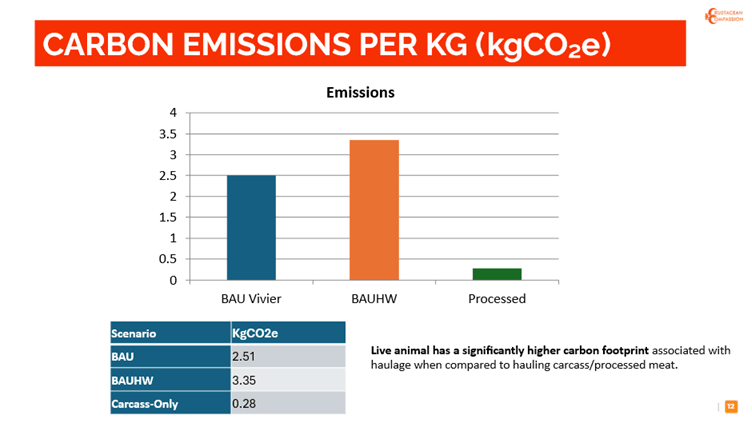
- Moving to a carcass only (high welfare) transport results in significant reduction in CO2 outputs comparing BAU (standard live transport) with BAUHW (live transport with a reduced stocking density supporting welfare), and processed or carcass only transport.
 [LP1]
[LP1]
- Moving to a carcass only (high welfare) transport results in reduced transport costs, profitability, local circular economy generation, and international market stability.
These simple examples demonstrating moving away from live transport to a humanely killed and early processed carcass supports many immediate areas as well as aligning with international legislations including for example the EU Green Deal (targeting climate neutrality by 2050) and the EU emissions trading scheme (ETS aiming to cover road fuels from 2027).
Differences from net zero environmental approaches
Net zero strategies focus on balancing measurable harms (e.g., carbon emissions) with mitigation or offsetting measures that neutralise the net impact in quantitative terms (Eichner, 2025). In contrast, welfare harms involve irreversible subjective experiences not amenable to offset or compensation. As noted in effective altruism literature, suffering caused by animal use cannot be undone by unrelated actions, unlike carbon emissions which theoretically can be neutralised by removals (Effective Altruism Forum, 2022).
Industrial animal agriculture's pursuit of "net zero" efficiencies often leads to intensified farming with compromised welfare, illustrating the risks of conflating welfare with net zero goals (Sustain Web, 2025). This approach can mask ongoing suffering under the guise of environmental responsibility.
Policy implications and recommendations
Crustacean Compassions main pillars of work are in three key areas – advocacy, industry engagement and education. To uphold humane treatment consistent with Crustacean Compassion’s mission, we then promote animal welfare policies which:
- Establish welfare as a non-negotiable baseline priority in legislation, prohibiting practices that cause unnecessary pain regardless of other benefits.
- Reject offsetting frameworks that justify harm to crustaceans on the grounds of achieving net zero balances.
- Promote the development and adoption of humane handling, stunning, and killing methods based on robust welfare science (Crump et al., 2022).
- Integrate welfare indicators that reflect qualitative wellbeing distinct from environmental or productivity metrics (van der Staay et al., 2025).
- Collectively demonstrate the symbiotic opportunities that high welfare has in improving One Health contributions.
Conclusion
Animal welfare is a fundamentally moral and experiential concern that cannot be subsumed under net zero frameworks.
Recognising the qualitative nature of suffering, particularly in sentient decapod crustaceans, mandates policies and practices that prevent harm outright and importantly build arguments which complement the expectation.
This approach aligns with scientific consensus on animal sentience and ethical imperatives to minimise suffering and importantly reinforces Crustacean Compassion’s mission and commitment to humane treatment beyond net zero thinking.
References
Birch, J., Crump, A., & Browning, H. (2021). Review of the Evidence of Sentience in Cephalopod Molluscs and Decapod Crustaceans. London School of Economics. https://www.lse.ac.uk/news/news-assets/pdfs/2021/sentience-in-cephalopod-molluscs-and-decapod-crustaceans-final-report.pdf
Barnhill, A. (2022). Moral reasons for individuals in high-income countries to reduce consumption of animal products: A philosophical analysis. Frontiers in Ethics, 6, Article 728. https://pmc.ncbi.nlm.nih.gov/articles/PMC9205278/
Crump, A., Browning, H., & Birch, J. (2022). Sentience in decapod crustaceans: A general framework for evaluating scientific evidence. Animal Sentience, 7(32), 1. https://www.wellbeingintlstudiesrepository.org/cgi/viewcontent.cgi?article=1691&context=animsent
Eichner, A. (2025). Animal welfare, moral consumers and the optimal net zero climate strategy. Climate Ethics Review, 14(3), 221-234. https://www.sciencedirect.com/science/article/pii/S0921800924003318
Effective Altruism Forum. (2022). The role of individual consumption decisions in animal welfare. https://forum.effectivealtruism.org/posts/HWpwfTF5M84jo4iyo/the-role-of-individual-consumption-decisions-in-animal
Sustain Web. (2025). Factory farms: could new net zero advice lead to their intensification? https://www.sustainweb.org/blogs/feb25-net-zero-climate-change-committee-livestock-farming/
van der Staay, F. J., Schmitt, K., & Mendl, M. (2025). Animal welfare definitions, frameworks, and assessment tools. Frontiers in Animal Science, 6, Article 1121. https://pmc.ncbi.nlm.nih.gov/articles/PMC12075010/
[LP1]This might need some explaining re BAU BAUHW etc that haven’t been introduced yet. Or use figures in the 2 bullet points to explain.