In the latest edition of my Tactics In Practice (TIPs) series, I analyzed the research behind protest in the animal protest movement! The full resource is well worth reading for any activist who uses street demonstrations — check out the full thing here: Tactics In Practice: The Science Of Protests And Demonstrations.
Key Highlights:
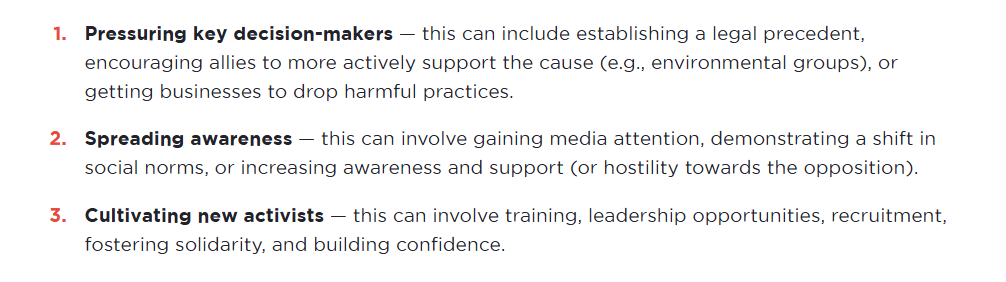
Protest groups tend to have three main goals, shown below. I wasn't able to find empirical evidence on Goal 3 (positive or negative), but anecdotal conversations lead me to believe that protests can serve as good cultivation tools for other activists. But I was able to find more information on the other two goals.
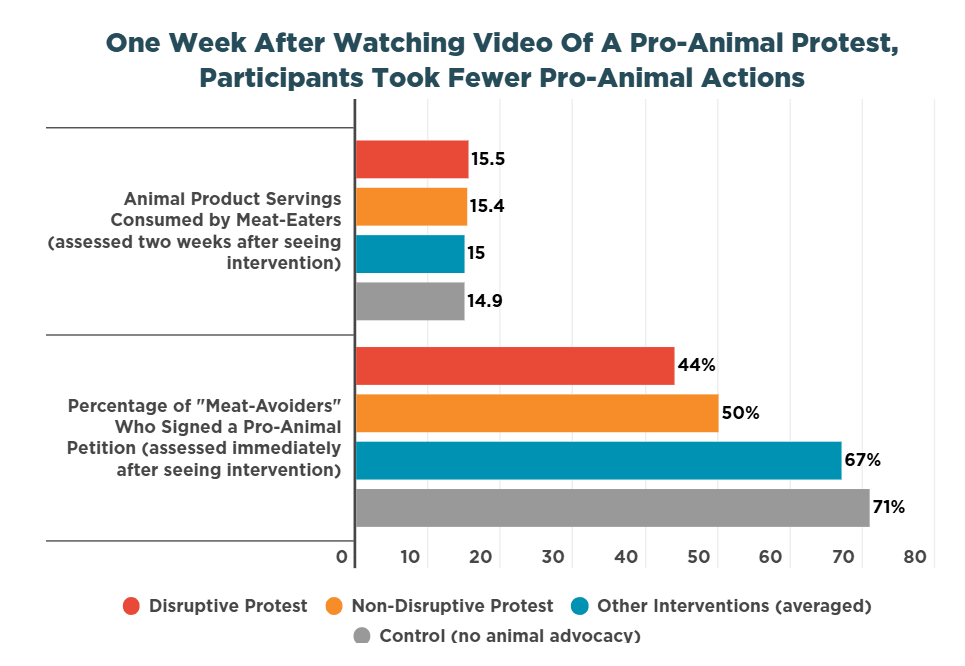
Protests can’t change people’s diets; we need to pursue other targets. (That doesn't mean protest is a bad tactic! Just that it's ineffective if we apply it to the wrong target)
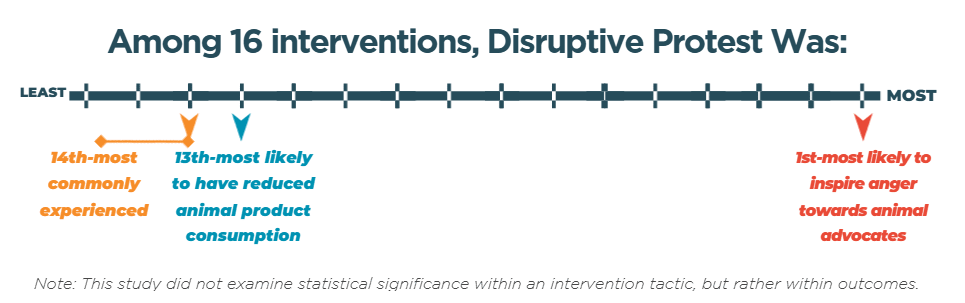
All protest has some form of backlash — this backlash is among the highest of animal advocacy interventions, if not the highest. While research shows this backlash fades over time, activists need to think critically about how to work with it. Either take steps to reduce the backlash (through media plans, carefully chosen tactics, etc.), or as part of a larger strategy. Which brings us to:
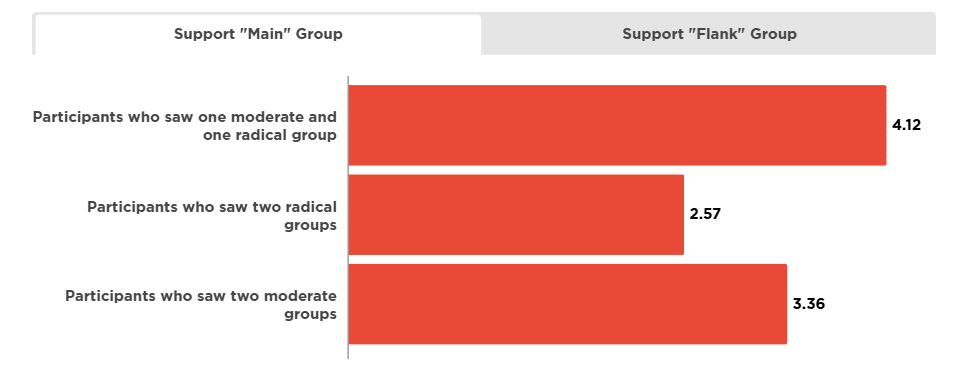
We need to think more critically about the “radical flank effect” (sometimes called “good cop, bad cop”) — if one protest group is perceived as more radical, a more moderate group will be more accepted. However, this requires careful strategy and coordination. I personally believe that groups involved in protest should consider which role they play in the broader ecosystem: are they radical? Moderate? And how will different groups engage with the key decision-makers?
Protest impact depends on the media in both the short-term and long-term, so protest groups need a media outreach plan.
Protestors need to think very carefully about the salience of their protest — where, when, and why is this protest taking place? Can activists carefully choose a cause more likely to garner media attention (something more specific than “animal rights”)?
Groups need to pick the goals of the protest carefully. As mentioned above, "go vegan" is unlikely to have much impact. This requires understanding opinion polling on a topic as well as the likelihood of specific stakeholders to create positive change.
Disclaimer: This blog post focuses on a new piece of research from Rethink Priorities. I was not involved with the funding or execution of this research, and therefore write this piece merely as a consumer. However, I am the Executive Director of Giving Green and a board member of Rethink Priorities, and acknowledge that these affiliations may bias my...
I am writing up two charity ideas I’ve wanted to investigate, but haven’t been able to, in the hopes someone will investigate them further. If you end up investigating either, I'd be most interested to see what conclusions you come to!
Vulture preservation as a global health intervention
Since the mid 1990's the vulture population in India has been rapidly declining. The reason is due to a few chemicals which are fed to livestock, which is highly poisonous to vultures.
...
Summary
1. With new funding potentially entering the effective altruism ecosystem, we wanted to estimate how much more the wild animal welfare (WAW) movement could productively absorb. We asked organizations with a public, dedicated WAW workstream to estimate their own room for more funding (RFMF). Although this does not capture the whole movement, we believe it captures a substantive fraction of it.
2. Summed across the five organizations that took part, the estimates point to...