Comments
Crosspost, and mostly written for non-EAs.
An obvious ethical principle: you shouldn’t hurt others a lot for benefits to yourself that are small in comparison. You shouldn’t pull a dog’s tail for your own amusement or set a cat on fire to release a pleasant smell. If this is correct, then standard consumption of animal products is immoral, because most animals we eat suffered greatly, for a long time, per morsel of meat made from their flesh or secretions.
The conditions farm animals undergo in life are so cruel that I literally cannot name every indignity they suffer. But a few methods of particularly common mistreatment include:
- Caging: They are kept in small cages where they have to stand on painful metal all day.
- Confinement: They have almost no space—chickens have about as much space as a sheet of paper. They can express none of their natural behaviors.
- Squalor: They must live in filth and feces, inhaling acidic ammonia all day. When people go into factory farms, they often describe it as the worst smelling place they have ever encountered.
- Wounds: These nasty conditions combined with violence from other animals (triggered by the aforementioned conditions) mean that animals often have festering open wounds. Pigs bite at the tails of those in front of them—hens savagely peck at each other, causing serious wounds. Most chickens have burns on their legs from lying in feces all day.
- Selective breeding: Egg-laying hens on average break bones three times, because their bones are brittle from excessive laying. Chickens sold for meat are so large that only about 3% can walk properly, and they spend most of their time lying down against the acidic feces that burns them. Selective breeding to increase dairy production has left dairy cows’ udders so bloated that they struggle to walk.
- Disease: Injuries, unsanitary conditions, and close quarters lead to very high prevalence of disease. Fish often have big chunks of their flesh eaten through by flesh-eating parasites. Between 19% and 74% of pigs have respiratory issues. 89% of egg-laying hens develop osteoporosis.
- Mutilation: Pigs have their tails cut off and are castrated; chickens have their beaks sliced off with a knife; lambs have a rubber band tied around their testicles until their testicles die. Beef cows are also dehorned and disbudded with a hot iron of around 750 degrees, many times hotter than standard ovens.
- Separation: Parents are separated from offspring, which is very distressing for all involved parties.
- Transport: Animals are transported for a long time in stressful conditions without food or water on their way to slaughter. This is very dangerous—it kills 15% of broiler chickens and 25% of hens.
- Slaughter: Slaughter is often painful. Many are gassed to death. Others have their throats cut.
The average meat eater eats about 2,400 chickens and 4,500 fish in their lives.1 Each meal of meat that you eat will cause animals to suffer for a long time. Thousands of extra animals will suffer because of you. You’d be jailed for animal abuse if you treated a dog the way most farmed animals are treated. If it would be profoundly evil to treat one dog that way, how much more evil is it to treat thousands of other animals that way? If the average meat eater both went vegan and began torturing dogs regularly, total animal suffering would be reduced.
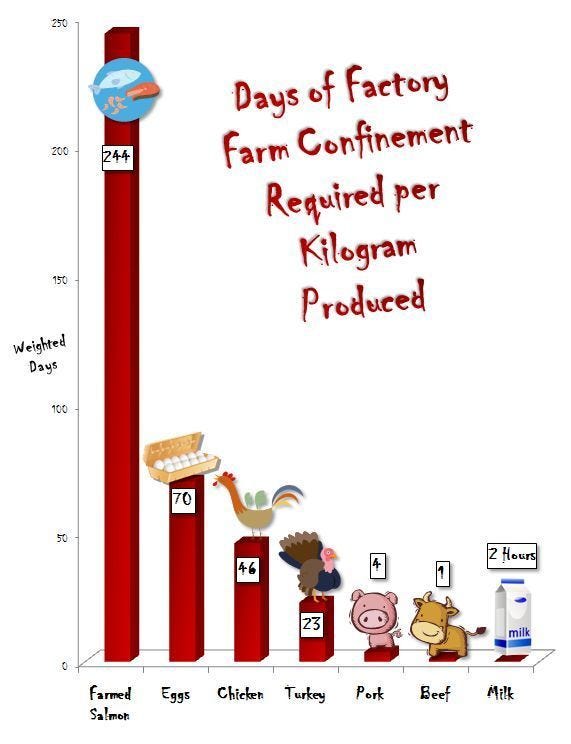
Is this bad? Yes. It’s bad to be in pain because of how pain feels, not how smart you are. Animals, though not smart, and not our species, can still feel pain, so they matter morally. This is why it’s bad when dogs are tortured. Imagine having your bones broken, being locked in a cage, and being unable to turn around for months because someone wanted to eat your corpse. This would be bad even if you weren’t human, couldn’t talk, and were only as smart as a human toddler.
Just take a moment to think about this. If you eat meat in the normal way, thousands of extra sentient beings will be tortured because of you. Doesn’t this seem wrong? Is meat really worth this? Could you look those animals in the eye and feel good about consigning them to torture so that you can eat their flesh? How do you condemn evildoers for their wrong acts, if you consign others to torture daily for comparatively trivial pleasure?
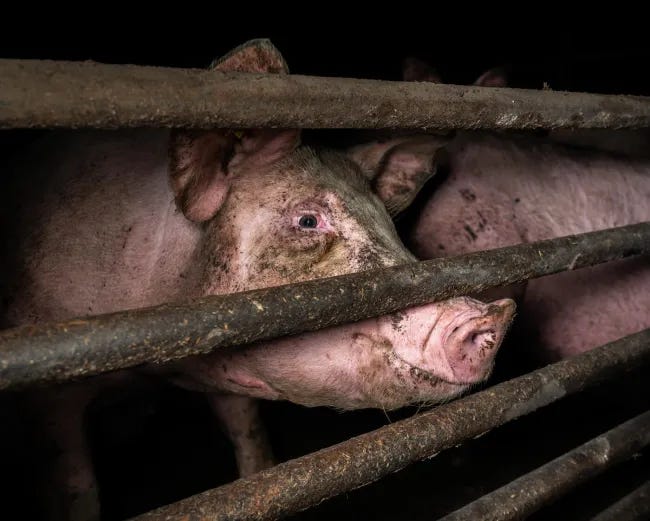
Look her in the eyes, and tell me this is justified.
If you’re a Christian: would Jesus approve of this? If you’re a Muslim or Jew, would God? If you’re a secular humanist: what could this be other than the deepest betrayal of humanist values—of compassion and decency and care for the vulnerable. If you’re a human, what could this be other than the blackest, most rotten, deepest betrayal of your own humanity? The sensible reaction to these ghastly torture chambers is incandescent rage and a tireless desire to extirpate them from Earth, not funding them to continue their ghastly operations.
Now you might wonder: do meat eaters really cause this torture by eating extra meat? Yes. Because the total amount of meat consumed must add up to the total amount produced, on average, one extra unit of consumption will trigger one extra unit of production.
It’s a bit more complicated than this though—there are thresholds, so that each time (say) 900 extra animals are consumed, an extra 900 are produced. Sometimes, then, when you consume meat, you’ll have no effect, but other times you’ll have a huge effect. Our best empirical evidence indicates that the average meat eater will trigger these huge thresholds multiple times in their lives, meaning that if you eat meat, probably thousands of extra animals will be tortured because of you.
I can think of a few reasons you might doubt the central vegan argument that you shouldn’t hurt others a lot for comparatively small personal benefit. First, you might think that you can’t be healthy on a vegan diet. But this isn’t right according to the largest group of nutritionists in the world. In fact, our best evidence indicates that a vegan diet is good for your health, reducing the risk of many diseases.2 It’s also a bit hard to take this seriously coming from most people who don’t otherwise do much to improve their health. If you can’t be bothered to exercise regularly for your health, then you don’t have justification to torture the innocent for a much smaller, more uncertain, and likely negative health effect.
Second, you might think it’s okay to eat humane meat. Maybe eating factory farmed meat is wrong, but what’s wrong with eating humane meat? I see four basic things.
It’s genuinely difficult to know if the meat you’re eating is humane. When animals are treated as livestock, farmers have every incentive to mistreat them. Over and over again, supposedly humane farms have been outed as places of incredible cruelty—in some cases, workers hammered live animals to death. Many of the labels that supposedly indicate the farm is humane mean little. Of the people who say they only eat humane meat, almost none of them really do—almost all eat from factory farms.
There was a brief period before I went vegan when I was trying to only eat humane meat, and yet on multiple occasions I ended up getting factory farmed meat by accident. So while it’s easy to say that you only eat humane meat, it’s hard to do. It also means avoiding the vast majority of animal products—never ordering meat from a restaurant or from a supplier you haven’t investigated in detail. You shouldn’t trust yourself to be this careful consistently when almost no one is.
- Even if you trust yourself to do this, your diet can impact others. I’ve convinced a lot of people to go vegan over the years. Odds are decent you can influence people. If people are convinced to only eat humane meat, odds are good that they’ll keep eating factory farmed meat. So the diet you should adopt is the one that you’d most want to convince others to adopt. But convincing others to buy humane meat still means that they’ll regularly facilitate torture, so that shouldn’t be your diet.
- If we want a future that treats animals well, we’ll want one that takes their interests seriously. But it’s harder to do that if you’re eating them. Empirically, we know that eating meat causes people to care less about animals. A vegan world is thus the best vehicle for humane treatment of all sentient life.
- Lastly, eating meat is seriously morally risky. There’s some chance that eating meat hugely violates the rights of animals. Just imagine if you were doing the same to humans: breeding them into existence, giving them a good life, and then killing and eating them. On standard views, that would be incredibly wrong—and it’s at least highly non-obvious whether eating meat is wrong for similar reasons.
The most important thing: if you’re planning to eat “humane” meat, actually do it. Don’t just say you’ll do it when arguing with vegans and then forget about it five minutes later. While I’ve met many different people who say that they only eat humane meat, I know of only two people who actually take this commitment at all seriously.
A last thing to note: you shouldn’t just change your diet. You shouldn’t just not facilitate torture. If you can prevent lots of torture without much cost, you should do that too. It turns out you can—the best animal charities spare animals from about 10 years in a cage per dollar they raise. If you give $100 a month, then you can prevent 1,000 extra years of torture every month. By pressing a button, you can help fight back hell.
That is my basic pitch for veganism. There are a bunch of ridiculous objections that people have to veganism, like that lions eat meat. I won’t insult your intelligence by addressing them at length, though I’ve comprehensively addressed them before. I will merely submit that none of them seem to provide much justification for causing the torture of the innocent for your own pleasure, and that if you think you have an argument for such a conclusion, then something has gone badly wrong in your thinking.
(If you could like, restack, and share this article, I’d hugely appreciate it, because I think it’s important. Also, if anyone sets up a $30 recurring monthly donation to effective animal charities, they get a free subscription to the blog. Lastly, call your senators and tell them to vote no on the farm bill that would destroy most state animal welfare laws).
25



There are a few things missing from this argument, that I think are important to add:
1. Even on "humane" farms, most animals will only live a few months. It takes some clever twisting of logic to say that bringing someone into existence only to kill them a few months later isn't wrong.
2. Even on the ideal free range farm, animals don't live as well as they could. E.g. where I grew up, there are free range sheep. But they are still treated roughly by the farmers, they still die out on the fields if they get sick or too cold. Why settle for humane when we could actually care for animals the way we do for our pets?
3. Donating is great, but political action is also essential if we ever hope to achieve fundamental change for animals. Join protests, sign petitions, write to your representatives and vote for politicians who promise to fight for animals.