Comments
This is a summary of an extract from our grant renewal application for CEA's Community Building Grants programme
2025 was a solid year for EA Netherlands. Completions of our in-house introductory course grew 140% (36 → 87); EAGx attendance grew 36% (380 → 517) and set an all-time EAGx record for GWWC pledges (57 pledges, ~$2.9M lifetime giving, $436,000 when counterfactually adjusted); and we commissioned the first independent qualitative impact evaluation in the national EA organisation space. We also learned some things that didn't work. In 2026, we're shifting focus toward strengthening our in-person offering — building the room before we fill it.
EA Netherlands is the national EA community-building organisation for the Netherlands. We're a two-person team (Marieke and James), supported by contractors, interns, and volunteers. We support ~750 actively involved community members, ~16 local groups, and a co-working space in Amsterdam.
Survey data suggests the Netherlands is the fourth-largest national EA community globally (5.8% of EA Survey respondents), and Amsterdam is the largest hub city outside the UK/US. The community is notably older and more gender-balanced than the global average — largely working professionals, with a median age of 32.
Our theory of change has stayed much the same since 2023, and is described in some detail on the EA Forum here.
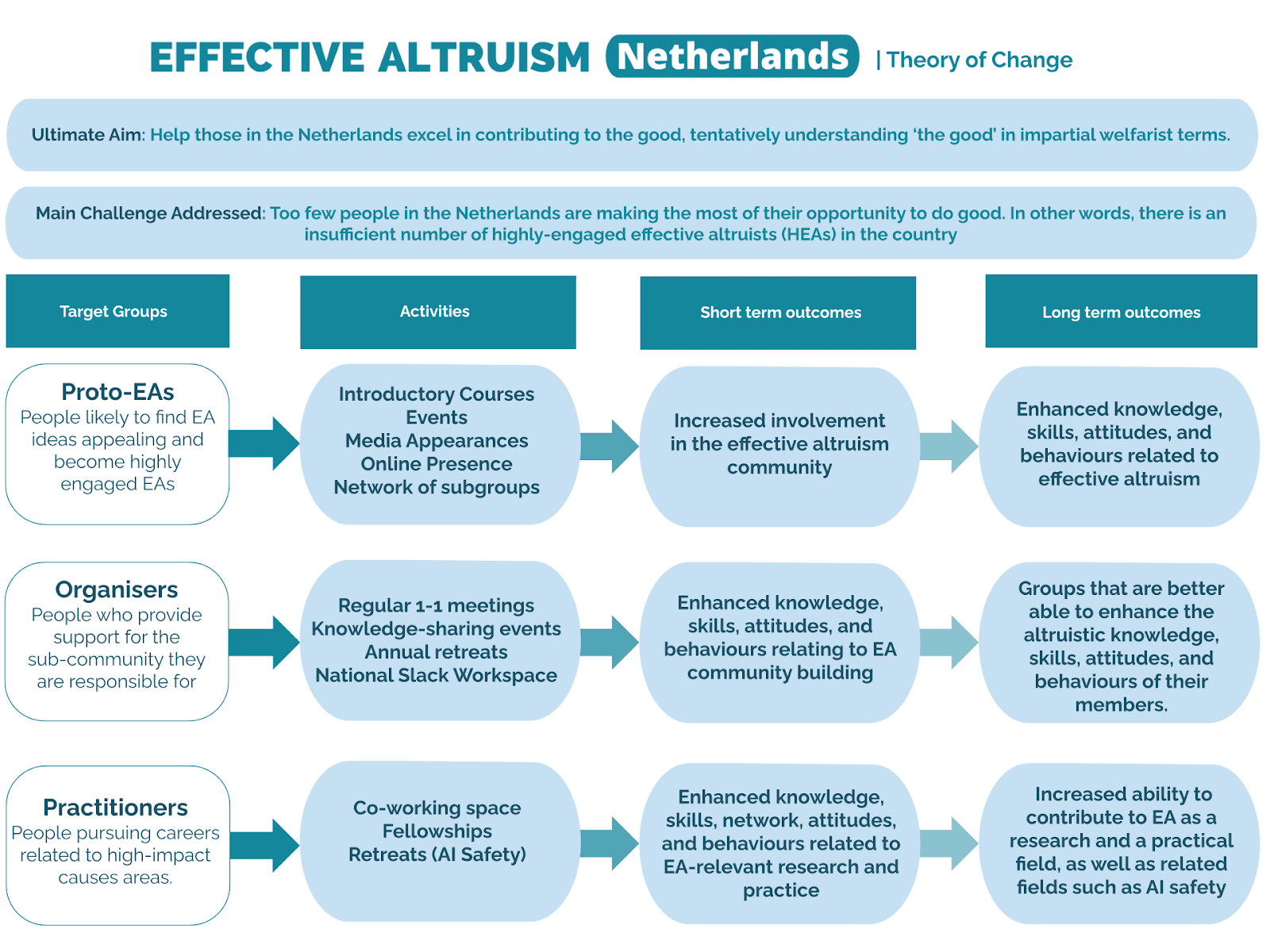
Although there have been some changes, we still organise our work around three target groups:
In the past year or so, we’ve started working more with the concept of ‘community capital’: the sum of individual career capital multiplied by the community's coordination ability.
On the career capital side, we operate a pipeline that moves people from initial awareness through to sustained engagement. Our introductory course is the primary on-ramp, supported by marketing (including paid advertising) and wide bridge events that reach audiences beyond existing EA networks.
On the coordination side, we invest in community infrastructure: the Amsterdam co-working space, organiser support, limited in-person programming, and an EAGx conference every ~18 months.
Our 2025 strategy was to focus on top-of-funnel growth while improving our monitoring and evaluation. The diagnosis was straightforward: EAN's core programming was working well for people who found us, but we were reaching far too few people relative to the addressable audience. We set three objectives, framed as stretch targets where achieving 60–70% would represent a strong result:
Objective 1: Improve conversion rates in the introductory programme funnel to achieve 100 completions. Key results focused on increasing website traffic, improving conversion at each stage of the funnel (website → intro course page → application → participation), and conducting an awareness baseline study.
Objective 2: Expand reach and impact of wide bridge events. Target: 4 events (up from 1 in 2024), average attendance of 15+, with at least 25% of attendees new to EA.
Objective 3: Conduct an independent impact evaluation. Commission external research to evaluate EAN's influence on career, donation, and organising outcomes, and publish the findings.
Additionally, EAGxAmsterdam 2025 was a major organisational commitment, though not a formal OKR.
This was our biggest growth story. We tripled applications (from ~93 in all of 2024 to ~100 per quarter in 2025) and grew completions 140%, from 36 to 87. The stretch target was 100; against the 60–70% framework, 87 was a strong result.
The driver was a significant investment in marketing. We brought on a paid social media agency (Amplify) for performance marketing and a content agency (Not So Creative) for brand marketing, alongside a rebuilt website. Instagram went from effectively 0% of applications in early 2024 to 57–73% by mid-2025 — the single biggest shift in our acquisition data.
Who we're now reaching. The share of complete EA newcomers — people who'd heard of EA but never engaged with the content — rose from 41% to 64%. We're reaching genuinely new people, not recycling existing networks. Participant quality held steady: 54% hold a master's degree, satisfaction remained at 9/10, and the cohort shifted toward mid-career professionals, consistent with our targeting.
Interestingly, the psychographic data from our application form tells a more nuanced story than "less engaged = less aligned." Pre-course values-alignment scores actually increased as Instagram-sourced applicants came in: the expansive altruism subscale rose from 5.44 to 5.96, and effectiveness focus from 5.11 to 5.68. We appear to be finding people who were already values-aligned but hadn't encountered EA as a framework — proto-EAs waiting to be reached.
Why this might matter for counterfactual impact. In earlier cohorts, many participants had already spent 50+ hours engaging with EA content before signing up. They were more likely to find their way into the community eventually. The current cohort is different: genuinely new to EA, but with the right psychological profile. And the behaviour change data is trending in the right direction — the proportion reporting significant increases in effective donation has risen steadily from 53% (2023) to 75% (Jan 2026), career impact intentions hit 80%, and confidence in one's ability to make a positive impact climbed from 63% to 85%. If anything, the course appears to be producing stronger reported behaviour changes among a less pre-engaged audience. The counterfactual participant — someone who wouldn't have found EA without our marketing — is arguably more significant than the one who was already deep in EA content.
Honest tensions. Scaling a free course through paid advertising brings predictable trade-offs. NPS declined from +62 (2024 average) to +46 (2025) to +38 (January 2026) — still positive, but the downward trend is worth watching. Maintaining attendance quality at larger cohort sizes has been a challenge: the best 2024 cohorts achieved 70%+ strong attendance with near-zero dropout, while larger 2025 cohorts have been more variable. We also missed our 100-completion target.
A quick note on what we mean by "wide bridge." The concept draws on Damon Centola's work on social change and network theory. Centola's research suggests that complex behaviour change — adopting new beliefs, norms, or practices — spreads not through weak ties (as information does) but through redundant ties: multiple reinforcing connections within overlapping social clusters. A "wide bridge" is a connection between two communities that has enough redundancy for complex ideas and behaviours to cross over, not just awareness. In practice, this means designing events that create multiple points of contact between EA and adjacent professional communities, so that EA ideas can actually take root rather than being heard once and forgotten.
We ran six wide bridge events in 2025, up from one in 2024 — hitting the volume target from Objective 2. But we should be honest: only one event genuinely functioned as wide bridge outreach.
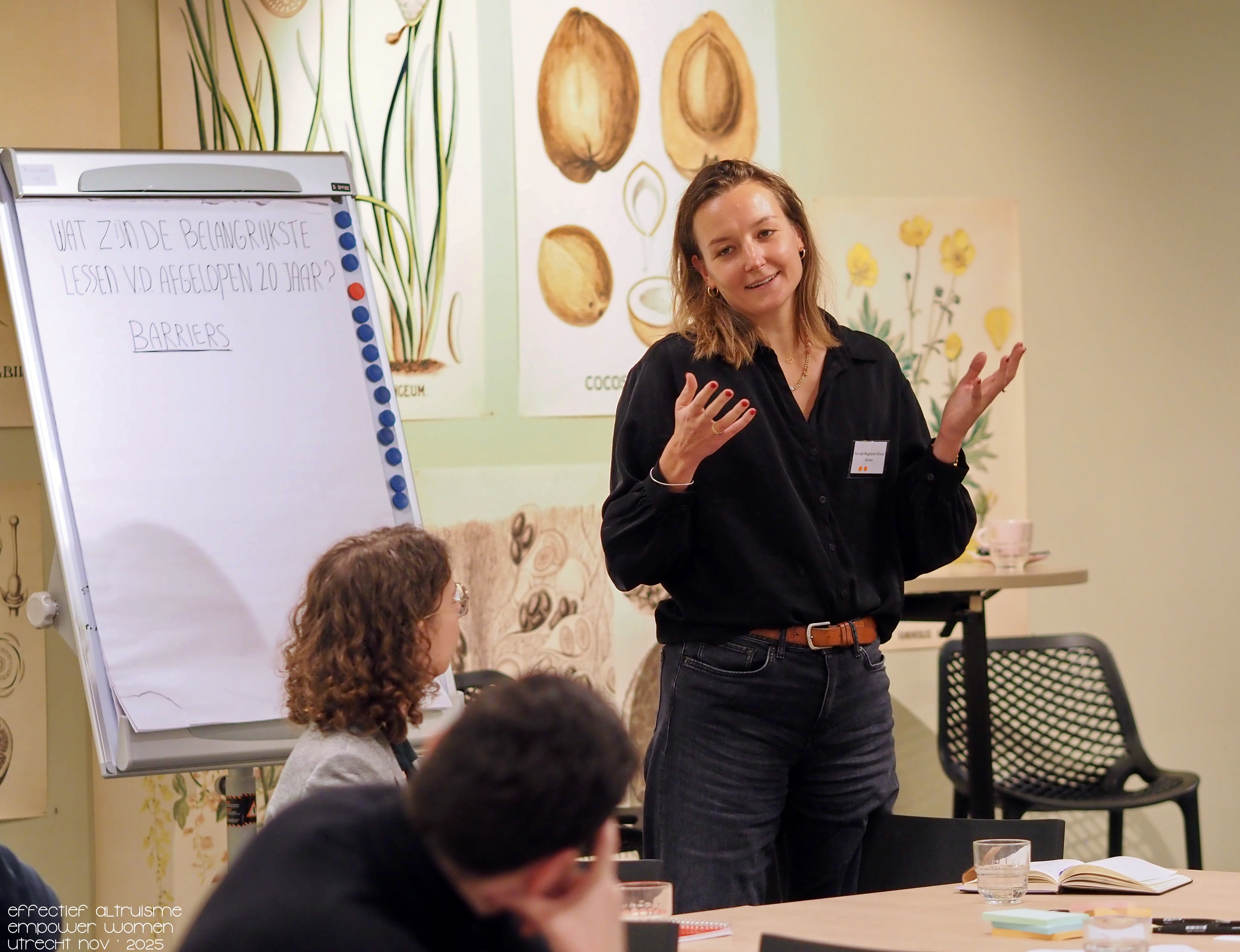
The Women's Empowerment Event (26 attendees, 54% new to EA) was a clear success. It was co-hosted with impact-focused partner organisations working in global health and women's economic empowerment, featured roundtable discussions and a keynote, and created exactly the kind of redundant ties Centola's work predicts would matter — multiple touchpoints between EA community members and professionals from adjacent impact-focused networks. At least one partner organisation received over €100k in funding through connections made at the event.
The AI Safety Co-Working Days (44 total attendees across three sessions) generated strong interest and highly positive feedback, but reached very few new people (9% new to EA). Their primary value was improving coordination within the existing Dutch AI safety community — valuable, but not wide bridge. The Researchers' Unconference and Impact Fair had limited outreach value.
We now have a much clearer picture of what makes a wide bridge event actually work: professional audiences with a specific shared identity, high-quality speakers, structured networking, and — crucially — partnership with organisations that bring their own networks to the table, creating the redundancy needed for ideas to cross community boundaries.
On the advice of an M&E expert familiar with EA community building and the work of EA Netherlands, we commissioned Bath Social & Development Research to conduct a QuIP (Qualitative Impact Protocol) study — 24 blindfolded in-depth interviews with people who'd engaged with EAN over the past 3–4 years. In a QuIP study, researchers interview beneficiaries without knowing the specific intervention being evaluated, and without prompting the participants about specific interventions they might have experienced, which reduces confirmation bias and surfaces what people actually remember and credit as influential. This is, to our knowledge, the first independent qualitative impact evaluation conducted on a national EA community-building organisation.
Key findings:
The study also surfaced honest challenges: tension between "small tent" and "big tent" approaches, anxiety about career market saturation in EA cause areas, and a "moral burden" associated with EA's high expectations. We're taking these seriously.
Bath SDR have invited us to co-submit a proposal to the European Evaluation Society to present these findings.
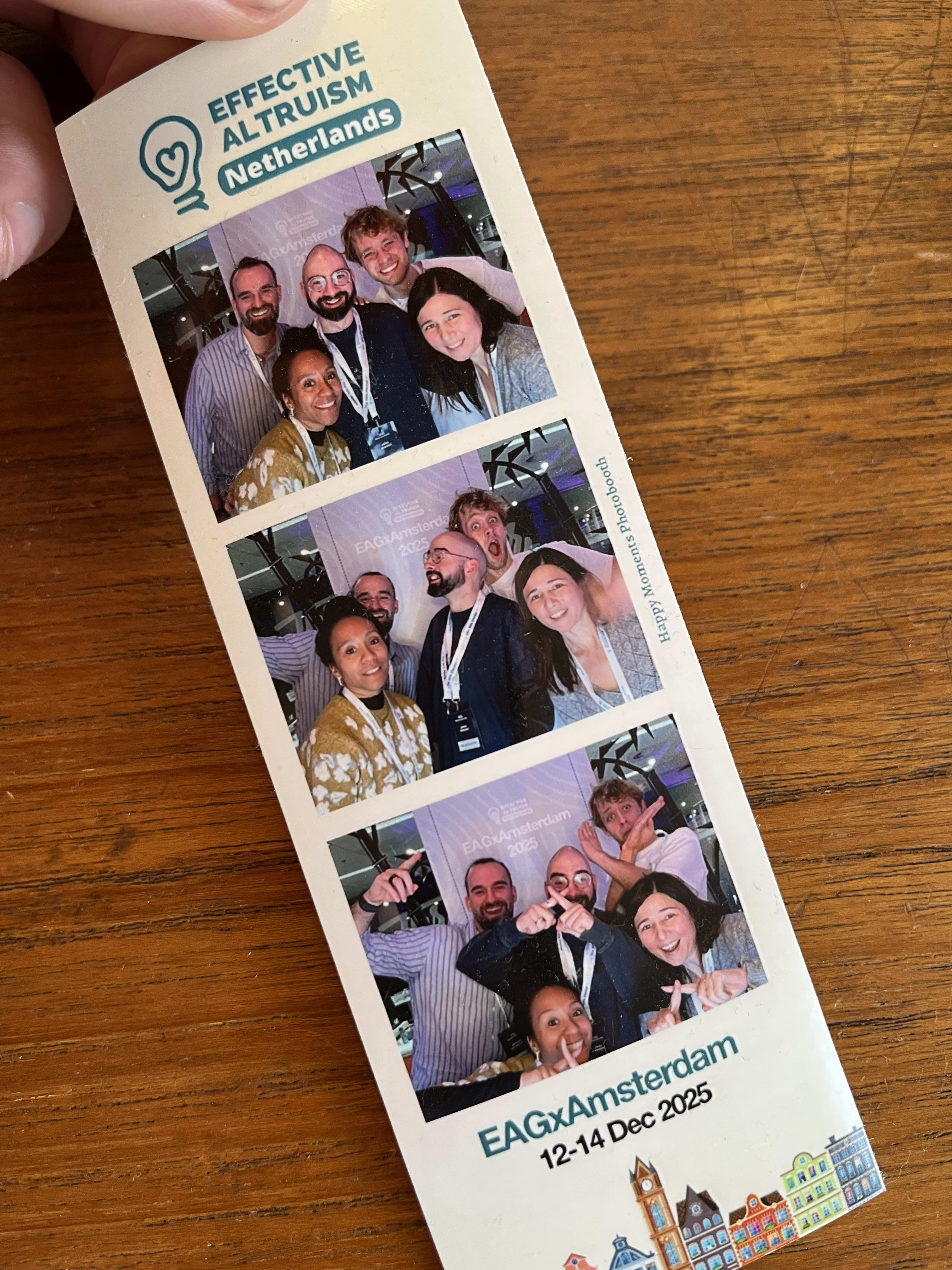
Held 12–14 December at B.Amsterdam. Key numbers:
A new "Talk + Fireside Chat" format scored 4.93/5, significantly above the 4.26 baseline for standard talks — worth expanding. The December date created some friction (holidays, exams), and female attendance dropped from 40% to 35%.
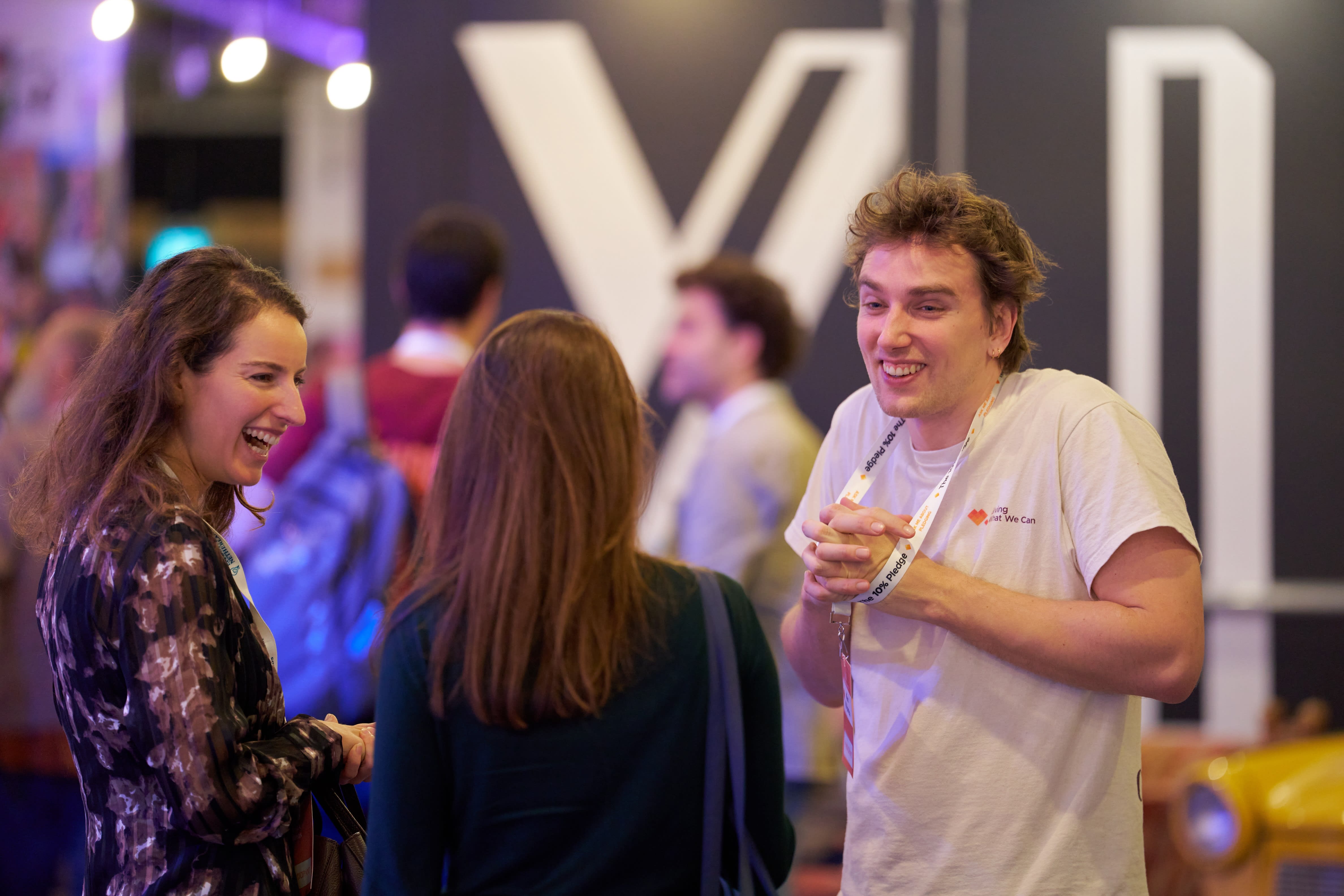
Neither of these was a 2025 priority, but both kept running and both matter — the QuIP study and our case studies consistently point to the co-working space and the organiser network as critical infrastructure.
The Amsterdam office continued to serve as a community hub, open on average 20–23 days per month with occupancy rates between 53% and 78% (out of 8 workstations). Over the grant period, 36–39 unique visitors used the space each month. Our September 2025 user survey (n=24) returned an NPS of +83 with zero detractors, a mean recommendation score of 9.3/10, and users reporting an average of 3 additional productive hours per day from working in the space. The office hosts a genuine cross-section of the Dutch EA ecosystem: regular users include people working in AI safety research, effective giving, global health, climate, animal welfare, charity entrepreneurship, policy, and grantmaking. Of the 24 survey respondents, 17 had received funding from EA-aligned funders including Coefficient Giving/Open Philanthropy, the Survival and Flourishing Fund, the Long-Term Future Fund, and the EA Infrastructure Fund. The office is funded through a mix of an EA Infrastructure Fund grant, co-tenant fees, and a small EAN contribution.
On the organiser side, we supported ~16 active groups and ~40 organisers through one-on-one mentorship, quarterly meetings, and an annual retreat (rated 9/10 by 20 attendees). Most university groups successfully transitioned to new boards, and we identified potential new organisers in several cities. This is steady-state community maintenance rather than a growth story, but it's the foundation that everything else sits on.
Against the three objectives:
Objective 1 (intro course to 100 completions): 87 completions — a strong result against the stretch target framework, though short of the headline number. The deeper story is that we solved the communications bottleneck that had been holding us back, tripled applications, and reached a substantially more counterfactual audience. The awareness baseline study was completed. Website traffic and conversion KRs were mixed — scaling top-of-funnel through advertising naturally dilutes conversion rates, which created some tension with the conversion-focused KRs.
Objective 2 (wide bridge events): We exceeded the volume target (6 events vs. 4 target) and the attendance target. But only one event — the Women's Empowerment Event — genuinely achieved the wide bridge objective of reaching people outside existing EA networks. We're being honest about this because the distinction matters: running events for existing community members is valuable, but it's not what this objective was about.
Objective 3 (independent impact evaluation): Fully achieved. The QuIP study was completed, findings were delivered, and the results are informing our 2026 strategy. We're among the first national EA organisations to have independent, blindfolded qualitative evidence for our theory of change.
EAGxAmsterdam: Exceeded targets on attendance, applications, cost efficiency, and satisfaction. Really pleased with the GWWC pledge numbers, although of course, much of the credit here goes to the exceptional team staffing the booth.
Overall: a strong year, with the biggest wins on the growth and evidence sides, and the clearest lesson being that "wide bridge" requires more intentional design than we initially assumed.
The aggregate numbers above don't capture what this looks like at the individual level. Here are a few anonymised examples from the past year or so — chosen to illustrate the range of ways community members are applying EA thinking, not because they're representative.
Corporate professional → workplace giving group → animal welfare founder. A mid-career professional at a major Dutch tech company co-organised an EA workplace group that has led to hundreds of colleagues donating over $850k to effective charities in three years. He then left his corporate role, conducted extensive cause-prioritisation research into animal welfare bottlenecks, found a co-founder, and is now establishing an animal welfare NGO. He found his current part-time role through a connection made at the EAN co-working space.
STEM graduate → AI safety researcher. A mathematics graduate pivoted to AI safety after engaging with the Dutch EA community. He completed technical AI safety training programmes, then found an internship through an AI safety WhatsApp group connected to the EAN network. He contributed to a widely-used LLM evaluation framework and was subsequently hired full-time as an AI safety researcher. He has said he likely wouldn't have made the pivot without the co-working space and community — few junior AI safety positions were available in the Netherlands, and the community made staying and working here viable.
Rationality workshop → intro course → AI safety community leader. A marketing professional attended one of our rationality workshops, signed up for the intro course, became interested in AI safety, and within months co-founded the revival of an AI safety community group in Amsterdam. She now co-directs the group, has organised technical and governance courses, and built a volunteer team — bringing a communications perspective that the AI safety community often lacks.
Senior policy professional starts donating. A policy advisor at the Dutch central bank, with an Oxford economics background and roughly a decade of experience in financial regulation, completed our intro course at the end of 2025. She went from zero EA engagement to completing the programme, attending our national unconference, and starting to donate to GiveWell-recommended charities — all within a few months. She's early in her EA journey, but represents the kind of high-leverage professional our intro course is increasingly reaching.
Intro course graduate → EA organisation staff. A community member who completed our introductory programme several years ago went on to volunteer as a facilitator, build our current online course platform, and stay connected to the community through events. When he was later contracted to rebuild EAN's website, the close collaboration brought him back into the EA orbit at exactly the right moment — a team member shared a role at a major EA organisation, he applied, and was hired.
AI safety career through community infrastructure. A computer science graduate moved from studying AI at a Dutch university to volunteering with a local AI safety group (incubated by EAN), then attended our national AI safety retreat, where she heard a talk by a former EAN community member about her career path into EU AI governance. Inspired by this, she applied for and was accepted into a competitive AI policy fellowship, which led directly to a research role at a European policy organisation focused on future generations.
These cases illustrate something the QuIP study also found: the community infrastructure — the co-working space, the events, the organiser network — functions as connective tissue. It's rarely one intervention that changes someone's trajectory; it's the accumulation of touchpoints, connections, and opportunities that a well-maintained community makes possible.
EAN's operational spending during the grant period was approximately €197k. The two largest line items were staff costs (€135k, covering two co-directors at 0.8 FTE each) and M&E (€20k, including the QuIP study). The remainder went to marketing and communications (€18k, covering the NSC and Amplify contracts), organiser support (€5k, mostly the annual retreat), the co-working office (€6k, with the other half funded by an EA Infrastructure Fund grant and co-tenant fees), and smaller amounts on events, wide bridge programming, and operational costs.
EAGxAmsterdam 2025 was funded separately through a CEA events grant and cost approximately €181k. The venue accounted for two-thirds of that (€121k), with contractors (€46k) making up most of the rest. The €387 cost per attendee — down from €586 in 2024 — reflects both better negotiation and the efficiency gains from higher attendance.
Our strategy for 2026 is to strengthen our in-person offering across onboarding and community programming. Build the room before we fill it.
We estimate the Dutch EA community currently has roughly 750 actively involved members, of whom around 300 are new this grant period. Beyond that, approximately 130 are committing to impact through career changes, organising, or significant pledges, and around 86 are working in high-impact EA-motivated roles or making substantial donations. How much room is there to grow? It's worth grounding this in comparison to other membership organisations rather than abstract TAM estimates. The Fabian Society has fewer than 10,000 members in the UK; population-adjusted for the Netherlands, that's roughly 1,500–2,500. Meanwhile, even genuinely niche Dutch interest communities reach impressive scale: the NKBV (the Dutch mountaineering society — in the Netherlands, a country whose highest point is 323 metres) has 80,000 members. The cycling union has 30,000. A realistic ceiling for the Dutch EA community is probably somewhere in this range, and we're nowhere near it. Our awareness research reinforces this: somewhere between 89,000 and 267,000 people in the Netherlands have heard of EA, but the conversion rate from awareness to active involvement is well under 1%.
So reach isn't the binding constraint yet. But neither is reach alone sufficient. 2025 showed us we can get people through the door — the marketing investment tripled applications, and the intro course is producing strong behaviour change among a more counterfactual audience. The question is what happens next. Our intro course is mostly online, our only consistent in-person offering is the co-working space in Amsterdam, EAGx happens every 18 months, and our other in-person events are heavily dependent on volunteers. The QuIP study and CEA's Indicators of CBG Group Impact study converge on the same finding: community belonging, in-person networking, and physical hubs are the mechanisms that actually cement engagement and drive the career and donation outcomes we care about. Right now, we're underinvesting in exactly the things the evidence says matter most for converting a newcomer into a committed community member.
This gives us the strategy for this period: strengthen our in-person offering across onboarding and community programming, so that we have the strongest possible value proposition when we do scale outreach further. We'll maintain significant investment in reach — the headroom justifies it — but focus new resources on conversion and retention. Build the room before we fill it.
We're still finalising the details, but the broad direction is:
EAN is primarily funded through CEA's funding programmes (CBG, EAGx, EA Infrastructure Fund), but we also welcome direct donations — particularly as we explore funding diversification. If you'd like to support our work, you can donate here or reach out to James at [email protected] to discuss how you can help.
Thanks for reading. Happy to answer questions in the comments.


Well done, impressive work from both of you! What has been achieved over the past year truly deserves a big compliment.
The part about wide bridge events seems particularly interesting for the Ten Percent Club, I'll mention this post.
The choice to focus in the coming period on improving onboarding after the introductory course feels very strong and sensible. It aligns well with what seems to be needed to maintain and deepen engagement.
Thanks Marijn!!
Centola's book 'Change: how to make big things happen' is really good.
He has six key tips: