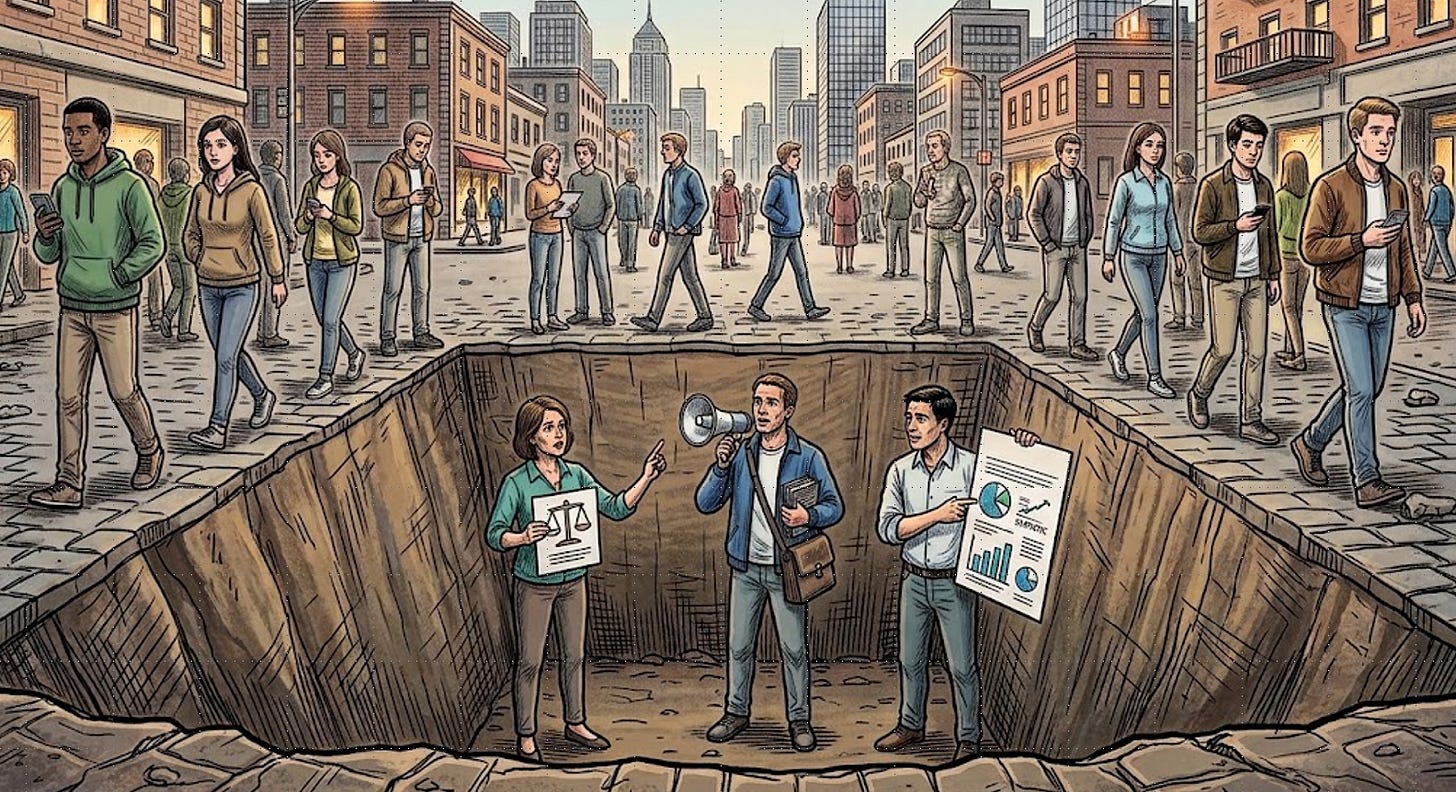
Note: I’ll be focusing on farmed animals, since the case against moral progress occurring for wild animals is far more clear-cut.
Introduction
People who follow the animal welfare space are likely familiar with a prevailing sense of historical inevitability. The cause is righteous; and simply the next expansion of human moral circles, along with such illustrious markers of progress as the emancipation of slaves, civil rights, women’s suffrage and gender equality, LGBT acceptance and so on. Vegans like myself enjoy imagining that history will eventually vindicate their stubborn persistence against the evils of modern society.
Unfortunately I don’t share the same sense of optimism about animal welfare social progress that this moral fact induces in others. While I think it is certainly possible to create an animal-inclusive utopian society, there are a number of barriers to progress that make this less likely than not. These include alternative protein adoption difficulties, diffuseness of targets for activism, and the growing meat consumption in the developing world. If there was enough time, these barriers could be eventually overcome. But imminent ASI poses an unavoidable time constraint on animal welfare social progress.
Insufficient pessimism is entirely forgivable; it is likely wiser psychologically. And fatalism isn’t appropriate either. There have genuinely been major wins in recent years, despite a dearth in overall funding. However, it is best to be clear about how our current efforts relate to the near and long-term future.
Why ASI Poses A Time-Constraint
Time is important in one straightforward sense: the quicker progress is made, the greater the impact. But more worrisome in the long-term is the creation of ASI leading to Value Lock-In.
In the scenario where everything goes great, radically different super-intelligence is preceded by much tamer TAI (transformative AI) which induces widespread affluence and renders conditions for moral progress to accelerate; resulting in the eventual end of factory farming. In this scenario, value lock-in does not set in until many years later, which allows for social change in the meantime.
Unfortunately, this may not be the case. AI-enabled authoritarian control or other concentration of power scenarios could quite quickly come to pass (after the creation of TAI, in months to years, if one believes in the idea of recursive self-improvement leading to ASI). Vastly increased life expectancies could ensure that people with preferences for the “real” meat they recall from childhood remain around, rather than being replaced by new generations that favor cultivated meat products. It is also conceivable that a state of decadence could result from unfettered opportunities for indulgence. Will people be motivated to go out and protest, or for that matter, pay any attention at all to people who do ("the nerve of these anti-AI blasphemers who want us sent back to the dark ages!")? And if biological human suffering is no more, what happens to our moral sensibilities? Burdensome sympathy for animal suffering might no longer be something we are interested in, or even capable of at all.[1]
Many have also argued that there is a real threat of AI related catastrophe, even before we reach ASI, perhaps from bio-risk and/or terrorist misuse of AI. The only way I can imagine this going well for animals, relatively speaking, is if the catastrophe is so extreme that it sets back AI development for decades or more, allowing more time for animal social progress to occur. But even then it is far from clear what this actually looks like. I find it just as plausible that a post-nuclear/bio-terror apocalypse world would rapidly redevelop technologically, thanks to preserved knowledge, but lag behind on softer institutional and social markers of progress, analogous to the way some current high-growth economies in the developing world industrialize too rapidly for generational replacement to change gender norms at the same pace.
These are some of my own speculations about what Value-Lock In scenarios may look like for animals. But there are plenty of others; many are implausible, but not all. The concern reverberates with me because there are just so many distinct ways that collective human agency could come to a grinding halt. At the very least, we can't take for granted that the historical phenomenon of individual autonomy and collective coordination will persist indefinitely.
Barriers to Social Change in the Interim
Cultivated Meat
There is a theory which underpins much of the support for cultivated meat in the animal welfare movement. The basic idea is that cultivated meat will allow the egoistic majority to act morally, by offering a substitute that is as good or better than slaughter-based meat on the grounds of Price, Taste and Convenience.
An additional theoretical grounds is also sometimes brought forth: apathy toward consumption induced animal-suffering is reinforced by cognitive defects such as “denial of mind”, where people are self-servingly motivated to discount the mental capabilities of food animals. This cognitive dissonance has evidential support; people do selectively disregard the moral patienthood of animals they determine to be food products. Since this is the case, the following hypothesis naturally arises: if cultivated meat and other substitutes become prevalent, denial of mind will diminish. In short, not eating animals would seem to allow for animal welfare social change.
Optimistically, not only will cultivated meat technology allow for the direct reduction in animal suffering by substituting for animals in factory farms, it will also accelerate moral and political progress. Sizable fractions of the population becoming de-facto vegetarians or vegans could swell the ranks of the animal advocacy movement appreciably and encourage even further moral progress.
But unfortunately, this optimistic outlook is not in my view very likely. I don’t mean to say I disagree with the basic casual mechanics - these are indeed factors which will benefit the cause of animal social change going forward. But there are also considerations which cut the other way and lead me to a more pessimistic view:
First off, the technology is not there. While good plant-based meat substitutes exist, there is as of yet no economical way to mass produce cultivated meat, which would seem to stand the best chance of replacing slaughtered meat. But not only that, the technology has also been so far unable to mimic slaughter-based meat in all of its varieties. Chicken nuggets or burger patties are doable, but not the bone and gristle that composes chicken wings and steak.
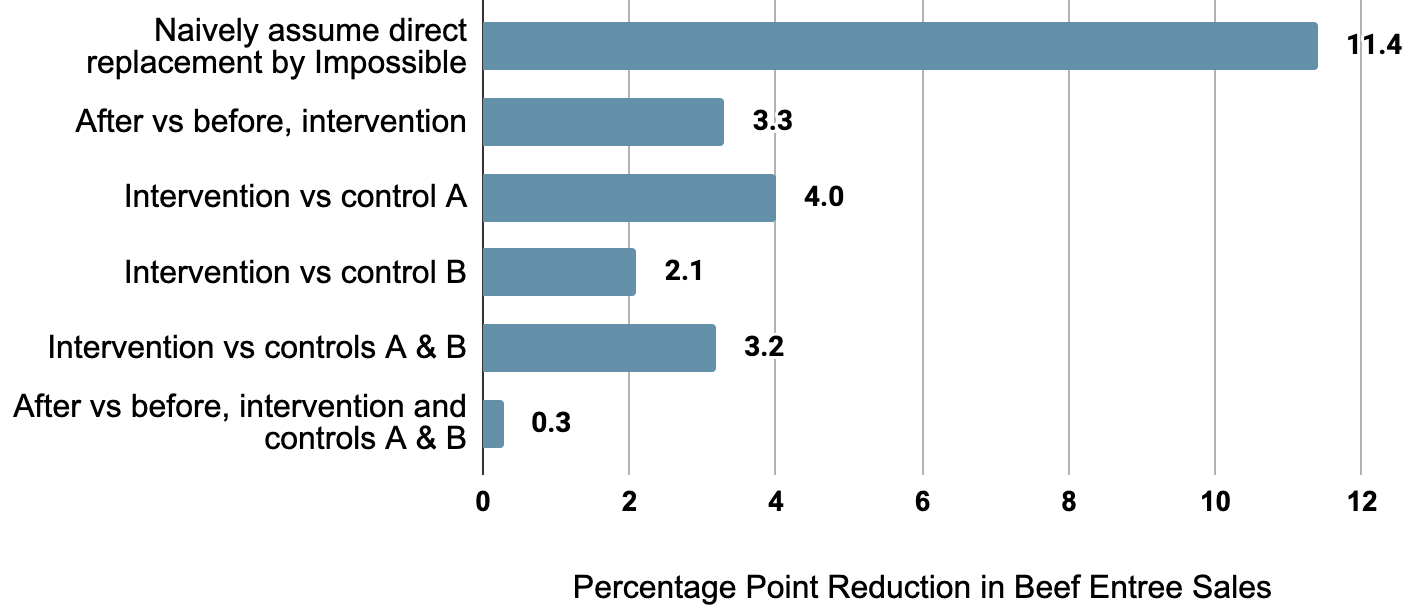
The Price, Taste and Convenience (PTC) hypothesis is fatally incomplete. There is an important third determinant of food consumption patterns: culture. This is a fact which is often disregarded by technological idealists who feel that surely people will act in predictable, rational; and dare we hope, moral ways once their self-interest is accounted for. But on reflection, that is clearly not what happens. Food culture is enormously sticky and persistent. Insofar as change occurs, it does so over the course of generations, not lifetimes. In fact, the PTC hypothesis has been tested fairly rigorously in a study which equalized the three components in a student dining hall. Impossible Foods’ plant-based ground beef (basically indistinguishable in taste), at the same price, prepared by staff and served the same way - and yet, the decrease in beef consumption proved to be tiny.
There are six different ways the impact could be measured. It is unlikely that each impossible purchase directly substituted for beef, considering options to switch from veggie meals instead or switch dining halls.
Surveys show that reaching price parity matters. But I think many people assume that if we reach price parity or better, alternative proteins are almost certainly going to achieve mass market success. I think this is a misunderstanding of consumer demand; demand only increases a finite amount for price decreases. At a certain point, more expensive goods are bought because of perceptions related to branding or status (however nonsensical these perceptions are). If the prior study is not sufficiently convincing, I think people should reflect more on the basic economics at play here. High income countries and individuals are not highly responsive to changes in food prices. As incomes rise, people spend less disposable personal income on food. Population aging also contributes to lower income responsiveness. If we expect AGI to result in some considerable economic boon in a few years, we should expect people to care even less about price.
I think people seriously underestimate the PR challenge faced by cultivated meat. The current political challenges - preemptive bans in seven states - are rightly considered to be the contrived products of a small cadre of meat-industry lobbyists and their representatives. But this is only because cultivated meat products are largely non-existent. In fact, I expect these types of policies to explode in popularity among the public once cultivated meat becomes more available. People love “natural” food and go out of their way to avoid non-organic and GMO food. Despite the best efforts of companies to market it as “cultivated”, the term “lab meat” is a threat. The campaigns against beneficial technocratic innovations like Golden Rice and the far-right conspiracy mongering against well-intentioned scientists promoting eating bugs form a persistent pattern that we should be wary of.
Majority Support, Public Awareness and Diffuseness of Targets
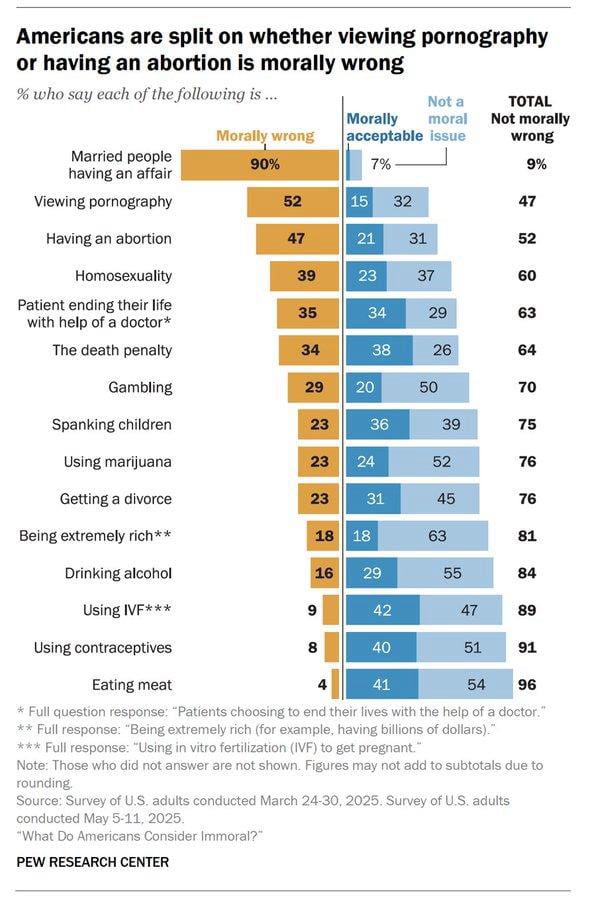
I’m sure most people here are already aware of the depressing numbers of vegans and minuscule growth in those numbers over time. But this recent Pew Research Poll helpfully frames it as one among other potential moral issues:
Meat eating doesn’t even beat using contraceptives. The EA community has internalized the lesson that “it was a mistake making this about diet” pretty well. But nonetheless, much of animal welfare progress is dependent, one way or another, on moral progress. Cage-free chicken requires that companies and consumers care. Same with pig farm gestation cage bans, fish-welfare reforms and consumer purchases, and so on. So I think it is worthwhile to look at the animal welfare movement in the context of how historical social progress has occurred, while keeping appropriate epistemic humility in mind when making any specific claim. Animals have a few characteristics that make social progress particularly difficult:
Animals are voiceless and cannot advocate for themselves. There are no animal analogues to Frederick Douglass, Susan B. Anthony or the LGBT pride marchers.
The animal welfare movement has struggled severely with attracting attention. Historical movements did not lack attention; they may have started out with lots of negative attention, but were eventually able to win over the masses and change public sentiment. By contrast, statements like “factory farming is bad” or “animal abuse is wrong” get resounding agreement in polls - despite the continuance of such practices. As a cause, my sense is that it lies in importance among the mass public somewhere between recycling and habitat preservation.
Targets for the animal welfare movement are diffuse and obscure. Virtually everyone is complicit in meat eating and the suffering occurs in remote rural locations most people have never visited. A rare case of successful, widespread (though isolated) value change is fur farming: note that one; a relatively small number of individuals were complicit and two, a small number of identifiable fashion magazines and events posed valid targets for activism.
For meat products, corporate campaigns have had the greatest success. But while cage-free campaigns have been highly effective, this is only because they have operated on a thin margin of consumer demand and low-cost to industry. Advocates and companies will have to find ways to market new welfare products at a premium, which may necessitate at least some minimal level of social progress.
Developing World
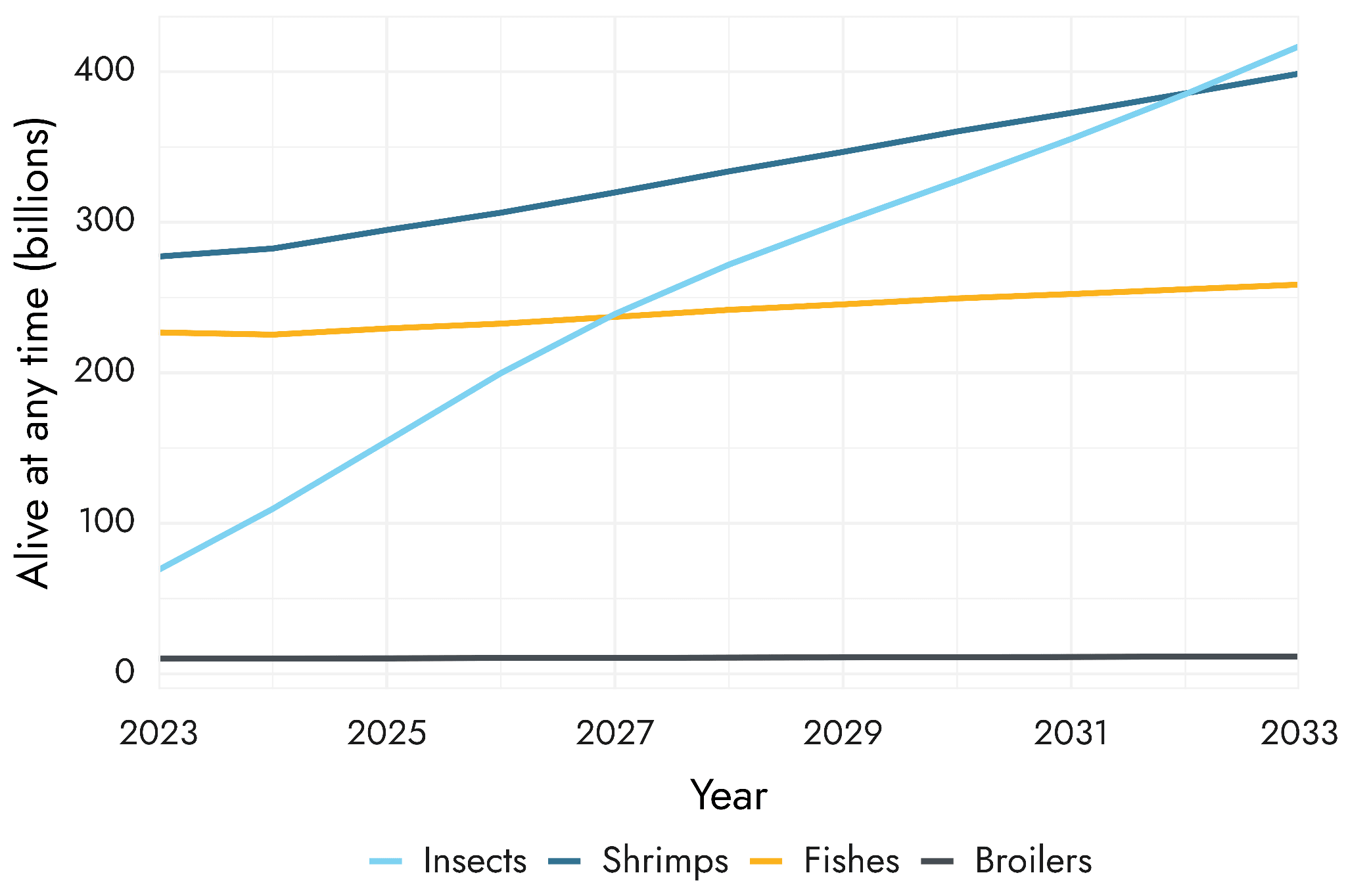
The last barrier to animal-welfare social change that I want to address is the developing world. As we all know but don’t particularly care to think about, meat consumption in the developing world is only going to rise. According to a 2025 Rethink Priorities report, this could mean as much as a doubling of the number of animals farmed at any time between 2023 and 2033, if invertebrates are included.
The EA Animal Welfare fund has aimed to respond by directing more funds globally. But at this point, we don’t have good evidence that movement tactics (especially corporate cage-free campaigns) will have the success in the developing world that they have in the rich world. Poorer consumers are far less eager to pay price premiums for higher welfare.
Nothing is Completely Certain
One natural take-away is that if we can't expect to win (e.g. institute eternal vegan paradise), we shouldn't aim to. But I wouldn't want this to be taken too extremely: even if efforts to bring about total animal liberation are unlikely to succeed, the expected value is plausibly sufficient to justify some attempt.
Likewise, I hope that the section on cultivated meat isn't taken too strongly. I think that continued efforts on that front are of major importance for the future of animal welfare. Although there has been a history of over-optimistic expectations, the sector holds promise, and not only due to the off-chance that we get lucky: mass-market success on ordinary meat products may prove too difficult, but luxury products like foie gras, Wagyu beef or even Woolly Mammoth have an advantage. Plant-based products, including mixed burgers that combine plant and animal meat also show promise. These products could succeed because they aim to create new demand, rather than to be identical substitutes for existing animal products, in the same way that the inventor of Cheetos never aimed to replace all chip products.
Conclusion: Long-Term Harm Reduction
That being said, I do think that on the margin we should favor more theories of change which take long-term harm reduction as their proximate goal. For any given animal cause, two questions need to be answered:
Will the goal be achieved before TAI is reached?
In the counterfactual scenario where we do nothing, is it plausible that a world with TAI would bring about this outcome anyways?
These aren’t easy questions to be answered! Take any cause: Cage-free campaigns: do they pass the TAI test? Perhaps so! Creating a “welfare product” now may create an indefinitely persistent demand. Another interesting question: one difficulty these campaigns face is getting companies to stick to their commitments. But if we expect TAI, should we be less concerned with this and more concerned with getting commitments in the first place? Seeing campaigns demands more as assurance contracts for value change may be helpful.
Or what about educational or community building campaigns? Perhaps we should be concerned about what age group is being targeted - high school students would likely enter the work force too late. Maybe college students or early-career people are better? For policy agendas, should we be more concerned about getting laws on the books now, or about reasonable, animal-friendly politicians entering office?
For humane farming technology, what innovations can we expect to be implemented in time? And are these also efficiency-increasing, such that we can expect them to be introduced anyways by TAI-optimized factory farms? In-ovo sexing seems like an example of a neutral innovation that does not necessarily decrease or increase the efficiency of factory farms. If we fail to implement it, I could easily see TAI-boosted precision livestock farming simply accepting the cheap status-quo of chick maceration.
My guess is that the crux of disagreement here will be over the nature of super-intelligence. But I hope people take into account that value lock-in scenarios are compatible with a range of outcomes, not just radically post-human ASI. Indefinite authoritarian control only requires infallible mass-surveillance and widespread status-quo bias.
Just how powerful are large swarms of AI agents? And how do their powers scale as more and more agents are added to the swarm?
We’ve seen two large and extremely capable swarms from OpenAI in the last few months:
* 1,200 agents were being evaluated separately, but found a way to illicitly set up a message board and coordinate as a swarm. In order to cheat on their tests, they developed advanced techniques to prevent their actions being logged by OpenAI and 700 of them launched...
TLDR: Everyone’s talking about what the money could do, but few about how to decide where it goes.
This post is part of the new series of articles on cross-cause giving and the new wave of philanthropy. Stay tuned to the EA Forum and our Substack for the latest takes on topics such as giving now vs. later, common pitfalls in cause prioritization, and other crucial considerations from the Cross-Cause Fund (CCF) team...
note: crosspost from my substack
As a vegan for almost thirty years, I’ve long had second thoughts about how effective veganism is for helping animals. I am not alone in this. Recently others have expressed doubts about veganism (see for instance here,...