Comments
This essay was written, in two parts, as part of Austin Chen's just.write challenge. It is (somewhat) crossposted from my substack, with a couple of small changes.
“And another will be established at the other end of the Galaxy, let us say,” and he smiled, “at Star's End”.
Isaac Asimov, Foundation
In literary studies, Laurence Sterne’s Tristram Shandy has a reputation for being both a foundation and a demolition of the novel as a genre, gleefully subverting and mocking conventions that had barely become established in eighteenth-century England. One example is the linear, biographical narrative: Sterne takes roughly four volumes to get his protagonist born, frequently indulging in digressions that turn the course of his narrative into a series of famously crooked lines:
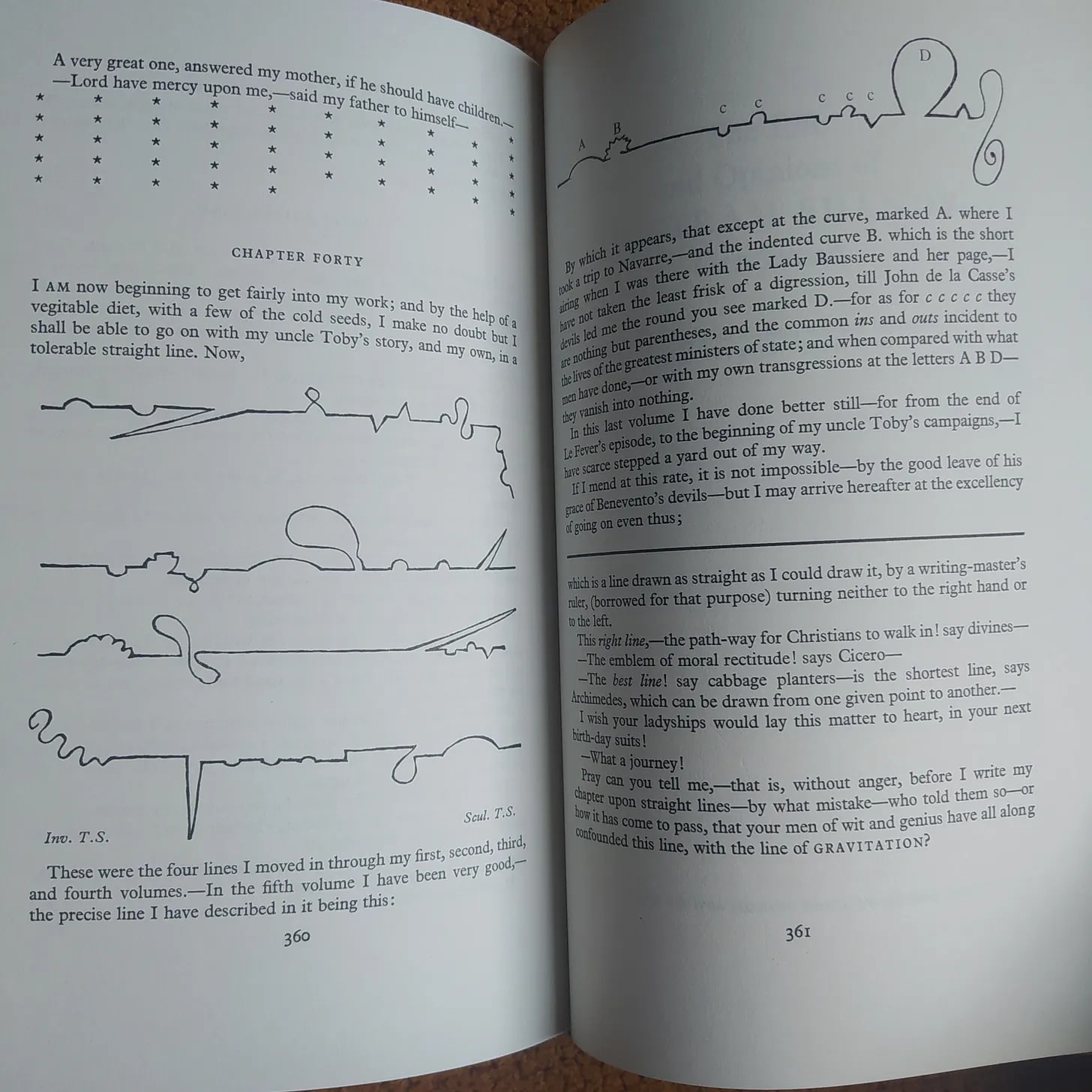
These drawings immediately came to mind when I thought about the rather contorted and unusual route by which I discovered both effective altruism and the rationalist communities. Or perhaps I should think of it as a geodesic: the shortest path between two points can look rather strange, depending on the surface it lies upon. So, whichever metaphor works for you (the first is more humanistic, the second more sciency), let me tell you how I stumbled into these two intellectual movements.
A Very American Scandal
In the early twenty-twenties, yours truly had started teaching C1 and C2-level English courses at work, whose descriptors include “Can understand enough to follow extended discourse on abstract and complex topics beyond their own field, though they may need to confirm occasional details, especially if the variety is unfamiliar1”. So I was searching for abstract and complex topics to prepare listening and speaking activities with, and was rather intrigued by a Johnny Harris YouTube video that tried to explain NFTs (and, as a sideshow, blockchains and public ledgers). It also gave me a good idea for a speaking card.
X’s algorithms smell rather effectively the winds of change in your interests, so I started getting suggestions for posts on cryptocurrency and sundry related stuff. So, in late November 2022, after having read some vague and decontextualized hints of some big financial mess of Enron and Bernie Madoff proportions in tweets, my feed showed me a link to a Forbes article on The ‘Fake Charity Nerd Girl’ Behind the FTX Collapse.
The article, as much journalism tends to be, was rather lurid and sensationalist, but reading between the lines, one could glean the picture of a brilliant, introverted, intellectually and ethically serious, mathematically gifted young woman, and a massive nerd to boot. Just as Tyrion Lannister has a soft spot in his heart for “cripples and bastards and broken things”, I have one for nerds. So my curiosity was piqued, and I started reading more about this whole FTX/Alameda thing, and the philosophy of effective altruism. Social media wasn’t very helpful on this issue, and the discussion was mostly reduced to inordinate amounts of hate and mockery of this lady’s looks. But amidst the noise, I also found a link to her infamous, now-defunct Tumblr, which was being mined for as many juicy, decontextualized and scandalous tidbits as it could provide.
A Great Blog… Book… Hypertext? Whatever
I am far from the first person to state that Caroline’s blog is a very fine and interesting piece of writing. In a (likely unintentional) way, it almost reads like a canonical, postmodern, hypertext fiction, only better and more interesting than anything Michael Joyce, Shelley Jackson or your run-of-the-mill literary theory professor was trying to peddle you a few years ago in your backwater university. Here was a real story with a fragmented narration, a (presumably) unreliable narrator, and a lot of other texts (newspaper articles, video segments, blog posts, internet forums, soundtracks…) you had to add and explore to make it all make sense. Through it all you get a glimpse at a wonderful mind and a fascinating personality: highly intelligent, mathematically gifted, nerdy, humorous, sarcastic, and endlessly entertaining, but also self-deprecating, uncertain of herself and, sometimes, painfully self-critical. A lot of the entries are musings and reflections on economics, ethics and Effective Altruism, and the author comes across as someone with a very serious moral outlook and a genuine desire to do the most good, which creates a strange, almost Greek-tragic effect when contrasted with the terrible situation in which she ended up. You also get a lesson that is easily forgotten but important to keep in mind: anything you’ve ever written can and will be used against you someday and read in the meanest, most uncharitable way imaginable.
But I don’t need to sell World Optimization to you. If you’re reading this post, it’s extremely likely that you’ve encountered that blog already. I am bringing it up here because, besides how absorbing I personally found it -I went through all its entries during the Christmas holidays-, it introduced me to an unfamiliar intellectual world whose existence I had barely suspected and composed of communities with distinctive approaches to reason, morality, optimization, and doing good. I started reading lots of books and articles about these strange new worlds (for me) of economics, utilitarianism, decision theory, AI and social interventions. Overall, I feel that this has significantly enriched my intellectual and moral life, which is rather good for me. The irony, of course, is that this intellectual enrichment arose from a disaster that Caroline, EA, and many others would surely have preferred never to have happened. There are infinite threads in the Multiverse where this doesn’t take place, but unfortunately, we currently share one of those in which it did.
An Alien Universe
The Anglophone philosophical tradition is rich, but here in Spain we seldom get exposed to it at all, whether in our younger years or at university. While I had some of the usual names in mind (Adam Smith, David Hume, John Stuart Mill and Jeremy Bentham), I had never bothered to give them a look. As for economics, in my younger, Marxist years I could dismiss it as a ‘bourgeois pseudo-science’, and in my later years just ignore it as boring and not particularly useful for a person like me. But this changed in late 2022, and I got myself reading and thinking.
I had a really hard time taking in utilitarian/consequentialist ethics2, though. To my mind, it felt like some sort of arrogant, cartoony, comic-supervillain way of looking at things, something that Doctor Doom would have enthusiastically endorsed as the constitution of Latveria. Focusing on consequences would mean belittling what at the time I considered the proper moral framework (i.e., intentions and rule-following) and could easily be perverted into an ends-justify-the-means mentality. I had constructed a perfect straw man of consequentialism, which was very difficult to get rid of when reading about these things. When I started reading posts on the EA Forum, I couldn’t help thinking… this is weird. Inhuman. The sort of ethics someone with no instinctive sympathy for other human beings might design, having to somehow derive it from rules of logic and quantify it with absurd, made-up numbers.
And yet the more I kept reading, the more I was impressed by the moral seriousness and the real-world demands and effects of espousing this philosophy. Posters were tackling really unglamorous interventions and ugly calculations, and they were using them to pool their own money and resources towards helping others. This I found somewhat mind-blowing. In my experience, private philanthropy has a much lower profile down here in Spain, outside religious institutions, and the common-sense attitudes I had most often encountered towards these topics fell into one of two buckets:
伐柯伐柯,其則不遠。
In hewing an axe-handle, in hewing an axe-handle, The pattern is not far off.
Let’s say your interest in Effective Altruism has been piqued by some introductory reading and you want to learn more. Also, let’s assume you’re not a student at an Ivy League university, and that there are no physical communities nearby (my nearest one is about six hundred kilometers away). Even without those constraints, a good place to go would be the EA Forum, where I registered on December 9, 2022. There was lots of material to read there, both in forum posts and in sequences like The Introduction to Effective Altruism Handbook, but being the bookworm that I am, and despite the infamous advice that if you wrote a book, you fucked up, and it should have been a six-paragraph blog post, I immediately directed my attention to books.
From my notes, I can see that in 2023 I finished Peter Singer’s The Life You Can Save in February and MacAskill’s Doing Good Better in April; in 2024 I participated in the EA Virtual Introductory Effective Altruism Program and its online book club; and in 2025 I joined The Precipice Reading Group, which centered on reading and discussing Toby Ord’s The Precipice.
But I don’t want to turn this post into a list of books I read, short summaries and their effect on me. Instead, I think it is better to hone in on the first, which arguably had the greatest impact. And besides, it was a book I somewhat hated and still do.
The Man You Can Hate
You will likely have heard the famous quotation, “When I hear the word ‘culture,’ I reach for my revolver.” Most people, when they hear the word ethics, reach apprehensively for their wallets and start wondering what rational argument will be used to force them to part with their money or sacrifice some of the pleasures that make life worthwhile. Morality tends to leave a bitter taste in the mouth, so it helps if you can despise the ethicist preaching from his high horse and find any oddities and inconsistencies that will allow you to ignore the argument. In this respect, Peter Singer offers an embarrassment of riches. One just has to take a cursory glance at what he has to say about infanticide, disability, sex with animals and euthanasia, or at the substantial sums he spent on private care for his mother when she developed Alzheimer’s disease—hardly a cost-effective choice by his own standards.

The Life You Can Save rehashes the same arguments and the Drowning Child thought experiment first formulated in his article Famine, Affluence and Morality. You know how the argument goes. I remember it leaving an extremely bitter taste in my mouth, not so much because of the implicit demandingness of the argument as because I felt the thought experiment was smuggling highly contestable premises under the cover of everyday intuitions.
After thinking it over at length, I realized that I strongly reject impartial consideration of interests, i.e., I don’t believe we have the same obligations towards everyone, regardless of our relationships and commitments, or that we are morally required to maximize the good we do. And beyond that, I found, on reflection, that I have a completely different, anti-realist view of ethics as ultimately reducible to contractual obligations, agreements and reciprocal expectations among rational persons capable of understanding, accepting and complying with mutually binding rules. Think of the writings of Thomas Hobbes, David Gauthier or Robin Hanson, if you enjoy some name-dropping and/or would like to make a quick check on Wikipedia, your favorite LLM or (in the only living one), his latest post.
I also found Singerite attempts to equate the truths of ethics with those of mathematics quite infuriating (mathematical theorems follow from axioms and inference rules; different consistent frameworks can yield different mathematical systems, all of which are ‘valid’ and ‘true’, but I don’t think ethicists would accept the same approach to ethics). And besides, mathematics, while abstract and ethereal, manifests itself in this world through its unreasonable effectiveness in, and indispensability to, the natural sciences, which serve as indirect verification of mathematical truths—something ethics sorely lacks.
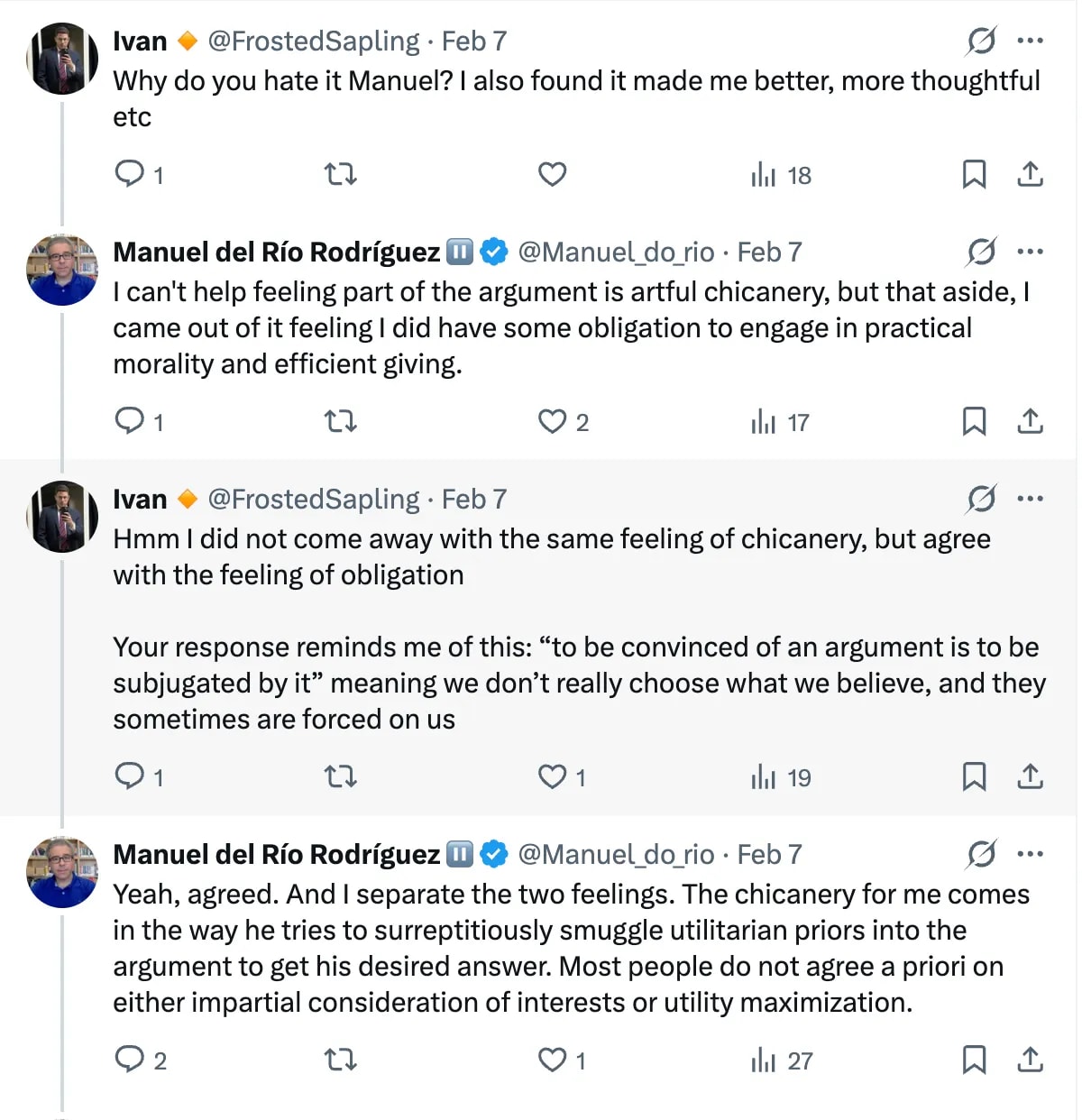
Paradoxically, though, I’d say that no philosopher I’ve ever read has had a stronger influence on my actual behavior, because while strongly disagreeing with the gist of his argument and utilitarian ethics, I did come away from the book thinking that
The Friends We Met Along The Way
The Chinese verse with you read a few lines above is from the poem “Fa Ke” (伐柯), or “Hewing an Axe Handle”, number 158 of The Classic of Poetry (詩經), the oldest surviving collection of Chinese poetry, which dates back roughly three thousand years. The original uses a very simple image (when you make a new axe handle, the model you need is already in your hands, i.e., the handle of the axe you’re using) as a parallel for marriage arrangements, particularly the need for a mediator. Here I am appropriating it in a different sense: while EA beliefs and theory can be learned from books, EA itself becomes palpable when you see its ideas at work in actual people and in the community they form. I live very far away from any established EA communities, so my interactions with EAs have had to be virtual for the most part[2].
Social networks and internet fora get a bad rep for both the shallowness and negativity of most interactions, and yet this hasn’t been my personal experience. Whether replying to posts on the EA Forum, commenting on personal blogs or interacting on X, the Effective Altruists I’ve encountered have invariably fit a pattern: nice, kind, thoughtful people who are trying to do real good in the world and live up to their high ideals. Young, too (almost all of them younger than me), and I am not ashamed to say that I’ve learned valuable things from them. And yes, I know this sounds like selection bias and a potentially unrepresentative sample[3], but it does make for a striking contrast with the stereotypical mental picture you might have of the followers of an ethical system that can feel cold and almost inhuman. Without trying to be exhaustive or to bore you with a catalogue of admirable people, let me indulge in a little name-dropping, with the implicit suggestion that you should be following them, reading their work and interacting with them if you don’t do so already.
Frances Lorenz is a real flesh-and-blood Lorenz Attractor of kindness and playfulness, qualities I find all the more admirable given some of the difficulties she’s faced. But even more than that, she is one of those rare people who can make me listen, reconsider my assumptions and occasionally change my mind, even on subjects where my convictions are rather firmly entrenched (my anti-woke inclinations come with their own collection of blind spots). And she has a wonderful substack which you should be reading.
Rafa Ruiz is a paisano of mine, although, amusingly enough, we always seem to end up talking to each other in English. He’s a remarkably smart philosopher who has just completed his dissertation on moral progress, and I had the privilege of reading its introduction and offering him a few thoughts about it. He has a digital presence well worth following and I can’t wait for his dissertation to come out in book form. And besides, he can be quite funny too, as testified by this recent tweet of his:

Andy Masley has been a recent discovery, and has also come to the fore as the guy making painstaking efforts to debunk some of the more sensational claims about AI data centres and their water consumption. He exemplifies a very EA commitment to careful empirical reasoning, which I appreciate, but what strikes me the most about him is the incredible patience and reasonableness with which he handles the most stupid, bigoted and pig-headed conversations on the everything app, which is a skill/virtue I mostly lack.
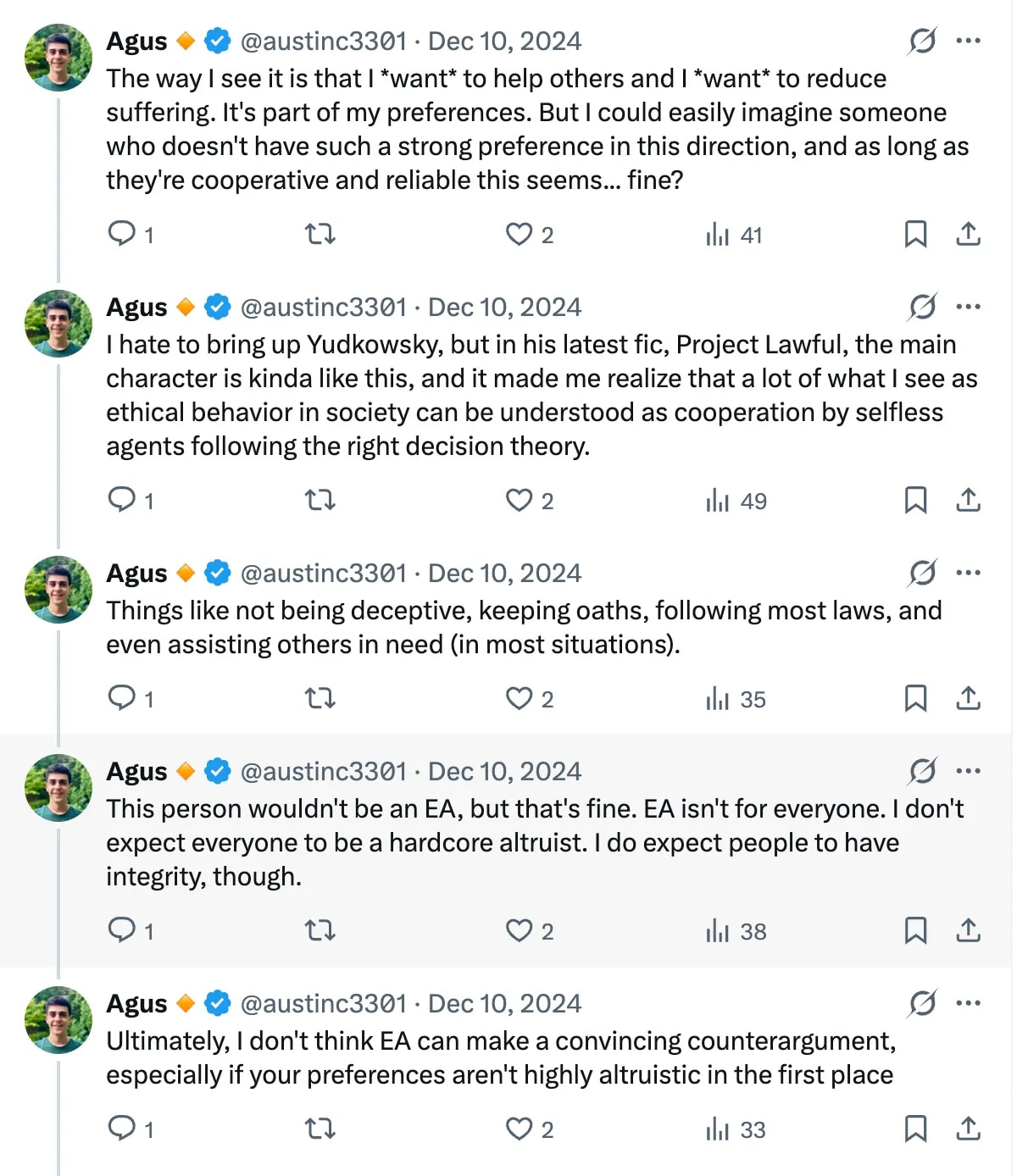
Agus Covarrubias, Sam Glover and Aaron Bergman are three remarkably thoughtful young men with whom I’ve enjoyed discussing all sorts of things, but particularly philosophy, ethics and moral realism, even if we don’t always see eye to eye. I am not exactly sure of which one of them had a tweet exchange with me in early 2023 in which I was discussing how unnatural I found an ethical system that is focused on consequences, to which he retorted that an ethical system based on self-flourishing could be quite narcissistic. That tweet got me angry at first, but after pondering it more, I was able to see how, from the other point of view, this actually made sense.
Kirsten, meanwhile, is a wonderfully playful and funny person whose old EA Lifestyles account and blog were a fresh take and an ironic overturning of the stereotype of EAs as humorless, robotic optimizers. She’s now considering making the rather brave leap from the British civil service into entrepreneurship, and I wish her every success.
The list could go on for a rather long time, and there are lots of other people I should be talking about[4]. But I feel it is enough to give you a snapshot of the type of people I’ve encountered and have been talking about.
A circle has no end
It has become something of a running joke that almost everybody who interacts with Effective Altruism these days prefers to call themselves EA-adjacent. Quite apart from the fallout of the movement’s recent controversies, I think there’s something to be said for keeping one’s identity small.
I suppose I qualify for the adjacency label in a rather literal sense. For one thing, I disagree with some of the moral assumptions that EAs take for granted; for another, I feel I’m a particularly bad fit for the movement, and don’t have much to offer it. I am οὖτις, a middle-aged, not particularly brilliant, moderately paid teacher, working in a profession with little obvious leverage over the future, living in a peripheral corner of Europe and far from the places where things happen.
Pretty close to me is the town of Fisterra, whose name comes from the Latin Finis Terrae, ‘end of the earth’. According to the historian Florus, when Decimus Junius Brutus, campaigning in northwestern Iberia in 137–136 BCE, reached this end of the ocean, he watched the sun sink into its waters with a mixture of awe and religious dread, feeling that he had reached the remotest ends of the known world. Two thousand years later, the world has become a much smaller place. The geographical distances remain, of course, but much of their power to keep people apart has disappeared. From my little corner of Galicia, I can now participate in conversations and communities that would once have been entirely beyond my reach.
I’m glad to have found these people, and to contribute what little I can. From my little outpost on the galactic periphery, far from Trantor and Terminus alike, I’m happy to lend my support, however modest, to the efforts of the different latter-day Foundations and Havens of the present that hope to prevent humanity from falling into an age of darkness and bring utopia just a little bit closer.
And for Nobody, I suppose that’s not such a bad place to be.
A more amenable update on the Singerian view was pointed to me, three years ago, by Agustín Covarrubias, who directed me to R.Y. Chappell’s Beneficentrism.
After some strenuous searching, I did find about four people in my whole region who showed some interest in Effective Altruism, and we’ve met a couple of times and established a small donation team in the Spanish equivalent of Giving What We Can.
Holly Elmore, whom I follow and respect, would likely castigate me for this, and one could make the point that she’s had wider and more representative access to EAs, but here we’ll have to agree to disagree. Frances Lorenz, more convincingly, would bring the case that there are some worrying sexist behaviors in the community unpunished and unnoticed.
A different post in a different place would be about my interactions with Rationalists, a subculture which in many ways I feel is a better fit for me and my preferences than EA itself. I should also mention again, as in the first post, Caroline Ellison, a person who I look up to as an inspiration, despite the serious and tragic issues she was involved in. And this is a hill I am happy to die on.