This is a written version of a workshop I gave at EAG NYC in October 2026, edited to make sense in article form. Other materials: Slides with narrated audio, slides without audio, handout.
Introduction
"In war, what in ordinary times would be thought weirdly zealous becomes expected...For do-gooders, it is always wartime." - Strangers Drowning
I'm opening with this quote because I want to hold in mind that many people reading this are working under a mentality of high urgency.
The EA atmosphere has felt different to me since Hugging Face and the sea change in existential risk discourse. I know that for lots of us the times do not feel normal.
So this piece is about how to be more okay in abnormal times. It’s for anyone working under chronic urgency or moral demandingness - especially people working on x-risk, or anything else tethered to rapid advancements in AI. But in my experience the same themes apply to other cause areas too.
This isn’t about specific mental health problems, and I don’t assume readers have any. Instead I hope to persuade you that sanity and sustainability are nonnegotiables for all of us; to share some perspective from working as an EA therapist; and help you start planning for ongoing stability.
Where are you starting from?
Let's check where you're starting from. On the one hand, someone in a constant sprint at the edge of burnout who's doing nothing to care for themself should pause and sleep and probably make a plan for handoff.
But at the other end, sustainability isn't our only priority. At a certain point, adding more exercise (or fun, or rest) starts trading off against stuff we care about more.
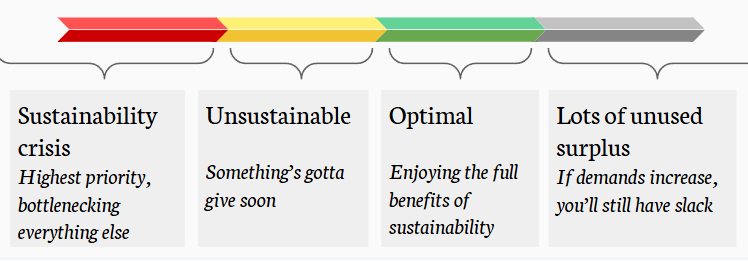
So where we want to be is in the green, where we're putting our capacity to good use while also getting the full benefits of sustainability.
And my fear is that many of us enter the yellow too often - where we're working at a level that can't be sustained longterm, performing suboptimally, and constantly running a background risk of burnout.
The case for sustainability
The case for sustainability is simple. If you agree with three premises, working sustainably should be among your top priorities.
- We’re constrained. Humans are limited. We’re organisms. There are conditions where we function well, like being rested and calm; and those where we function poorly, like being distracted, exhausted, or stressed out for a long time.
- High-stakes problems need us at our best. The world’s most pressing problems are best attacked under conditions of not just adequate functioning, but excellent functioning. I'm thinking of things like creativity, clear reasoning, executive function, emotion regulation, and distress tolerance. These are really hard to do when you're unwell.
- The shortest timelines are longer than human cycles of burnout. People can burn out in weeks, and take their contribution to zero, faster than the window for contributing to our most important problems is closing. And it seems likely that the path to TAI routes through multiple points of high urgency, raising the costs of burning out too early. (Obviously, if you think I'm wrong here, feel free to continue sprinting unchecked - but I think that’s at risk of burning out and taking your contribution to zero.)
On valuing personal wellbeing
I’m aware the above framing is rather self-instrumentalizing. I don't want to debate how much weight to put on personal wellbeing for its own sake, mostly because similar actions are implied no matter where that lands.
But let me say this once clearly: I actively recommend you do stay in touch with the care you have for yourself, and with your preferences and desires, not just your basic needs.
This is not theoretical, and it's not a therapist platitude. I have seen people perform worse by their own lights because they instrumentalized themselves too hard. And I've seen that when people are able to re-enfranchise their own preferences and desires, it helps them persist more in important work. So please hear all of the recommendations here in the spirit of serving both worthy causes and personal wellbeing.
What does the literature say?
"...EAs seem to believe that work-life balance is a scam invented by Big Deontology to sell more low-impact charity.” - this post by ozymandias
That’s hilarious. Is there anything to it?
We can probably agree there exists a failure mode where people use concepts like work-life balance as cover for…doing whatever they want. But that is not the average calibration of people reading this.
And we’ll find that the research supports taking sustainability more seriously, not less. I'm deliberately keeping this part short, because you likely appreciates the bottom line already. But let’s briefly consider a few findings from contexts that have things in common with EA.
High-stakes professionals function better with rest
- There's an extensive literature finding that doctors think less clearly and make more mistakes when they're working long shifts.
- And it's not surprising, given the effect of sleep deprivation: one study found that being awake for 24 hours degrades performance on a cognitive task as much as being drunk. So if you face the choice of continuing to work at the end of a long day, recognize that's a decision to do your work impaired.
- In the military, we see that people become less resilient to stress as the balance shifts in favor of more deployment and less rest. But self-care, and working under leadership that prioritizes personal wellbeing, can buffer this a bit.
- If the literal armed forces can do self-care to stay mission-ready, so can you.
- Among activists, people who feel like they can't rest are at higher risk of leaving the field.
Psychological detachment is important
- Another insight from the burnout literature is the idea of "psychological detachment" - having mental space that's totally unplugged from work.
- The research here shows that when you have headspace separate from work, you're less emotionally exhausted, better able to reengage the next day, and less likely to burn out when your job has a lot of demands.
Conservation of resources theory
- In organizational psychology, conservation of resources theory models stress and resilience in terms of people's resources.
- Resources are broadly defined here - not just things like money and health, but also goods like relationships or self-efficacy.
- In this literature, losses and gains have asymmetrical effects of stress, just like loss aversion in behavioral economics. When you lose resources, you need a greater-than-equivalent gain to recover from that stress.
- And often, you have to invest further resources to get that gain.
- When you're socially isolated, you have to actively schedule time with people to restore a sense of connectedness.
- If you're exhausted from being too busy, you have to purposefully protect and dedicate full nights of sleep to restore your cognitive performance.
- The bottom line is that it's extremely important to avoid "loss spirals" - when your resources are depleted, you have less to invest to recover, so you're at risk of staying stuck.
On culture, briefly
- If you run an org or manage a team, know that org-level interventions for burnout tend to do better than individual-level, at least in overworked physicians where most of this research is done.
- The types of things highlighted in meta-analyses are usually versions of decreasing demand on employees and increasing their agency.
- We also know from the military that functioning well under stress requires unit cohesion.
- This is more than having friends and coworkers - it's a sense of shared mission, interdependence, cooperation and camaraderie.
- But be careful that making the mission salient doesn't tip over into rewarding martyrdom, because that becomes a risk factor for attrition.
Failure modes
I’m a therapist for EAs, and these are the most common errors I see people make in sanity and sustainability. Trust that I mean this section nonjudgmentally, as I’ve done all of these myself!
Assuming you need a complex solution
Or: "Not doing something obvious, because it sounds too obvious."
You might imagine someone who's struggling with productivity and distraction at work and thinks they need to go on medication or work with a coach. But really, the things they should check first are finding a more comfortable chair, or noise-cancelling headphones, or cleaning their room.
Discontinuing loadbearing practices when you're doing okay
If something is benefiting you, taking it away is a loss you’re likely to feel.
You might say, "Well, I don't want to have a bunch of unused capacity. If I'm sleeping 8 hours per night and have a bunch of important work to do, and I feel like I have plenty of energy, is it really so wrong to sleep 7?"
Maybe not. That's an empirical question. But whenever you remove a sustainability practice, consider that an experiment that incurs some risk, and be honest about what happens.
What about sprints? Sprints are fine if they are time-limited, for a specific high priority, you can afford to be temporarily depleted afterwards, and you have a plan for recovery. Many things we call sprints do not check all those boxes.
Not accepting tradeoffs (tactically)
It’s all too common that someone is excellent at thinking about tradeoffs abstractly, but then turns around and resists making them in practice. The error I usually see is someone just continues taking on new demands without checking what they're going to displace.
You cannot sum your effort to greater than 100%. So when you're considering a new project or commitment, actually ask, "What am I willing to trade away to make room for this?"
Not accepting tradeoffs (emotionally)
There’s also an emotional side of not accepting tradeoffs. Perhaps you realize you have to make them, but you’re also bemoaning this, and imagining how your idealized self could do everything, and recriminating yourself for not being higher-capacity. And that is a use of capacity.
You're allowed to grieve your human limits, but not constantly. You should spend most of your time just living by the math, within constraints.
The tyranny of infinite stakes
There's a phenomenon I noticed in clients with anxiety, especially OCD, long before I was working with EAs. The client would have a fear of something truly awful, like killing their own kid, and say effectively "I know I'm being irrational, but it would just be so bad." As if that settled the question of what to do. And then they would let the fear decide all of their next moves, including doing unhelpful compulsions and ruminating constantly, way past the point of actually serving the goal of keeping their kid safe.
I started calling this the tyranny of infinite stakes. It’s tyrannical because one consideration (how horrifying certain outcomes truly are) has unchecked power over all other considerations, including other top priorities (like their own sanity). And it even starts to obscure the practical question of how best to guard against the outcome.
EAs need to be wary of this tyranny because it plays into our disposition to think in terms of expected value. And when you put a term into the equation that's like, "This outcome is infinitely [bad/good] and therefore anything that feels in service of [avoiding/protecting] it is automatically the right call," the equation starts to break.
Spending down to zero
It's natural, if you're someone who's trying to maximize impact, to feel like as soon as a bit more capacity comes in, you should push it out the door in service of some important project.
But that puts you in a very high-risk and inflexible position. You always have almost-nothing in the tank.
So it's harder if you do need to sprint, and when stressors fluctuate you might run out of gas. You want to be able to go on work trips without getting sick every time. You want to be able to say yes to unexpected important meetings and crush them.
For more on spending down to zero, see this post.
Pain as the unit of effort
Speaking of good posts, "Pain is not the unit of Effort." It sure seems like we implicitly think it's virtuous to suffer as we do the good work. If you're not suffering, the view goes, you probably have more to give.
Well, I have many existence proofs that this is just not the case. People I know who are exceptionally productive in high-impact roles but just aren't miserable.
It's not just because they were blessed with a unicorn disposition so they can work constantly. The people I'm thinking of take vacations, and go dancing, and watch TV. And not even just because "this will let me work harder.” It's more like they have a picture of the good life that involves personal flourishing and rest, and also working super hard at times. Which is the portfolio I recommend.
At the end of the day, it's an empirical question whether people get better results when they're suffering or when they're flourishing. Don't be on the wrong side of it just because your social circles incorrectly valorize running yourself ragged.
If this resonates, I also recommend the Replacing Guilt series by Nate Soares, especially the post "detach the grim-o-meter."
Not asking for what you need
For folks who are probably more ask-culture than average, it's possible some of us need to go even further.
Maybe you can technically afford to volunteer your time, but you know you're at risk of feeling resentful if unpaid commitments pile up, so you ask whether there's funding. Maybe you're an evening chronotype, and you ask that your most important meetings don't get scheduled first thing.
"In abnormal times, normal things do not apply"
In some ways this entire workshop is trying to defeat this failure mode. But let's make it extremely explicit.
It is insane that AI might kill me, and you, and our children. Factory farming is insane, and biorisk, and infant mortality. The scale and stakes of these things are absolutely heart-exploding.
And. Absurd problems and abnormal times do not render everything absurd and abnormal. Some mundane laws of nature just keep on churning. Your body will continue needing sleep. You will still think less clearly when you're stressed and irritable. Your gut will continue to want things that feel joyful, no matter what your EV calculations say.
You can either see all of this clearly enough to account for the things that affect your ability to contribute; or not.
Anyone reading this has already passed through so many filters of moral luck, privilege, random chance and hard work to actually have a shot at personally helping with the problems you find most compelling. And even given that tremendous good fortune, some of us are gonna burn out. And some of those folks could have continued the good work if they had navigated differently.
So don't be fooled. Solving this world's deeply abnormal problems requires many normal things to go well beforehand. Your own stability is one of them that's most under your influence.
Underpricing normalcy
Closely related is underpricing normalcy in general. These nervous systems really like predictability. It takes a toll to be in constant threat-management.
So I strongly recommend you preserve access to "normal" spaces if you can - both social contexts and headspaces.
This is different that just not working all the time. It's spending time with people who don't think about x-risk. It's allowing your own brain to assume there will be a future even if part of you fears there won't.
I know it might feel like acting normal is one more cognitive bias we need to correct for, like we correct for scope insensitivity when making donations. But I think that's badly misguided. I've come to see normalcy as a sanity-preserving nutrient to protect, and I find that when I start to feel a bit too deep in AI substacks, letting my nervous system resettle in normal life for a bit helps me feel more grounded and stable, even when I turn back to EA topics.
Treating leaving as a fake option
No one actively claims that people can't leave things. But I find that the question of stopping, or quitting a job or taking a leave of absence, or leaving EA entirely, hits different when it's you. People treat it like it's correct to name it among one's options, but not correct to actually do it.
I won’t tell you what you should do. I happen to think it is allowed for people to leave. I think that if a situation is hurting you, it is right to look for an exit.
If you want to say it is tragic that people can't or don't push themself harder, that's fine.
But at least consider what effect it has on a person to tell themself they are trapped. We cannot have a culture that traps people.
For more in this direction, see this and this post.
#1 failure mode: Spending "work neurons" unstrategically
I saved this one for last, because it connects to the single most important technique I hope you take away from this article.
We've seen that being low-resource is a risk factor for burnout. And that in order to stay engaged longterm, you need to give your brain time away from work.
So it's no surprise that one of the least-helpful things you can do is spending attention in a way that gets you the worst of all worlds: Vaguely pointed in the direction of work so you're not getting a break, draining down your capacity, yet not actually moving projects forward.
Know when you're working and when you're not
In view of all this, my number one recommendation for people working under chronic urgency is as follows:
Know when you're working and when you're not.
(And switch modes fully and purposefully.)
Lessons from constructive worry time
This advice is inspired by one of my favorite CBT skills, "constructive worry time". It's an intervention for anxiety, when you block off time for deliberately thinking through unsolved problems, and otherwise you redirect your attention whenever you have an urge to ruminate, or else make a note to yourself that you can review during your next scheduled worry time.
Constructive worry time was developed as a corrective to people's default approach to worry, which is inefficient and burdensome. With worry, most of us tie up part of our attention on and off most of the time, in a way that gets all the costs of polluting your mood and attention but without getting the benefits of actually deliberate problem-solving.
My concern is that an analogous, unstrategic default happens in how people work in chronic urgency.
They feel some pull to think about work all the time, because it's so important.
But they do so unskillfully: 1) They end up less present for experiences that might otherwise be replenishing; 2) it prevents the psychological detachment that we know is protective against burnout; 3) and it's also not their best work - it's fragmented, repetitive and mindless.
So I think one of the most important things you can do is make your engagement in work more purposeful.
Constructive worry vibes
You can certainly do the formal constructive worry time setup, where you schedule yourself time to think through all your extraneous work-related worries. The standard recommendation is usually half an hour a day toward the end of the day but not right before bed.
But I think it's even better if we also try to cultivate "constructive worry vibes" in how we allocate attention.
Here's what I mean.
- Cultivate metacognitive awareness of where your attention is. You can do this by practicing mindfulness; by doing mental noting where you flag to yourself "I'm about to check Slack"; "I'm with my family but I'm thinking about a work project."; or even by talking to yourself out loud, "I'm pulling out my phone to look at AI Twitter."
- Clean up your transition out of work. Identify in advance where you will pick up when you return, such as by making a to-do list for the next day. This reduces the urge to continue thinking about work. You’re able to say to your brain, "We are working the plan. I will get to that tomorrow at 8am."
- When you have the urge to work more during personal time, pause. First ensure that 1) You endorse it for a specific reason, 2) You have capacity, and 3) It's not trading against something else important. Otherwise, schedule it for a time that's a better fit.
Here’s a corollary that’s almost too obvious to print: Be really careful about doomscrolling. It is way too easy to waste a bunch of neurons this way.
Instead, really try to make your media pay rent. When you're looking at work-related news or discourse, aspire to a bar where you can name what you're looking for, how you'll use it and why now is the correct time. No one has any reason to believe they're the exception to the attention economy. And because reading discourse from your field feels productive, you're probably miscalibrated on how worthwhile it is.
No free lunch
When you feel time constrained, it's natural to be drawn to things like "I'll just listen to this podcast on biosecurity while I'm folding laundry." As if it's a free life hack to be mentally working when getting something else done.
But the benefits of headspace away from work still apply, no matter what else also happened. Either it was good for you on net to have thought about pandemics for the additional hour that evening, or it wasn't.
Likewise, don't do brief dips in and out of work headspace if you can avoid it. It's not free to jump on x-risk twitter when you're going to the bathroom. That’s inviting attentional capture, making you less present for your life, paying the costs of attention switching; and all for brief, low-quality engagement.
To make these considerations vivid, try asking, "How would I design someone's lifestyle so they could never have a break from work?"
Maybe they could check their Slack before getting out of bed. Maybe eat all their meals at the office. Maybe only live with, date and hang out with people working on the same issues. You don't have to stop doing all these things; they might be worthwhile to you on net. But they are not free.
Make a sanity plan
In mental health it's common to make a safety plan for managing suicidality. The basic idea is to plan ahead for how you'll manage periods of acute risk, so that you don't have to do high-bandwidth problem-solving under especially bad conditions.
I recommend that you do something similar for sanity and sustainability. But unlike suicide safety plans which are mostly crisis-reactive, the sanity plan should be a balance of proactive and reactive. Here are the essential components I recommend for every sanity plan:
Physical self-care
In a powerful kind of therapy called dialectical behavior therapy, or DBT, taking care of your body physically is classified as an emotion regulation skill. That's for good reason: feeling well - strong, energetic, calm - makes everything else easier, including thinking clearly and managing stress.
You know this stuff. Actually do it.
Regular exercise pays for itself. Sleep pays for itself.
If you drink or use drugs more than you endorse, there is value sitting on the table every day you don't work on that.
And practice literally physically tuning in to how different habits make you feel below the neck. If caffeine makes you feel anxious and irritable, it's not performance-enhancing.
Mental health resources
I hope this one is self-explanatory. Mental health resources exist, including some culturally tailored to this community. Meds exist and make life more livable.
And please don't forget about emergency services if you're having thoughts of suicide or seriously hurting others:
- US: Dial 988, text HOME to 741741
- UK: Dial 999, Samaritans at 116 123
- Go to an emergency room
Relatedly, as of Q4 2026, I'm currently trying to work out how psychologists can better support EA/AIS. If you have thoughts about resources your org or community could make use of, I'd love to hear that.
Social support
Social support, along with physical exercise, might be the intervention with the greatest consensus to make people more well.
If you feel chronically low on social support, see if you can think of one thing to do in the direction of getting more. It could be looking into a group or event, confiding in someone, or reaching out to someone you haven't been in touch with for a while.
Alternatively, if you have enough support yourself and some capacity to spare, consider if there’s someone in your orbit who could use some extra support.
Check-engine lights
Just like suicide safety plans, an important piece of a sanity plan is identifying: how will I notice that I need to make a change? Consider your own personal "check engine lights."
Most check-engine lights are some version of "I feel bad a lot of the time" (e.g. feeling chronically exhausted or tearful) or "I’m doing things I don’t endorse" (e.g. avoidance, withdrawing from friends).
"If…then" plans
In order for your check engine lights to mean anything, you should know what you'll do when they're going off.
It can be hard to predict what tradeoffs are justified in specific situations, but you can go ahead and pre-register some interventions that you endorse at least considering if things get worse in the future. Such as:
- Looking into therapy
- Starting or changing medications
- Making a handoff plan for essential duties
- Telling someone you need support
- Reassessing after some sleep
- Taking a leave of absence
I want to especially highlight making a handoff plan for essential duties. You don't want to end up in a position where you need to scale back at work for your own sanity (or maybe you just have the flu and need to rest) but you can't consider that because you're blocked on a belief that "I have too many responsibilities." Managers and chiefs of staff, you can do your part to normalize that planning for handoff for any high-stakes work is smart and normal.
(Also, I included “get some sleep” because mental health crises can be quite brief. Their peak acuity is often minutes to hours. So if you do find yourself in panic or despair, it is absolutely correct to get support, but I also hope you can take comfort that in the vast majority of cases, you will feel significantly better after some sleep, food and water and a change of scenery. So please don't make big or irreversible decisions at the height of emotion.)
Accountability
Tell someone about your sanity plan, or intentions you have for sustainability. Ideally this is someone who's close enough to you to notice when you need support, and whom you wouldn't mind hearing from if they're concerned about you.
Try to review your sanity plan regularly, both so it stays fresh in your mind and so you can update it if circumstances change. I recommend monthly or quarterly, and if you can tether it to something you already do like a quarterly review, even better.
Limits of all kinds
Consider limits on anything that, left unchecked, claims more of your capacity that you endorse. This may include:
- Work hours: Is my schedule about right for me, trending toward too much, definitely way too much, or do I have room to comfortably work more?
- Social media: For some of us, the move is “delete entirely.” Otherwise, you know about apps and blockers. If it's not working without them, it's silly not to try them.
- Personal admin for issues of high urgency/demandingness: Many EAs are drawn to things like preparing your household for pandemics/infrastructure disruption, donation planning or morally auditing your budget. Give these block(s) of dedicated attention, but timebox them so you can mostly just live your life.
- Discussion of work or x-risk during personal time (especially if you live with or are close with a lot of people in your field).
Not-to-do lists
Call to mind the sorts of things that tend to drain a lot of your capacity, lower your agency or generally jeopardize your mental health.
And then, when your capacity is especially low, consider a temporary ban on those things.
Maybe you have complicated family or a messy ex, and you're not interested in being estranged, but you know it's a bad idea to talk to them when you're in the middle of an important decision at work. Or maybe you commit to staying away from gambling or substances while you're trying to meet a deadline.
Choose your own sanity
Each of us have our own idiosyncratic ways of staying well and grounded, and these ought to be included in your sanity plan. Maybe it’s hobbies, socializing with non-EAs, religion, meditation, or reminding yourself of reasons we might not be doomed. It can be anything that's supportive of sanity and sustainability in your experience, as long as it doesn't have a bunch of downside risk.
Constructive grieving time
I like to say in therapy, only half-joking, "the rational response to life is to cry forever." One of the things I appreciate about EA is kinship with people who are appalled by the world's suffering and unwilling to normalize it.
But there's a cost to that. Being even somewhat in touch with the badness of the world’s worst problems, or the unboundedness and urgency of existential risk, is a heavy emotional weight to carry.
It's also a bit psychologically weird, in my experience, to be partly in touch with x-risk and partly just walking around getting groceries and chatting with neighbors. Even as I said before that normalcy is good for us, holding both sometimes leaves me feeling slightly alienated from part of myself.
So a handful of times I've found it helpful to set aside some time for neither engaging in EA, nor engaging in normalcy, but instead just to feel my own grief and fear and validate those feelings. I call this constructive grieving time, and it’s my own answer to “choose your own sanity.”
I do this in the form of a written conversation with myself, where I'll speak from the perspective of existential dread, or whatever emotion I feel drawn to attend to. Then I'll respond to it, as a kind of compassionate witness, offering validation or support. I just type this into a google doc like I'm writing a screenplay.
For me, a practice like this brings some emotional relief in the moment, and it also leaves me feeling freer in my headspace overall. That's why it's constructive - it gives your emotions proper attention, but it also gives that attention in a bounded way so most of your day can be spent living normally.
Next steps
If you're even a bit persuaded that there's something to all of this, here's what I recommend you do next. Right now, before closing this tab: make a calendar event, reminder or send yourself an email to say "Think more about sanity plan."
Then actually, literally fill out the sanity plan on the last page here. Fill it out now if you have time! Notice where there are gaps. Consider this your nudge to start therapy, meds, exercise or setting limits on overwork. Identify what needs to happen to patch your vulnerabilities.
And if you're in a position to do so, encourage people who might benefit from a sanity plan to make one.
May you be well
Thanks so much for giving some of your time to read this. And if you take any of the advice, I appreciate your trust, and your efforts to look after yourself. May you be well.