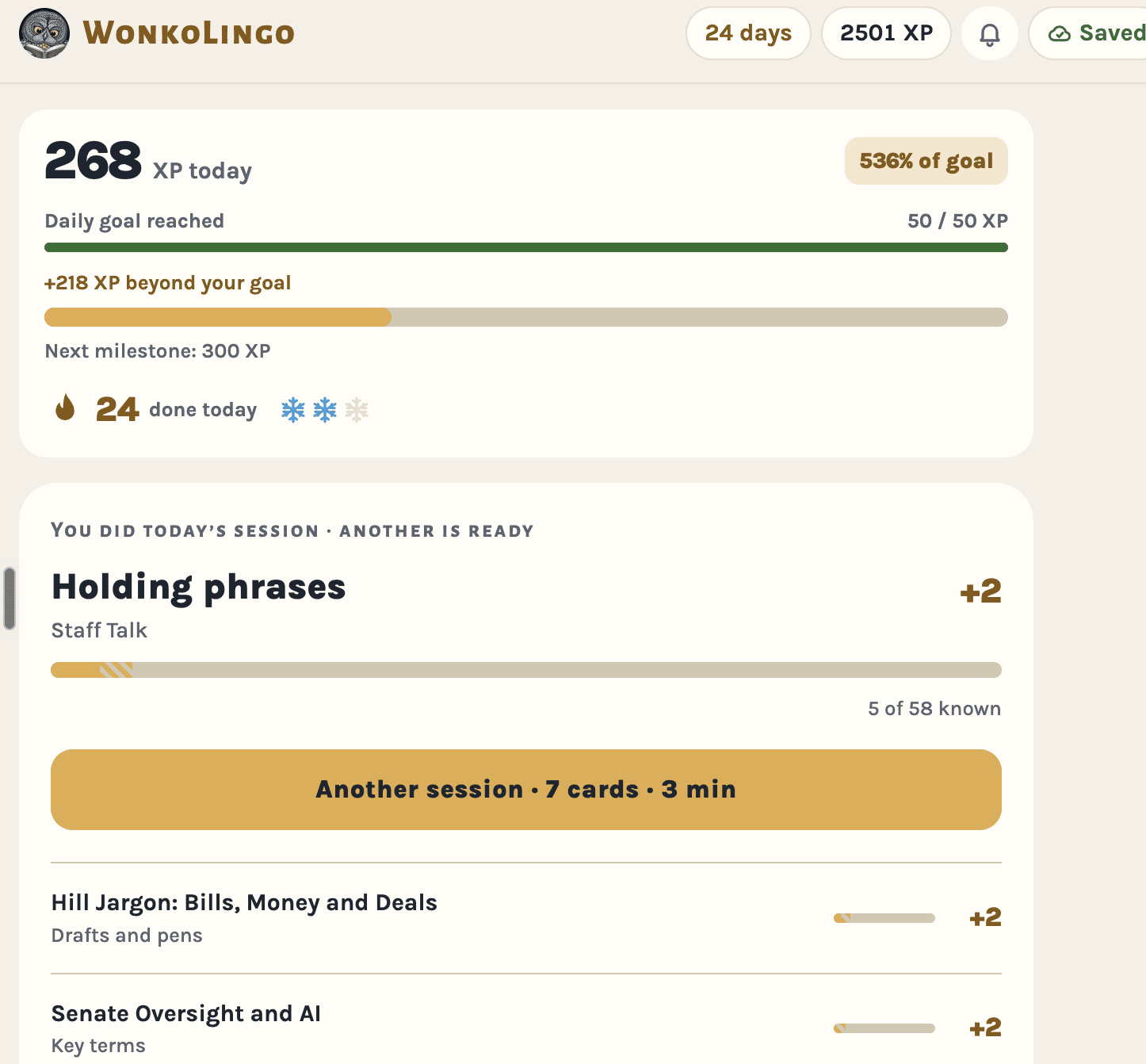
WonkoLingo (App Store or browser) is a free, AI-powered mix of Anki & Duolingo meant to teach users about AI policy, US government, and Congress. It tries to capture the entertainment and stickiness of Duolingo's streaks and reminders while using Anki-style spaced repetition. It also uses AI to grade short answer questions and give you feedback on them.
Why I made it
After a few years working in another sector, I’ve spent the last few weeks trying to get back up to speed on AI policy. I wanted enough background to have well-informed views on the various policy levers and what it would take to make them happen. I was quickly overwhelmed by how many ideas are on the table and how many areas of knowledge they draw on. I also knew I’d never actually sit down and teach myself Congressional procedure or the legal details of each proposal.
I’d tried Anki before but never stuck with it. Duolingo was a different story: I kept up a nearly year-long streak learning Hindi, mostly because of the daily notifications and not wanting to break the streak. I figured plenty of other people were in the same spot with AI policy, so I went a bit wild with vibe-coding and built a tool I hope is useful to everyone in the field.
How the courses are made
For now the courses are generated almost entirely by AI with a lot of red teaming and back and forth with me to ensure that questions are well-formulated and useful (though I haven't reviewed all cards). I generally feel good about the accuracy of the questions and broadly think they cover their topic areas in useful ways. That said, I expect there are some questions which are somewhat off or a bit confusing. In the future I'd love to have experts vet these courses to ensure they're well-built to teach what's most important but I've already found it useful as-is. In the meantime I am crowdsourcing improvements to courses through feedback, gradually working through them myself, and improving the instructions the AI follows when it writes courses.
Fun stuff
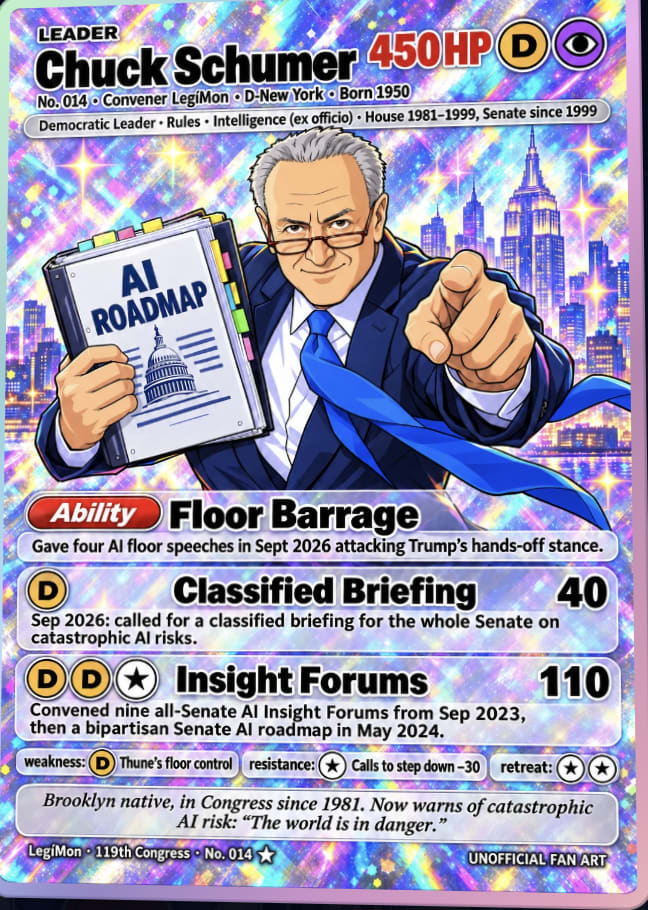
To make WonkoLingo a little more fun (and educational) I've included a reward system where you earn LegíMon cards like the one below for completing questions. You can also check out all the LegíMon cards here.
Mark any question you already know the answer to or don't care to learn 'don't need this' right away. The course cards are meant to be a menu of things you could learn rather than a list of things you need to know.
Give feedback on any questions which feel unclear or which seem off in some way (there's a button for this).
Add friends so you can see streaks & turn on notifications.
Create courses or cards for things you want to learn. E.g. if you're working at a government agency and want to learn all the acronyms of various offices and departments. To do this, use the instructions in the 'create a course' section to get your AI to generate a course, review it, then upload it. Alternatively you can add single cards to your daily lists manually or with AI help.
Please reach out if you have feedback or want to help vet courses
You can fill in this form to let me know any feedback you may have or to indicate you want to help out.
Sample questions
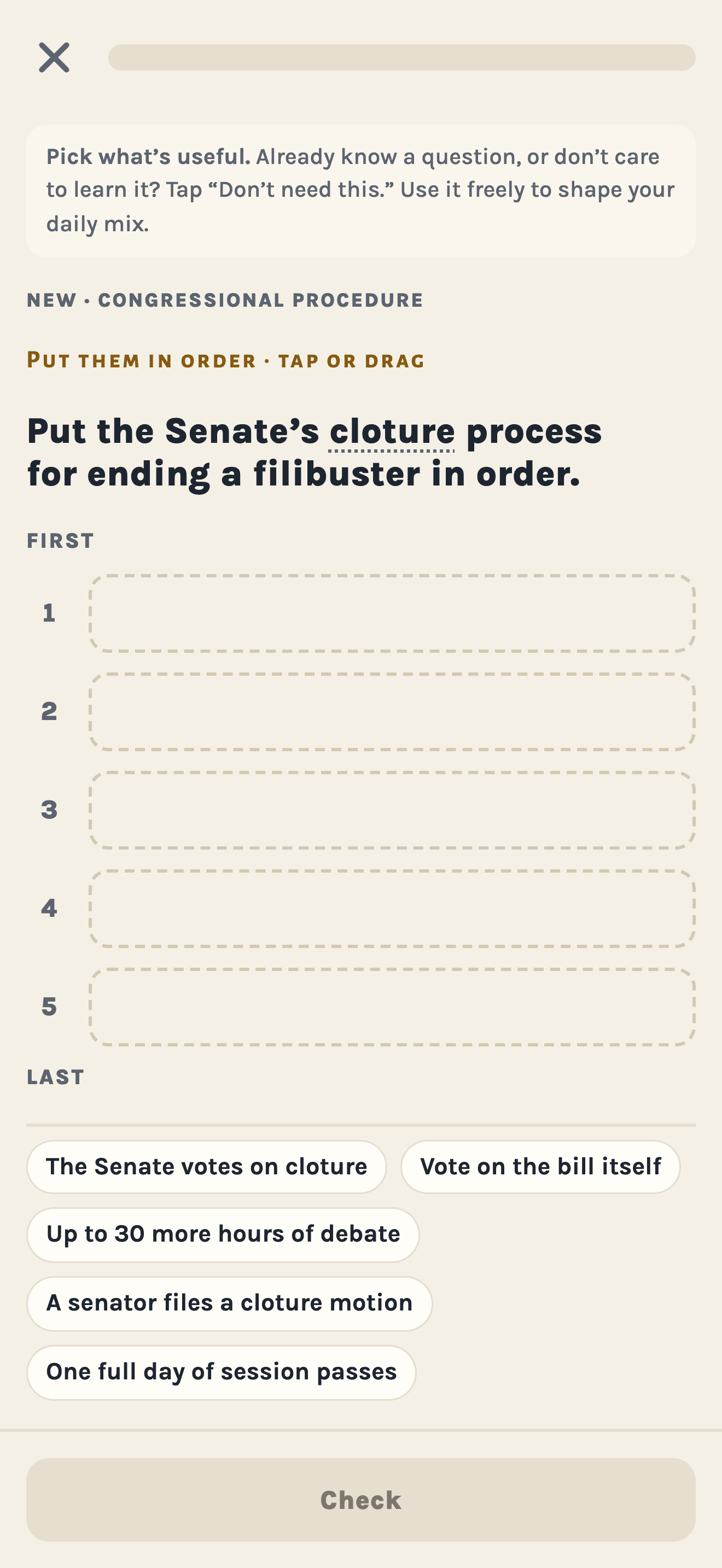
What some questions look like in WonkoLingo
SB 53 & the RAISE Act: What internal reporting system must a large frontier developer run for covered employees under SB 53?
Answer: An anonymous internal channel with monthly status updates to the reporter
Congressional Procedure: How many votes does Senate cloture on a bill usually need?
Answer: 60, three-fifths of the Senate.
AI safety policy levers: A Chinese AI lab barred from buying advanced chips rents the same chips from a US cloud company’s data center in Malaysia, where the chips were legally shipped. Name two policy tools that would help address this.
Answer: Any two of: Cloud know-your-customer rules, export controls on remote access, export license conditions that bar the data center from serving restricted customers, adding the lab’s subsidiaries to the Entity List
AI & Emergency Powers. In 1952, President Truman ordered the government to seize and run most of the nation’s steel mills to head off a strike. No statute authorized it. How did the Supreme Court rule?
Answer: Struck it down: no statute or constitutional power covered the seizure.
AI & Concentration of Power. On December 3, 2024, South Korean President Yoon Suk Yeol declared martial law and sent troops to the National Assembly. How was it overturned?
Answer: 190 lawmakers got inside and voted unanimously to lift it.
AI and Biosecurity. The Japanese cult Aum Shinrikyo had money, labs and trained scientists in the early 1990s. What happened when it tried to make biological weapons?
Answer: It failed repeatedly, then turned to chemical weapons.
AI Timelines and Forecasting. In a 2023 survey, AI researchers gave even odds that machines would beat humans at every task by 2047. What even-odds date did they give for every job being fully automatable?
Answer: Around 2116, about seventy years later.
Oversight: A senator in the minority party writes to an AI company demanding documents. Must the company comply?
Answer: No. A letter by itself has no legal force.
Note: This post was crossposted from Planned Obsolescence by the Forum team, with the author's permission. The author may not see or respond to comments on this post.
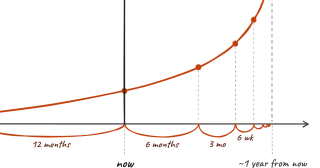
Subtitle: If acceleration compounds, the naive extrapolation implies superintelligence within a year
This post discusses a public METR report on AI R&D acceler...
TL;DR:
* When we started Rethink Priorities (RP) in 2018, our mission was, simply put, to close the knowledge gaps that stopped people from improving the world as much as they could. That hasn’t changed much, but the landscape we’re doing it in is shifting.
* In 2027, we plan to grow our core GHD, Animal Welfare, and Worldview Investigations teams to take on emerging priorities across causes, including those that the forthcoming transformative AI is creating.
...
This was cross-posted from the Animal Charity Evaluators blog.
We update our list of recommendations annually. This year, we announced our recommendations on November 10.
Most people who care about animals arrive at the same impas...