Comments
Book Review: Never Let Me Go by Kazuo Ishiguro
TLDR:
(spoilers follow, you can also read here)
This book is the equivalent of seeing someone wear a lovely, thick, warm, knit sweater on a sunny beach. The sweater plot is so nice, but I keep thinking it would really be more at home in a different location genre.
bffr
This book makes no sense as a sci-fi(-ish) novel. For context, it is about a group of clones, created so they can eventually become organ donors. Unfortunately, this premise falls apart if you think about it for even a minute.
How were these children born?
There are only two options here: they were grown in vats or they were born to human mothers.
If they were grown in vats, then this world has technology advanced enough to gestate embryos. In which case, wouldn’t it be easier to use this wonderful technology to simply grow organs in vats? Surely growing a single organ has to be easier than growing a whole baby.
If they were born to human mothers, then where are the mothers? Do they have mixed feelings about this whole setup? Are they trying to rescue their kids? The closest analog to them in our world would be surrogates who carry pregnancies for others, and surrogates don’t disappear once kids are born. Some of them like to keep in touch with ‘their’ kids or at least know of them. Some of them follow up on ‘their’ kids to make sure they’re safe; this is how some scandals about baby factories have come out. Are the mothers in this timeline okay with the kids they birthed being treated like this?
How do the clones not realize what’s coming?
For almost their entire childhood, clones only realize what’s going to happen to them at the most abstract level. They know, but they don’t truly get it. In the book, this is explained away by the schoolteachers being really careful about how they disclose information about the clones’ fates; they do it in a way that is truthful but muted.
Except there is no way a school could maintain the level of infosec required to keep these kids blinded. One of these kids would have to pick up one book, any book, and the game would be up.
- Does the book mention parents? Oh, why don’t I have parents?
- Is the book about coming-of-age? Oh, I wonder if I’ll have freedom as an adult?
- Does the book mention aging? Oh, I wonder if I’ll grow old?
I’m not saying they would have mutinied, but I don’t buy that their knowledge of their future is so incomplete. In the real world, kids do sometimes learn about sex before their parents formally give them the birds-and-bees talk, and they sometimes even learn about facets of it that their parents would really prefer they didn’t know. In this fake world, how the hell are the teachers keeping the even bigger secret of you-are-freaks-without-rights under control?
What organs are they donating?
Clones generally start feeling a little sickly after their first donation, more and more sick after subsequent donations, and die after their fourth donation. So, what four organs are they donating?
I just… I’m pretty sure the human body does not have four such organs.
Either you donate an organ and it’s basically fine (e.g., kidney, liver, bone marrow, and for the most part, lung), or you donate an organ and you die. I don’t think the human body has four organs, where the loss of each one makes you mildly sicker and sicker.
Ishiguro kind of knows this. The only time he actually mentions the specific organs being donated, he refers to a kidney and a liver. But both of these are non-harmful donations! People donate kidneys and liver lobes all the time! They go on to run marathons and have jobs! It is not a death sentence!
I have so many questions
- After graduating from school at sixteen, the clones spend two years at a cottage before beginning their “careers”. Why?
- Said “careers” consist of first caring for other clones for 2-10 years, and then becoming a donor. I’m not sure what the carers are doing. It’s presented as a fairly skillful duty, but the only caring we see on the page is Kathy bringing biscuits and water to her charges.
- This world has the technology to edit the clones’ DNA. Why not make them more docile?
I’m starting to sound whiny, or stupid. The company line around this book is IT’S NOT HARD SCI-FI. It’s unsporting to ask too many questions, because the book is not about the details of the technology. It’s about vibes. But then…
Why didn’t they escape?
The company line around this question is THE QUESTION IS NOT, WHY DIDN’T THEY ESCAPE? IT’S WHY DON’T YOU? PEOPLE CAN GET TRAPPED IN THEIR LIVES WITHOUT KNOWING THEY ARE LIVING IN A NIGHTMARE BECAUSE THEY HAVE BEEN INDOCTRINATED AND THEY DON’T REALIZE THE HORRORS…
No. No, no, no.
I actually quite like the fact that the clones don’t try to escape. I like it because this is not an action-adventure book. It would be an annoying reading experience if, after 80% of the book being a slow moody introspective monologue, the last 20% became a race to the border. I wouldn’t enjoy reading it, and I suspect Ishiguro wouldn’t have enjoyed writing it. When I read mysteries, I don’t question why murderers are always so elaborate and extra; when I read Ishiguro, I don’t question why characters don’t run. This is a walking and talking book. No running in sight. I’m willing to enjoy that as a genre convention.
I don’t accept it as an intentional choice, some sort of a commentary on the nature of invisible prisons. I think it is pretty unfair to defend against unflattering plotholes by hiding behind genre conventions, but then give credit for the flattering plotholes as stylistic choices. Either this book is bound by soft sci-fi plot conventions or it’s not. Miss me with the fundamental attribution error (literary version).
BFFs
So if the book isn’t about cloning, what is it about? It’s about a love triangle.
Namely, Tommy and Kathy are perfect for each other, but Ruth (Ruthless, hmm?) keeps them apart by getting in a romantic relationship with Tommy and in a frenemies relationship with Kathy. The central tragedy of the book is that Kathy and Tommy don’t get enough time together, first because of Ruth’s meddling, then because they are both donors destined to die young. This is the injustice that stands in for all the other injustices clones suffer off the page. It represents everything they’ve been denied: their hopes and dreams, their freedoms, their small pleasures. All of that is reflected in Kathy and Tommy only getting a few months with each other.
Why?
Why all the Sturm-und-Drang about cloning, only to not really discuss cloning at all?
Because what this book really wants you to think about is:
Is it right that we make them suffer, even though they have souls?
Kathy and Tommy’s love story provides the suffering, but the beating heart of this book is the question about souls. That’s why the book brings up cloning, only to not get into it. For the purposes of the book’s question, it is enough to know that clones exist. We don’t need to get into how or why. They need to merely exist, so we can watch them be human children, and then human adolescents, and then human teenagers, and then human adults. At each milestone, they seem so very human, and they even engage in the all-too-human act of falling deeply in love with someone else, except suddenly, at the end, they are treated as piles of organs. Clones are the perfect canvas on which to paint this question about souls, because they’re human, but they’re slightly off.
Beef
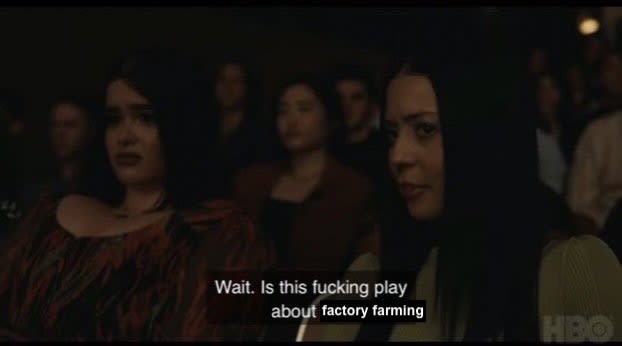
This book should have been an allegory about factory farming animals for meat.
I think the do-clones-have-souls question is uninteresting. I didn’t need a whole book to be convinced. I was convinced at the first sentence: My name is Kathy H. A human-like character telling me her name? She’s ensouled. Check.
But even if she didn’t have a soul, even if she didn’t love Tommy, even if she didn’t make art as a child, even if she didn’t dance while listening to her favorite song, even then, it would not be right to make her suffer.
Seriously, this is a book about a group that is treated as not-fully-alive, grown for their organs, in harsh conditions, and then remorselessly killed. This is factory farming. And if instead of reading it as sci-fi, you read it as an allegory for factory farming, this book is perfect. Suddenly, all the cloning plot holes don’t matter anymore.
How do they not understand what’s coming? They don’t have the kinds of minds that can predict the future (probably).
What organs are they donating? Doesn’t matter, the organs are obviously a thin metaphor for being killed for meat.
Why don’t they escape? They are animals; they literally are not smart enough to outwit their captors.
It wouldn’t take much. Let the characters live next to an animal farm. Let one of their guardians be a part-time farmer. Actually, now that I think of it, they do live in an old farmhouse for a couple of years after graduating. It has barns and stables and everything. I’m pretty delulu, so that is enough for me to make the allegory-theory my headcanon. And with this new lens, the book is even more heartbreaking than it was before.
barf
You know what’s not heartbreaking? Finishing a beautiful novel where the last two sentences are this gorgeous depiction of emotional repression:
The fantasy never got beyond that—I didn’t let it—and though the tears rolled down my face, I wasn’t sobbing or out of control. I just waited a bit, then turned back to the car, to drive off to wherever it was I was supposed to be.
And then being hit on the next page with
The questions and discussion topics that follow are intended to enhance your group’s reading of Kazuo Ishiguro’s Never Let Me Go. We hope they will aid your understanding of this devastating novel of innocence, knowledge, and loss.
Fuck off with the "devastating novel of innocence, knowledge, and loss"! I’m still crying. Let me recover.
I think movies do this absolutely right where, after taking you on a wild emotional journey, they’ll give you long end credits with appropriate music to pull yourself together before you reenter the real world.
Books could do this too! The ideal ebook experience would be, after finishing this book, having the option to listen to the original Never Let Me Go song. Or, if playing an mp3 is too much to ask in 2026, the publisher could put in a drawing, a small reflection from the author, hell, even a map of Norfolk. Anything. Please. Just don’t end abruptly like


TL;DR — It’s mildly interesting that a famous artistic married couple in the 1800s was on opposite sides of the doomer/boomer dichotomy, in a way that feels surprisingly contemporary in relation to AI discourse.
(A better formatted version of this is here.)
Frankenstein; or, The Modern Prometheus is a mediocre book wrapped around one small and dazzling idea. What if a scientist thoughtlessly invented something huge, and then not even a full second after the invention finally worked, realized that he’d made a huge mistake and ran away?
The idea cuts away a lot of unnecessary realism (how difficult it is to invent something, how rare moral epiphanies are, how people stick to bad projects because of sunk costs, how hard it is to forecast badness) to boil down to a single scene the whole moral question around science: what happens when a scientist invents something BAD?
In Frankenstein, the scientist runs away in horror. And then a whole bunch of tedious gothic melodrama happens and some people get hurt but none of that really matters. The book isn’t famous for what happens in the Arctic expedition sideplot or the ‘spying on people in a cottage’ sideplot. It is famous because the scientist ran away in horror.
It is easy to imagine why the question of science being bad was in vogue at the time. Science was in the air. Mills and machines were in use. Children were in factories. Aldini was using electricity to induce twitches in corpses. Luddites were up in arms. Several million smallpox vaccines had gone into arms. The famous GDP chart was initiating the launch sequence.
But Mary Shelley wasn’t the only Shelley writing a book with Prometheus in the title and a reference to Paradise Lost on the first page. A mere two years after Mary Shelley published her book, her husband published Prometheus Unbound.
The title is a reference to Greek playwright Aeschylus’s Prometheus Bound. In that play, Greek god Prometheus finds out Zeus is planning to kill the human race, so he goes behind Zeus’s back and gives humans not only fire, but also skills like writing, math, and agriculture. Zeus is mad and he punishes Prometheus by tying him to a mountain and torturing him, but eventually they reconcile.
Percy Shelley rewrites the Greek ending to give Prometheus his heroic due. In his version, Prometheus doesn’t reconcile with Zeus. No, Zeus is a tyrant, and reconciling with him would defile Prometheus. Instead, Shelley has Zeus be deposed, so that Prometheus can be freed while remaining unrepentant. And mankind, now ruled by a kind and just ruler, blossoms:
These are opposing visions of what happens when mankind gets knowledge that gives it godlike powers. In Mary Shelley’s doomer vision, the person who uses this power regrets it immediately, and suffers because of it for the rest of his life. In Percy Shelley’s boomer vision, the person who gives mankind this power never regrets it, and eventually lives to see his actions result in utopia on Earth. Two hundred years later, on the eve of transformative AI, both their visions are still live.
Thanks for sharing. I've been thinking about Frankenstein a lot recently and I hadn't read Percy Shelley's work.
Arguably, the scientist ran away in horror before the work was done. There's a plot line that gets cut from a lot of adaptations where the creature kills someone and a servant girl gets blamed. Frankenstein knew it was likely the monster yet says nothing, allowing the girl to be executed for the murder.
In the book, there's surprisingly little time spent on the creation of the creature, he does it quickly and unthinkingly as a student. Whereas the lab scenes are the main event in movie adaptations.
Perhaps helpful context about Mary and Percy Shelley: