The 2-day-long national Swiss AI Safety conference in Zurich happened this last weekend, it was cool, and you should consider coming next time if you're able.
Main post
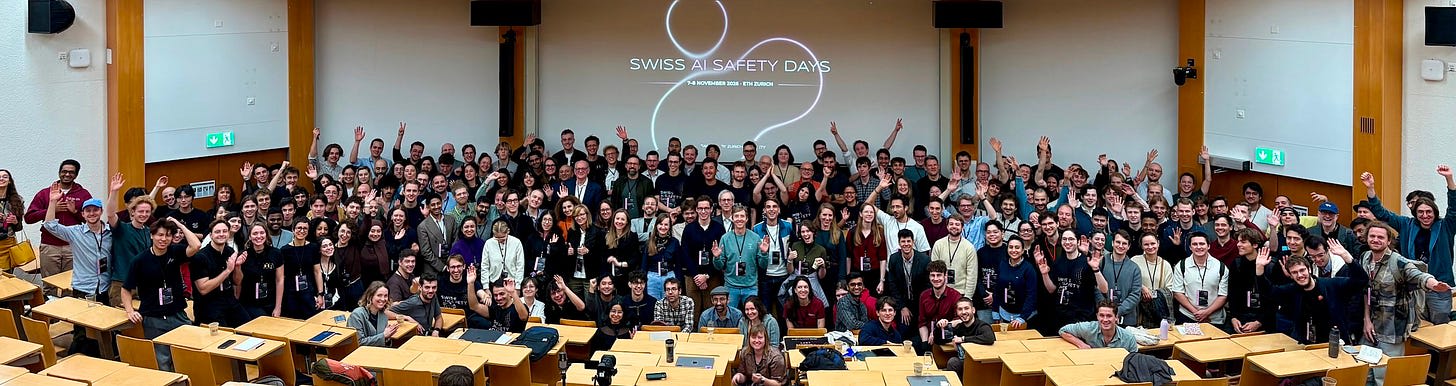
In a recent episode of his podcast, Steve Eisman—the real-life guy from The Big Short and a man I respect—claims that the only reason the labs are scared about AI risk is that the people in Silicon Valley are all nerds who can't tell that science fiction is meant to be fiction. This is wrong on many levels[1], but perhaps the biggest sin is implying that the only ones talking about this are in Silicon Valley. Meanwhile, 9000 km away[2] from California, over 400 of us nerds met up in Zurich last weekend to figure out how to make AI go well for everyone. The Swiss AI Safety Days 2026 (SAISD26) just ended, and it was a blast. Here’s my experience attending as an ETHZ master’s student.
The nerds in question
Why Zurich anyway?
Eisman was at least correct in that the Bay Area is one of the two most important AI Safety (AIS) hubs, with London being the other one. But momentum is building outside the US and the UK. Singapore, Paris, and many other cities have dedicated AIS offices and orgs. Zurich is one such place that I’d argue is particularly well suited for technical AIS: the city is home to a top 3 school in engineering worldwide, has some of the bestML researchersin the world, and hosts offices of essentially every major player in AI.[3]
Switzerland more broadly is also well suited for policy work, given its history of neutrality and recent concern over global AI risks from the Swiss government. This mostly happens in Geneva and Bern, but it’s easy to move between any two cities in the country, so there’s a strong link between the work there, and the more technical side here. There are strong exchanges with other hubs as well, because Zurich is well connected to all of Europe.
And it’s also just nice to live here. I cannot stress enough how cool and well-functioning this city is.[4] Efficient and reliable public transport, walkable everywhere, and with two blocks rarely looking the same. It’s lovely.
I credit these advantages as some of the main reasons Zurich AI Safety (ZAIS) has been able to grow so quickly. They ZAIS team organized SAISD26, and this year was only its second edition. In just one year, applications doubled (800+), and the event ran at full capacity (440). I have no doubt that they will be looking to expand even more next time.
Who was there
Age range
The most striking thing to me was the variety of people attending. Of course, there were the big-name speakers like Stuart Russell or Yoshua Bengio. But mostly, what I saw was a strange and exciting mix of ages and backgrounds. A lot of us were students, so naturally I met many people on the younger side (18 to 26 range). From Swiss universities, yes, but also neighboring countries like France, Germany, and Austria. But I also saw and talked to attendees with decades of experience, most notably professors and senior engineers. The variance in ages was much larger than other conferences I’ve been to.
Backgrounds
This was also the case for backgrounds. It’s true that most were focused on the technical side, but it certainly wasn’t all. AI law and policy was still a notable focus, and I also saw social scientists and science communicators. Overall, one thing I did feel—and which was quite reassuring—is that this was an exceptionally smart and capable group of people.
Orgs
I should also mention the orgs. A lot of the big AIS players had representatives at the event. A technical lead from Google DeepMind gave an off-the-record talk, as did a founding member of Apollo Research. Apollo also had a stand, along with Anthropic, Future of Life Institute, FAR.AI, MATS, ARENA, Pivotal, Apart Research, MIRI, Epoch AI, EleutherAI, 80,000 Hours… You get the idea.
The vibe
The sense I got from the keynotes, workshops, and 1-on-1 discussions was a blend of excitement, fear, and a sense of duty.
Excitement, because as the AI industry has grown exponentially, a similar trend is emerging in AIS. There is more money than ever, more orgs than ever, more political support for it than ever. And yet the field is still very new, which can also be exhilarating. People doing PhDs in experimental physics sometimes spend years working on a single project. The PhD students I talked to in AIS say it feels like they’re doing 4 or 5 projects in the time span of one.
But that’s also what caused the fear. About the only fact that had strong consensus is that we are not ready for transformative AI. We don’t understand how the models work yet, we don’t know how to steer them or keep them contained yet, we don’t know how to properly evaluate them yet. And although progress has come in each of these areas, it is rapidly outpaced by the progress in capabilities.
This then led to the sense of duty. Most of the attendees at SAISD were mission-driven.[5] They think the risk from AI is too big to ignore, and decided to work on it themselves. I did not get the sense that there were many who were in it for money, prestige, or any reason other than legitimate concern.[6] I don’t know how sustainable this will be if the field continues to grow, and I think it’s good that there are already other incentives to join. But at least for now, SAISD attendees were mission-driven.
Not just extinction risk
One thing I think is worth highlighting is that not everyone at the event considered human extinction as their main concern. I spoke to somebody with an important position at an org you’ve probably heard of. When I asked them what the field was missing, they told me that, in their view, too many funds were going towards preventing extinction risk. The risks were real to them, but they didn’t think it was plausible enough to be number 1. Because so many funds go towards preventing that, they thought other important issues were being neglected.
I share this not to say that I agree or disagree with this view, but to highlight that AIS isn’t just about doom. This person was legitimately concerned about AI, had dedicated their career to its safe development, and had worked at some of the most important institutions in the field. And yet they questioned the likelihood of extinction risk.
I take away 2 things from this: first, that we should preserve and encourage more diversity of opinions within AI safety. I’m glad that we don’t all agree on what the priority risks are, because if we did then we would definitely be missing something! But second, it also shows that even if you reject the plausibility of doom scenarios, you can (and I think should!) still be worried about the safety of AI systems. And there might still be things to do within AI safety that feel both meaningful and interesting to you.
What I learned
On a personal note, I really did get a lot out of SAISD. I came in with a bunch of questions about what to do with my career, and how to help. Oddly, I don’t feel like I got answers, but rather what I got was better questions.
I went into the event unsure if I should drop out of my master’s; I’ve come out of it looking into what learning opportunities would warrant doing so, and looking into how I can upskill and learn within ETH if those other opportunities don’t arise. If I were to stay, I also wondered whether I should change my master’s to Computer or Data Science; instead of looking to homogenize with the field, I’ve come out of SAISD hungry to see where my specific skillset and background would be useful in ways that others haven’t been able to cover. And I also wanted to know which area of AIS I should try to go into. Instead, I’m now wondering how to develop research taste and identify areas that everyone might be neglecting.
Food and venue
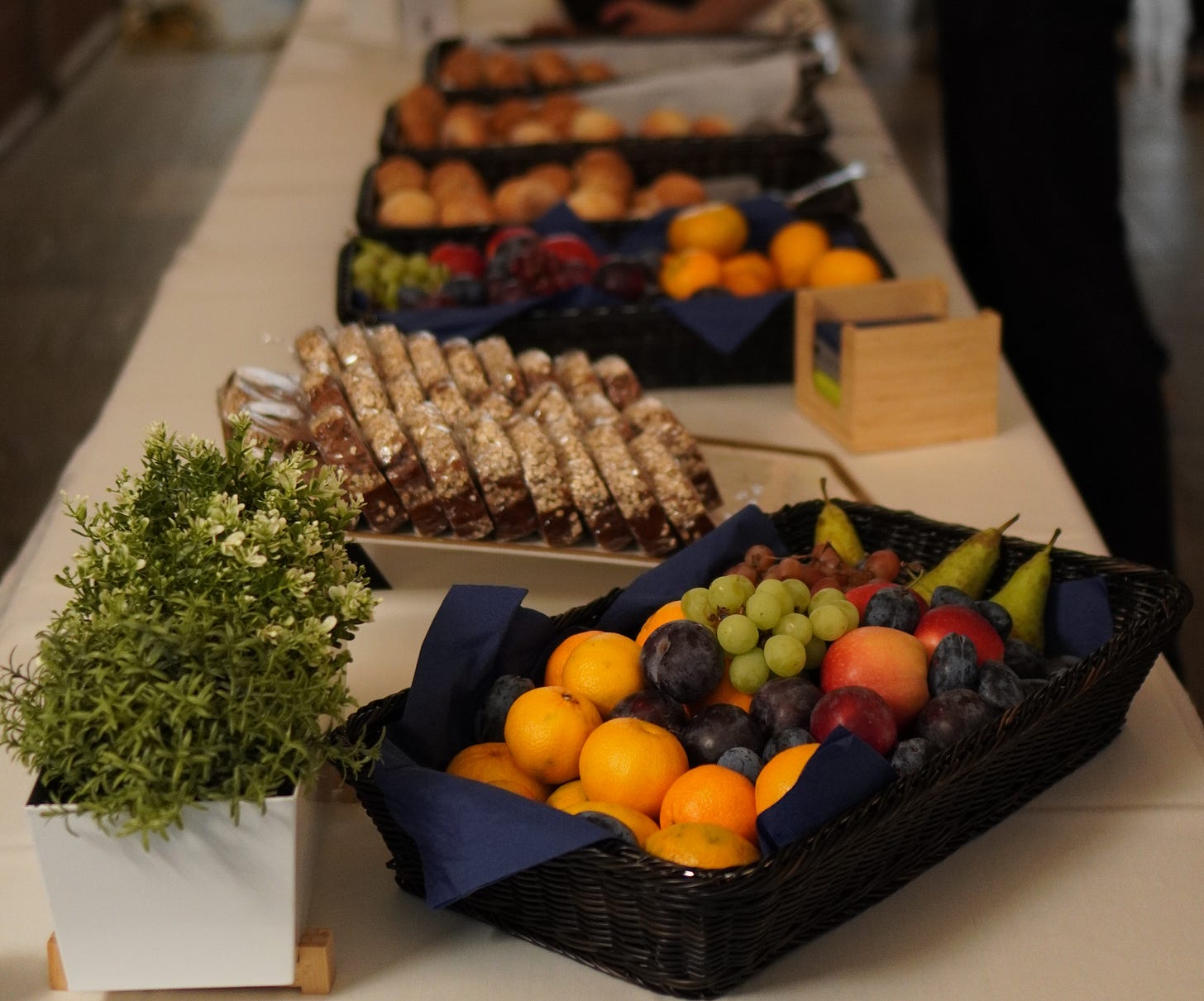
You can tell whether an org is ready to scale based on how they handle logistics. The event ran smoothly, and the all-plant-based catering was absurdly abundant and better than events three times its size. Kudos.
Breakfast included fresh fruits, cakes, and excellent croissants
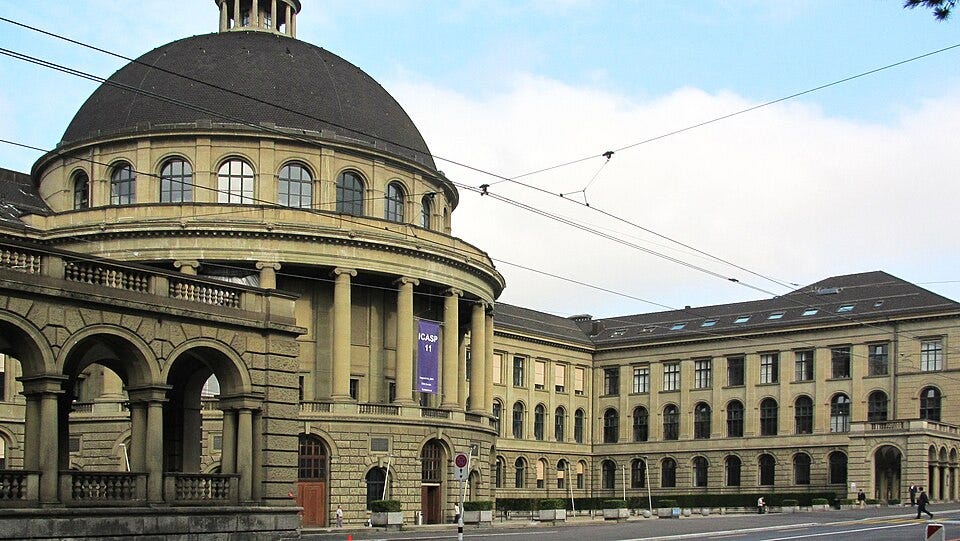
The conference itself was hosted in ETH’s main building.
Zürich, ETH Hauptgebäude by Jürg-Peter Hug (Juerg.hug) / CC BY-SA 3.0
It’s a beautiful and iconic building that’s definitely worth a visit.[7] I do think it’s confusing to navigate for newcomers, and the acoustics near the main hall aren’t great. So that’s maybe something to reconsider. But it was pleasant overall.
Bottom line
I really enjoyed my time at SAISD26. It clarified a lot of things about what AIS is, and what steps I need to take to start contributing. It made me glad to be in Zurich, which feels like a city that is rapidly growing for AI safety. I see a path for us to become another one of the big hubs, and although I don’t know if we’ll get there, I’m excited by the possibility.
But none of that matters unless we do something. The last words spoken at a SAISD26 keynote came from the closing remarks of Patrick Widmann, the director of ZAIS:
We can talk for two days about AI safety, but if we don’t act on it, nothing will change.
Also notable is the implication that any event told through fiction cannot happen in real life. As if sci-fi didn’t have a track record of occasionally predicting the future.
The locals might try to downplay how awesome Zurich is. DO NOT LISTEN TO THEM. The Swiss are sometimes shockingly oblivious at how bad most cities are in comparison. This is true even for Europe, but it’s especially true if you—god forbid—come from the Americas. They can’t even imagine how poorly we design our cities over there.
Tbf, there is also a survivorship bias here. ZAIS had to filter in who got accepted, and how committed someone was to AIS was one of the factors that helped them decide. Less mission driven participants may have applied and been rejected
In fact, given the level of credentials of most working participants, I suspect they could be making more money, or would have something more stable, outside AIS. But I have no data to back this up so take it with lots of salt
It’s worth a visit, to the chagrin of us students, who sometimes end up acting like zoo animals, as we study while tourist take pictures through the windows lol
Crossposted to Less Wrong
‘Like most of life’s dangers, the dangers of artificial intelligence are not easily identified from the armchair.’
J Dmitri Gallow
Epistemic status
I’m not an expert in this field, and herein I make some sweeping generalisations educated guesses about the overall...
Note: This post was crossposted from Planned Obsolescence by the Forum team, with the author's permission. The author may not see or respond to comments on this post.
Subtitle: If acceleration compounds, the naive extrapolation implies superintelligence within a year
This post discusses a public METR report on AI R&D acceler...
TL;DR:
* When we started Rethink Priorities (RP) in 2018, our mission was, simply put, to close the knowledge gaps that stopped people from improving the world as much as they could. That hasn’t changed much, but the landscape we’re doing it in is shifting.
* In 2027, we plan to grow our core GHD, Animal Welfare, and Worldview Investigations teams to take on emerging priorities across causes, including those that the forthcoming transformative AI is creating.
...