Comments
Donors need to know how best to fund peace: Introducing CEGA's Peace Per Dollar Initiative
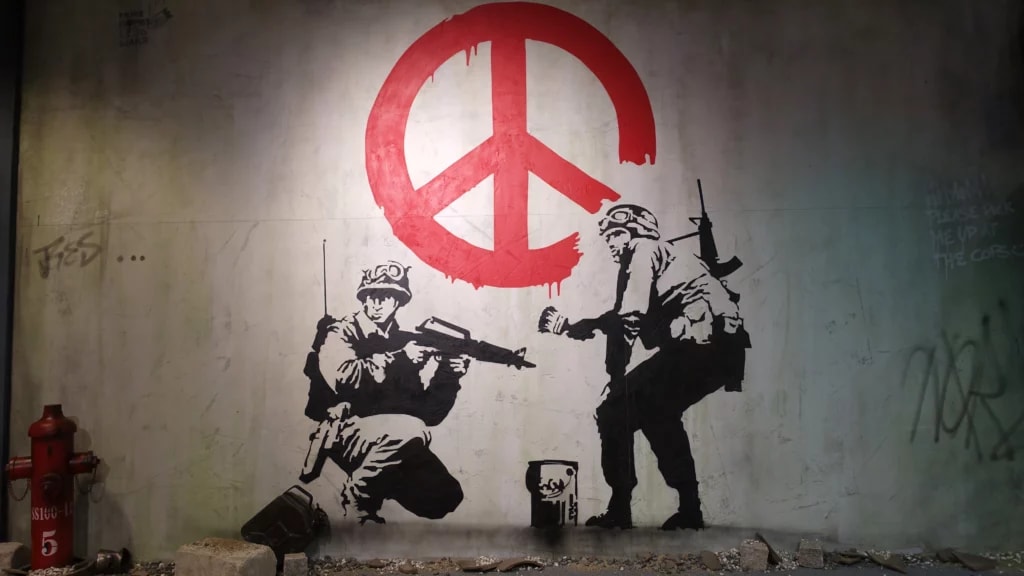
Stockholm, Sweden, The mystery of Banksy. Max Folle
Authors
Josh Martin Eeman Abbasi Sean Luna McAdams
Wars are getting both more frequent and more destructive. Our technology for preventing or even mitigating political violence has improved to help us meet this challenge. But are we really able to “stop a war” before it starts? If so, how much would it cost? And would it be worth it?
Recent decades have seen a welcome emphasis on “what works” in development. Yet economists like Nobel Prize-winning Esther Duflo have argued that modern development economics should be “more concerned about ‘how’ to do things than about ‘what’ to do.” Responding to this call and to recent cuts in development assistance, the sector has renewed its emphasis on cost-effectiveness as a north star for value. Peacebuilding – our principal technology for addressing political violence – is playing catch up, recognizing that its sustainability depends on delivering verifiable social return.
What would it take to have a functioning market for evidence in peacebuilding?
Only 1.3% of the US Agency for International Development 2021 budget was dedicated to “Conflict, Peace and Security” programs. In 2023, just 0.2% of the World Bank’s operational budget was dedicated to the organization’s largest multi-donor trust fund for “state and peace building.” The United Nations Secretary-General has frequently called for member states to commit greater resources to conflict prevention.
The paucity of international investment in preventing conflict seems out of step with the salience of the issue. High profile wars and terrorist attacks dominate news cycles and affect political debates in many countries, particularly in the OECD. After many decades in which they decreased, battle deaths hit a 30-year high in 2024. Wars are not only more frequent, but bloodier than they have been in the past.
Analysts have frequently attempted to make the “business case” for increased investment in conflict prevention, arguing that the billions spent yearly in peacekeeping and humanitarian assistance—representing only the most direct consequences of conflict—should alone justify a greater focus on prevention. In the landmark Pathways for Peace report (2018), a dynamic cost-benefit analysis found that the international community could save close to $2.5bn per year in potential peacekeeping by investing strategically in conflict prevention in only a few countries, effectively covering the full cost of the initial investment within 15 years. More recently, an IMF working paper claims an economic return as high as $103 for every dollar spent on conflict prevention via “conflict-sensitive” macro-economic policies alone.
Unfortunately, such arguments have not garnered action from decision-makers. The missing link seems to be the difficulty in demonstrating how prevention funding could be spent to effectively reduce the likelihood of violence. Critically, researchers have only weakly linked programs and policies rigorously tested in the empirical scientific literature to precursors of large-scale outbreaks of violence. While many studies have shown promising reductions in violence, crime, or support for aggression, it is much less clear how violence prevention techniques might be scaled, or bundled, to meaningfully reduce large-scale events like war. (How many former combatants must go through trauma-informed psychosocial support in order to prevent the resurgence of hostilities? How many national dialogue forums must be televised in order to create the political will needed to sign a peace agreement?) In 2022, the foundation Open Philanthropy (now Coefficient Giving) investigated the social value that could be harvested from investing in preventing civil conflict, concluding that although it is “reasonably convinced this area is both important and neglected relative to its importance….[we are] quite uncertain how much of a difference micro-scale interventions like cognitive behavioral therapy will make on macro-scale events like war.”
Demonstrating the “tractability” of conflict prevention as a social investment requires not just more research, but better research—namely coordinated and targeted research designed to plug gaps in the current understanding of how individual-level interventions to prevent conflict ladder up to collective benefits through increased community trust, cooperation, and ultimately peace (or, alternatively unrealized violence and destruction). It also requires testing its utility at the scale required to prevent conflict. Taken together, the promise of some day being able to ‘engineer peace’ depends on more robust mechanisms for getting leaders to use research appropriately in the practice of conflict prevention.
Donors need to know how much peace they can buy with their dollars: Introducing Peace Per Dollar
On October 17-18, 2024, CEGA and the United Nations Office for Countering Terrorism’s (UNOCT) International Hub for Behavioral Insights jointly hosted an event on the sidelines of the Empirical Studies of Conflict (ESOC) Project Annual Meeting at the University of California-Los Angeles featuring 18 carefully selected experts from government, civil society, academia, and international institutions to discuss the opportunity to “engineer peace” through an improved research-to-practice pipeline in the field of conflict prevention. Discussion centered on the role of a new research-to-practice hub that would seek to catalyze a) the production of empirical research on preventing and countering extremism and political violence and b) the translation of this research into deployable and cost-effective interventions that could meaningfully reduce the burden of conflict in fragile settings.
CEGA’s new Peace Per Dollar (PPD) initiative is the first iteration of this vision. Before we can produce more empirical interventional research and translate it, we need to answer basic questions and establish norms for what cost-effectiveness should look like in this sector. Which interventions are relevant for comparison? What needs to be measured? How can we ensure harmonization of outcomes and cost data templates to allow the field to accumulate knowledge through metastudies and cost-effectiveness analyses? Critically: how sensitive are donor decisions to new evidence that might change their perspective on the value of a given peacebuilding technique?
CEGA’s Approach
Donors have reduced development and humanitarian budgets; it is even more important as a sector we develop and institutionalize approaches that will allow us to prioritize investments to ensure we continue to make impact. PPD is part of CEGA’s cost-effectiveness agenda: if we are to credibly alleviate human suffering caused by war we must first identify the most cost-effective strategies for conflict prevention. We are also building standards, tools, and methodologies to rigorously measure the cost of rigorously evaluated interventions both retrospectively and prospectively to bring this critical piece of information to the service of decision-makers making consequential decisions of how to invest limited public budgets. Understanding the “return to investment” among different peacekeeping interventions, or peacekeeping interventions versus competing investments in anti-poverty, health, or education efforts will be a critical decision-support input for leaders in the social impact sector.
Our goals at this early stage are humble. We need to first articulate—and gain acceptance for—our methodology for cost-effectiveness. That means establishing parameters that allow us to compare different kinds of peacebuilding interventions. We will gather and systematize data on both impact and cost, both of which are lacking in the current empirical literature (the latter is nearly non-existent). Finally, we need to tighten confidence intervals by offering support to organizations who seek to improve the rigor of their impact and/or cost estimates.
These are all analytical tasks. If we succeed in executing these, will we see a response from both demand and supply of the peacebuilding market? Will new donors emerge? Will legacy peacebuilding organizations seek to demonstrate more rigorously that they can be worthy destinations for funding? We believe there are many more people, including philanthropists and practitioners, who care about ending destructive wars and promoting peace than one might assume. We hope our research will give them the tools they need to make the right choices in deploying evidence to prevent and mitigate war.