Comments
Vasco, I have read your analysis on advocating for furnished cages with great interest - thanks for posting it. While I appreciate the rigorous attempt to quantify welfare impact using a cost-effectiveness framework, I believe the resulting conclusion—that we should pivot to advocating for furnished cages—relies on a clinical interpretation of data that conflicts with the biological and operational realities of egg production & hen welfare.
As a welfare specialist with experience measuring these systems on-farm, I would like to offer a counter-perspective on why furnished cages are not a "stepping stone," but a strategic dead end.
1. Improvement vs Acceptability
Your model suggests that furnished cages capture ~70% of the welfare benefits for a fraction of the cost. This relies on the premise that welfare is a linear scale where "less suffering" equals "adequate welfare."
This is a false comparison. A furnished cage might be cheaper to install & run than a cage-free aviary, but it fails to solve the fundamental problem. To use an analogy: A bicycle is significantly cheaper to buy and run than a car, but if your requirement is a 100km daily commute, the bicycle is not a "70% solution"—it is functionally insufficient.
Similarly, while a furnished cage is empirically better than a barren battery cage, it still abjectly fails to meet a hen’s most basic ethological needs. It provides a slightly less bad life, but it does not provide a life worth living. It offers almost no opportunity for positive experiences or pleasure (let alone basic needs), which are critical components of any welfare assessment. I’m interested to understand how you accounted for positive experiences?
2. The Reality of "Furnishings" - and a correction re cage standards
You mention that furnished cages in the EU require specific resources, such as "at least 250 cm² of littered area per hen". This is incorrect. That specific requirement is for non-cage systems.
The requirement for furnished cages is "litter such that pecking and scratching are possible." In practice, this usually manifests as a small area of Astroturf. On farm, we see these resources failing consistently:
- Nesting: The "nest" (not 1 per 7 hens as suggested in your post) is often just a curtained corner. It lacks the seclusion hens are highly motivated to seek, and because space is so limited, these areas are frequently dominated by higher-ranking hens, blocking access for subordinates, resulting in stress and frustration
- Perching: The perches in furnished cages often have limited head height and hinder movement around the cage. Birds resting on them are frequently disturbed or displaced by active hens because there is nowhere else to go.
- Dustbathing: This is a high-priority behavior for hens. It is simply not possible in a furnished cage.
- Claw shortening devices: these are required because the hens can’t engage in appropriate floor scratching behaviour , which would lead to natural claw shortening
Advocating for furnished cages would amount to welfare washing. It allows the industry to claim they have "reformed" the system by adding token resources that do not meaningfully improve the bird's subjective experience.
3. Infrastructure lock-in
You argue that advocating for furnished cages could "create momentum" for global efforts. I strongly disagree. I think it would present a strategic risk.
Producers operate on long investment cycles. If we convince a producer in a developing market to invest millions in furnished cages today, we are not creating a stepping stone; we are cementing a ceiling for the next 20 years. Once that capital is sunk, the economic incentive to upgrade again to cage-free vanishes.
We have seen in Europe that welfare in cage-free systems improves over time as producers gain experience. The cage-free system has a high ceiling for welfare potential; the furnished cage has a very low one. By advocating for the latter, we are complicit in locking millions of birds into a system that the rest of the scientific & advocacy community recognises as negative for welfare. I am in total agreement with you that advocating for furnished cages would decrease the cohesiveness of the existing community working to improve the lives of laying hens globally
Conclusion
Your calculation determines that furnished cages are "cost-effective", but it prioritises economic efficiency over the subjective experience of the animal. A system that denies a bird the ability to dustbathe, escape aggression, or experience pleasure should not be considered a welfare reform (rather a system reform), regardless of what the data says.
We should not dilute the global standard. Cage-free is currently the only commercially feasible option that meets what the scientific welfare and advocacy community almost unanimously recognises as the minimum threshold for acceptable welfare.


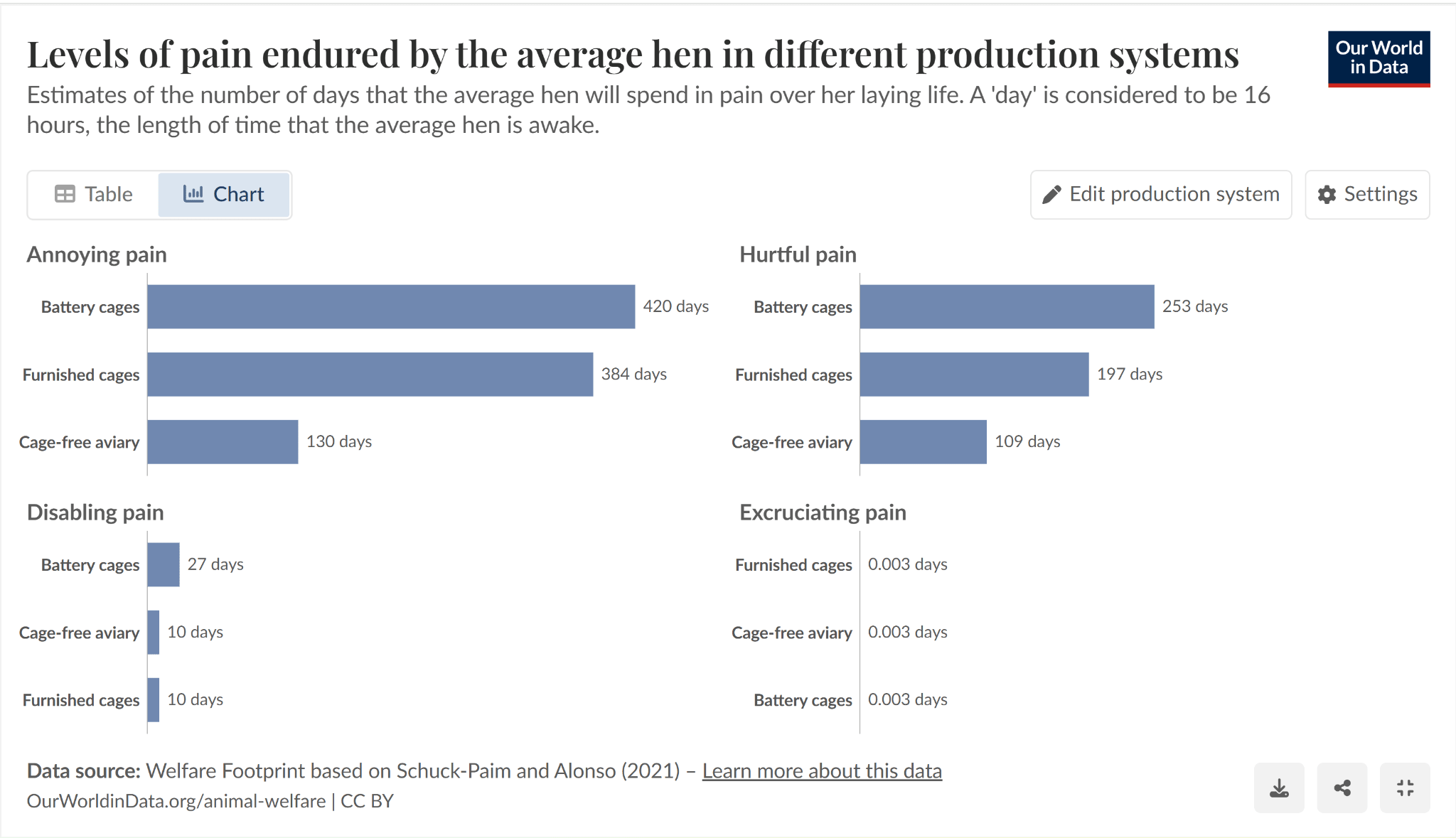
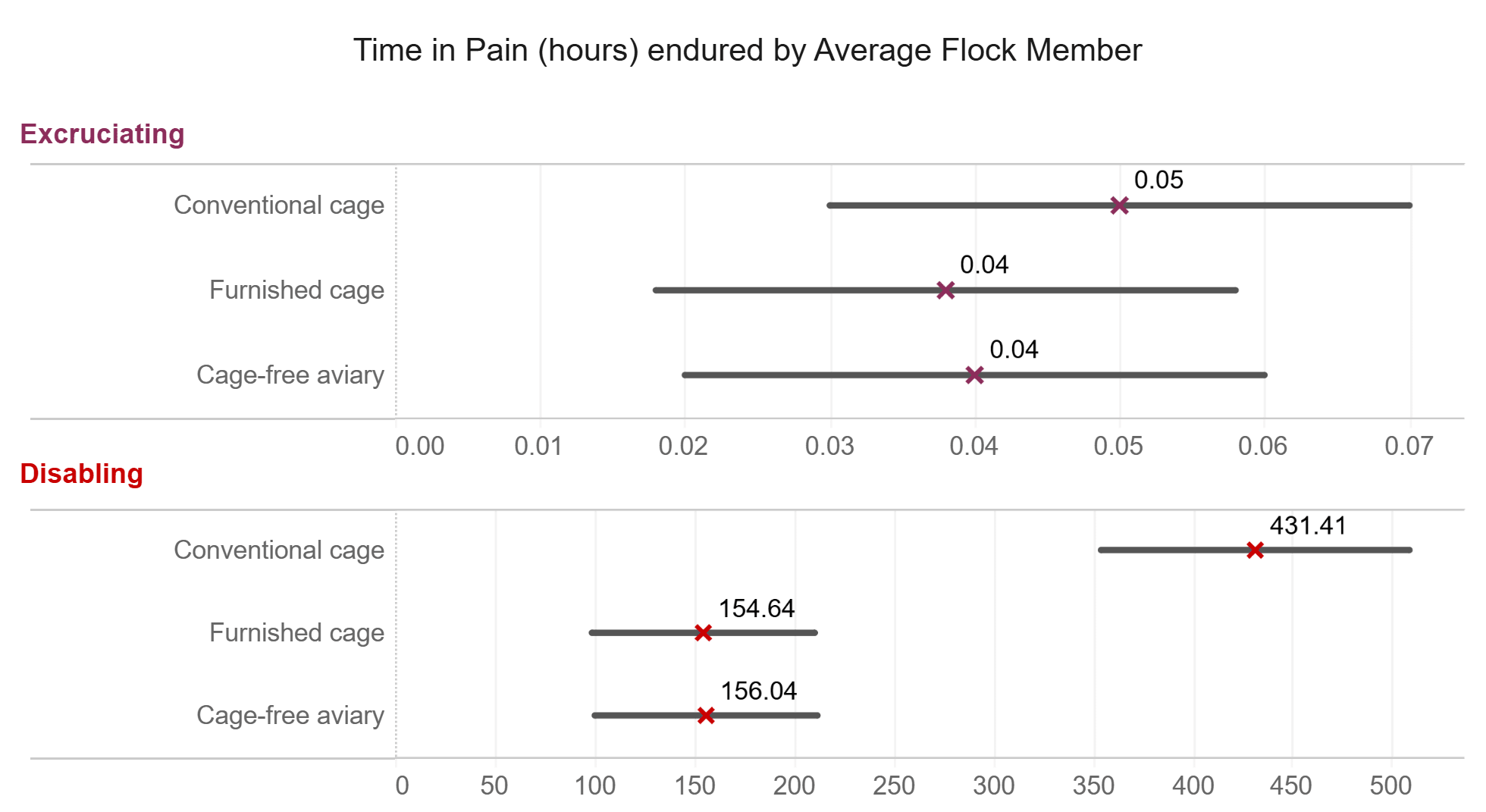
I don't think this is a good idea:
Thanks for the relevant points, James.
Changing from conventional to furnished cages, and from these to cage-free aviaries is more costly than directly changing from conventional cages to cage-free aviaries. However, the direct change requires a greater initial investment, and has a greater potential to decrease revenue due to increasing the cost of eggs 4.02 (= 1/0.249) times as much as the change from conventional to furnished cages. So I think having furnished cages as an intermediate step may at least in some cases derisk the overall change. 2 changes would still not make sense for a short time between changes. However, even if furnished cages are fully banned in the EU from 2032 on, which I guess is optimistic, there would still have been 20 years (2012 to 2032) with battery cages fully banned, but furnished cages not banned in the EU. Assuming there are still 30 years until 90 % of layers are cage-free, some farms will only make the final transition in 30 years. This could mean 15 years until full implementation of furnished cages, and 15 years from this until full implementation of cage-free aviaries.
I discuss this a bit in the 1st paragraph of the discussion. In addition, I wonder whether the significant reduction in the time in pain as assessed by WFI could be used to get people enthusiastic about having furnished instead of conventional cages.
My intuition is that the probability of securing a welfare reform is a sigmoid function (S-curve) of "advocacy spending"/"increase in cost". If so, and furnished cages increase the cost of eggs 24.9 % as much as cage-free aviaries relative to conventional cages, advocating for furnished cages could increase the probability of securing a welfare reform a lot for cases where advocating for cage-free aviaries results in a probability which is still at the bottom of the sigmoid.
I agree verifying furnished is harder than veryfying cage-free aviaries. Do you know the extent to which this was a challenge in the context of the EU's ban on conventional cages? I assume enforcement is usually more difficult in other regions. On the other hand, they already have the EU as a model to follow.
Very interesting discussion - thank you for this!
"However, even if furnished cages are fully banned in the EU from 2032 on, which I guess is optimistic, there would still have been 20 years (2012 to 2032) with battery cages fully banned, but furnished cages not banned in the EU."
I think this scenario is accurate but only if the period between the (first) ban on battery cages and the (second) ban on enriched cages is exactly 20 years.
In this two-step approach, any ban on enriched cages will require a transition period that is approx. 20 years starting from the moment the enriched cages were built. This is the average time companies need to write off their cage infrastructure (Belgian and Dutch studies mention 15 to 25 yrs depending on cage type etc.). Countries will not enforce a ban before the writing off period has ended (unless they are willing to compansate companies for these costs which seems unlikely).
Turning to the EU situation; if the ban on enriched cages is adopted before 2032 (ie. 20 years after the 2012 ban), the enriched cages (built in 2009-2011) will just be written off so EU countries could indeed limit the transition period of the ban to 2032.
However, if the ban on enriched cages is adopted after 2032, many of the 'first generation' enriched cages may have been replaced by new enriched cages. This will push countries to provide a new transition period of 20 years starting from the adoption of the ban. This would mean 2052 or later.
So if we advocate the two-step approach, we must be sure that thesecond ban follows within 20 years. And that's something you can never be sure of (as legislators can always postpone these deadlines).
Thanks for looking into this, Joren.
You seem to assuming that furnished cages are overwhelmingly built every 20 years, and were last build just before 2012. If this was the case, the vast majority of furnished cages would be renewed just before 2032 without a ban to end furnished caged before then. So I would agree that a ban would as a result happen in 2032 or 2052. However, in reality, I expect furnished cages to be built or renewed gradually, not all at once across the EU in a few years. So I believe a ban on furnished cages does not have to start in very specific years further apart by 20 years like 2032 or 2052.
In any case, I do not think it would make sense to advocate for furnished cages in the EU. Only 38.2 % of layers were in cages in the EU in 2024. So there is already significant momentum for cage-free.
I believe advocating for furnished cases in Africa and Asia would be better (although I am not confident it would be a good idea). The timeline I suggested above of 15 years until full implementation of furnished cages would allow for 75 % (= 15/20) of conventional cages to operate for a lifetime of 20 years. The remaining 25 % could be compensated for the 5 years (= 20 - 15) of fixed costs that did not get amortised. Moreover, there would only be rigid timelines applying to a whole country for political work. For work targeting companies, there could be different timelines, and therefore less need for some producers to end the operations of farms before they operate for their whole lifetime. Companies transitioning to furnished cages earlier could source their eggs from producers which transitioned to furnished cages earlier due to having started with older conventional cages. In addition, they could source eggs produced in furnished cages in the EU.
Thanks for the reply Vasco.
However, in reality, I expect furnished cages to be built or renewed gradually, not all at once across the EU in a few years.
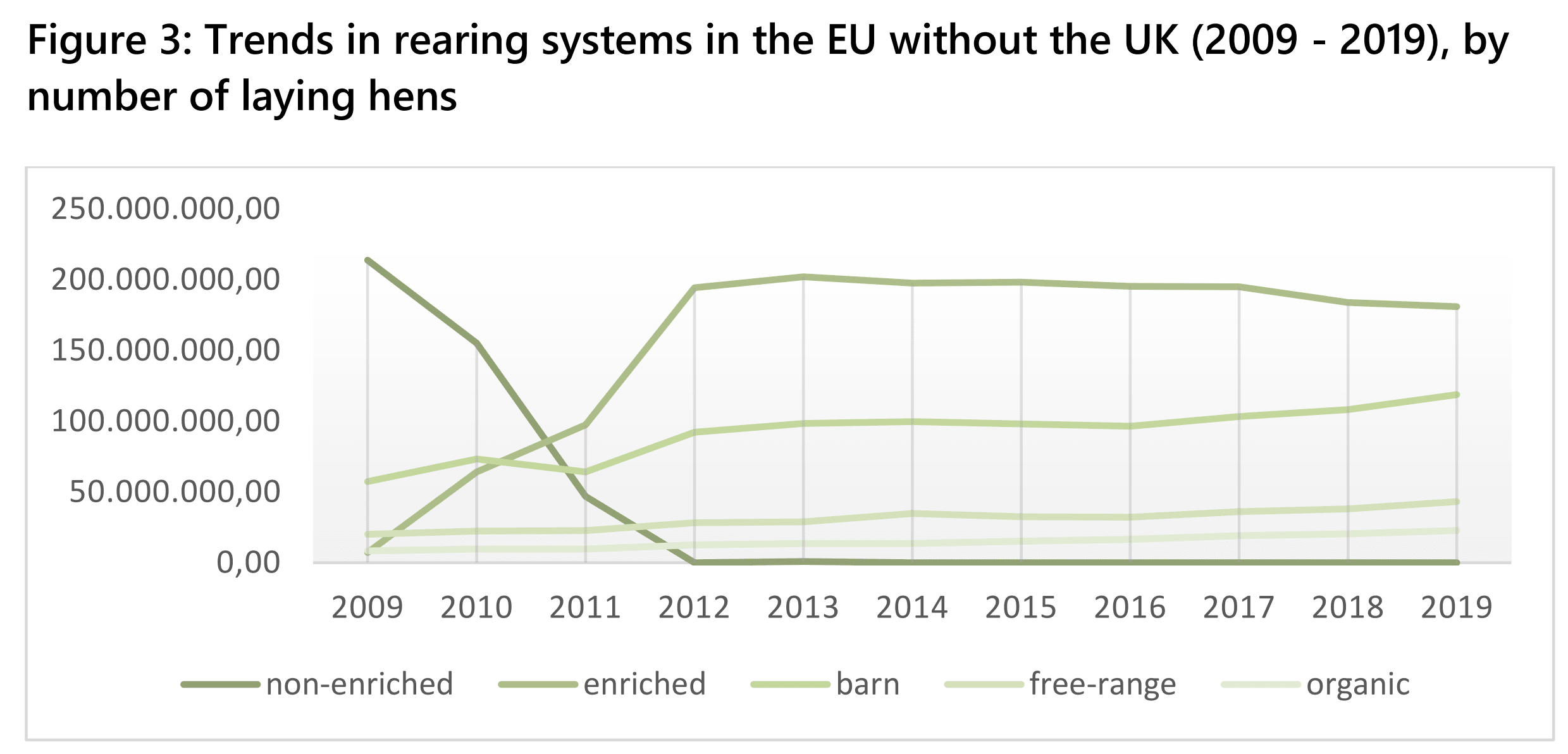
My understanding is that the battery-enriched transition did happen all at once in the EU. That's also confirmed here on page 11 (and also here p. 28-33). Battery cage companies waited until 2009-2011 (just before the ban on battery cage entered into force). The only exceptions are the cages that broke/burned down and new cages (in the period 1999-2010) but they are limited. But maybe I underestimate the power of voluntare schemes (such as BCC) nowadays, or the increasing consumer demand for cage-free eggs. This may make it more gradually indeed.
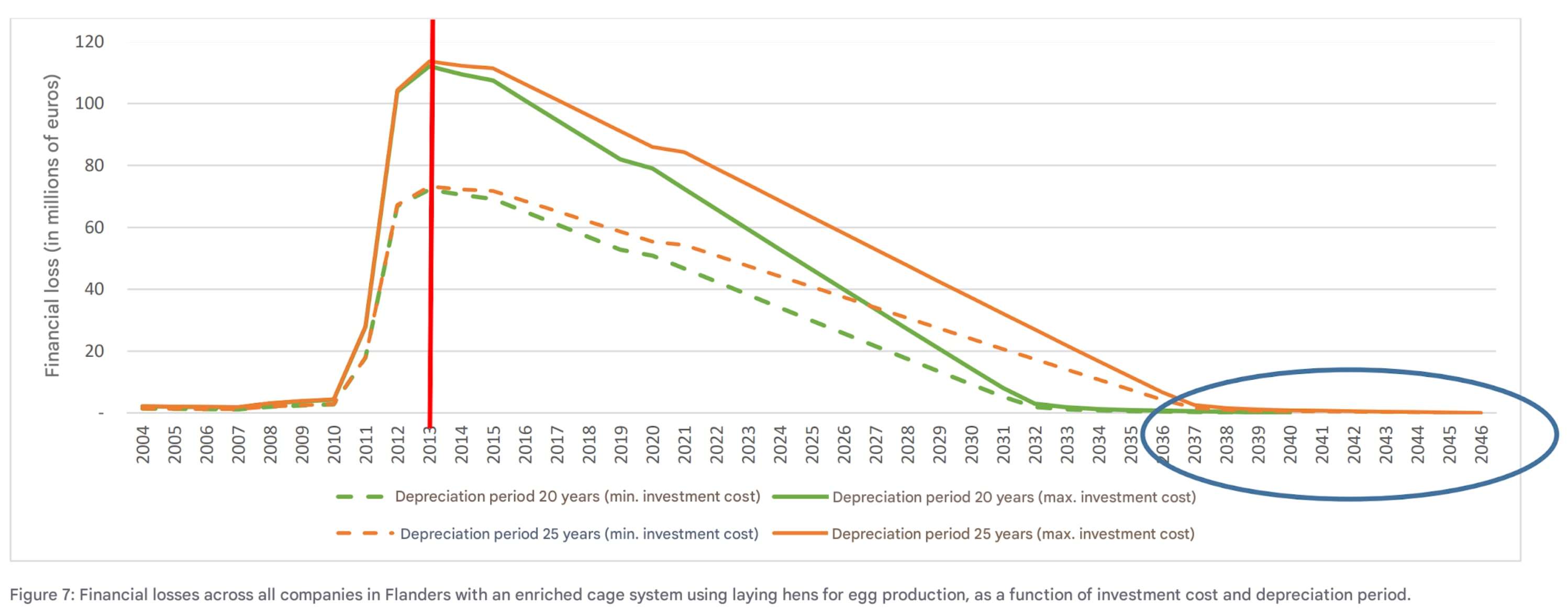
In any event, as a result of this sudden transition in 2009-2011, Flanders provided a transition period for the ban on enriched cages at 25 years starting from 2011 (so 2036). You can see their calculation here on page 36. This was to ensure that almost all enriched cage infrastructure would be written off and companies would not have too much loses. The Netherlands followed a similar reasoning.
So I still think your two-step approach is only a good idea if you are certain the second ban will be implemented within 20 years time. And that's not likely to happen in practise. Look at the EU, where we banned battery in 1999 and now time is running out to ban enriched because of the infrastructure lock-in. Between now and 2032, many companies will change their first generation enrhiced cages, which makes a ban on cages all the less likely to happen soon.
Figure 3 of the report you linked from Compassion in World Farming (CIWF) does show the transition from conventional to furnished cages happened just in 3 years in the EU, from 2009 to 2011. Very interesting. I did not know it happened so fast.
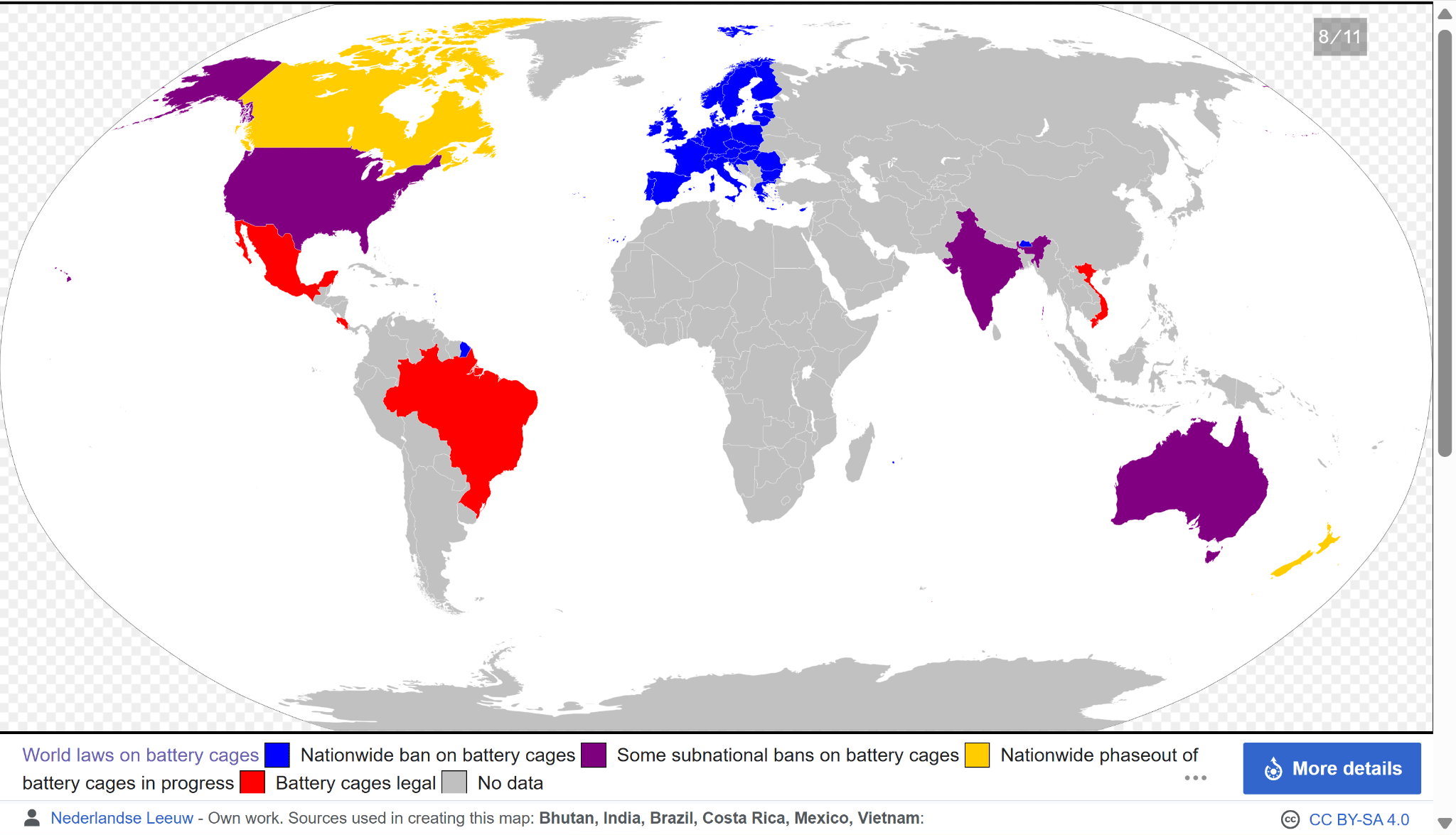
However, I do not think this implies keeping hens in cages in the EU will be banned from either 2032 or 2052 on. If this was the case, I would have expected bans in the EU to all start in 2032, whereas there are many timelines. 1992 for Switzerland (this one is not relevant for our discussion because it happened before 2012), 2020 for Austria, 2021 or earlier for Luxembourg, 2023 for Iceland, 2027 for the Czech Republic, 2028 for Wallonia (a region of Belgium), 2029 for Germany (2026 for non-exceptional cases) and Slovenia, 2030 for Slovakia, 2035 for Denmark, and 2036 for Flanders (a region of Belgium). Colony cages are still allowed in the Netherlands, and I am not aware of a ban on all cages having been announced there. Did I miss it?
In any case, do you think EU's global influence is sufficiently strong to determine what to advocate for in Africa and Asia? I agree it would not make sense to advocate for furnished cages, for example, in China if this could undermine a ban on cages there from 2032 on (because the new furnished would still be very early in their lifetime then). Yet, I do not see situations like this coming to pass. I expect Africa and Asia to become cage-free at least 20 years after the EU does. So I believe there is time for new furnished cages there to operate for their full lifetime of 20 years.
Impressive overview - thanks for sharing this!
And I very much like your idea (20 years enriched before total ban) but only if we make sure there are no second generation enriched cages. And I think the EU situation is now showing us this is difficult to achieve.
The EU countries you mention (BE, FR, GE, SL, SL, DK and CZ) are in the good scenario. If you start counting from 2010-2011 (built date of most cages) these countries all impose a transition period that is 15 years or more, which confirms my assumption that they took into account the infrastructure costs of those cages built in 2010-2011. I think the Luxembourg ban entered into force in 2020 (act of 2018) but I believe they did not have any cages anymore by then.
The problem lies with the other EU countries. If they (or the EU) do not ban enriched cages before the moment most companies invest in a second generation of enriched cages (around 2030-2032), I think we are stuck with these cages for at least another 10-15 years. Banning these second generation cages before they are written off (or at least for most part) seems politically/economically impossible.
"Colony cages are still allowed in the Netherlands, and I am not aware of a ban on all cages having been announced there. Did I miss it?"
No, you are correct. But I believe the infrastructure lock-in is the main reason why NL has these colonies instead of a total ban on cages. When Dutch politicians started pushing for a total ban on cages at the time, the minister asked experts to calculate the cost. And they pointed out that it would really hurt all those companies that had just transitioned from battery to enriched and invested in new cages (leading up to the 2012 ban). So the ban was off the table and eventually the political compromise was to allow transition from enriched to colonies, but only in 2021 to soften the blow. I think this again illustrates the problem of this lock in.
Thanks for the very relevant sources you have been sharing too. I strongly upvoted your initial comment because I have found this thread valuable.
The report you linked exploring the consequences of banning enriched cages in the Netherlands (here is an English translation) says conventional cages had fully depreciated in 2012.
2012 is when the ban on conventional cages in the EU started. So the above supports your take that cages will only be banned when they are near the end of their lifetime. However, I do not think this means a ban on cages in the EU will start, for example, in either 2032 or 2047 (= 2032 + 15). I think it just means the ban will have to be announced 15 years before it enters into force such that the economic loss is minimised. This is in agreement with the report above.
As a result, if the EU announces a ban on furnished cages in 2026, I guess it will only start applying to all cages (instead of just new cages) in 2041 (= 2026 + 15) or so. Here is an estimate of the economic loss from shortening the transition period. From Table 1.1 of van Horne and Bondt (2023), the housing cost for furnished cages is 3.39 2021-€/hen, 4.84 $/hen (= 3.39*1.22*1.17). For hens with a lifespan of 70 weeks (WFI assumes "60 to 80 weeks for all systems"), 1.34 hen-years (= 70*7/365.25), the housing cost of furnished cages is 3.61 $/hen-year (= 4.84/1.34). I estimate there were 149 M hens in furnished cages in the EU in 2024. So I think renewing all furnished cages in the EU would cost 538 M$ (= 3.61*149*10^6), 1.20 $/citizen (= 538*10^6/(450*10^6)). I speculate 50 % of the value can be recovered via exporting the cages to countries outside the EU. Consequently, for cages fully depreciating in 15 years, the cost of shortening the transition period by 1 year would be 17.9 M$ (= 538*10^6*(1 - 0.50)/15), 0.0398 $/citizen (= 17.9*10^6/(450*10^6)).
As a side note, the calculations for the Netherlands did not account for the possibility of exporting the cages.
Agreed on the 15 years. My good/bad scenario was a bit too black/white indeed.
And good point on export. FYI: p. 10, 30-31 of the Flemish study also explains that it did not tak into acount the exporting option (because lack of data). But the study does mention that they did some interviews with companies and they replied that they were not eager to export outside EU because they did so with the battery cages at the time and this increased competition they considered unfair. Not very scientific of course but this makes is very difficult to argue (in a political) that export should be taken into account.
Thanks for sharing Vasco! On the point about public support - sadly I don't think that Welfare Footprint's data will be enough to convince people about these kinds of reforms. I think welfare reforms have to almost immediately make intuitive sense for them to receive mainstream public support. E.g. organizations have been doing a great job trying to popularize the term 'Frankenchickens' as a way to make the welfare issues of broiler chicken breeding more salient, but that's still been a really heavy lift and comparing two different kinds of cages seems even harder.
Hi Max. I very much agree WFI's estimates alone will not be persuasive to the public. However, I wonder whether it would be possible to communicate the importance of nests, perches, and litter. The EU banned conventional cages. So at least some decision-makers and citizens in the EU had to prefer furnished cages over conventional cages. Maybe these were people that engaged more with the topic, and such level of engagement cannot be reached as a result of public campaigns targeting companies. In this case, as I say in the post, "there may still be room to advocate for political change in more authoritarian countries like China where companies are less subject to public pressure".
Great points from you here and from @Mia Fernyhough in another thread! What about in countries where animal advocacy is (almost) nonexistent and where the counterfactual is probably not cage-free, but no change at all? Curious what the two of you (and others) think. I know this does not address all the limitations you raise, but maybe the most crucial ones?