Comments
Summary: We have developed a prototype app called the Food Welfare Explorer. This tool uses AI to provide approximate, tentative animal welfare analyses based on food pictures or descriptions. Its primary purpose is to test how to best communicate welfare information to consumers immediately, acting as a bridge while long-term, quantitative data using the Welfare Footprint Framework (WFF) is still being developed. We are currently seeking specific feedback from the Effective Altruism community on the app's design, content, and communication strategy to ensure that when rigorous scientific data is ready, the interface to deliver it is ready too.
The Challenge: The Gap Between Data and Decisions
The Welfare Footprint Framework (WFF) represents a significant leap forward in animal ethics. It aims to quantify animal welfare in concrete, time-based terms—specifically, the cumulative duration of pain and pleasure experienced by animals in various production systems. While this framework is gaining traction among advocacy groups and policymakers, the process of building comprehensive, rigorously validated "Welfare Footprints" for specific products takes considerable time.
This creates a critical gap: How can we help consumers make welfare-informed choices today, using the best approximations available while rigorous data is still being generated?
The Solution: The Food Welfare Explorer
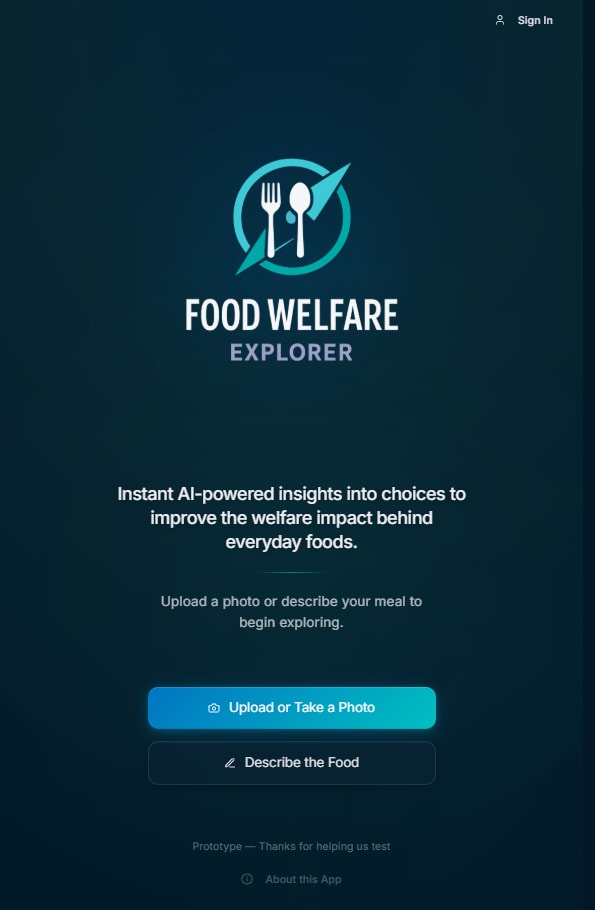
To address this immediate need, we have developed a prototype app called the Food Welfare Explorer. This tool acts as a bridge, utilizing current advances in Large Language Models (LLMs) to provide approximate, tentative animal welfare analyses based on food pictures or descriptions.
The app serves as a "live experiment" to test how intuitive, real-time welfare information influences everyday decisions. Our strategy is twofold:
- Welfare information expression (a semantic sandbox): To experimentally explore how animal welfare information could be meaningfully expressed to non-expert users once Welfare Footprint estimates become available. This involves testing language, concepts, and framing strategies for communicating welfare impacts, and is closely related to Module VI of the Welfare Footprint Framework (Expression and Notation).
- Interface and interaction design: User-test the communication vessel now, ensuring that when official estimates are ready, the interface to deliver them is seamless and effective.
How the Prototype Works
The user experience is designed to be straightforward, interactive, and educational.
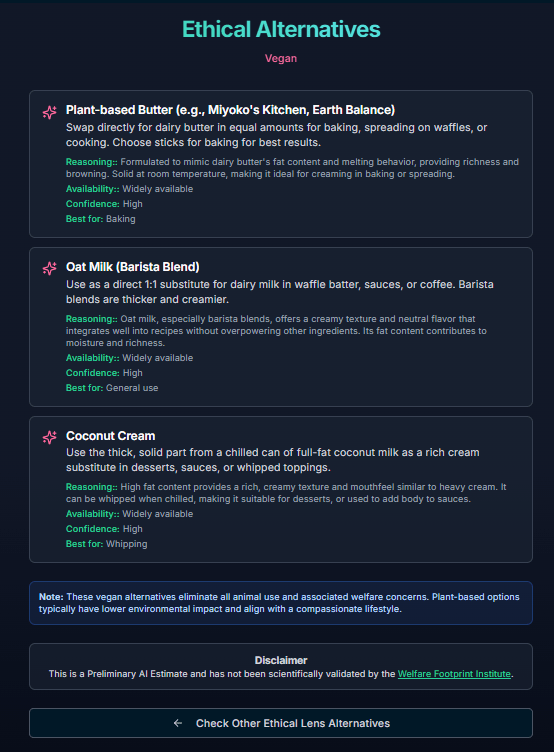
- Upload: The user writes a description or takes a photo of a food item, such as a packaged product or a meal.
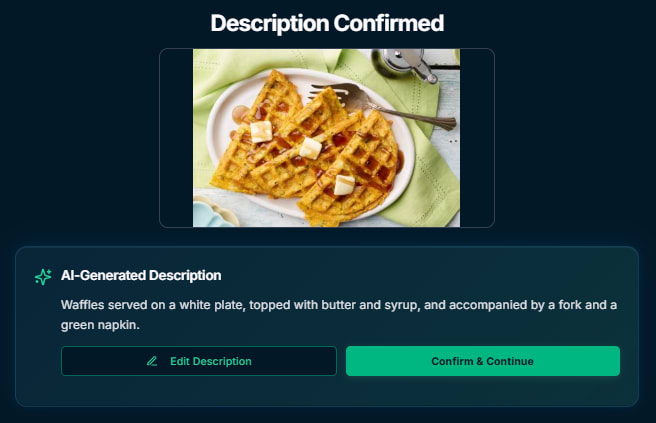
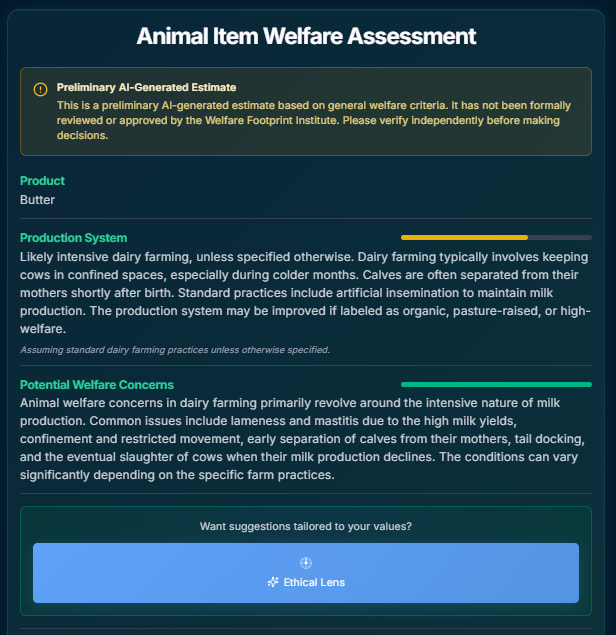
- Analysis: The system identifies animal-derived ingredients and generates a brief welfare analysis.
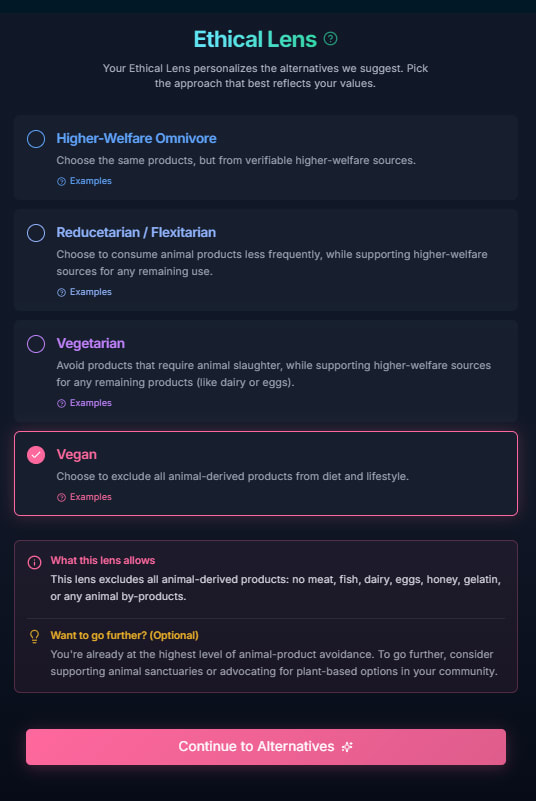
- Lens Application: Acknowledging moral pluralism, the user can view this analysis through different "Ethical Lenses" (detailed in the Appendix).
Transparency and Call for Collaboration
This project is built on radical transparency. We are explicit that all current results are AI-assisted approximations, not official WFF estimates. The AI’s behavior is guided by documented prompts that will soon be publicly available. While that documentation is being finalized, the Appendix below lays out the rationale for the prototype’s most important conceptual element: the ethical lenses used to interpret welfare information.
We are inviting the Effective Altruism (EA) community, ethicists, and developers to collaborate with us. We specifically seek feedback on:
- Substance: Is the information provided relevant and accurate?
- Design & UX: How can the presentation of evidence be improved to encourage compassionate choices?
- Technical Input: Suggestions for prompt refinement and dataset linking.
Looking Ahead: The Ecosystem of Welfare Information
The long-term vision for the Welfare Footprint Framework is to make animal experiences as quantifiable and transparent as economic or environmental impacts. This prototype is a strategic step to test one possible interface for delivering these results once they are fully available.
We anticipate that as rigorous data is released—starting with the upcoming book, The Welfare Footprint of the Egg—it will be utilized across many formats, including certifications, labeling schemes, and other digital tools. However, we see immense value in starting this work now. By experimenting with the Food Welfare Explorer today, we can identify what works and what doesn't in communicating welfare data, ensuring that we are ready to effectively translate the science into consumer action the moment the data arrives.
We look forward to your feedback. Feel free to write to [email protected] or share your thoughts in the comments below.
Appendix: Four Ethical Lenses - Progressive Views on Reducing Animal Harm
Many people wish to bring their everyday food choices into closer alignment with their own ethical concerns about animals. This framework recognizes that values, constraints, and starting points differ, and it presents a range of approaches—from modest, accessible changes to more comprehensive forms of harm reduction. Wherever someone situates themselves, informed choices at any level can meaningfully reduce animal suffering.
1. Higher-Welfare Omnivore ("The Welfarist")
- Summary: Choose the same products, but from verifiable higher-welfare sources.
This lens focuses on improving conditions for animals within existing food production systems. It prioritizes animal products sourced from farms that meet defined welfare standards, such as cage-free egg systems, pasture-based dairy, or operations certified by welfare-focused schemes like Global Animal Partnership (GAP).
Rather than changing what is consumed, this approach centers on how products are produced. Higher-welfare systems often reduce extreme confinement and allow animals greater freedom of movement and expression of species-typical behaviors. While animal use remains part of this lens, it supports incremental changes that can improve conditions for large numbers of animals within current supply chains.
2. Reducetarian/Flexitarian ("Lower Consumption")
- Summary: Choose to consume animal products less frequently, while supporting higher-welfare sources for any remaining use.
This lens builds on higher-welfare sourcing by also reducing overall consumption of animal products. The emphasis is on shifting everyday meals toward plant-based options, while treating animal products as occasional rather than routine components of the diet.
When animal products are included, this lens favors those from higher-welfare systems. By lowering total demand—particularly for products associated with intensive, high-volume production—this approach aims to reduce the scale of animal use over time, without requiring complete dietary exclusion.
3. Vegetarian ("No Slaughter")
- Summary: Avoid products that require animal slaughter, while supporting higher-welfare sources for any remaining products (like dairy or eggs).
The vegetarian lens centers on removing meat and fish from the diet, thereby avoiding products that directly depend on the killing of animals. At the same time, it may continue to include animal-derived products that do not involve slaughter, such as dairy, eggs, or honey, often with attention to sourcing.
This approach reduces direct participation in food systems organized around animal killing, while still engaging with some forms of animal agriculture. It reflects a boundary drawn specifically around slaughter, rather than around all forms of animal use.
4. Vegan ("No Animal Use")
- Summary: Choose to exclude all animal-derived products from diet and lifestyle.
This lens seeks to avoid the use of animals in consumption altogether, extending beyond food to areas such as clothing and other everyday products. It excludes meat, dairy, eggs, honey, leather, wool, silk, and related materials.
Veganism can be understood as an effort to minimize direct involvement in systems that rely on breeding, keeping, or using animals for human purposes. While indirect impacts cannot be entirely eliminated, this approach most consistently limits intentional animal use across multiple domains of daily life.
Closing Note
These lenses are intended as interpretive tools, not moral judgments. The Food Welfare Explorer uses them to organize information in ways that reflect different ethical perspectives, allowing users to explore outcomes that are meaningful by their own standards. Movement between lenses is not assumed, required, or evaluated—each represents a valid and coherent approach to reducing animal harm under different constraints and priorities.


Just checked out the prototype – it's cool! I like the idea of using this as a bridge while more rigorous WFF data is still being developed. Curious how you’re thinking about how this might fit alongside existing certifications or labeling schemes once WFF estimates are available (i.e. more complementary, overlapping, or something else)? And who do you see as the most promising early adopters for a tool like this?
Thanks, Becca — really glad you took a look and liked it.
On your point about how this relates to certifications and similar tools: we see this as strongly complementary to them, not an alternative. When Welfare Footprint estimates become available, our hope is that they’ll be usable in many different ways by different stakeholders — including certification initiatives themselves — rather than being tied to a single interface or application.
This app is best understood as an early exploratory step: a way of seeing how people actually engage with welfare information, what resonates or causes confusion, and how different framings influence choices. We hope these insights can be useful not just for us, but for anyone thinking about how WFF-style estimates might be effectively deployed beyond a single app.