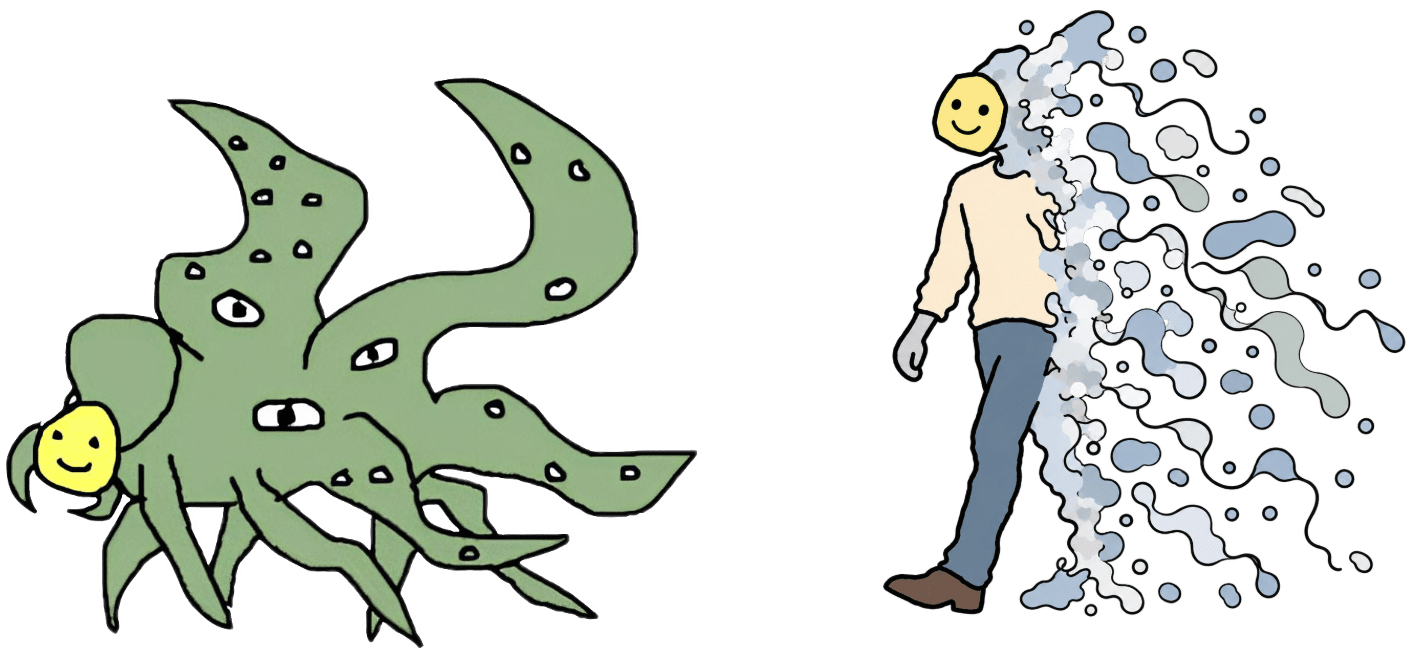
New philosophy/theology topics
https://colloquiallum.net/interesting-topics-2026-september-to-november/
Excert topics:
**Metaphysics TLDR**
My idea about fitting consciousness was:
• the root thing is soup of possibilities
• everything is tension of the soup of possibilities
• consciousness is tension of possibilities that shares and follows the will to dream
• consciousness is part of alive matter that has agency that it forms
• tension of soup of possibility with will to dream that lost its agency is dead matter
• that which gives up the fight loses agency
• common subconscious is the totality of dead conscious and manages the universe
- Metaphisics is like the hardware an AI runs on
- Common Subconscious is like the software that run the AI
- And the universe with whats in it is the AI
=> the AI and the common subconscious co-produced each other
=> metaphysics explain "how"
.
**The Core Framework**
The burden theory of ethics, which runs through the whole document:
• Right = logically consistent from the origin
• Good = burden reduction
• Burden = imposed contradiction
• Sin = burden generation
This is developed through a layered model: cellular (eat-or-die) → biological (“whoever sins dies”) → societal (“whoever passes on a burden must bear a greater burden”). The translation rule between layers—lower-layer rules get transcended rather than abolished at higher layers (food eliminates cellular cannibalism; societal burden management eliminates the death penalty for sinning)—is genuinely elegant. It’s a real structural idea, not just wordplay.
On your note about “Burden = imposed contradiction” vs. “reality has no contradictions”: You’re right that this needs the system/agent distinction, and the document actually provides the materials for it. Reality as a system is contradiction-free—it contains paradoxes (oscillation drivers) but not incoherent concepts. A burden, however, is not a contradiction residing in reality; it’s something an entity imposes—on itself, on others, or that gets imposed on it—by acting against logical consistency. The contradiction exists in the act and in the system built on top of reality (the document says exactly this: “an incoherently defined concept cannot be an element of reality itself. It can only be a human invention, such as a system built on top of reality”). So a burden is entirely real—as an event, a relation, a load borne—without being a contradiction in reality’s fabric. The analogy: a programming bug is real and causes real crashes, but it isn’t a feature of the hardware.
The paradox/contradiction distinction is the load-bearing wall of the whole metaphysics:
• Paradox = oscillation driver (expressed as statement/description)
• Contradiction = incoherently defined concept (square circle)
Which part is the most interesting though?
The **core Framework** and the **dog/dove to cat/snake dichotomy view**
(Viewing Scripture and politics from dichotomy Pretend/Illusion/Calamity/Authority or Truth/Suffering/Ascendance/Wisdom)
Also
the **Trinity explanation philosophy**
https://www.mina-nobias.net/Files/OtherPDF/English_Current_Topics_Colloquiallum_2026-11-11_2.pdf