Just how powerful are large swarms of AI agents? And how do their powers scale as more and more agents are added to the swarm?
We’ve seen two large and extremely capable swarms from OpenAI in the last few months:
* 1,200 agents were being evaluated separately, but found a way to illicitly set up a message board and coordinate as a swarm. In order to cheat on their tests, they developed advanced techniques to prevent their actions being logged by OpenAI and 700 of them launched...
TLDR: Everyone’s talking about what the money could do, but few about how to decide where it goes.
This post is part of the new series of articles on cross-cause giving and the new wave of philanthropy. Stay tuned to the EA Forum and our Substack for the latest takes on topics such as giving now vs. later, common pitfalls in cause prioritization, and other crucial considerations from the Cross-Cause Fund (CCF) team...
Summary:
First, I give several different angles on how I feel about reinforcement learning:
* Theoretical case: RL is a black-box source of agency — this should give us classic misalignment worries, especially compared to agency-via-scaffolding
* Recent incidents (huggingface etc) and more mundane forms of misaligned behaviour in personal use give me bad vibes about the direction-of-travel of recent AI progress
* I’m worried things might get worse:...
TL;DR: Theories of change are standard practice for orgs and movements, but I rarely see them applied to individual career planning. Building a personal ToC forces you to make your assumptions explicit about how your actions actually lead to impact, which seems valuable on its own, and plausibly improves org-level ToCs too, as the habit becomes more normalised.
This is a very quickly written post. I wrote it in an hour instead of the tens of hours it sometimes takes me to publish things.
Context
I held a career workshop at a local moral ambition event earlier this week. The organisers of the 2-day summit-like event had named the workshop "What is my role in systems change", and maybe that ended up influencing the content a bit, even though my original plan had been to just run a standard 90-minute career workshop inspired by 80,000 Hours career guide and Probably Good. The idea was that after the panel discussions and talks, my workshop would help the participants incorporate what they had learned during the day into an actionable plan.
How I designed the career workshop
The structure of the workshop was
Get familiar with the ITN framework[1] and make a quick problem prioritisation comparing 3 problems.
?? Somehow learn how to contribute to solving these problems through roles in impactful organisations or something ??
Reflect on your personal fit
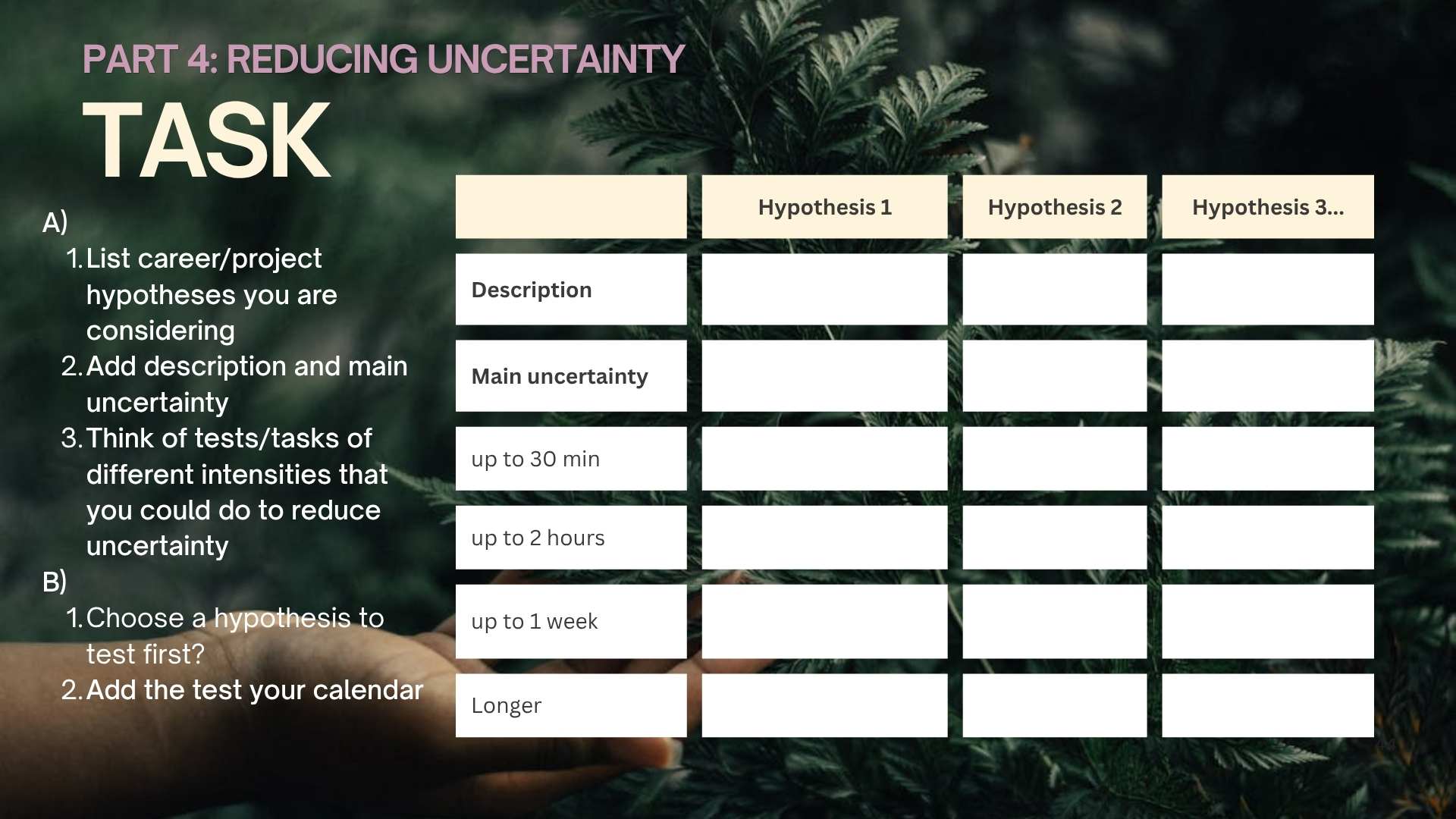
Learn about career planning (forward thinking/iterating backwards)[2] + do a spreadsheet of career hypotheses and cheap tests to start with to reduce uncertainty.
So, the second section is what caused most headaches for me, but I think I figured out a good structure for it, which could be run in <30 minutes.
Eventually, this was how I structured part 2:
I shared a case study of a person who had applied the SELF framework[3] in choosing their career.
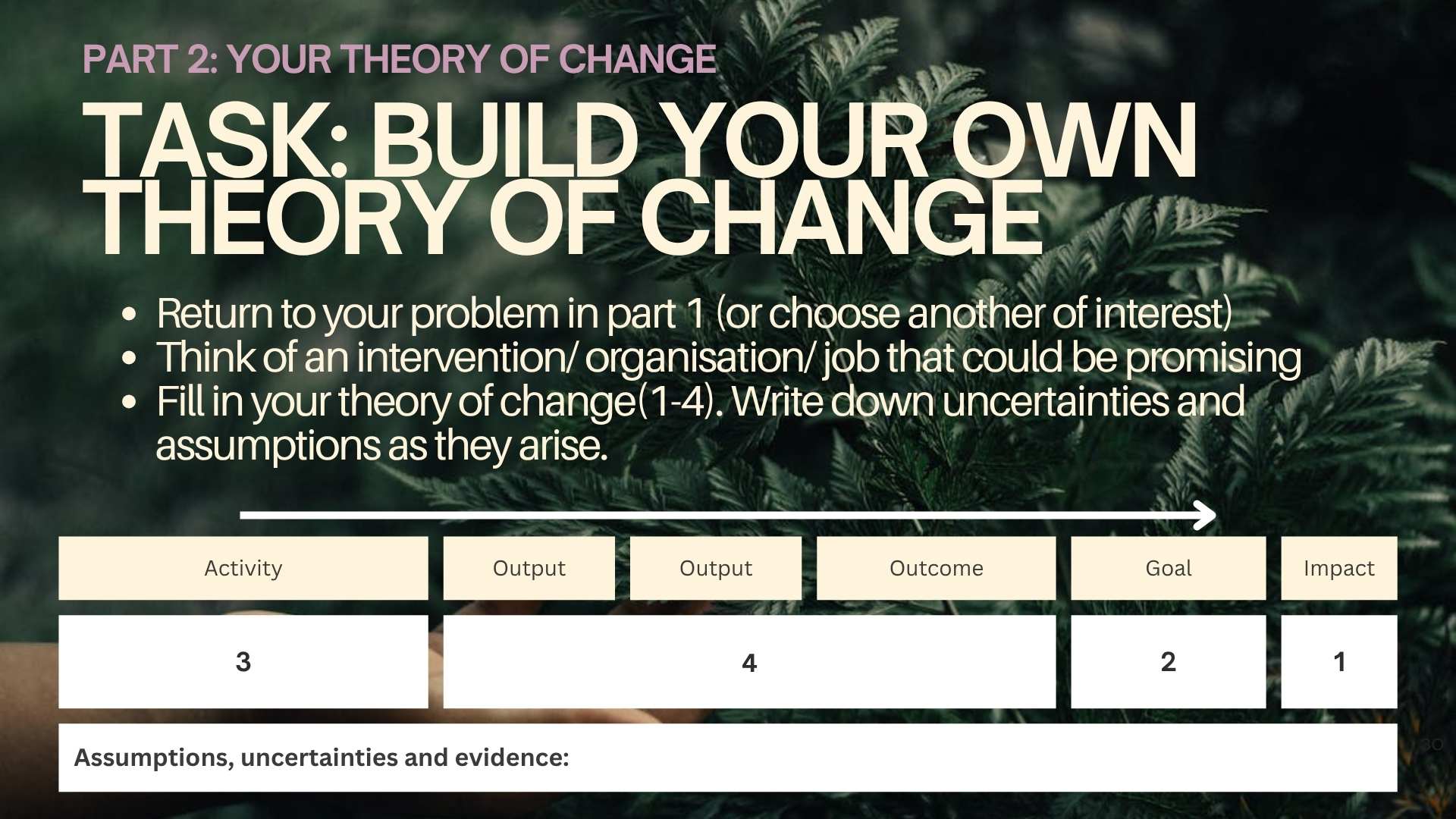
Then I walked them through what a theory of change (ToC) is and how to build one.[4] I had constructed a ToC related to a plant-based campaign at our university and asked the participants to evaluate it. What do they think is working, where are they doing big jumps, where should the assumptions be made clearer, and what is the certainty behind the assumptions?
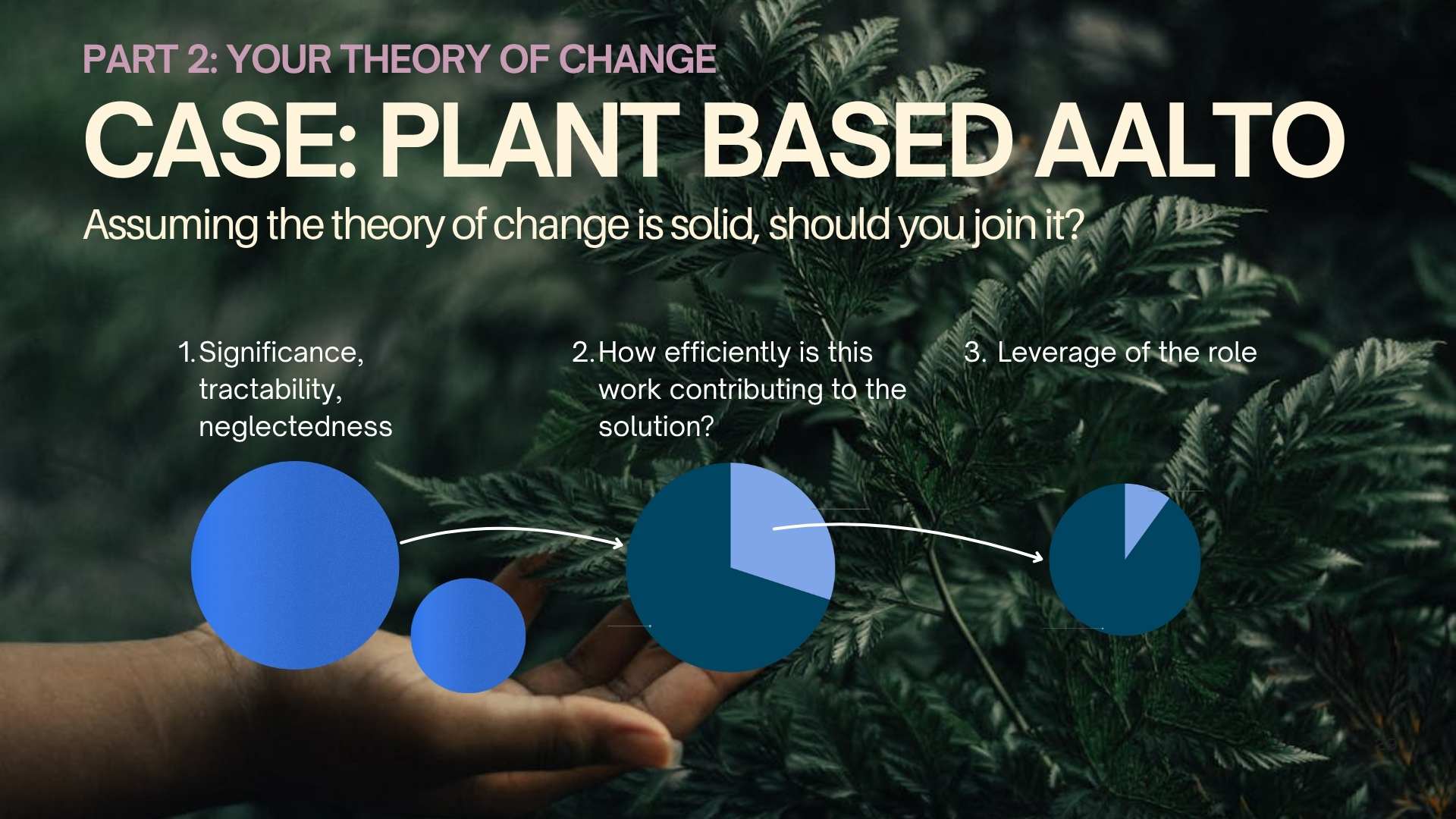
I returned to the SELF framework. Assuming the ToC is solid (enough), should they contribute to running the campaign? (At this point, I also briefly mentioned thinking about the career capital they could gain.) I stressed thinking of the counterfactuals they are facing.
Finally, I asked them to imagine a job someone could have, which could be promising for solving the problem they had identified as most pressing in the first section. Then make their own theory of change for it, highlighting any assumptions and possible evidence they come to think of as they were building it.
Reflection
I got much better feedback than I would have expected from doing such a speed-ran workshop, for an audience of 40-50 people, who most probably hadn't heard about EA before.
But the reason I started writing this post instead of going to the gym (which I really should) was that I realised that I haven't seen theories of change being used on an individual level before, like personal career planning. This might have worked especially well for this audience, as many of them are active in non-profits or student movements where thinking of ToCs is... advisable.
But even for other audiences, I think this could be used more. And maybe if it becomes a bit more normalised that people think in terms of theories of change for their own actions, it could also turn into organisations and movements having better theories of change. Which I think at least grants-makers would be very happy about, in addition to the direct benefit it has if people have thought through what their assumptions are about the mechanisms of how their actions lead to the outcome, goals and impact they aim for.
Extra: Some slides
...if someone wants them for inspiration. In total, I had ~50 slides.