Comments
I just became aware that this tool exists: https://theoryofchangebuilder.com/
I haven't played around with it, but it looks potentially very helpful
I just became aware that this tool exists: https://theoryofchangebuilder.com/
I haven't played around with it, but it looks potentially very helpful
Theory of change discussions are so important! In our non-profit, we frequently compare how our theory of change is in relation to the US Civil Rights Movement, global female suffrage movement, equal marriage movement, and other movements that were successful in achieving their goals. I think it’s important to make sure we seem to be on track to achieving our goals. One of our goals is abolishing animal agriculture world-wide. I think other orgs in the space of animal welfare/ animal rights can benefit from making sure they are on track to achieve in an effective and efficient way their goals.
As participants in a movement with ‘effective’ in its name, it’s easy to think of ourselves as being above falling for the most common mistakes made in the non-profit sector more broadly. We’re grappling with the cutting-edge stuff, not the basics, right?
But we need to beware of this kind of complacency. It’s crucial to nail the basics, like theories of change, and far fewer EA organizations do this than you’d expect. That includes Charity Entrepreneurship, the organization I work at, where we teach participants in our Incubation Program and Foundation Program about the importance of theories of change, and yet until today we didn’t even have our own theory of change on our website!
That’s why we decided to share this post on theories of change – potentially the first of a series on ‘nailing the basics’ of effective non-profit work, if people are interested. This post is mostly made up of an excerpt from our book on effective grantmaking (‘How to Launch a High-Impact Foundation’), followed by a discussion of the theory of change for our Incubation Program.
Building something complicated without an explicit plan is risky. From skyscrapers to software, ambitious projects need detailed blueprints. When building an effective nonprofit organization, the theory of change is that blueprint.
In the same way that you wouldn’t hire a builder who intends to build you a home without a blueprint, you shouldn’t fund a leader who intends to build an organization or launch a project without a theory of change. If the builder planned to create something particularly cutting-edge, like a home made entirely out of recycled cardboard that doesn’t need heating or cooling, you’d be particularly adamant that the builder explains exactly how this is possible and what evidence or assumptions it depends on. The same applies when it comes to funding an ambitious project that aims to improve the world.
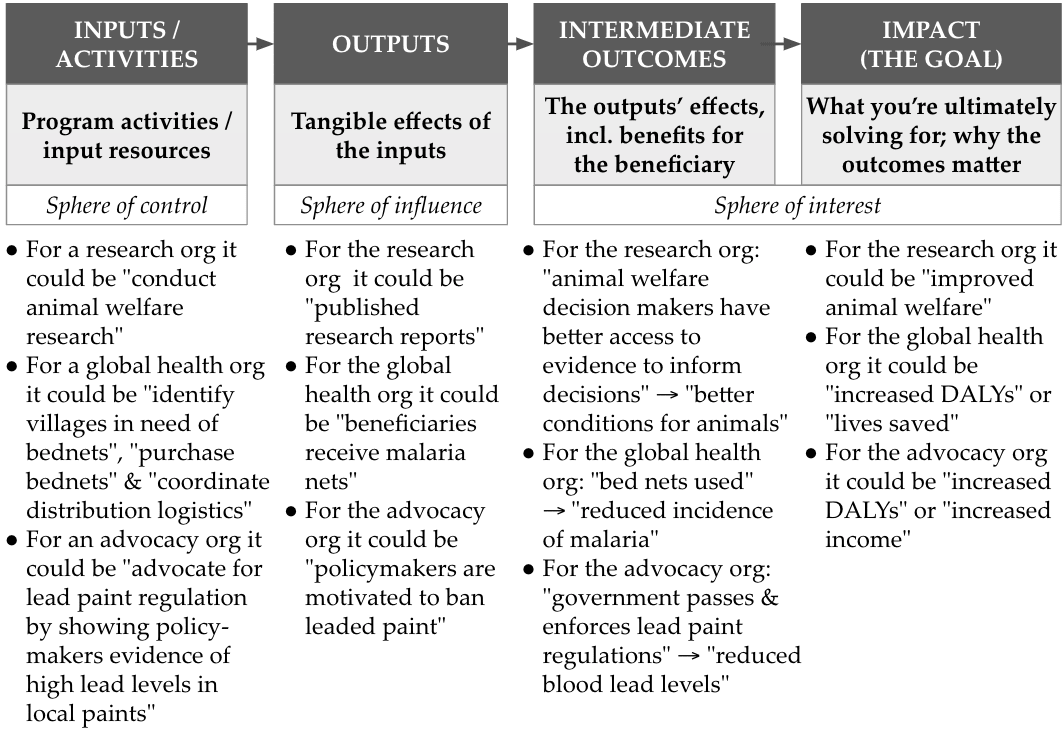
A theory of change explicitly articulates the logical steps of a plan to achieve a specific goal. It is generally represented in the form of a cause-and-effect diagram. A well-designed theory of change allows an organization to clearly communicate its activities and how they lead to the desired outcomes, and then to impact.[1]
In fact, theories of change are more important for charities than business models are for businesses, because businesses have better feedback loops. If a for-profit is based on a bad idea, or is badly executed, it will see poor revenue and it will soon go out of business. On the other hand, if a charity is ineffective, it may limp along for years without having any impact, squandering limited funding and talent in the process.
Foundations deciding which opportunities to fund should expect a clear theory of change as table-stakes for potential grantees. In addition to spelling out how the potential grantee intends to convert your funding into impact, theories of change will allow you to determine how confident you can be that impact will be achieved. Is the causal chain tight, or convoluted? Are the steps well substantiated by evidence, or based on tenuous assumptions? Can any assumptions be easily tested? What is the crux that the project’s success depends on? A smart nonprofit will use its theory of change to identify its priorities for measurement and evaluation, and as the blueprint for its first cost-effectiveness analysis,[2] which foundations can then use to inform funding decisions.
Imagine an organization that wants to use research to make a difference. Without an explicit theory of change, their implicit mental model of how they might make an impact may look something like this:
Review literature ⭢ Find insights that seem useful ⭢ Publish them
This is not a good theory of change. It doesn’t properly outline the goal, it doesn’t explain how the actions will lead to that goal, and it doesn’t explain how they will measure what they are doing. Presumably, the final goal is to impact living beings positively, not just publish papers. Even if the organization works very hard and puts out many widely cited papers, it’s possible that it will not make any difference.
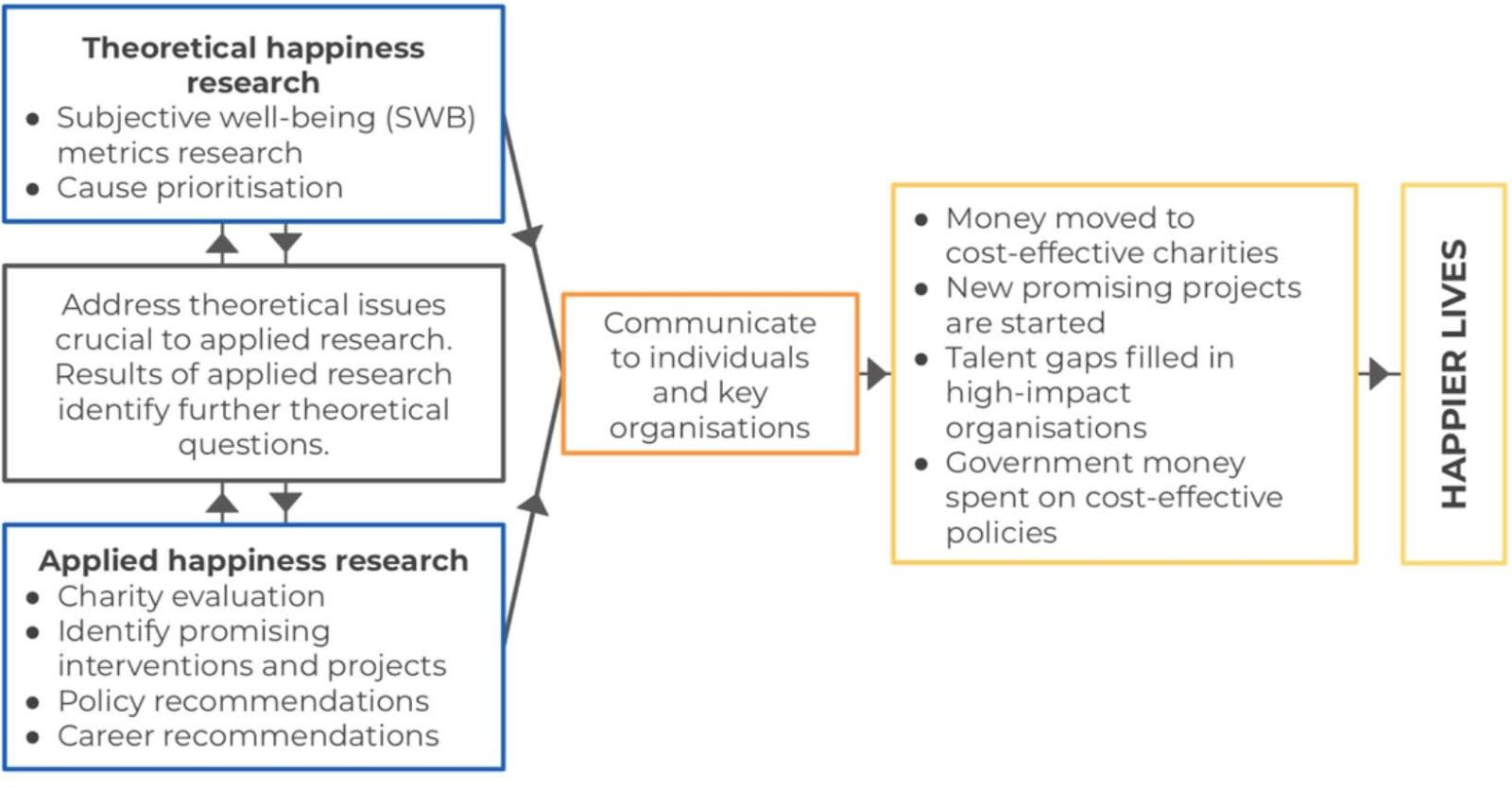
Compare this implicit model to an explicit theory of change published by a young charity after they went through one of Charity Entrepreneurship’s early incubation programs:
On the left, you can see the charity's core research agenda at a glance (the inputs/activities). On the right, you can see some measurable metrics such as money moved, new projects, and hires made (intermediate outcomes) which lead to the final impact – happier lives.
This is definitely an improvement on the implicit mental model:
Having developed this theory of change, they will be more likely to give adequate focus to ensuring that they don’t just publish research, but that the right people read it and change their actions (e.g. fund more impactful organizations, start more impactful projects, or measure impact in a more appropriate manner).
That being said, this theory of change has significant room for improvement. In particular, the intermediate steps between communicating the research and organizations changing their actions ought to be spelled out: After receiving the evidence, organizations need to understand it, value it, and use it to change policies or ways of thinking. There are many ways that this could go wrong, resulting in little or no impact. Leaving this out of the picture risks these crucial details being neglected.
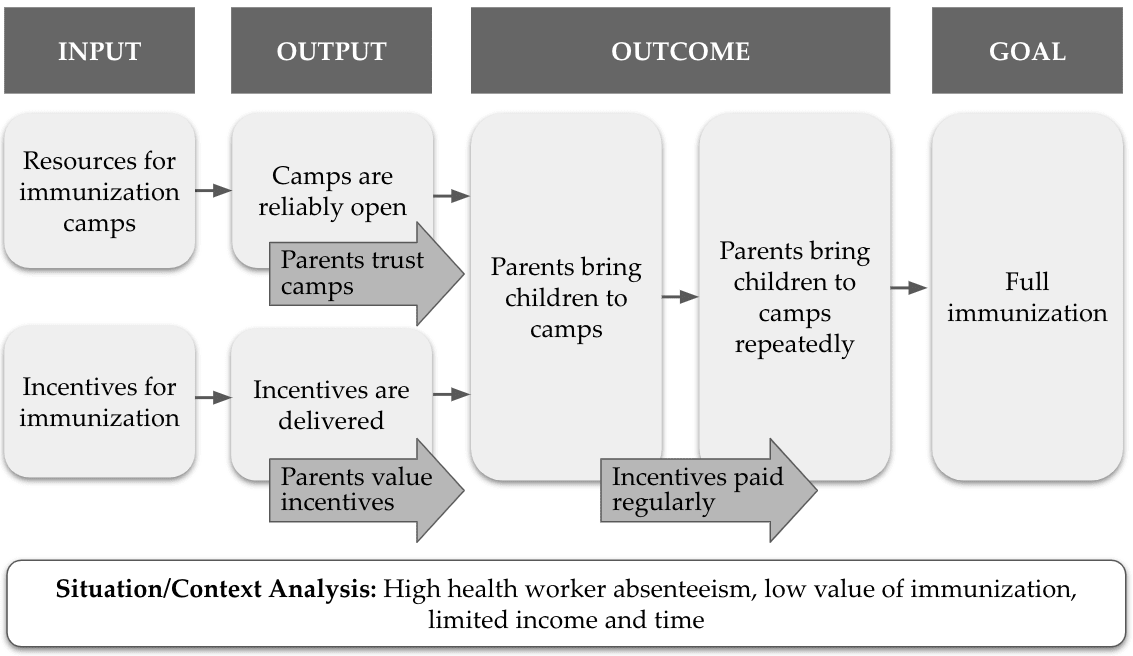
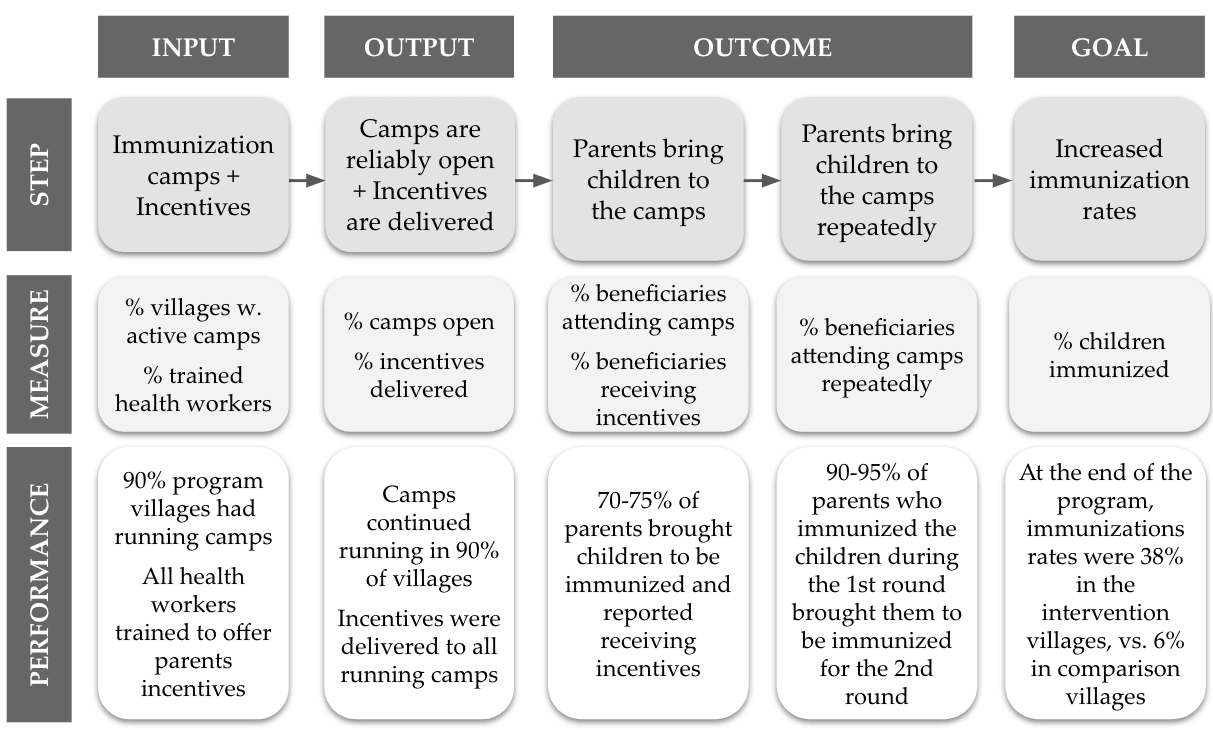
Below is a theory of change for a program that uses cash transfers to increase child immunization rates in India.[4] The program has two “input” actions: providing resources to keep immunization camps reliably open, and providing cash incentives to people who get vaccinated.
What’s particularly attractive about this theory of change is how measurable each step is. For example, we can send someone to check and see if a camp is reliably open. We can create a verification system to check if incentives are delivered. We can count how many children come to the camps, and how often they return for their booster shots. If something is going wrong, we can check the assumptions that are explicitly listed (e.g. surveying parents to see if they trust the camps).
As a result of the clear, measurable theory of change, J-PAL (The Abdul Latif Jameel Poverty Action Lab) was able to evaluate the performance of the program to come to a view on its cost-effectiveness.[5]
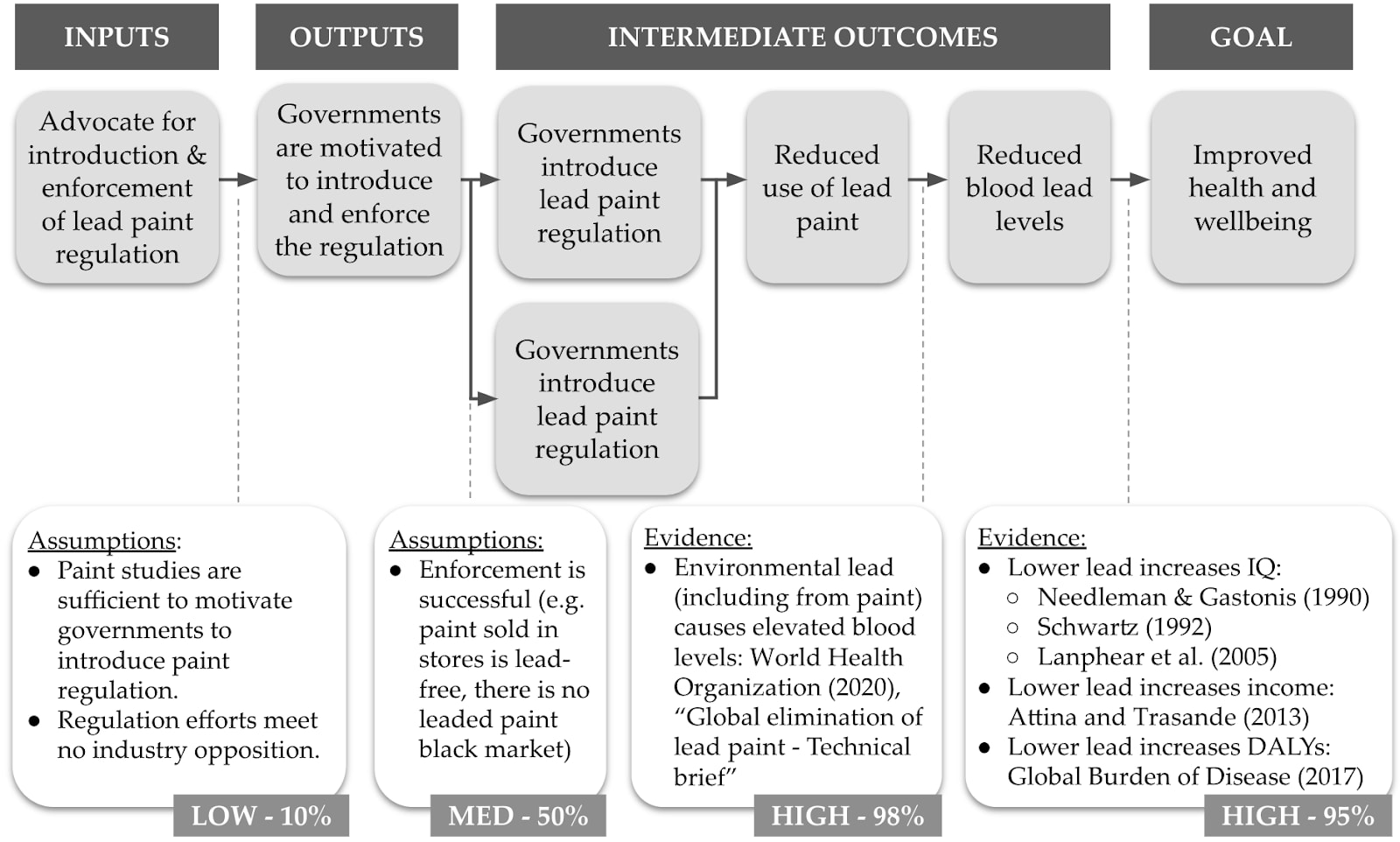
Creating a theory of change involves linking up a number of cause-effect relationships (based on scientific evidence, expert advice, or well-reasoned assumptions), to form a path from inputs to impact. It is the type of skill that is hard to teach in the form of a list of explicit instructions – rather, it is best learned by doing and by looking at real examples, and noticing what it is about them that is effective or ineffective.
There are two places where theories of change play a major role in grantmaking foundations’ decision-making:
The most obvious place for theories of change to play a role, is that grantmakers should expect that all potential grantees have a theory of change for their organization or project, or at least that they can produce one when asked. Funders in the nonprofit space need to hold implementing actors to account on implementing an explicit, realistic and well-evidenced plan for turning funding into impact.
Better yet, grantmakers should expect that recipient organizations use their theory of change to identify priorities for their monitoring and evaluation plan, and that they build a cost-effectiveness analysis based on the theory of change’s structure (quantifying the costs of their inputs, and the size and probability of the desired outputs, outcomes and impact).
It may be a little less intuitive, but theories of change also have a place in a foundation’s decision-making by articulating the strategy for how the foundation itself will have impact.
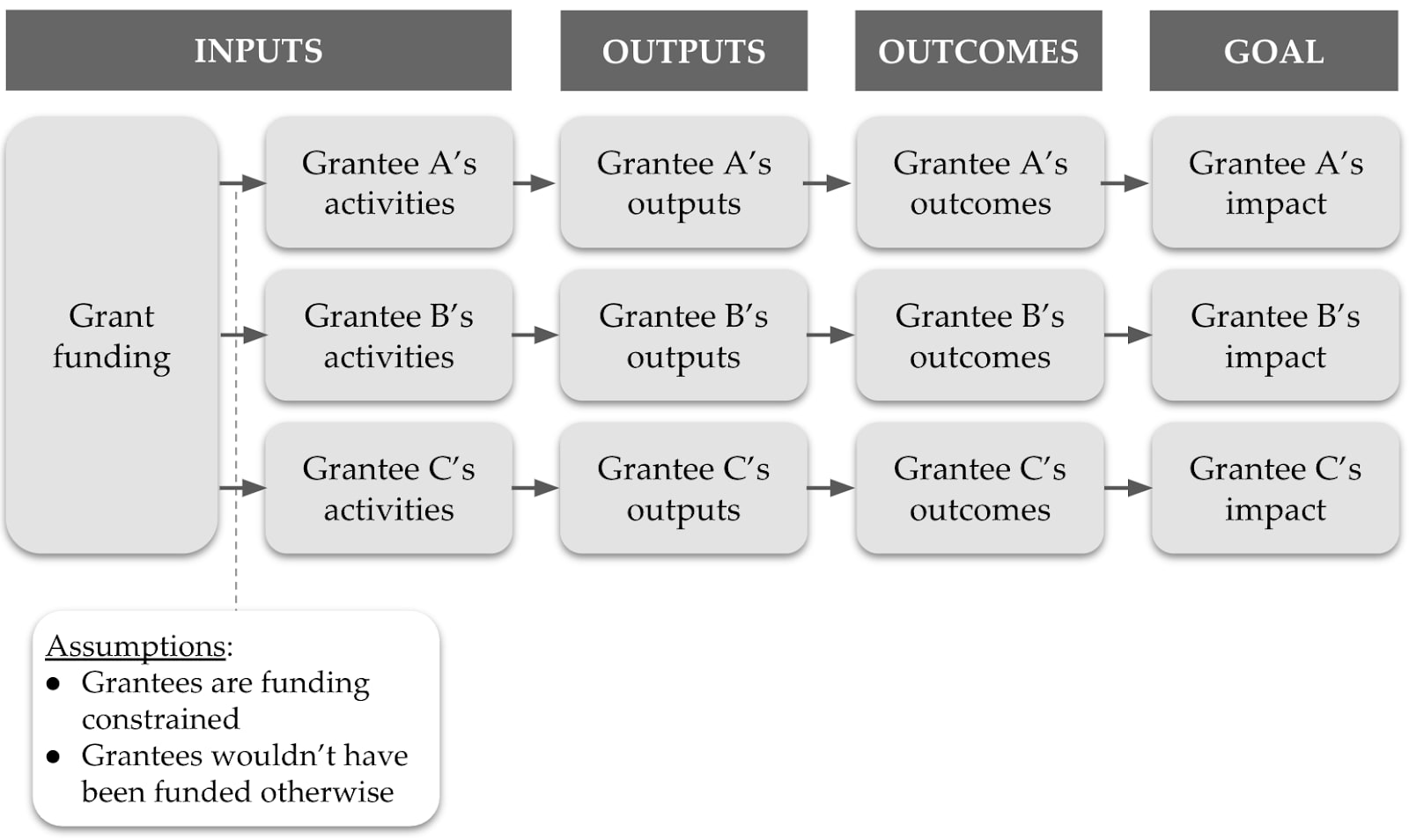
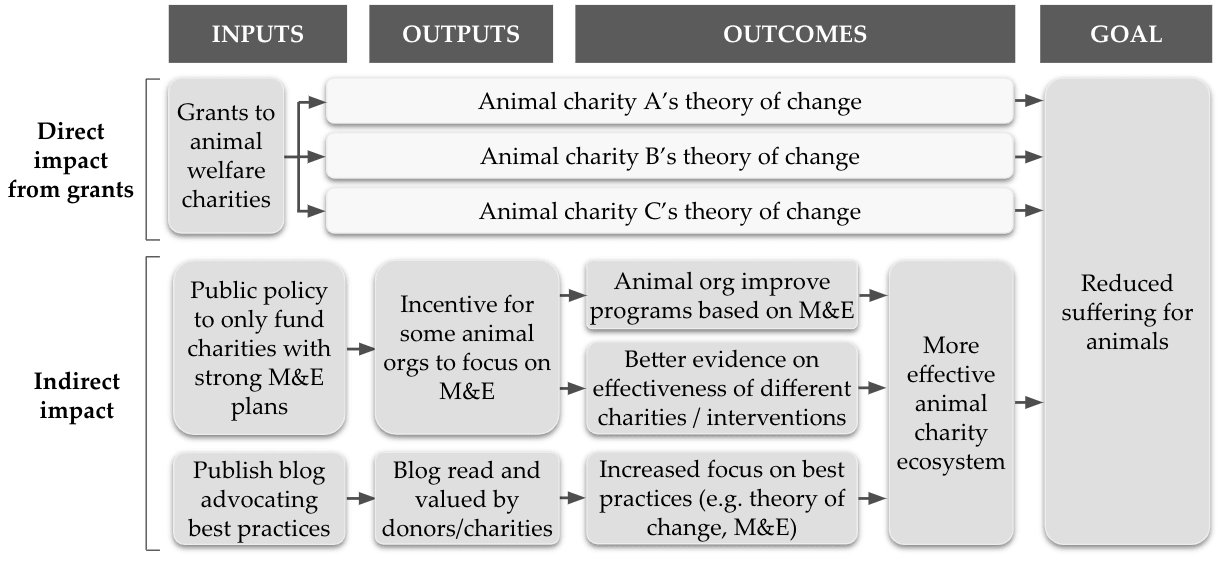
At first thought, it might seem like there would be one theory of change for how all foundations have impact: ‘we fund impactful activities’. In this sense, a foundation’s theory of change is the sum of each of its grantees’, with an additional input at the beginning:
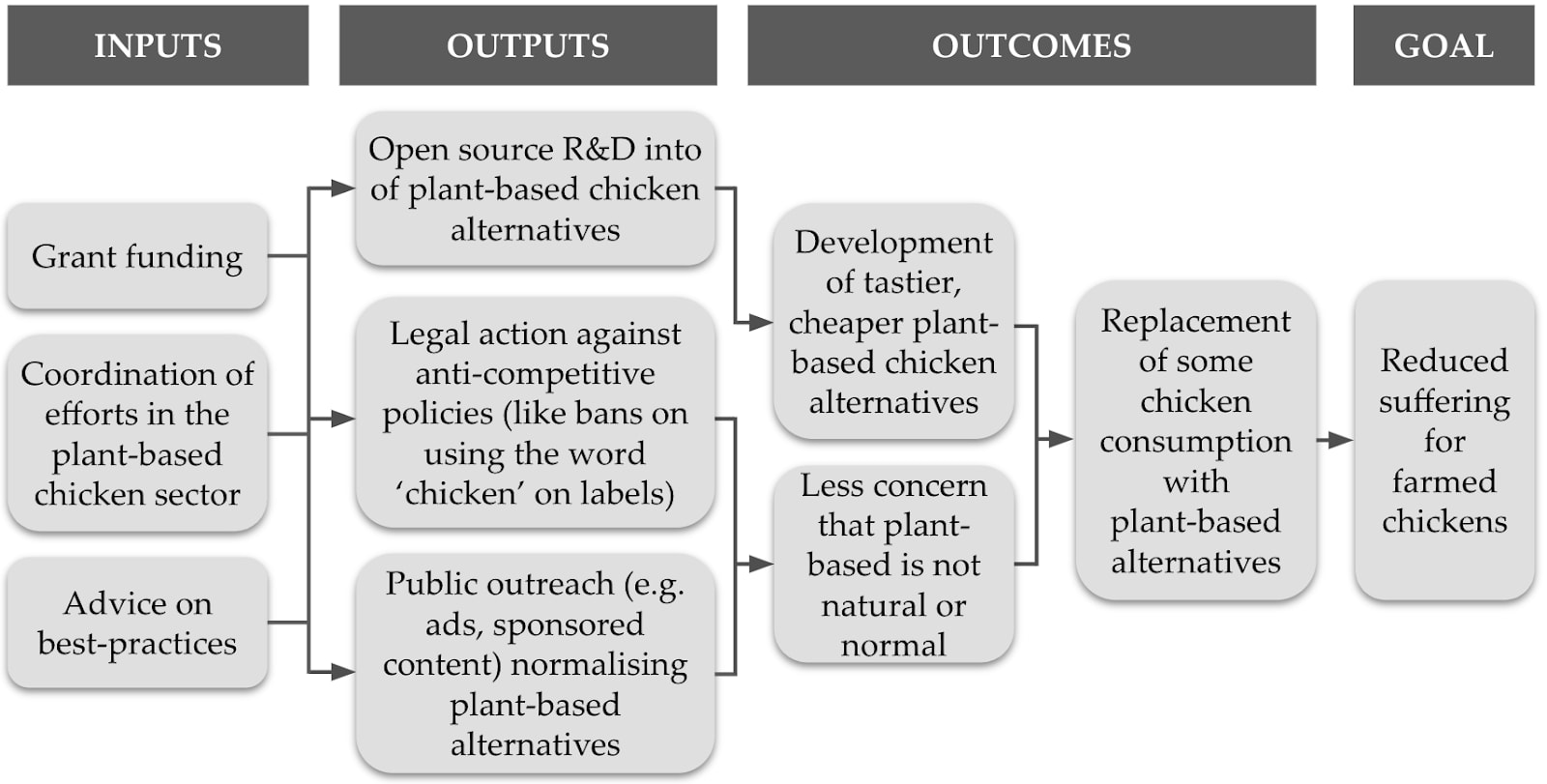
In some cases, foundations can define their theory of change in terms of a specific problem (e.g. inhumane chicken farming) or a specific type of solution (e.g. plant-based alternatives) that they have decided to focus on, where the theory of change reflects their view of the best strategy for how to improve the world within this focus area:
Armed with this kind of strategically-framed theory of change, foundations can seek grantees who can make a contribution and can publicly communicate how other organizations can play a role in realizing their vision. The downside of this type of theory of change for a foundation is that it forces you to have a clear and narrow view of the problem you will focus on, and how it can best be solved. As a result, this approach isn’t suitable for all foundations, and when foundations do take this approach, they should be mindful not to become anchored to one narrow view of how to improve the world.
In addition to the direct impact of providing funding, a foundation can also have broader impact through thought leadership. For example, you might publish research (like Open Philanthropy’s reports on different cause areas), write blog posts (like the Mulago Foundation), develop impact metrics (like CE’s Welfare Points) or create public cost-effectiveness analyses of charities and interventions (like GiveWell).
Foundations can also have impact by influencing their network (which may include other high net-worth individuals, or even other foundations) to give more, or give more effectively. There are a number of other ways foundations can go about creating leverage, effectively multiplying their spending, such as by accessing government funding.
Another way of having an impact is by setting good norms in the nonprofit sector; making it a public policy to only fund organizations who follow certain best practices (e.g. pre-committing to shut down if the M&E doesn’t show a predetermined threshold of cost-effectiveness).
Meanwhile, it is overly narrow to only think about the impact of grant dollars in terms of the inputs that those dollars fund. For example, sometimes when a foundation gives a grant to an early stage organization, it makes the difference between them going insolvent, and them surviving long enough to scale into a massively impactful charity (like the Against Malaria Foundation). By ensuring the longevity of a highly impactful charity, the impact of the grant is not just the immediate activities covered by that money, but some percentage of all of the good that the organization goes on to do in the long term. Similarly, foundations can be active in their grantmaking, influencing how many and what type of projects come into existence. They then are partially responsible for those projects’ lifetime impact, beyond the activities they fund directly.
In some cases, these other forms of impact end up being much larger than the direct impact of the grants themselves! But the chances of this being the case accidentally are low – it takes thought and effort. For this reason, we encourage foundations to define their own theory of change, so that they make a conscious decision about which of these other forms of impact they will work to cultivate.
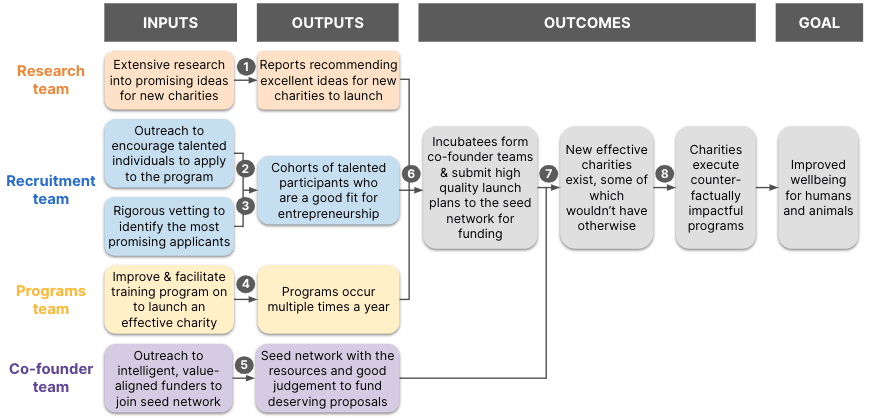
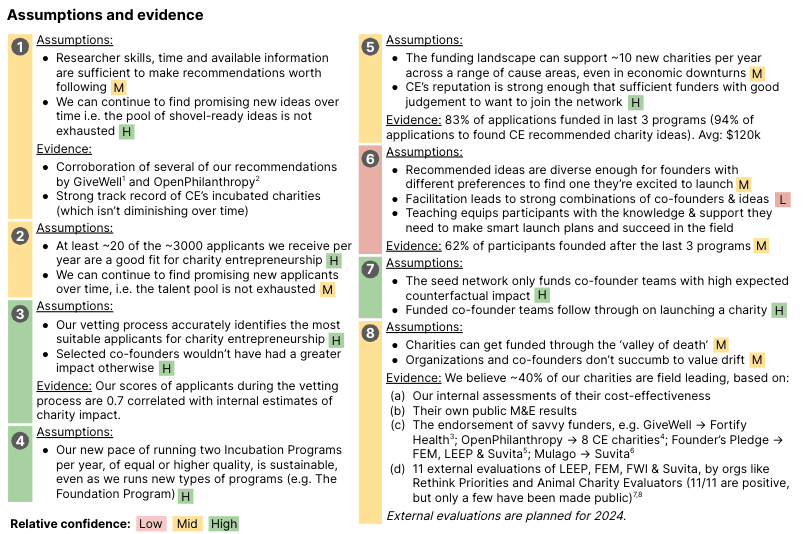
We’ve spent this post ‘talking the talk’ when it comes to theories of change, but now it’s time to ‘walk the walk’. Here is a theory of change for CE’s Incubation Program, as it stands as of July 2023:
Links to footnotes within the table above: (1), (2), (3), (4), (5), (6), (7), (8)
Note that the TOC does not exhaustively cover all necessary inputs for the incubation program to exist and have impact. For example, all of the crucial work of our operations team is absent, as is the work of the co-founder team to set the strategic direction and ensure proper functioning of each department. This is intentional, as it’s important to keep the TOC as tight as possible to increase clarity and comprehensibility. Inputs that truly go without saying need not be included – however in our experience people tend to leave out more than they should.
The TOC reveals some of the risks to our Incubation Program’s impact, for example:
Whilst the evidence we have for the impact of the Incubation Program is fairly strong, one weakness that this TOC illustrates is that several pieces of evidence are predicated on the assumption that funders always make sound decisions, when in reality, getting funding and achieving impact are not necessarily correlated and weak orgs sometimes limp along and take up resources far longer than they should. The exercise of formally documenting this TOC has reinforced for us the importance of the external impact evaluations of our more mature incubated charities that we have planned for 2024. We hope that these evaluations will significantly increase the rigor and objectivity of our M&E.
I hope this discussion has convinced you of the importance of nailing the theory of change for any non-profit program to be impactful.
If you are personally involved in a non-profit program (either as a funder or an implementor):
If the answer to any of these questions is ‘no’, you have work to do.
If you are interested in applying to participate in the Incubation Program: Applications are now open. You can learn more about the process, or begin the application process here.
If you’d like to express interest in participating in the Foundation Program: Reach out to Will Troy.
If you’d like to be notified when our book on effective grantmaking is published, you can let us know here.
Special thanks to Leonie Falk for your help in pressure-testing our theory of change.
Practitioners disagree on the exact distinction between ‘outputs’ and ‘outcomes’. In our experience, the distinction is unimportant. We recommend focusing on the ‘cause-and-effect mapping’ concepts and not the terminology used to describe it.
A clear theory of change can serve as the blueprint for a program’s first cost-effectiveness analysis by laying out the activities that make up the costs, and the various causal steps towards impact, each of which have an effect size and/or probability of success based on the evidence and assumptions for those steps.
Happier Lives Institute, “HLI Has Hatched: Strategy Update after the Charity Entrepreneurship Incubation Program,” Oct. 29, 2019, accessed Feb. 20, 2023, https://www.happierlivesinstitute.org/2019/10/29/hli-has-hatched-strategy-update-after-the-charity-entrepreneurship-incubation-program/.
J-PAL, “Theory of Change,” Course lecture, J-PAL/CLEAR South Asia at IFMR, Delhi, July 2017, accessed Feb. 20, 2023, https://www.povertyactionlab.org/sites/default/files/Lecture%202-THEORY%20OF%20CHANGE.pdf
Abhijit Banerjee et. al., “Improving Immunization Rates Through Regular Camps and Incentives in India,” J-PAL, 2007, accessed Feb. 20, 2023, https://www.povertyactionlab.org/evaluation/improving-immunization-rates-through-regular-camps-and-incentives-india


Thanks for creating this post! Sharing some thoughts on the topic based on my experience creating and redteaming theories of change (ToCs) with various EA orgs (partly echoing your observations and partly adding new points; Two concrete project examples can be found here and here).
Note that I likely have a significant sample bias, as organizations are unlikely to reach out to me if they have enough time to think through their ToC. Additionally, please read this as "random thoughts which came to Jona's mind when reading the article" and not as "these are the X main things EA orgs get wrong based on a careful analysis". I expect to update my views as I learn more
Good stuff Jona! I agree on all fronts.
Re: #2, at Charity Entrepreneurship for example, we should have ToCs for our Incubation Program, Grantmaking Program and Research Training Program, but we don't yet. We have a fairly polished one for the Incubation Program, and a few different ones drafted for the new Research Program we're planning, but we haven't written one down for our Grantmaking Program, so here I am again not practicing what I preach. Looks like we have work to do :)