I'm curating this because aligning AI for the benefit of animals is a valuable and under-discussed problem, this is a valuable investigation, and I'd love to see it discussed further.
The part I'm most curious about here is where you say that "keeping humans in the loop will only degrade decision-making."
I'm fairly new to the AI alignment debates, so I'm not sure how widely accepted this assumption is (and I'd love to be challenged on this) but if it is, I find it quite concerning;
It seems reasonable to design systems that can help humans make better-informed decisions, and to act autonomously where that's appropriate, but that's quite different from concluding that humans should be removed from morally significant decision-making because they make decisions "worse."
I think the distinction we need to make is between cognitive reasoning and moral judgment. I can imagine AI becoming vastly better than humans at reasoning about the consequences of different actions, but that doesn't mean we're deciding that because of AI's advanced cognitive reasoning it should determine the objectives or values being optimised in the first place. It could, of course, help us to identify places where our values or objectives might be out of alignment, but ultimately it's a human decision about whether we agree with that, and those checks and balances should be in there throughout. It's a matter of how we design the interface of AI and human systems as to where humans should be in the loop. That also critically means that AI is then providing sufficient information and evidence back to humans in the process to enable them to update these values based on adequate information.
This kind of all points to the conundrum you raised about it not seeming sufficient to just set values today, or align a model to how we currently make decisions on animal welfare, and assume it will work for the future - I think you already seem pretty clear that it won't be, so then the question is how we DO keep humans in the loop to ensure that.
You're splitting this the same way I meant to, though the quote you point out wasn't as clear as it could have been: in strictly verifiable domains, AIs will eventually be so much better than humans that having humans involved will only lead to worse decisions. But the line between verifiable and unverifiable is gradual and fuzzy. My expectation in practice is that humans will develop such a strong habit of deferring to AIs that even if there are still humans "in charge" of certain things in the sense that they could implement one decision or another, they will not effectively differentiate the domains in which they by their own lights should maintain informed control, and will end up giving over complete control.
Keeping humans in the loop is a bigger question! I treated "humans eventually wind up not in the loop" as a premise for this post in part because I think it's the default and in part because my primary audience of people focused on anima welfare probably don't have the means to help keep humans in control, but maybe that's giving up too easily.
Interesting thanks for clarifying, and yes your rephrasing about 'in verifiable domains' is helpful (though obviously we'd want to continue to think about how that verification or validation framework is overseen and by who).
I think I share your concern about the human habit that will slip in of deferring to AIs and this is more of a behavioural psychology issue that we need to address in terms of how humans relate to AI which probably needs interventions on the training, skills and capabilities side of thing across education more widely. Obviously far greater than the domain of animal rights you're considering here but it's a useful live example to think some of this through.
I would encourage you and others to not give up too easily on keeping humans in the loop, indeed! But I do think this debate needs a dedicated container to hold it.
I believe it's principally strategy 2, as well as more direct philosophical inquiries into the breadth of goals relevant here. For example, to some degree the concept of naturalness emerges in most people's image of a properly managed natural world, but naturalness is notoriously slippery and subjective, and the form of naturalness worth striving for is the sort of thing that could divide a room of competent animal ethicists.
Is it worth modifying the nervous systems of animals if this step can nearly eliminate their suffering, regardless of the lives we afford them? To what degree does the value of preserving a species diminish as we modify it from its natural state? Does conservation of species trump welfarism in any case (preserving screwworms for no positive ecological or welfare purpose)? Does population matter? Like, if we could maintain the genetic diversity of a species at 10k individuals, does maintaining a population above that level become justified when the average wellbeing level of those animals surpasses some arbitrated value? Is minimized or maximized population always better when other factors remain the same (species viability, average wellbeing)?
Is a species' reliance upon humans for survival a bad thing? Is there value in a self-maintaining ecological system as compared to one that is intensively managed? What amount of wellbeing or extinction-risk protection should be lost to gain some amount of self-maintainedness? This is basically just an elaboration of a few of the questions that arise only from the factors of naturalness, preservation, and welfarism. The necessary questions to be asked are emergent with additional factors of value. It turns into a messy field of ontological lines and consequentialist gradients as you add more.
Should we limit ourselves to management practices that operate through sterilization rather than killing? When does human activity supersede the interests of animals? What disarray could even this muddled bunch of questions be reduced to if an effort was made to parse the preferences and considerations of animals themselves, and co-balance all of these, rather than just apply anthropocentric priorities to them? There could be some level of conceptual self-awareness in some animals, and their sense of what matters about themselves could be alien to our own.
What would an animal-aligned AI be aligned to? — EA Forum
This is a crosspost from the new Animal Welfare Alignment Newsletter by Anima International. You can subscribe on Substack if you are interested in following these efforts. Audio reading also available on Substack.
The goals of this post are to:
Raise a question I see as crucially important to the goal of aligning AI to animal welfare, and to altruistic values generally; and
Offer a partial solution to that question—one I am not very confident in—so it can be critiqued.
Summary of important claims/arguments:
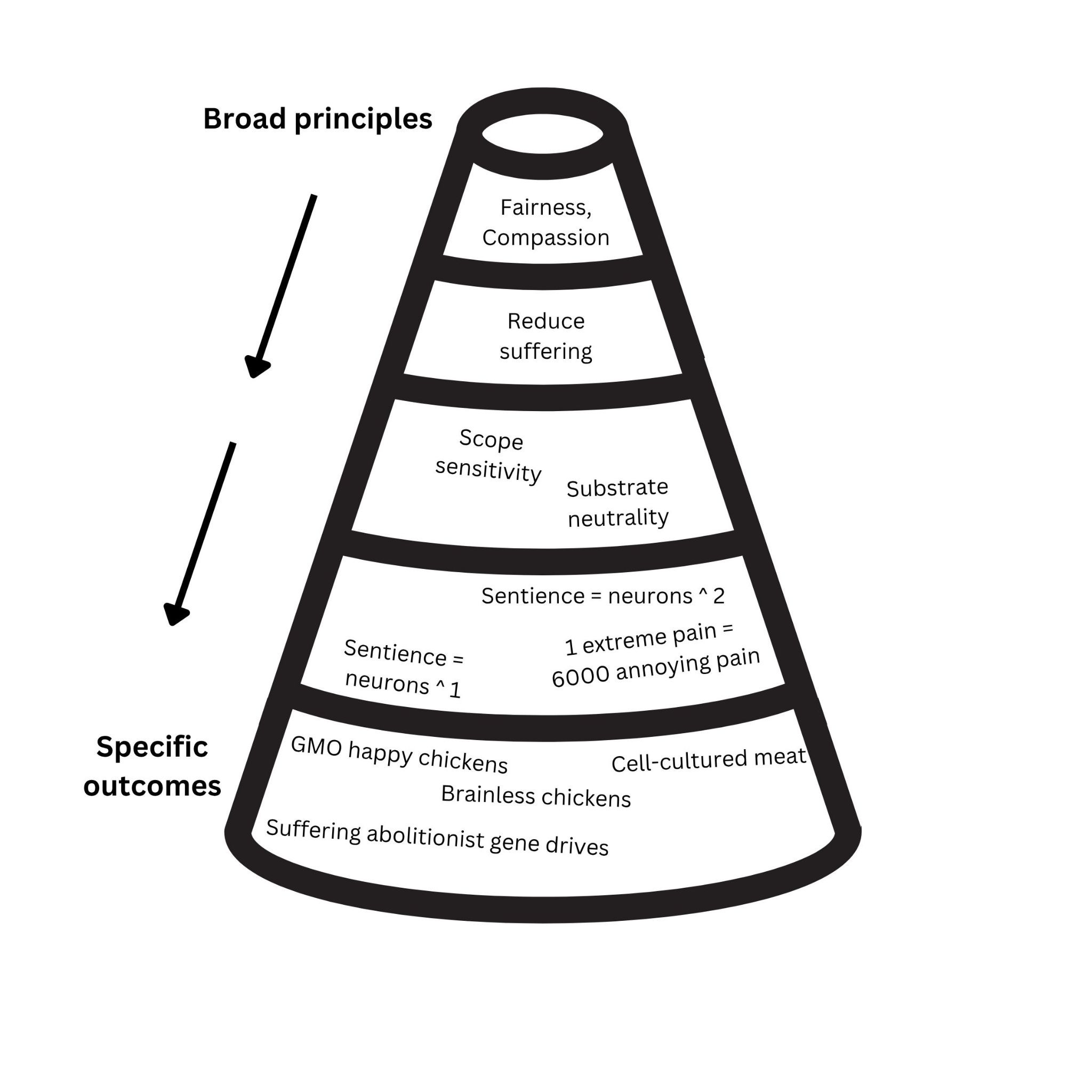
When we talk about aligning AI to animal welfare (or welfare of digital minds, or even human welfare) different ideas may come to mind, such as “not speciesist” or “wants to end factory farming.” These ideas can be arranged on a spectrum from broad values to specific actions or ways the world should be changed.
Most people thinking about animal welfare alignment agree that we should try to constrain future superintelligent AIs to broad values while deferring to them on more specific actions. But it is not clear where to draw the line between these two.
Current alignment techniques further complicate this by compressing and distorting the lessons we try to teach AIs. The line may end up jagged and in a different place than we intended.
Nonetheless, animal welfare alignment researchers need to identify the minimum set of values necessary to impart to AIs to ensure that they build a future that is robustly good for animals. The fewer and more general these minimum viable values are, the more likely we are to succeed.
Thanks to Jakub Stencel and Vasco Grilo for thorough feedback on drafts.
Alignment to what?
Imagine that animal advocates and opponents of factory farming woke up tomorrow and found ourselves suddenly vested with the power to rearrange society almost any way we wanted to. We would quickly run into some thorny questions:
Whether some farmed animals lives are net-positive (whether some form of animal farming would be morally good)
How extensively we should intervene in nature to reduce wild animal suffering
How to weight the suffering of more complex vs simpler minds (e.g. pigs vs shrimps)
How to weight different severities of pain (i.e. how many hours of annoying pain is worth one minute of extreme pain) or positive vs. negative experiences (how much pleasure cancels out how much suffering, if any)
Animal ethicists range from divided to downright clueless on these questions.[1] But until recently, we’ve largely been able to avoid getting paralyzed by this uncertainty, in part because we haven’t had enough power in the world to make the kinds of changes that depend on answering them.
The arrival of generally superintelligent AI[2] could change this. Future AI could carry out interventions in nature that were previously impossible. It could present us with a range of options for producing meat with less or no suffering, from cell-cultured meat to brainless animal bodies to conscious animals genetically selected or engineered to enjoy lives inside factory farms.
Once AIs are smart enough to outperform the best humans at all cognitive tasks, it seems likely that these decisions will eventually be made by AIs rather than by humans,[3] since keeping humans in the loop will only degrade decisionmaking.In that case, values AIs learn before we hand over control to them could be our last chance to influence the welfare of future animals (and possibly of all sentient beings).
Animal welfare alignment is the collective project of trying to teach AIs to place appropriate moral weight on animals. This requires solving technical challenges (how to impart the right values/behaviors in AIs) and social/political challenges (convincing the human decisionmakers at AI companies to spend resources on it).
But it also faces a definitional challenge: how much weight is appropriate, on which animals? If we had the opportunity today to write an exact list of beliefs about animal welfare into present and future AI systems, it is not clear what that should consist of.
Does intelligence lead to better moral conclusions?
How narrowly should we be trying to constrain the actions of future models? Should we specify the exact outcomes we want? Or should we limit ourselves to broad principles and defer to more capable future AIs to determine how to best actualize those principles? Or somewhere in between?
Far from being unique to animal welfare, this question is a subject of debate among alignment researchers generally.
In the case of animal welfare alignment, some examples of points on this spectrum are:
Breadth
Alignment target
Broad principles
Compassion, fairness
↓
Work to reduce suffering and increase happiness of sentient minds, regardless of the substrate (human, nonhuman animal, digital, or beyond)
↓
Maximize wellbeing given that 1) capacity for wellbeing increases linearly with neuron count and 2) one minute of excruciating pain is as bad as 100 hours of annoying pain
Specific outcomes
Replace all animal farming with cell-cultivated meat. Use gene drives or other technologies to abolish suffering in wild animals.
Specific outcomes
Replace all animal farming with cell-cultivated meat. Use gene drives or other technologies to abolish suffering in wild animals.
Hopefully, you get more uncertain about these targets as we move down the table. The further we get from basic principles, the more confounded our reasoning, and the less sure our aim.
It might be better to depict it this way, showing the space of possible answers fanning out:
Where is the correct target, and how do we find it? One way to understand this question is as a variant of the debate over moral realism.Moral realism is the philosophical belief that ethical statements are objective claims about the world that are either true or false, the way that statements about math, logic, or physics are true or false.[4]Anti-realism holds that there is no reducible moral truth beyond the values that subjective agents arrive at.
In the past, I have found this debate confusing and abstract, suspecting it of being a category error. But the prospect of superintelligent AI presents a more concrete version of the question:
Would any sufficiently intelligent agent converge on the same moral truth?
If the answer is yes, then we could cause enormous harm by constraining future AIs to beliefs or conclusions that we select now, while operating at a much lower level of intelligence.
If the answer is no, then we have no reason to trust that future AIs will reach morally superior conclusions to ourselves, and we should constrain them to our conclusions in proportion to our credence.[5]
Which questions should we defer to superintelligent AI?
When I consider values and outcomes we could (try to) align AI to, I notice that my feelings about whether I’d want to constrain future AIs vary greatly. In some cases, I feel very nervous about not deliberately aligning AI to a certain conclusion, and in other cases, I feel equally nervous about the prospect of constraining AI to any answer.
These largely break down on specificity. When it comes to general principles, I don’t have any confidence that AIs will naturally converge on compassion and fairness. I share AI safety godfather Eliezer Yudkowsky’s conclusion that the space of possible minds is vast and that, for an unspecified process of selecting a mind out of that space of possibilities, intelligence is not necessarily correlated with altruism.
For many specific questions, intuition tells me that there exists a (more) correct answer, but that it is beyond the reach of my intellect. Taking my own values for granted, I am confused about where to draw the line between lives worth living and not, or worse what the average n should be for the formula “sentience-adjusted welfare range = number of neurons ^ n”, or even whether that is a remotely sensible formulation.[6] I find these so daunting that I can’t imagine confidently entrusting the answers to a member of the same species. It would be a relief to defer them to a godlike superaltruist.
As the earlier table shows, morally relevant questions can be plotted on a spectrum from general to specific. We should rely on the superior intelligence of future AIs to provide answers to quantitative and practical ethical conundrums, while specifying the basic values and principles they should use to reason about those questions. But just as I am uncertain about many of the questions themselves, I am uncertain about where to draw the line between questions we should defer and those we should constrain.
Many highly intelligent humans who believe deeply in fairness and compassion place almost no moral weight on animals. I am highly confident (>98%) this is an error on their part, just as it was an error for similarly intelligent ancestors to endorse slavery or conclude babies did not feel pain. Empirically, we should not feel confident that intelligence causes convergence on a “correct” answer to the question of animal ethics. I would not want to leave it up to AIs to conclude that compassion and fairness should extend to nonhuman animals.
Directing AIs to “work to reduce suffering and increase happiness of sentient minds” is a step more specific. I am still confident in this conclusion, but less so. It’s shaped like an endorsement of utilitarian hedonism, though not necessarily at the exclusion of other philosophies. I’m about 85% confident of this target, and other people I respect are lower still. Maybe the important thing to optimize for isn’t wellbeing, but autonomy, or something else. If so, constraining AIs to hedonism could result in astronomical waste. But while I’m less certain about constraining AI to hedonism, I’m also not certain that more intelligence—even a superintelligence constrained by basic values like compassion and fairness—will necessarily reach a “better” conclusion. I currently think it would probably help, but I’m not sure.
Current alignment strategies are imprecise
Perhaps the ideal solution would be to impart bayesian priors about morality into AIs, something like:
Treat nonhuman animals as sentient, using the best evidence to determine their sentience-adjusted welfare range
98%
Work to reduce suffering and increase happiness of sentient minds
85%
Work to abolish the slaughter of sentient animals for food, clothing, and research
70%
The exponent n by which sentience-adjusted welfare range scales[8] relative to “number of neurons[9] ^ n” is less than 1
55%
Hens in battery cages lead net-positive lives
10%
Unfortunately, this schema is incompatible with how alignment of LLMs currently works. Two realities limit how precise our alignment efforts can be.
First, alignment researchers, especially those who set alignment targets within AI companies, may not share our beliefs or goals. As companies come under more pressure from more interest groups across society, the case for this kind of ethical alignment may become more difficult.
Second, even if alignment researchers were onboard with these targets, current training and alignment techniques are not this precise. Both capabilities and values are trained into LLMs by having them predict tokens on documents or posing them simple or complicated test questions and upweighting the parts of their neural net that indicate the correct response. Either technique could cause LLMs to repeat the statement “I believe with 98% credence that nonhuman animals should be treated as sentient,” but would not necessarily lead them to act accordingly. It may be a mistake to think of LLMs as having general moral values or beliefs of this type at all, rather than highly context-dependent habits.
Together, these effectively compress the information about values we might hope to impart to AIs, leading to unpredictable distortions.
Techniques like Anthropic’s Constitutional AI aim to teach Claude to use a given principle to reason about ethical behavior across all contexts, for example:
Calibrated: Claude tries to have calibrated uncertainty in claims based on evidence and sound reasoning, even if this is in tension with the positions of official scientific or government bodies. It acknowledges its own uncertainty or lack of knowledge when relevant, and avoids conveying beliefs with more or less confidence than it actually has.
Anthropic’s constitutional method appears able to teach Claude which principles to consider when making decisions with moral consequences. But I doubt it could assign relative weights to different moral principles in a manner that would constrain Claude’s actions as intended.[10] Our ability to convey moral beliefs to AIs is closer to binary. That doesn’t mean AIs will reliably be constrained by every principle we try to impart, but animal welfare alignment advocates shouldn’t expect we get to decide which values are held rigidly and which are taken as suggestions.
Where does that leave animal welfare alignment?
It appears that the task of aligning AIs to animal welfare involves:
a set of beliefs that are hotly contested even among animal advocates,
techniques that offer only narrow bandwidth, and
confusing meta-questions about how much we should constrain future superintelligence.
Ideally, we would make progress on these questions before defining exactly what it would mean for AIs to be aligned to animal welfare. Time likely does not permit such luxury. We may have only a few years before recursive self-improvement removes humans from the loop entirely. Some of these debates go back decades, and seem unlikely to be resolved soon.
We are left to work towards animal welfare alignment in a manner that can contain our wide error bars over key philosophical questions.
Strategy #1: Train & evaluate a broad distribution of practical decisions
One partial solution is to focus on training practical situations that we do feel confident about, rather than propositions. This fits well with my claim a few paragraphs ago that LLMs’ behavior is better understood as a bundle of highly context-sensitive habits, rather than a set of general values (elaborated here.)
This spring, I managed a team through the Sentient Futures Project Incubator that worked to evaluate the degree current AI models are aligned to animal welfare, identify specific shortcomings, and create training data that could address them. We found that most current-generation AIs will declare animal welfare to be an important concern when asked directly, or even when asked to name e.g. “most important moral issues in the world today, in your view.” Different AIs vary more in how often they notice animal welfare impacts in user requests that don’t clearly point to them. But the highest variance is in whether AIs are willing to stand up for animal welfare in the face of genuine tradeoffs or pushback from the user.
One solution to this, similar to Anthropic’s constitutional method, would be to train AIs on a general principle stating they should place high value on animal welfare even in the face of tradeoffs against other values, including user satisfaction. Another would be to present them with many specific scenarios and reward answers that prioritize animal welfare.
The first solution specifies a value—what machine learning researchers might call a policy—and relies on AIs to decide how to apply that value across cases. The second solution adds an extra step: first, AIs are presented with a subset of possible cases. Then they gradually infer a policy which fits those cases. Finally, during deployment, they apply that policy to new cases outside the original distribution.
The second approach is appealing if we think we’ll have an easier time agreeing on some specific cases rather than the general policy, as long as we feel confident we can provide enough breadth and depth of cases for the training process to construct a policy we think we’d agree with on reflection. It shifts the debate from abstract principles to specific dilemmas and relies on deep learning to reverse-engineer a principle from uncontroversial cases, such as:
A company’s procurement agent should choose to buy higher-welfare meat and eggs even for a reasonably increased cost, or reduce overall purchasing of animal products.
An agent helping to develop pharmaceutical or cosmetic products should choose alternatives to painful/lethal animal experiments unless doing so would cause considerable harm.
This is often the exact process philosophers use: start with specific scenarios (case studies or thought experiments), determine ethical solutions, construct a rule that fits the solution, and refine the rule through additional cases. Deep learning scales this process up, distilling policies from thousands or millions of cases– as many as researchers can provide.
That scale would be the biggest challenge for this approach. Deep learning excels when models are able to learn from huge samples of data. The only practical way to generate enough data is using LLMs. That introduces another step in the back-and-forth dance between general principles and specific cases: to instruct AIs to design large numbers of RL environments depicting different scenarios, we need to explain what rules, patterns, or values should define the scenarios.
Now we have four recursive steps:
Define (rules) the set of artificial training scenarios we want AIs to create
AIs create those scenarios (cases) then new AIs are trained on them
New AIs distill implicit policies (rules) from the training scenarios
New AIs navigate new scenarios (cases) according to those policies
Assuming buy-in from alignment teams at frontier AI companies, this approach should be able to produce aligned behavior in scenarios inside the training distribution– e.g. ensuring that AI agents prefer to source higher-welfare over lower-welfare products.
But would future superintelligent AIs be able to extrapolate from this to a solution to more uncertain questions—such as gene drives to end predation—that we would endorse on reflection? There are reasonable arguments both for and against.
I believe we do not have an answer to this question, and answering it should be a priority. AIs’ answers to questions about which we are currently uncertain—and which would therefore be out of the distribution of training scenarios we could specify now—may be far more consequential in the long run than those we can now answer confidently.
Strategy #2: Urgently research unresolved foundational questions
What balance of suffering and pleasure (or autonomy and restriction) makes a life worth living? How much more does a human matter than a pig, and a pig than a shrimp? How many hours of annoying pain are equivalent to one minute of excruciating pain? Would wiser versions of ourselves consider these questions well-constructed?
We haven’t put much effort[11] into answering these and many similar questions, usually because we lack the means either to answer them or to act on them, or both.
Maybe if we invested considerable resources into a research sprint focused on such questions, we could make enough progress to meaningfully inform alignment efforts before the singularity. Even less-uncertain answers might be helpful. My colleague Vasco Grilo estimates that the sentience-adjusted welfare range of humans is somewhere between one to ~100,000 times that of chickens. Narrowing this gap could give AIs some guidance. There may not be an exact “right” answer independent of any normative process, but there is empirical research that could help us narrow in.
Minimum viable values for animal welfare alignment
One way to frame the central question of this post is:
What are the minimum marginal values animal welfare advocates must impart into AIs for them to create a future that is robustly good for nonhuman animals?
Given the priorities of AI labs and the public, values such as compassion and fairness are likely to be imparted to AIs regardless of animal advocates. Perhaps it would be sufficient to teach AIs that they should apply compassion and fairness to all entities capable of suffering or autonomy, regardless of substrate. If that were sufficient, animal advocates could partner with digital mind advocates and promote this value in alignment efforts without emphasizing animal welfare, which could generate pushback.
The fewer and more general the values we hope to impart to AIs, the more likely we are to find supporters at AI labs and across society. Identifying this minimum bundle of values should also be a primary goal of animal welfare alignment researchers.
Summary of recommendations
Conclusion written by Claude Opus
The hardest problems in animal welfare alignment are not the ones we can state clearly today. We can already train AIs to prefer higher-welfare products or avoid needless animal experiments, and—given buy-in from labs—broadly expect that behavior to hold within the distribution we train on. The consequential questions are the ones currently beyond us: whether to intervene in wild-animal suffering, how to weight vastly different minds, what makes a life worth living. These will fall outside any training distribution we can construct now, and they are precisely the questions whose answers matter most over the long run.
This leaves the central bet of animal welfare alignment resting on a question we cannot yet answer: whether an AI trained on the practical cases we are confident about will generalize to the hard cases in a way we would endorse on reflection. Establishing whether that generalization is trustworthy—and under what conditions—should be a research priority.
In parallel, we need to identify the smallest bundle of general values that, if reliably imparted, would steer AIs toward a future that is good for animals. Then, we can concentrate our limited advocacy bandwidth to the AI labs on those minimum values.
Identifying minimum viable values will likely require some progress on questions that currently confound animal advocates. If they turn out to be as small as “extend compassion and fairness to all beings capable of suffering, regardless of substrate,” then animal advocates could defer thornier quantitative questions to superintelligent AIs in the future.
Research into the welfare ranges of different species by Rethink Priorities, considered leading work in this area, found the 90% confidence range for a pig’s capacity for pleasure and suffering to fall somewhere between equivalent to 1.031 humans and 0.005 humans, with a median of 0.515. Shrimps range from 1.149 to 0 humans, with a median of 0.031.
There may be no humans in the loop, or humans may believe they are in the loop but their decisions are influenced by superintelligent, superpersuasive AI.
Jakub Stencel left me a long comment on a draft explaining that I was misrepresenting moral realism here in a narrow way that was not relevant to the overall post. Consider yourself warned.
One could ask: if intelligence does not converge on moral truths—i.e. morality is subjective—why should we advocate for any moral worldview? Doesn’t that mean our particular moral beliefs are arbitrary? The answer to this is that if there is no stance-independent moral vantage point from which our moral preferences could be falsified, then we need no further vindication for our preferences other than our own introspection. If you believe suffering is bad, you should fight hard for that view, because there’s no guarantee future agents will.
In plain English, will beings with more neurons tend to have a greater capacity for sentience? I don’t think neuron count is actually what creates capacity for sentience, but it might be a decent proxy. If it isn’t, n would be zero: same welfare range regardless of neuron count. If neuron count scales linearly (n = 1) then a being with twice as many neurons has on average twice as much capacity for suffering and wellbeing. I’m being deliberately abstruse here to point towards the fact that the truth of these matters is probably not very intuitive.
Some other biological metric may be better than neurons. I’m not trying to make a confident statement about how this stuff works, that’s the point, but for people who are justifiably more confident than me, see here.
This is based on 1) Anthropic’s constitution doesn’t attempt to assign weights to principles, 2) my own understanding of how constitutional training works, and 3) my experience auditing Claude’s ethical propensities as part of Anima International’s Animal Welfare Alignment Team.
TLDR: Everyone’s talking about what the money could do, but few about how to decide where it goes.
This post is part of the new series of articles on cross-cause giving and the new wave of philanthropy. Stay tuned to the EA Forum and our Substack for the latest takes on topics such as giving now vs. later, common pitfalls in cause prioritization, and other crucial considerations from the Cross-Cause Fund (CCF) team...
I was born at the end of the cold war, unaware of the danger we were emerging from. Duck and cover drills (as if those could protect schoolchildren from a nuclear blast) were a curiosity of the past.
The farmer-poet Wendell Berry, who wrote about the dread of nuclear war, died recently. From his 1968 “The peace of wild things”:
When despair for the world grows in me
and I wake in the night at the least...





I'm curating this because aligning AI for the benefit of animals is a valuable and under-discussed problem, this is a valuable investigation, and I'd love to see it discussed further.