Summary
- I have argued saving human lives, decreasing the consumption of animal-based foods, and improving the conditions of farmed animals may change the welfare of soil animals much more than increase the welfare of the target beneficiaries (humans or farmed animals). Those interventions change agricultural land, and therefore affect soil animals, whose density varies by biome.
- I suspect many people believe the effects on soil animals of interventions targeting non-soil animals only matter if one cares about soil springtails, mites, and nematodes. However, I would worry about indirect effects on soil animals even if I thought soil springtails, mites, and nematodes had a probability of sentience of exactly 0. In this post, I illustrate replacing fast with slower growth broilers, and hens in battery cages with ones in barns or aviaries may change the welfare of soil ants and termites much more than increase the welfare of chickens.
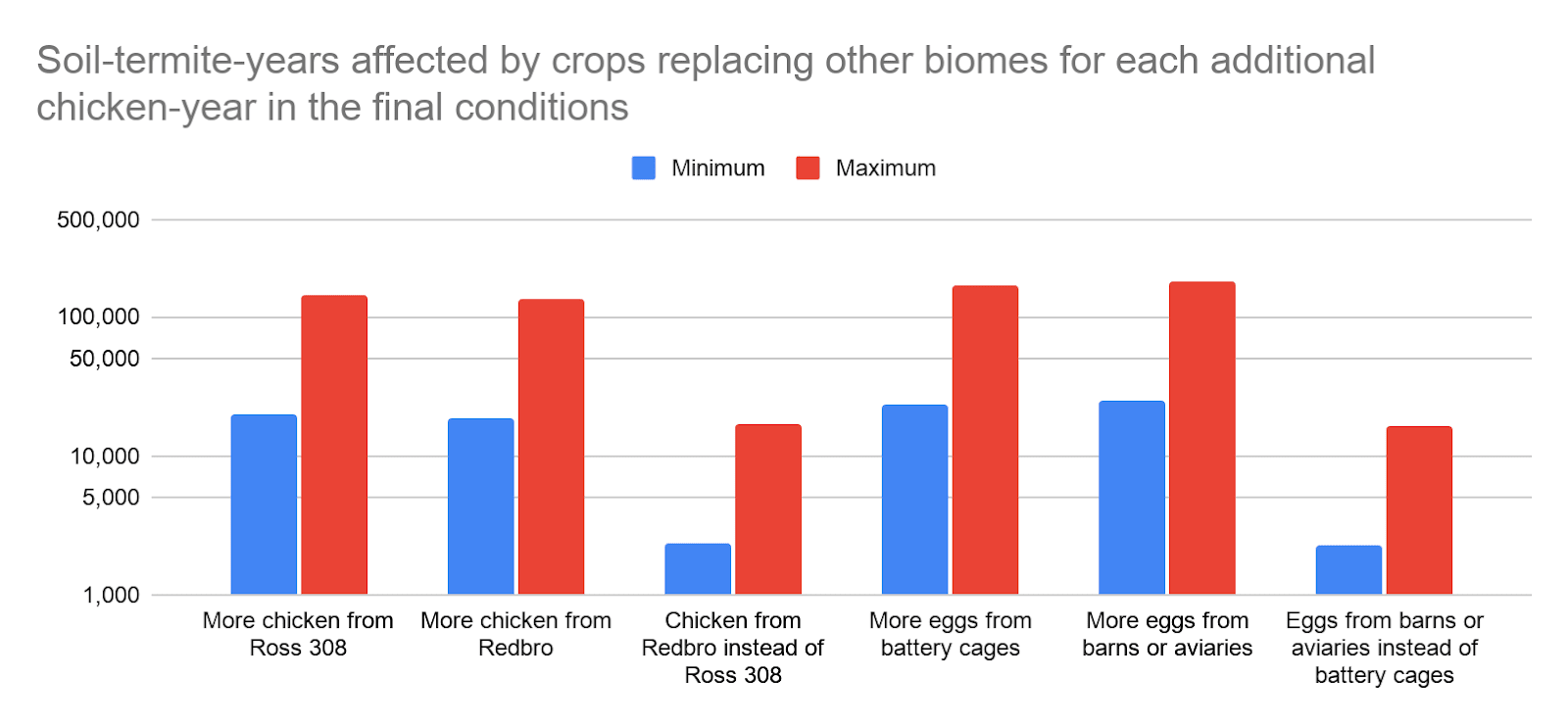
- Depending on the biome replaced by the additional cropland, my estimates for the change in the living time of soil animals for each additional chicken-year in the final conditions range from:
- For chicken from Redbro (slower growth) replacing that from Ross 308 (fast growth):
- 375 to 10.8 k soil-ant-years.
- 2.34 k to 17.0 k soil-termite-years.
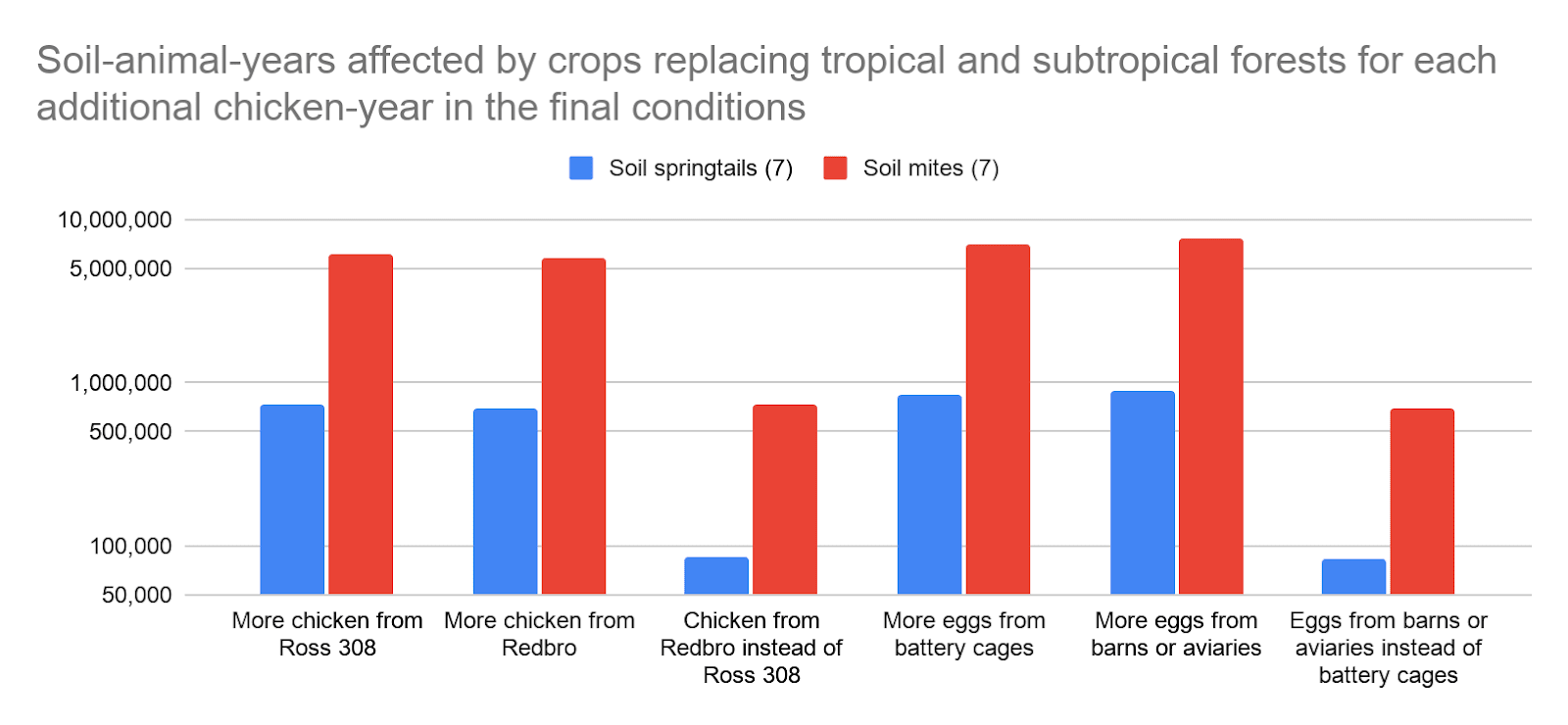
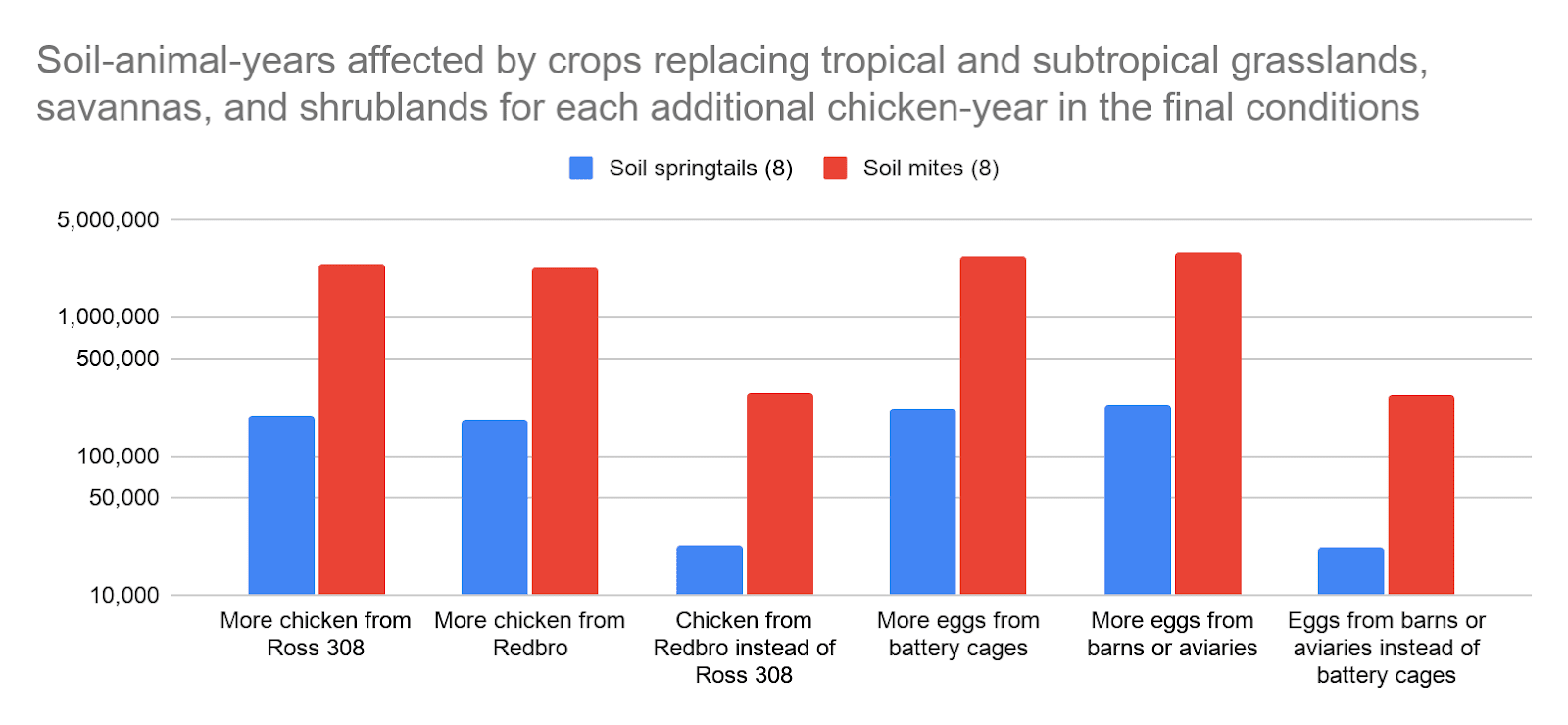
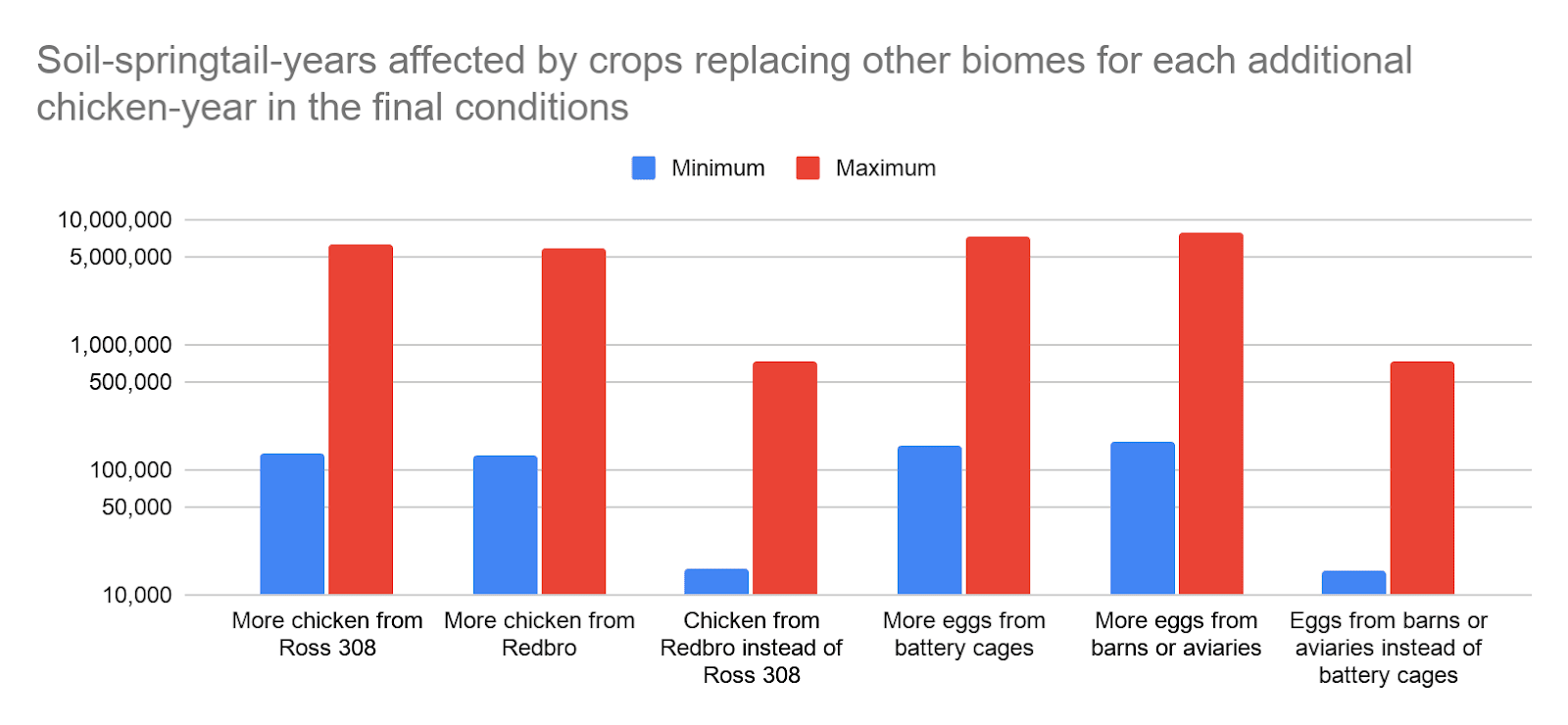
- 16.1 k to 743 k soil-springtail-years.
- 33.2 k to 1.26 M soil-mite-years.
- 116 k to 1.98 M soil-arthropod-years.
- For eggs from barns or aviaries replacing ones from battery cages:
- 364 to 10.5 k soil-ant-years.
- 2.28 k to 16.5 k soil-termite-years.
- 15.6 k to 722 k soil-springtail-years.
- 32.2 k to 1.22 M soil-mite-years.
- 112 k to 1.93 M soil-arthropod-years.
- In Bob Fischer’s book about comparing welfare across species, the tentative (expected) welfare range of chickens is 5.48 times that of black soldier flies (BSFs). I expect the welfare range of chickens to be around 5.48 times that of soil ants or termites under the methodology of Bob’s book, and the change in the living time of soil ants and termites is way more than 5.48 times the additional chicken-years in the final conditions. So I think replacing fast with slower growth broilers, and hens in battery cages with ones in barns or aviaries change the welfare of soil ants and termites much more than they increase the welfare of chickens trusting the welfare ranges in Bob’s book.
- I am more agnostic. I believe the change in the welfare of soil animals may be much larger or smaller than the increase in the welfare of chickens.
- I conclude chicken welfare reforms can easily increase or decrease welfare. I believe they may impact soil animals way more than chickens, and I have very little idea about whether they increase or decrease the welfare of soil animals.
- I recommend research on i) the welfare of soil animals and microorganisms, and ii) comparisons of (expected hedonistic) welfare across species. I think progress on ii) is difficult, but necessary to find interventions which robustly increase welfare. I also see lots of room for progress on ii) to change funding decisions even neglecting soil animals and microorganisms. For welfare range proportional to “individual number of neurons”^“exponent”, and “exponent” from 0 to 2, which covers the best guesses that I consider reasonable, the welfare range of shrimps is 10^-12 to 1 times that of humans.
- I am sceptical that targeting non-soil animals is a great way to build capacity to increase the welfare of soil animals later. I believe the most cost-effective ways of building capacity to help any given group of animals will generally be optimised with such animals in mind. I would also expect much more investigation of the extent to which interventions targeting non-soil animals are building capacity to increase the welfare of soil animals if this was key to whether they are increasing or decreasing animal welfare.
- Replacing Redbro with Ross 308, and barns or aviaries with battery cages decreases the demand for chicken and eggs due to increasing the price of these. I suspect the decrease in demand is large enough for cropland to decrease instead of increase, but I believe effects on soil animals may still be much larger than those on chickens.
Context
I have argued saving human lives, decreasing the consumption of animal-based foods, and improving the conditions of farmed animals may change the welfare of soil animals much more than increase the welfare of the target beneficiaries (humans or farmed animals). Those interventions change agricultural land, and therefore affect soil animals, whose density varies by biome.
I suspect many people believe the effects on soil animals of interventions targeting non-soil animals only matter if one cares about soil springtails, mites, and nematodes. These are the most abundant soil animals, but have the lowest individual number of neurons. So I assume their individual welfare per animal-year is the closest to 0. I guess many people suppose it is sufficiently close to 0 for their total welfare to be negligible compared with that of other soil animals (in principle or practice). In contrast, I can see their total welfare being much larger or smaller than that of other soil animals, and would not rule out nematodes. However, I would worry about indirect effects on soil animals even if I thought soil springtails, mites, and nematodes had a probability of sentience of exactly 0. I estimated indirect effects on soil ants and termites alone may be much larger than effects on target beneficiaries, but did not highlight it much. In this post, I illustrate more clearly that replacing fast with slower growth broilers, and hens in battery cages with ones in barns or aviaries may change the welfare of soil ants and termites much more than increase the welfare of chickens. Chickens in the improved conditions require more feed. So the welfare reforms lead to more cropland, and therefore impact soil animals.
Calculations
Here are my calculations.
Effects on chickens
I calculate the chicken-years per kg of chicken from Ross 308 and Redbro (fast and slower growth breeds) based on data from van Horne et al. (2025). I estimate the chicken-years per kg of eggs from battery cages, and barns or aviaries based on data from van Horne and Bondt (2023).
Effects on soil arthropods
I rely on the density of soil arthropods by biome from Rosenberg et al. (2023). I use values equal to the means across sites of each biome, but there is significant uncertainty (see Table S4 of the Supplementary Materials). I get the cropland needed per kg of chicken from Ross 308 and Redbro from van Horne et al. (2025), eggs from battery cages from Poore and Nemecek (2018), and eggs from barns or aviaries from Poore and Nemecek (2018), and van Horne and Bondt (2023).
Change in the living time of soil arthropods
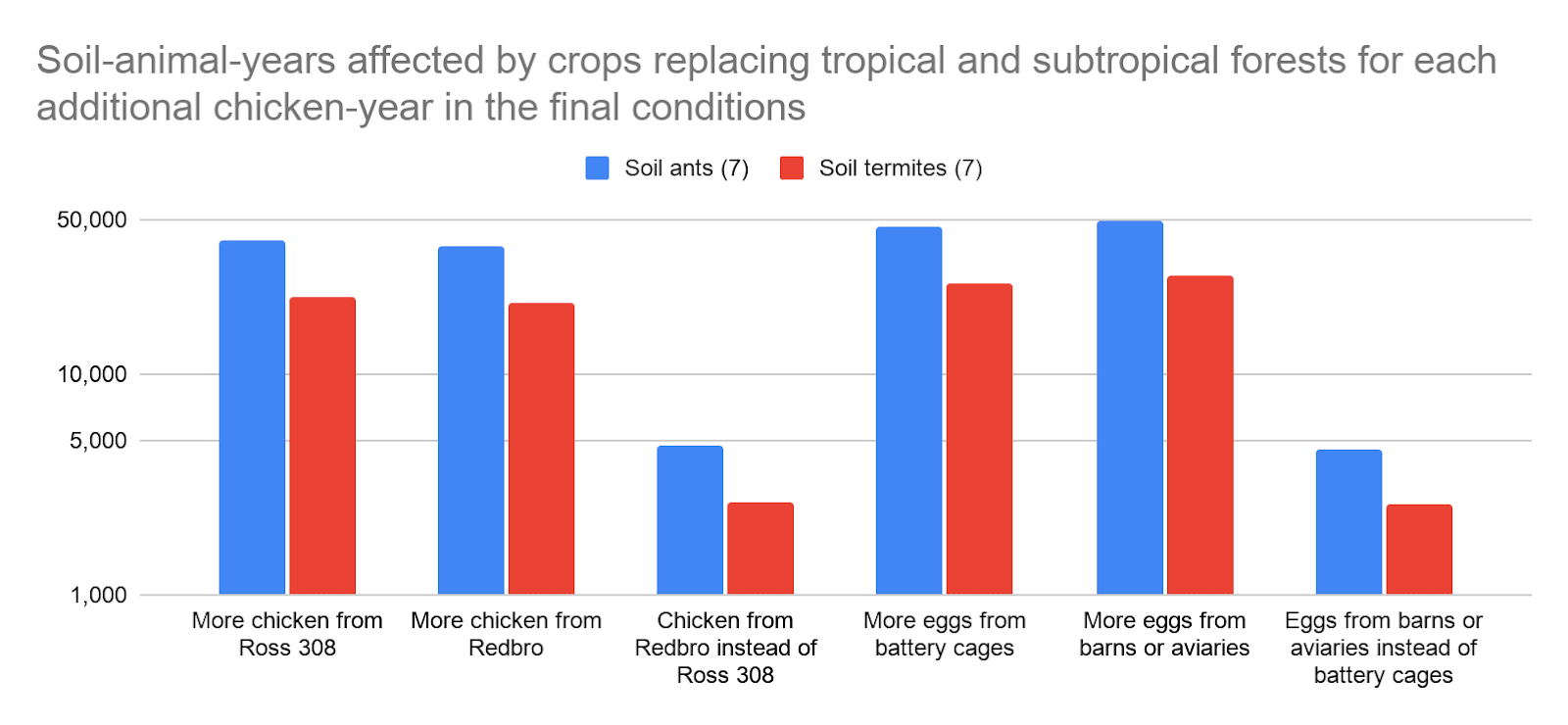
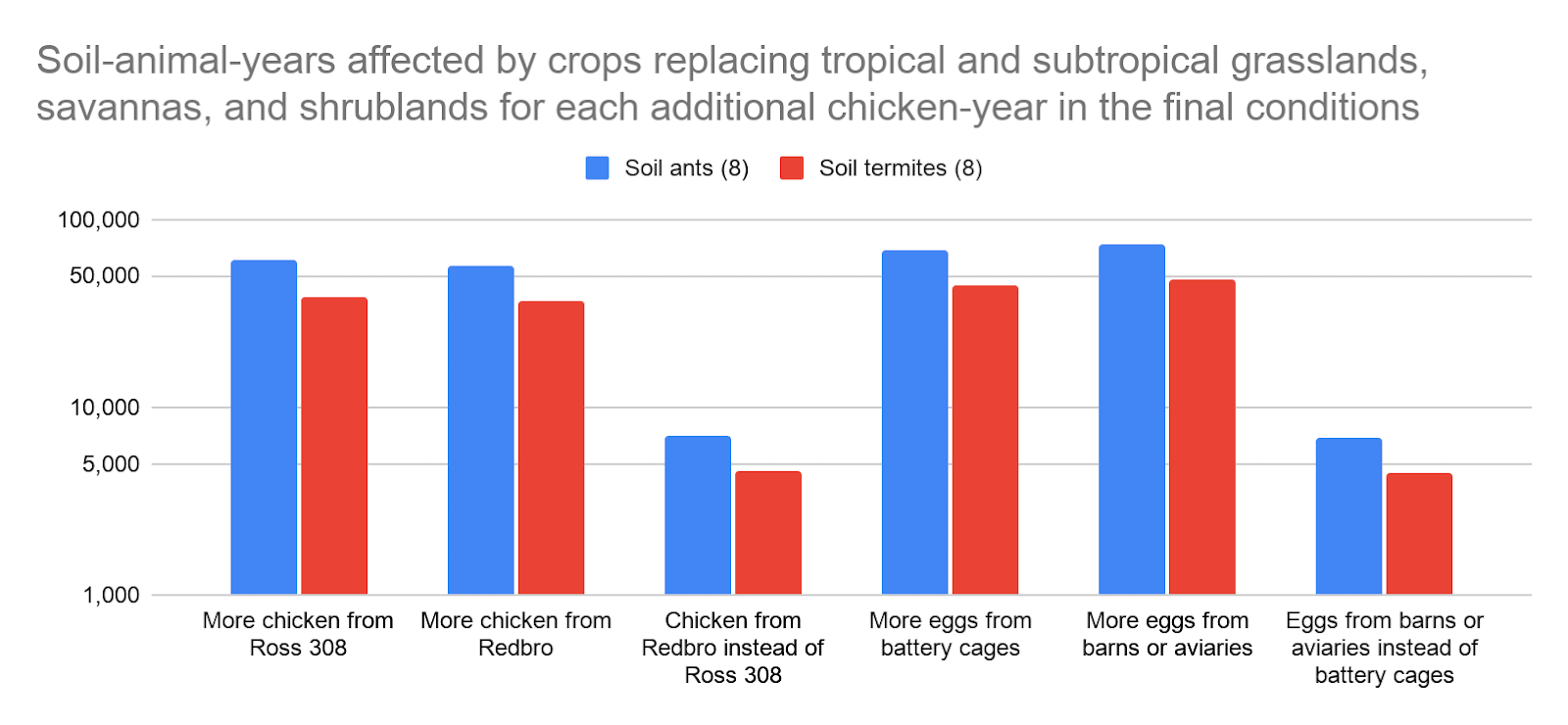
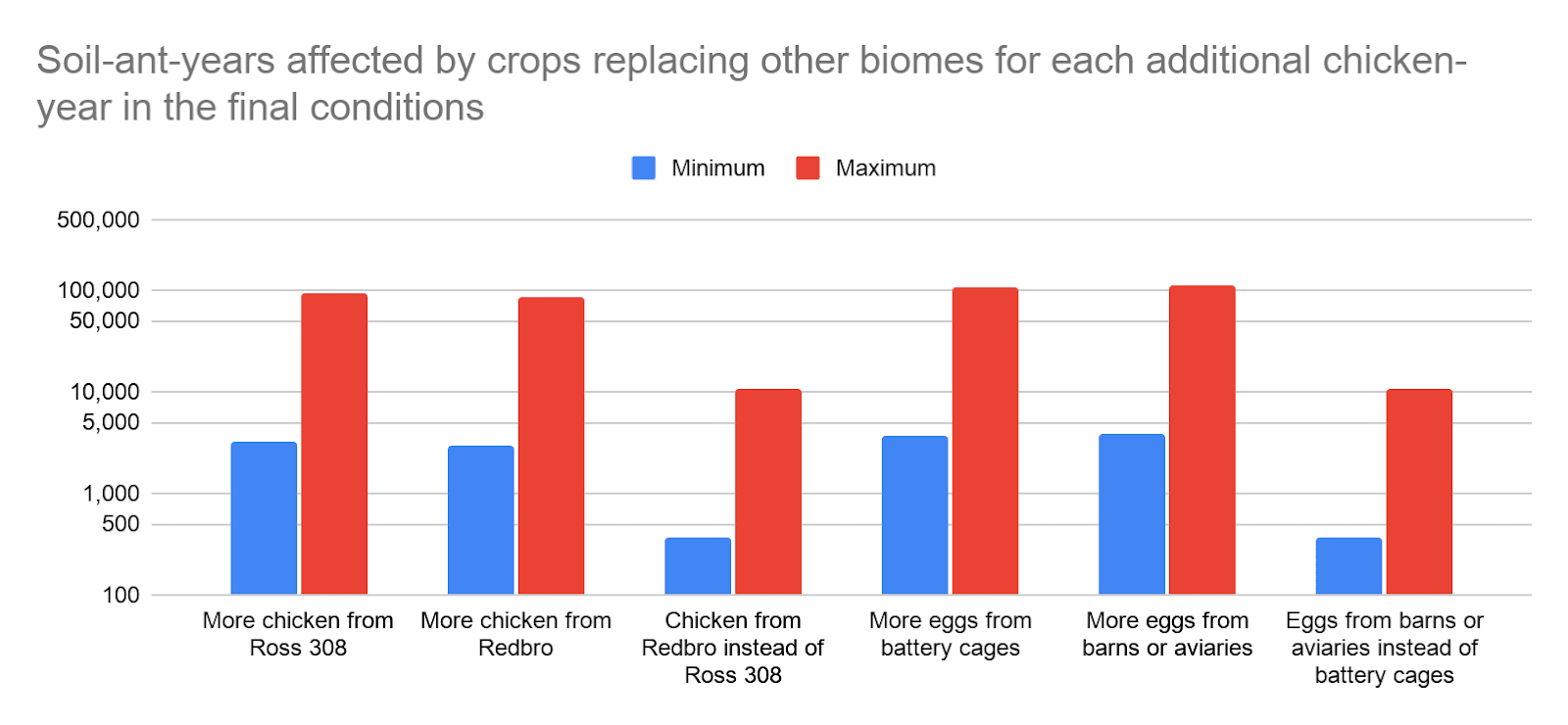
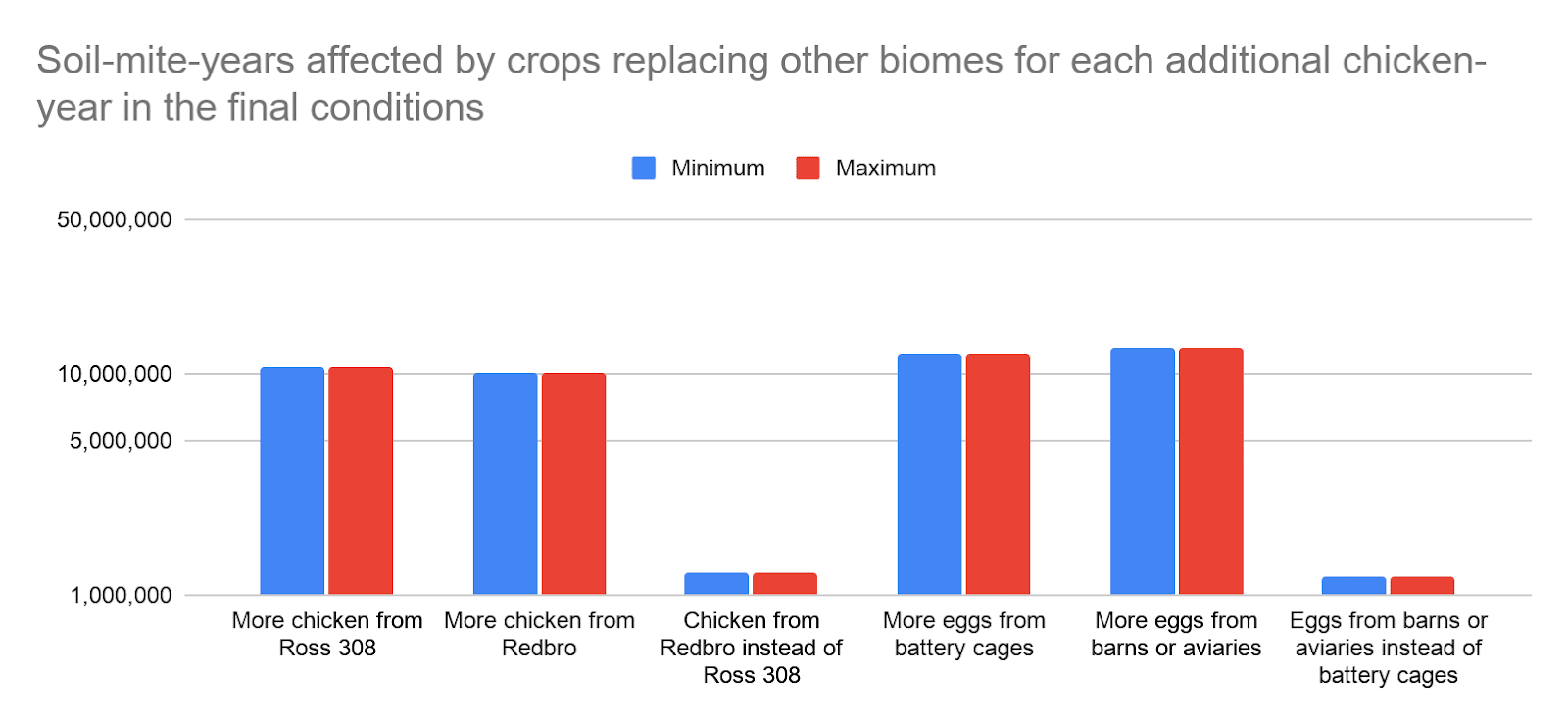
I present the results below for cropland replacing i) tropical and subtropical forests, and ii) tropical and subtropical grasslands, savannas, and shrublands. In addition, I present the range of results across all the 9 possible land use changes (I have data for 10 biomes, and therefore analysed the replacement of cropland with 9 different biomes). By “Soil-animals-years affected”, I mean an increase or decrease in the living time of soil animals in years.
Soil ants and termites
Soil springtails and mites
Discussion
I continue to believe that eating less chicken and eggs, and replacing fast with slower growth broilers, and hens in battery cages with ones in barns or aviaries may easily increase or decrease the welfare of soil ants and termites much more than increase the welfare of chickens. Depending on the biome replaced by the additional cropland, my estimates for the change in the living time of soil animals for each additional chicken-year in the final conditions range from:
- For chicken from Redbro replacing that from Ross 308:
- 375 to 10.8 k soil-ant-years.
- 2.34 k to 17.0 k soil-termite-years.
- 16.1 k to 743 k soil-springtail-years.
- 33.2 k to 1.26 M soil-mite-years.
- 116 k to 1.98 M soil-arthropod-years.
- For eggs from barns or aviaries replacing ones from battery cages:
- 364 to 10.5 k soil-ant-years.
- 2.28 k to 16.5 k soil-termite-years.
- 15.6 k to 722 k soil-springtail-years.
- 32.2 k to 1.22 M soil-mite-years.
- 112 k to 1.93 M soil-arthropod-years.
In Bob Fischer’s book about comparing welfare across species, the tentative welfare range of chickens is 5.48 (= 0.40/0.073) times that of BSFs. Welfare range is defined there as the difference between the maximum and minimum welfare per unit time among “realistic biological possibilities”. I expect the welfare range of chickens to be around 5.48 times that of soil ants or termites under the methodology of Bob’s book. I would be surprised if the welfare range of BSFs was significantly different from that of ants or termites. Godfrey et al. (2021) estimated 90 k neurons for a desert ant, and 92.5 k for a fruit fly (“vinegar fly”), and “individual number of neurons”^0.188 explains pretty well the welfare ranges in Bob’s book, as illustrated below.
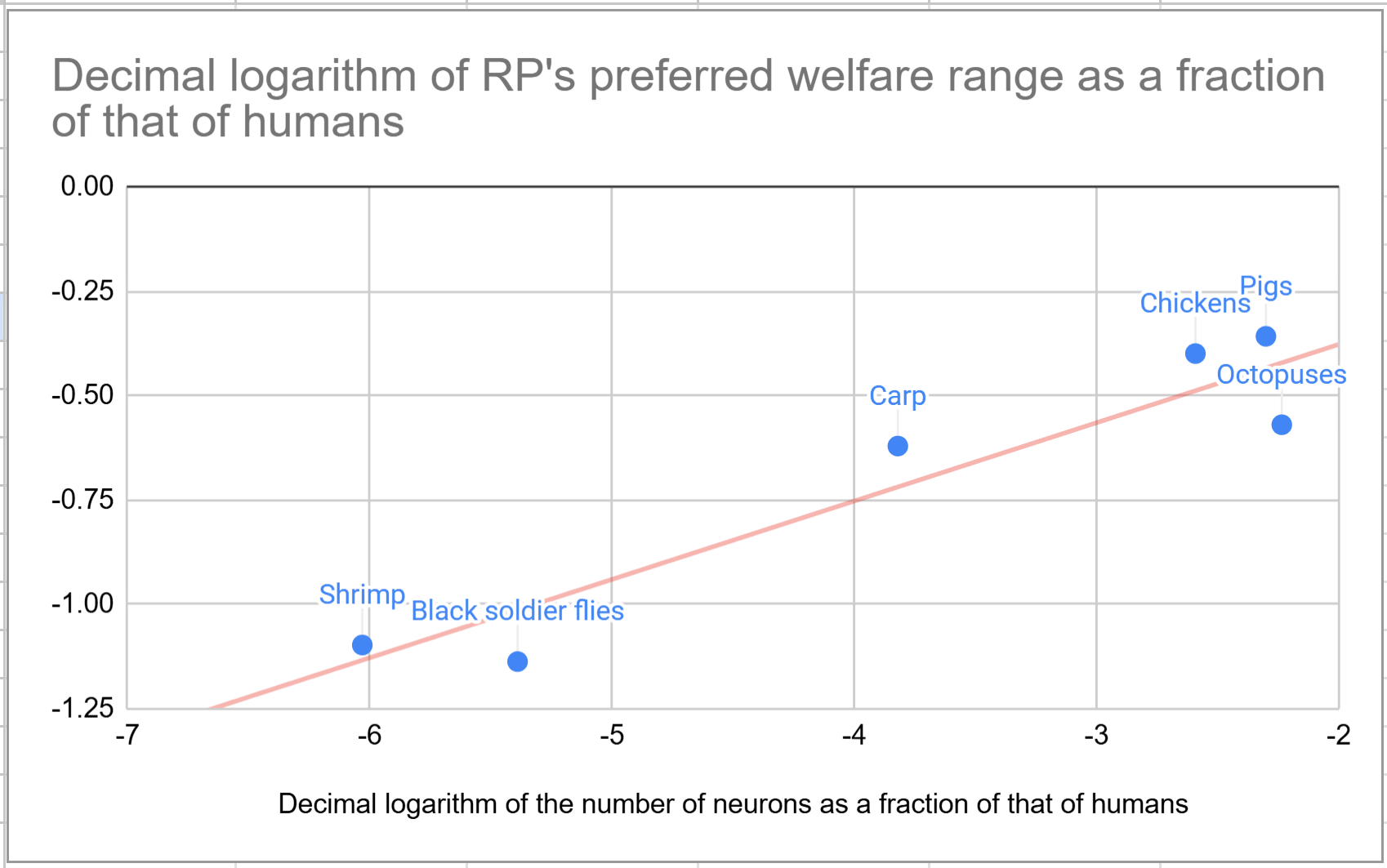
The change in the living time of soil ants and termites is way more than 5.48 times the additional chicken-years in the final conditions. So I think replacing fast with slower growth broilers, and hens in battery cages with ones in barns or aviaries change the welfare of soil ants and termites much more than they increase the welfare of chickens trusting the welfare ranges in Bob’s book.
I am more agnostic. I believe the change in the welfare of soil animals may be much larger or smaller than the increase in the welfare of chickens. Chickens have 221 M neurons (search for “Red junglefowl”), 2.46 k (= 221*10^6/(90*10^3)) times as many as the estimate I mentioned above for a desert ant. Consequently, for welfare range proportional to “individual number of neurons”^“exponent”, and “exponent” from 0 to 2, which covers the best guesses that I consider reasonable, I calculate the welfare range of chickens is 1 to 6.05 M (= (2.46*10^3)^2) times that of ants. This upper bound vastly exceeds the soil-ant- and soil-termite-years affected per additional chicken-year in the final conditions which I mentioned above.
I conclude chicken welfare reforms can easily increase or decrease welfare. I believe they may impact soil animals way more than chickens, and I have very little idea about whether they increase or decrease the welfare of soil animals. I do not know which species of soil animals are the most important to determine the change in the welfare of soil animals given the large uncertainty in welfare comparisons across species. I can see the most important soil animals being ants, termites, springtails, mites, nematodes, or any combination of these. To make matters worse, I have almost no clue about whether any species of soil animals has positive or negative lives in a given biome. I am also very uncertain about which soil animals become more or less abundant as a result of increasing cropland.
What now?
I recommend research on i) the welfare of soil animals and microorganisms, and ii) comparisons of welfare across species. I think progress on ii) is difficult, but necessary to find interventions which robustly increase welfare. For instance, ones that focus on the greatest sources of suffering across all species. I also see lots of room for progress on ii) to change funding decisions even neglecting soil animals and microorganisms. In Bob’s book, the tentative welfare range of shrimps is 8.0 % of that of humans. However, for welfare range proportional to “individual number of neurons”^“exponent”, and “exponent” from 0 to 2, the welfare range of shrimps is 10^-12 (= (10^-6)^2) to 1 times that of humans, as shrimps have 10^-6 times as many neurons as humans.
I would prioritise the above research over interventions decreasing the pre-slaughter pain of farmed invertebrates. I suspect these are the closest to robustly increasing welfare (in expectation), but I still do not know whether electrically stunning farmed shrimps increases or decreases welfare due to potentially dominant effects on soil animals and microorganisms. Furthermore, I would say such interventions may increase welfare only negligibly due to their target invertebrates having a super narrow welfare range, as it would be the case if shrimps had a welfare range equal to 10^-12 times that of humans.
Targeting non-soil animals is a great way to build capacity to increase the welfare of soil animals later?
I am sceptical. Here is a thought experiment. If the probability of sentience of soil animals was exactly 1, and the probability of sentience of non-soil animals was exactly 0, would you still consider interventions targeting non-soil animals among the most cost-effective to increase the welfare of soil animals, or build capacity for this? I think this would be a surprising and suspicious convergence.
I believe the most cost-effective ways of building capacity to help any given group of animals will generally be optimised with such animals in mind. I would target (optimise for increasing the welfare of):
- Humans in low and middle income countries (LMICs) instead of humans in high income countries (HICs) to increase the welfare of humans in LMICs.
- Humans in HICs instead of humans in LMICs to increase the welfare of humans in HICs.
- Shrimps instead of chickens to increase the welfare of shrimps.
- Chickens instead of shrimps to increase the welfare of chickens.
- Dogs instead of chickens to increase the welfare of dogs.
- Chickens instead of dogs to increase the welfare of chickens.
- AI systems instead of shrimps to increase the welfare of AI systems.
- Shrimps instead of AI systems to increase the welfare of shrimps.
Lewis Bollard expressed a related scepticism in the podcast How I Learned to Love Shrimp, which I recommend (the podcast as a whole, not just Lewis’ episode). It was about targeting chimpanzees, elephants, and pets with the ultimate goal of increasing the welfare of farmed animals. Here is the relevant part of the discussion from the chapter “Why winning small victories is important”.
Lewis Bollard 59:00
yeah, I don't think farm animal advocates should be doing things on trophy hunting or dogs, yeah, like I. I think first of all it really matters of is this thing you're campaigning for actually going to lead support, to more support for farm animals in future? And I think what we have seen in the us, for instance, is, like you, we've had huge progress for companion animals and that has just not trickled down to farming. It's like there has not been. There was this theory that like, well, you know, if we just get enough people to make enough progress on companion animals, then everyone will focus on farm animals. In fact, what happens is they just want more progress for companion animals, like rightly so, but like it's like actually no one ever switches over and if you try and switch them over, they're like no, I'm, I was there for the dogs, not the, you know, not the pigs. Yeah, yeah, instead, I think you need to get people started on the animals that matter.
Lewis Bollard 59:46
I have the same problem with like kind of non-human rights project approach of like we'll focus on, like elephants and chimpanzees, where I'm like, even if you win, I sadly don't think they will win, but even if you did, I don't think that trickles down to chickens and fish.
Lewis Bollard 59:59
Like I just think it gets people like to care even more about elephants and chimpanzees, and and so I think you have to focus on actual farm animal welfare stuff. Then in in terms of, yeah, what is a small win, like I think, getting like a small change to regulations that, like you know, is only incrementally making like the slaughter process a bit better regulated, or getting a commitment from a small company, or even just getting you know this recognized in official documents, or you know, I think there are other things like you can do that are not like the biggest thing. Or just, you know, just getting someone in the agriculture department who's working on animal welfare. I am very wary of the thing of like we should work on different issues in the hope that one day we will then be able to like pull people across to work on the issues we actually care about.
Lewis Bollard 1:00:45
Yeah, I also haven't seen that work out very well, but you can see the natural appeal of that and the other risk I've seen is that, like I've seen so many people who convince themselves of these stories where it's like when I was in the humane society, one thing that say is like well, yeah, we're not working on like farm animals now, even though we totally care about them, but like it's because it's just way more tractable to do this thing in congress. But you know, like, ultimately we'll switch across to farm animals. And I've seen people who've like retired now, who had like mindset their whole career and like how did it work out? Like did that ever happen? And I think, like I think part of the problem is you just like, once you start focusing on trophy hunting dogs, like you end up being really fixated on that. You end up like understandably, just like fixating on that goal. And that becomes the goal when you forget that it was like a tactic rather than, like you know, a piece. So yeah, if it was a tactic.
I would also expect much more investigation of the extent to which interventions targeting non-soil animals are building capacity to increase the welfare of soil animals if this was key to whether they are increasing or decreasing animal welfare.
Probably yes, and I suspect the decrease in demand is large enough for cropland to decrease instead of increase, but I believe effects on soil animals may still be much larger than those on chickens. My results for eating chicken from Redbro instead of Ross 308, and eggs from barns or aviaries instead of battery cages do neglect reductions in the demand for chicken and eggs. Chicken from Redbro is more expensive than from Ross 308, eggs from barns or aviaries are more expensive than from battery cages, and demand for chicken and eggs decreases as their price increases. So I agree replacing Redbro with Ross 308, and barns or aviaries with battery cages decreases the demand for chicken and eggs. I determine the change in cropland from improving the conditions of broilers and layers would be -10.7 % and -82.8 % as large accounting for the increase in the price of chicken and eggs. So I conclude the ratio between the effects on soil animals and chickens would be 10.7 % and 82.8 % as large, and that effects on soil animals may still easily dominate given the very large uncertainty in the soil-animal-years affected, and welfare comparisons between soil animals and chickens. Moreover, the effects on soil animals may become larger accounting for the increased demand for other foods resulting from the decreased demand for chicken and eggs.
Acknowledgements
Thanks to Anonymous Person for feedback on the summary, and Yuval Rosenberg for sharing the non-rounded estimates of Table S4 of Rosenberg et al. (2023). The views expressed in the post are my own.