This is a great result! I think your engagement was spot on, and clearly a new idea to many in the room. As for your first question; I would aim to make Effective Giving an 'add-on' rather than a replacement of what is already happening. As causes in EG are broad, it is quite feasible to connect to other ERGs and guide their fundraising towards EG goals. As a measure, I would always send a post-event survey and do another follow-up survey later in the year to see if people acted upon their earlier responses.
Of course you can add UTMs to your referal links, set up a campaign to direct donations to and follow up through the ERG newsletter (clicks).
80% of people already donating in one way or another was surprising to me as I read it - kind of cool to hear - do you think there's merit, if people delivering similar talks/initiatives in their own corporate environments, in asking that question really early on and having different versions of the content that they could lean towards depending on the responses?
How I introduced effective giving into my corporate job — EA Forum
How I introduced effective giving into my corporate job
Context: 8.5 years in corporate, and looking for impact opportunities
I’ve been working for Kraft Heinz for 8.5 years (first Italy, now the Netherlands). Over time I’ve become fairly active in our office community, partly because my roles have put me in contact with many teams, and partly because I genuinely enjoy connecting people who care about improving things.
About 1.5 years ago, I discovered Effective Altruism. The initial pull for me was a practical question: “If I want to help, how do I do it better?” I did an intro to EA course, learned about different levers (career, giving, advocacy, community building, etc.), and the first lever I actually implemented was effective giving. Concretely, I started donating through the Doneer Effectief Poverty & health fund and to GiveDirectly. That gave me a “default action” that felt both feasible and grounded in evidence-backed recommendations.
Then the next question arrived: “Can I live these values inside my day job, not just outside it?” I’m not in a role where I can redirect strategy overnight, but I do have access, relationships, and a platform. So I went looking for an intrapreneurship path.
The problem: good intentions, low impact signal
At Kraft Heinz, like many companies, we have Business Resource Groups (BRGs), employee-led groups organized around shared values or themes (culture, wellbeing, D&I, etc.). The one that I decided to join was the ESG BRG. At the time, the group’s direction was a bit unclear, so I joined with a simple intent: help shape it toward activities with clearer social impact.
When I looked at what we were doing, I saw a pattern: lots of local volunteering events.
I want to be careful here: I’m not anti-volunteering. Local volunteering can be excellent for:
employee engagement and morale
community connection
building a culture of service
giving people a first step into “doing something”
But as I observed it, the impact pathway was often fuzzy and the marginal impact hard to reason about. Many events were valuable culturally, yet didn’t feel like the strongest way to convert a motivated workforce into measurable benefit for others.
So my internal tension became: How do we keep the cultural upside while making space for higher-impact options?
Insight: effective giving is the most adoptable “EA lever” at work
The easiest EA practice I’d implemented personally was giving. It’s:
concrete
low friction
compatible with busy professional lives
scalable across many people
measurable (at least in inputs and, sometimes, outcomes)
So the pivot idea was: bring “effective giving” into workplace culture, not as a campaign, but as an invitation: “If you already donate, here are ways to do it with more evidence and more impact.”
This wasn’t an idea I generated alone. At EAGX Amsterdam, I met Jan Anne Amelink from Doneer Effectief, and Kim Verplancke from the 10% Club. Talking with them helped crystallize a workable approach: start with education, reduce friction, and treat it as culture-building rather than persuasion.
Action: a Lunch & Learn designed to feel safe, practical, and not pushy
Our BRG already ran Lunch & Learn sessions: invite an external speaker to share an idea during lunch. It works for a simple reason: free lunch lowers barriers and makes participation easy.
So we set up a Lunch & Learn for Feb 17, 2026 in our Amsterdam office:
Format: lunch + external speaker + Q&A
Speaker:Jan Anne Amelink, philanthropic advisor at Doneer Effectief
Attendance:85 people
We aligned in advance on what would be most useful for a corporate audience:
clarify the problem (good intentions don’t guarantee good outcomes)
show practical ways to choose charities using independent, evidence-backed evaluators
make the step from “I care” to “I can act” feel straightforward
The personal element that helped it land: my “impact dashboard”
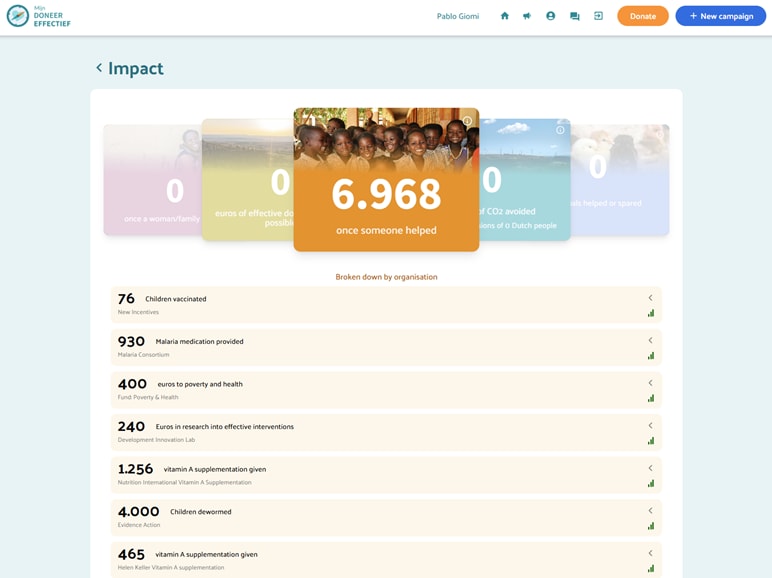
I added one personal component that turned out to matter more than I expected: I showed my own giving “impact dashboard” from donating through Doneer Effectief.
Two reasons I think this helped:
It made the concept tangible, not an abstract moral argument, but “here’s what it looks like in practice.”
It reduced the “salesy outsider” vibe. It wasn’t just an external speaker saying “you should donate differently”; it was a colleague people already knew saying “this is what I do.”
A surprising moment: 80% already donate
Midway through the session, I asked a simple question (partly as a “keep energy up” tactic):
“Raise your hand if you already donate to charity.”
Around 80% raised their hands.
I genuinely didn’t expect that. And it reframed the opportunity. We weren’t trying to create generosity from scratch. We were talking to a group that was already giving, meaning the relevant question wasn’t “can we get people to donate?” but “can we help people allocate donations more effectively?”
That’s a very different, and potentially much more impactful, conversation.
Practical enabler: tax deductibility
Another thing that resonated was simply clarifying tax deductibility. For many people, this is one of those “I’ve heard of it but never used it properly” topics.
When you show that effective giving can be easier than expectedand financially efficient, it lowers friction without moral pressure. It’s not “give more because you should,” it’s “if you already give, you can often increase impact per euro.”
A deliberate choice: no QR-code donation CTA (yet)
We debated including an immediate “do it now” call to action, e.g., a QR code to donate on the spot.
We decided not to do it this time.
Why:
We didn’t want to look pushy or transactional in a workplace setting.
The primary objective was concept adoption, not instant conversion.
We wanted people to have time to reflect and choose a path that felt self-directed.
Tradeoff: yes, we likely lost some “momentum donations.” I’m comfortable with that trade for a first iteration. Instead, we followed up with resources afterwards and plan to test a more explicit CTA in a future session once the concept is familiar.
Results (what we can say confidently)
We collected feedback via a survey:
22 responses
4.5/5 average score
76% said they would apply effective giving next time they donate
20 people asked to request the foundation to do an effective giving pilot
Important caveat: these are self-reported intentions, not verified donation behavior. Still, as an early signal of interest and openness, it exceeded my expectations.
What could have been better: foundation engagement + tech
Here’s a mistake I want to be transparent about:
We didn’t think early enough about involving the Kraft Heinz Foundation president, Andrea Budelli. The date was already set when we invited him, so he couldn’t join in person in Amsterdam with Jan Anne and most attendees. Instead, he joined from a different office via MS Teams.
Our Amsterdam room also has some technical issues, and for the first 10 minutes, we struggled to hear each other properly. Not catastrophic, but it diluted the opening and probably made it harder for Andrea to fully participate.
Next time:
coordinate the date around Andrea’s availability so he can be in person
run a full A/V test before the session (not five minutes before)
This seems minor, but when you’re trying to build internal momentum, especially with senior stakeholders, execution details matter.
The impact multiplier: potential leverage through the foundation
The most promising development wasn’t the individual interest (which was great). It was the foundation angle.
Many companies have foundations that direct millions annually. Individual employees might collectively donate thousands; foundations can deploy orders of magnitude more.
During Q&A, someone asked:
“Is the foundation doing something like this? Could it?”
That question alone felt like a hinge point. It showed the concept wasn’t just personally interesting, it was organizationally relevant.
Our next step is to meet with Andrea to explore how we could run an effective giving pilot: some structured way to test directing a portion of foundation giving toward more evidence-backed options, while respecting the foundation’s mission and constraints. I’m aware this is sensitive and will require careful stakeholder management and governance, but I already have signals that Andrea is open to the idea, so my hopes are high.
Key takeaways (so far)
Workplace culture can be a lever. If people already donate, the value proposition is “better allocation,” not “more guilt.”
Make it concrete. A colleague sharing a real giving experience can make “effective giving” feel doable.
Reduce friction, avoid pressure. For iteration 1, education + resources beat a hard CTA.
Leverage hides in plain sight. Foundations (and similar institutional budgets) can be much higher leverage than individual giving, if approached thoughtfully.
Operational details matter. Senior stakeholder engagement + tech reliability can determine whether an opportunity compounds or fizzles.
Next steps / requests for advice
This is where I’d love input from the EA community.
1) Foundation engagement:
For those who have influenced a corporate foundation (or similar institutional giving), what approaches worked?
What’s a reasonable “pilot” that balances ambition with political feasibility?
How do you frame this so it’s not perceived as critique of existing choices?
2) Measuring real impact (beyond intent):
We have early survey signals, but I don’t want to confuse enthusiasm with outcomes.
How would you measure whether this actually changed donation behavior (respecting privacy)?
Are there good proxy metrics you’ve used (pledges, follow-up surveys, optional tracking, resource click-throughs, etc.)?
3) Replication:
If you’re curious about implementing something similar at your org, especially via BRGs or employee communities, feel free to reach out. I’m happy to share the format, agenda, and what I’d change for iteration 2.
DISCLAIMER: This is my first post ever on the EA forum. I'm not very confident in my writing skills, so I've used the help of an LLM to improve this post from my initial draft. I'm keen to hear any feedback on the writing.
Note: This post was crossposted from the Coefficient Giving Farm Animal Welfare Research Newsletter by the Forum team, with the author's permission. The author may not see or respond to comments on this post.
Subtitle: On vegan advocacy, effective altruism, and FIFA
I turn 40 today. Here are some hot takes.
On factory farming
1. Our biggest challenge is salience. If factory farming led the evening news, it wouldn’t last lo...
Impressions from the 21st Annual U.S. Cluster Headache Patient Conference, organized by Clusterbusters.
On the morning of the last day of the conference, E. was hanging out with other “clusterheads” outside the conference hotel when he started having a cluster headache attack. Before he could go back to his hotel room, J. offered E. his DMT v...
When speaking to candidates who are considering working with us at 80,000 Hours, I often hear people worry about replaceability.
The familiar version of the worry is about whether the organisation will hire someone else in your place. If it will, then the difference you make by taking the job is only the difference between you and them.
There are a couple of well-known answers to that. The person hired in your place probably cares about the world too, and would go on to do somethi...


This is a great result! I think your engagement was spot on, and clearly a new idea to many in the room. As for your first question; I would aim to make Effective Giving an 'add-on' rather than a replacement of what is already happening. As causes in EG are broad, it is quite feasible to connect to other ERGs and guide their fundraising towards EG goals. As a measure, I would always send a post-event survey and do another follow-up survey later in the year to see if people acted upon their earlier responses.
Of course you can add UTMs to your referal links, set up a campaign to direct donations to and follow up through the ERG newsletter (clicks).