Comments
Crossposting this from LessWrong, with the permission of the author, Tom Smith.
In the past few years, many people around me have tried to convince me that US electoral politics is important. But like many other people in the community, I’ve been suspicious of many of the high-level arguments that I’ve heard. It felt like people were pulling numbers out of poorly-documented models I didn’t have time to examine and citing studies I didn’t have time to read. But I lacked a gears-level model of why and how individual efforts could impact electoral outcomes, and I felt intimidated by all the statistics and skeptical of trusting people adjacent to politics.
In the past year, as I’ve done more research and (more recently) volunteered on the ground to help Alex Bores’s campaign in NY-12[1], I’ve developed a gears-level understanding of how electoral politics in the US works.
I now believe that working on US electoral politics is one of the highest impact areas from the general AIS perspective. I feel like I was a fool for not thinking it through sooner. In this post, I’ll share some of the gears I’ve learned that inform this belief, with a focus on those that would’ve been most informative to my past self.
I’ve often heard that “every vote counts” and “this race is close” and I’ve shrugged it off and assumed there was no way I could actually make the difference in practice. I now think this was clearly wrong. For example, ~2% of open-seat primaries come down to 100 votes or less!
And that’s not even accounting for which races seem close or not. There’s not much to be done for races with an obvious frontrunner, but when the polls are neck-and-neck, the odds of a race coming down to just a handful of votes are even higher.[2]
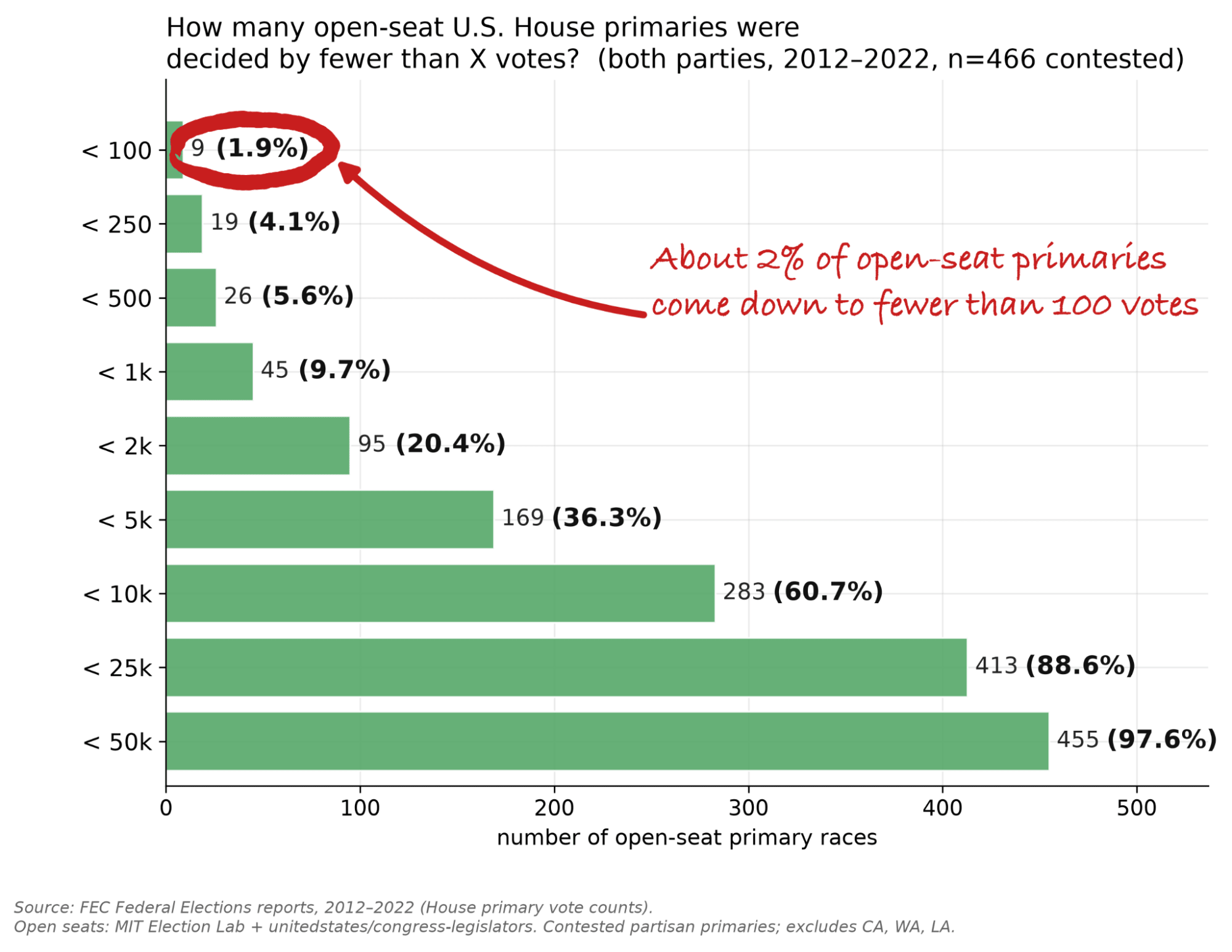
That is: in many genuinely contested elections, even a relatively modest effort can have very high expected value.
(People who know a lot about politics have objected to me adding this stat because they say it's way more informative to look at the specific details of the race to try and get a prediction of how close it will be. However, it's very hard for outsiders to verify those numbers, and I think knowing the base rate is a super helpful sanity check. You should not be that surprised if people say a race might come down to a thousand votes, especially if there are easy ways to verify the race looks close.)
Perhaps the best scalable baseline for how much impact you can have on an election is in-person canvassing: that is, standing around and talking to people on the street and telling them about your preferred candidate. In other races, you might knock on doors.
Talking to people does two things: (1) it lets you persuade them to vote for your candidate. (2) If they support your candidate, you can try to get their contact info or address and swing back around after the polls open and remind them to go vote.
In the race I've been involved with, canvassing seems to me to net 1/3rd of a vote each hour if you’re good at it, 1/10th if you’re not-so-good at it. In other races, I expect it to net out somewhat worse. (Note that if you flip someone away from voting for Lasher that’s two votes, one less for Lasher and one more for Alex).
These numbers come from a combination of noting how many good conversations people report getting per hour (the folks we're talking to often report not knowing basic and important facts about our candidate or having huge misconceptions, and then seem to genuinely change their mind after talking to us).
These numbers are adjusted for if we’re counterfactual or not, for people telling us what we want to hear, for volunteers reporting overly rosy numbers, and a general prior towards small effect sizes; when we just ask canvassers how many people they persuaded each hour, their off-the-cuff answer is closer to 1.
I expect in other races the number might be higher or lower: less population density makes canvassing worse, but you can do door-knocking in other areas in a way you can't in Manhattan where it’s all apartments, plus other races have lower name recognition and less saturation which probably makes canvassing a bit more effective. And of course talking to people about your candidate naturally works better if your candidate is someone you genuinely and deeply believe in and have good reason to be excited about.
I expected talking to people would involve knowing the policies of the person I'm advocating for in lots of detail, and I do know them well, but the large majority of the time, voters just want the same basic questions answered or want to see that there is an enthusiastic young person supporting the candidate.
You might be skeptical about the efficacy of canvassing as a persuasion tool: why would a 10-minute conversation on the street change anyone’s mind? But it turns out that many voters only know a few very surface-level sentences about a candidate, even in a race saturated with ads. A friend of mine who has done more canvassing than me has written up vignettes illustrating some of the successful conversations he’s had while canvassing:
Vignettes of sample persuasion conversations
One genre of conversation you get in NY-12 is with someone who has heard mostly negative things about Alex due to the ads from the accelerationist super PAC Leading the Future.polp[3] In one case, a middle-aged woman in Stuytown told me that she wasn’t likely to vote for Alex because of everything she’d heard about him working at Palantir, and the support his campaign is getting from Anthropic. She was willing to hear the counter-argument, so I spent about 10 minutes concretely walking her through all of it. In both cases I basically told her everything I knew. At the end of it, she said the explanations made a ton of sense and she was now pretty suspicious of LTF for trying to paint this negative picture of Alex. I’m not sure if she’s definitely voting Alex, but she seemed like she was leaning towards him.
P(Alex): 10% → 60%
Another genre is the stereotypical progressive voter. I met a young man in Hell’s Kitchen who told me about how he’d previously volunteered for Mamdani and what a great job he thought Mamdani was doing. Given his previous volunteering, I’d say it’s quite likely he votes, but he didn’t know anything about this race. My guess is that for this type of person, he knows about candidates if they’re sufficiently buzz-worthy in left-wing circles and Alex failed to clear that bar. However I told him all about Alex, what he stands for, and how he’s the most progressive candidate in the race (who has any real chance of winning) and is the subject of $10M in attack ads from tech billionaires. Pretty soon he was totally onboard and was telling me he was gonna talk to his friends about Alex. We chatted for a bit longer about random stuff we have in common, which I think helped add a personal touch and made it likelier he’d remember me.
P(Alex): 30% → 85%
Probably the highest votes-per-hour interaction I consistently have is one where I tell a voter that one of Trump’s biggest donors is funding a super PAC spending $10M against Alex, whereas there are no Republicans spending against any of his opponents, and they say something like “that’s all I needed to hear, he’s got my vote”. This has happened maybe half a dozen times, and it usually takes about thirty seconds.
P(Alex): 45% → 70%
I met a French man at a farmer’s market on the Upper East Side. He told me he didn’t support Alex because the AI bill he passed was overly burdensome regulation. He went to leave but I tried to keep the interaction going and offered to give my perspective on the RAISE Act. I described how light-touch it is, and how common-sense its provisions are. He started to come around. My guess is he’d heard a very distorted picture elsewhere but he didn’t know a ton of the specifics. This guy has a Master’s degree in CompSci or something similar. I don’t think he knew that this is also true of Alex, but he does now. He wasn’t super committed to Alex by the end of our conversation, but a lot of his negative perception seemed to have been undone. As he went to leave, he checked out the back of the flyer I’d handed him and made positive sounds about Alex having been endorsed by Liz Krueger, the local State Senator. He hadn’t taken a flyer the first time I offered it.
P(Alex): 5% → 30%
One way to help a candidate win is to convince people to vote for them. Another is to simply “get out the vote” (GOTV), encouraging people to go vote, either by getting names of people who already support the candidate and getting them to vote or by standing in strategic areas. You can often identify who is going to vote for your candidate based on demographics or location, or just by talking to people and seeing who says they support them. Then you just make sure they actually vote, because most people (70%+) don't.
The Bores campaign is very frugal, and sometimes takes actions that save money at the cost of substantial amounts of time and votes. I want to share some examples because I think people are sometimes skeptical about the effectiveness of ads (sophisticated circles like the readers of this document tend to find ads patronizing, so they typical-mind; solid studies show they work but take time to read and sift through). But it’s much easier to understand the effectiveness of operational expenses and time-saving measures at a gut level, in a way where you can really believe your marginal $3,500 matters.
Naturally, the campaign isn’t spending their money perfectly efficiently, so I might be able to find small-scale opportunities to spend money that look better than what marginal donations would actually go to. But I think they’re allocating money within a factor of 2 of the quality of these opportunities (if you think otherwise, it’s very tractable to get them to spend more on this stuff, so reach out to me and let’s do it!). That is, I think that the reason campaign committees spend their very limited financial resources on ads is because ads actually work. These examples serve as a soft lower bound on how much impact marginal donations can have, even donations to relatively well-funded campaign committees like the one I've been involved with.
Example 1: their best volunteer, someone I can attest is extremely agentic and competent, and someone who has probably counterfactually gained the campaign more votes than anyone else on the campaign save for Alex himself, has been driving Alex’s car around all day resupplying poll sites, then has to park car in Alex’s parking spot 45 min away from his apartment and then take the subway 45 min back, every day. The cost of a nearby parking pass would save him an hour and a half a day, which is ~12 hours of his time between now and the primary. Plus if the car was near the apartment he could also pick up other canvassers and help him on their commute.[4]
Example 2: campaign canvassers stand outside in 90+ degree heat. The volunteers work 2-4 hour shifts. It’s draining and thankless work, but I and others do it because we really do believe it works. As mentioned above, I estimate most canvassers get 0.1 to 0.3 votes per hour[5] (that’s after adjusting for if we’re counterfactual or not, for people telling us what we want to hear, for volunteers reporting overly rosy numbers, and a general prior towards small effect sizes).
Giving volunteers snacks and cold water makes them stay out longer, try harder, and come back more. The campaign already does this to some extent, but they have to be pretty frugal about it. I think if you spent $10 more per person on snacks for a three-hour shift of 20 people, you’d probably get at least another quality-adjusted canvassing hour.
Example 3: labor. Superstar canvassing leads on the campaign I believe are paid $30/hour. They organize the campaigns' whole canvassing operation, schedule shifts, and do a lot of admin work late into the night. The campaign has very few employees and many are fresh out of college. They’re passionate and working hard, but I know someone more experienced could add a lot of value.
As a more concrete example, the campaign at one point wanted someone to do graphic design work. It's clear from their existing graphic design work/social media work they're short on capacity here. Ex: they only had one version of their flyer and hadn't played around with different variants. A friend knew folks who were quite good but required pay, and the campaign was unwilling to pay. In general, in my experience, volunteers are just much worse and less reliable than paid professionals, and I don’t think they ended up finding a volunteer for the role.
A district like NY12 has about a thousand blocks. Some areas are a bit higher-traffic than others, but I think you could canvass almost as well on a 90th percentile street corner as on a 99th.
I think until you have one canvasser every 20 blocks, it’s very unlikely people are getting fatigued or that you'll talk to every promising person. The returns diminish some, but not that much (especially if you include effects like “people talk positively about how many great volunteers there are for this campaign). That’s 50 canvassers, and since they take breaks, you’d need 100 people to have those numbers the whole day.
And indeed, we're finding the people we send to the marginal locations get almost as many votes per hour as the folks sent to all but the very best locations (and when we find a really good location, we can usually send extra people there, and that location doesn't saturate).
The same is true of donations to campaigns (there's lots of productive ways to use money well beyond the scales a campaign can raise at; campaigns can only raise small amounts of money because donations are capped at ~$3.5k per person) and, of course, reaching out to friends: the more people vote the better. You will never in practice eat up the demand for voters to a point where your candidate becomes a clear favorite and margin help isn’t useful.
You can canvass in better spots, try different pitches, bring props like a big handwritten “Knicks in 4 Bores in 5” sign, bring your dog, whatever. These do make a real difference (above the 0.3 votes per hour being charismatic gets you), by what looks like ~2x to me.
Impact seems somewhat heavy-tailed. Even amongst canvassers selected for being high-quality and caring a lot, the best canvassers easily do 2x better than the average ones. If you zoom out to all volunteers, many people are essentially useless. While part of that is natural charisma and personality, a lot of it is effort: are they willing to show up, try hard, emanate high energy throughout a long day, and not be checked out? Lots of canvassers sit there and say the same robotic words to you if you approach them.
Most people who support a candidate won’t even do the basics, like telling friends they know to vote for them. For example, at an event with Bores campaign fellows (people who spend many hours canvassing and putting up posters), my friend discovered that multiple campaign fellows simply hadn’t thought to text their friends and tell them why they like Alex/invite them along to canvass.
Hardly anyone actually maxes out their donations to a candidate or volunteers intensely for them. The median open-house-seat primary candidate who raised any substantial money will have only 28 donors who max out[6] (the median not conditioning on raising substantial money is 0 max-outs).[7]
Most volunteers are there to tick a box, socialize, and get some warm fuzzies. If you try hard as a volunteer, a competent, motivated person could easily become a campaign's best volunteer and probably outshine some full-time staff.
People sometimes question whether money in politics matters at all. But from my experience, it clearly can matter: the attack ads against Alex definitely sway some people. From talking to people on the street, it's clear that many voters have seen the attack ads, or that the ideas in the ads have spread into the water supply.
As one very extreme example, I met one woman who showed me an attack ad that had bought up a whole page of a newspaper. She insisted this ad was an article in the paper and when I tried to point out the “Paid for by leading the future” text, she got defensive and insisted it was a good and respectable newspaper.
In this year’s Democratic Senate primary in Iowa, Zach Wahls was leading in the polls (by about 15 percentage points). Then, a super PAC spent about $10 million in support of Wahls’s opponent, Josh Turek, and polls shifted dramatically at the same time, putting Turek ahead by 20 points. As far as I know, there wasn’t any other dramatic shift in the race. Turek ended up winning by about 25 points. Extrapolating based on the number of votes in the primary election, the super PAC spending likely changed the margin of victory by about 75,000 votes and counterfactually caused Turek to win the race. This suggests an average cost per net vote of around $130. (Perhaps my actual point estimate is $200/net vote, as, most likely, there was some effect from campaign developments other than ads that I’m not tracking.)
To be clear, I think Manhattan is very different from Iowa in a number of ways, including that ads are much more expensive to run, but the spending in Iowa is strong evidence that campaign ads do move votes, and I don’t think that the situation in Manhattan is fundamentally different from that of Iowa – it’s just a matter of degree.
Obviously, everyone has a different financial situation, but I have found a lot of people can raise thousands of dollars by reaching out to acquaintances and explaining why a race is so important. Many people are much more willing to donate than to come out and volunteer, and donations require a lot less overhead to make use of than volunteers.
I think one $3.5k donation[9] in a race like NY-12 netted ~25 votes on launch day, and would net ~4 now (as it’s closer to the race and donations no longer help signal campaign strength), and I expect they'd be even higher in other races that are less saturated with money and that have cheaper media markets. (I hope the fact that these numbers are so high doesn't numb people to the effects of canvassing, by the way!)
The next thing you can do is reach out to friends, friends of friends and communities you're part of. In the first few hours of reaching out to friends, people are often able to net 2-4 votes if they hustle, and social butterflies can get more than 10.
Once you've exhausted that, you can canvass. This is the bread and butter that you can just keep doing until you drop dead. Good canvassing gets you 1/3rd of a vote per hour. That might sound small compared to the other numbers I gave, but it is very good and very worthwhile: I think 250 votes in the election I'm involved in increases the candidate's win probability by about 1 percentage point. So ⅓ of a vote per hour means that spending 750 hours increases Bores’s chances of winning by about 1 percentage point. As an intuition pump, it’s the same EV as spending your whole career[10] (which I hear is 80,000 hours long) to guarantee a victory. I personally find it intuitive that getting a great person elected can be very impactful, though I also have some gears for why I'm bullish on what a single legislator can do (but that's a post for another time).
It is a hard baseline to beat: for example if you’re trying to get votes you might be tempted to get dinner with a friend to pitch him in-person. But if dinner plus transit takes 2 hours and only nets half a vote,[11] that’s worse than canvassing! That's because, even though you know your friend really well, with canvassing, you can get directly to the point and talk to lots of people in a short amount of time.
There are lots of other, potentially better, interventions people can do if they're very well connected or very agentic or talented. For example, you could help a candidate get endorsements, write an op-ed about their policies, or help them design better flyers.
Note: I don't know if fundraising (or reaching out to friends or canvassing) will work in races that don't have a compelling pitch or a great a candidate; I know a lot of my success in reaching out to people is that I can genuinely say this race matters a lot. Luckily, I don't plan to get involved in races where I don't strongly believe in the candidate and think there's an important reason to support them.
The AI safety community started off shockingly skeptical of the value of donating to Alex’s campaign and has warmed up only after a lot of social proof has been provided. Lots of folks who refused to donate on launch day are excited to donate now even though donations now are less valuable and the fundamental argument is the same, because the vibes are clearer and they don’t want to miss the boat.
If Alex Bores wins his race, many people I nagged to donate or volunteer will feel like I was right, and I will gain social clout. If he loses his race by 2,000 votes or more, I'm pretty sure a lot of people are going to feel like they were short-changed and people will be much less willing to listen to me about elections.
The reality is that if someone wins by a good margin, then everyone's efforts in supporting them will be just as “wasted” as if they lost by a large margin. And I think there's a good chance he wins or loses by a relatively comfortable margin, because elections are noisy and hard to predict.
But people love a winner, even people who are normally very statistically literate. And people love trying to tell just-so stories and look for reasons why someone lost. I think partly this has to do with the fact that people have such poor gears of politics and are paying so little attention that the only way they can really try to make sense of whom to listen to is by reading the tea leaves of these individual elections' binary outcomes.
I think this phenomenon isn't unique to my social circles. We've seen it in the Dems after the last presidential election, and I'm seeing it all the time in microcosm. I’ve heard from an experienced canvassing friend that canvassing experts tend to be scared to try out and try new ideas, lest those new ideas flop and the candidate loses (even if those two outcomes are not that correlated).
This leads to a plethora of folk wisdom about what strategies do and don’t work (though different clusters of Democrats seem to have different and often contradictory folk wisdom).
Super PACs like LTF (the A16Z/Greg Brockman one) and Fairshake (the crypto one) take advantage of this: they know if they can oppose several underdogs who then lose their elections, then electoral folk wisdom will absorb the dogma that to oppose the super PAC is to throw away your race.
(The “Alex Bores” of crypto regulation was Katie Porter: Fairshake spent $10M, she lost, as did a myriad of other underdog candidates they opposed, and now Congress is cartoonishly pro-crypto and has passed very crypto-friendly regulations accordingly.)
I hear a lot of complaints about people getting too many ads (on both sides of this race), but the data on ads seems pretty clear [1, 2, 3] (though I haven't dug deeply on this and am mostly deferring). Even when some people are saying they’ve heard so much about the upcoming election that they're sick of it, other people have never heard of either candidate. When I tell most people what amounts to the content of the ads, they find it very helpful and feel persuaded.
It’s shockingly tempting to get carried away by anecdata and the views of the small but loud group that talks to you the most.
This effect doesn't play nicely with the fact that people mostly only track winning vs losing: I think when someone loses it’s easy to start placing blame on the interventions that the fake wisdom had a bias against.
Very few groups are truly, agentically, effortfully trying with elections. If 100 people max out to a candidate on day 1, that’s enough to nearly break the record for day-1 fundraising, and would move a race like Alex’s by ~8 percentage points [BOTEC]. If 100 motivated extroverted people hand out flyers for a few weeks, that’s an unprecedented ground game operation for a congressional race and would move a race like Alex’s by ~3k votes AKA 13 percentage points.[12] If 100 people each messaged everyone they knew and got 10 people to vote, that would improve a candidate's odds in a race like Alex’s by ~4%.
The exact numbers will look different (usually better) for other races, but even in NY-12, (sadly I feel much more confident in the NY-12 numbers than the generic numbers as I've thought about NY-12 a lot more, if I had to guess maybe for a random race the 15 pp for donations and the other numbers stay the same?). I personally find these numbers very exciting. The system is designed so that a group of people who care a whole awful lot can band together and make change, and it seems to work.
If you want to be part of those 100 people, consider donating to races you think are important, canvassing, reaching out and getting friends to register and vote, and shooting me a DM if you want to get more deeply involved in any campaigns.
I hope this makes elections feel more like a thing people can think about concretely and in a gears-y way. With my newfound models I feel increasingly sold that elections are a stupidly important and tractable thing to work on.
Alex Bores is the guy who passed the RAISE Act and is now being targeted by the giant A16Z, Greg Brockman, Joe Lonsdale Super PAC, and has a Democratic house primary on June 23rd.
I recommend just using this number as a jumping-off point and also considering things like the average turnout in the relevant district. You could also try making crude models of d(win)/d(votes) by fitting one Gaussian for each candidate, representing the number of votes each candidates gets, and shifting the means based on how many votes you move, then calculating the win probability (you can ignore effects on variance when your efforts are negligible relative to the total number of votes, and when the standard deviations are large relative to the shift in means, this reduces to the ~linear model). It’s also important to remember that even if the race comes down to 1000 votes and you only garnered 100, you still get a good fraction of the credit for that victory and on the flipside, if the race comes down to one vote, even if you got 100 votes and were fully counterfactual, you will be sharing the credit with many other people (though I think for the relevant analysis you only need to consider people running similar decision-making processes as you and with similar goals; I don’t think Alex Bores’s great-grandmother should get much credit for him winning even if he definitely couldn't have won if not for her deciding to have children. For more see Shapley values).
Technically, from their Democrat-specific affiliated organization, Think Big, which is its own super PAC.
Update: since writing my first draft this particular instance has been resolved, but I think it’s still quite illustrative of the tradeoffs at play. I would get another example, but my friend is too busy to reply to my messages and I want to ship this post.
This number comes from a combination of noting how many good conversations people report getting per hour and my experience with the content of the conversations I and others have. The folks we're talking to often report not knowing basic and important facts about Alex/having easily dispelled misconceptions and seem to genuinely change their tune after talking to us.
I’m counting a max-out here as $7,000, $3.5k to the primary and $3.5k to the general, as the general donation has real signaling value and helps in the primary.
Though for any candidate I’m posting about I hope that I will be able to rustle up more support than that!
For a standard campaign. For the Bores campaign as it’s so last-minute, reaching out to friends may well be better than hitting people up for donations if you have a lot of NY12 friends.
Using the $3.5k number as the max-out number, even though if you donated on day one, you could have donated $7,000, as it could have gone to the general, and that would have still been valuable earlier in the race.
In some weird world where AI timelines aren’t so short, but luckily this is an intuition pump for my monkey-brain which doesn’t understand short timelines well anyway.
Because your friend might not vote at all, or might have already been planning to vote for your candidate, or might not be persuaded by you. This calculation changes if your friend has lots of other friends they are likely to pitch to, or if they're likely to volunteer themselves.
100 people * 8 hours/day * 7 days/week * 2 weeks * 0.3 votes per person per hour * 4 pp increase in win odds per 1000 votes ≈ 13 pp increase.