A huge percent of animal products go into processed foods. People mostly don't read ingredients lists or care. We can reduce a lot of suffering by getting companies to switch industrial ingredient lists.
As a case study, I've been digging into how bird flu affected the use of egg in American processed food. I used an AI assistant for the data analysis and for help drafting this post.
Most of us think of eating animal products as a choice made at the shelf or on the menu. A lot of it isn't.
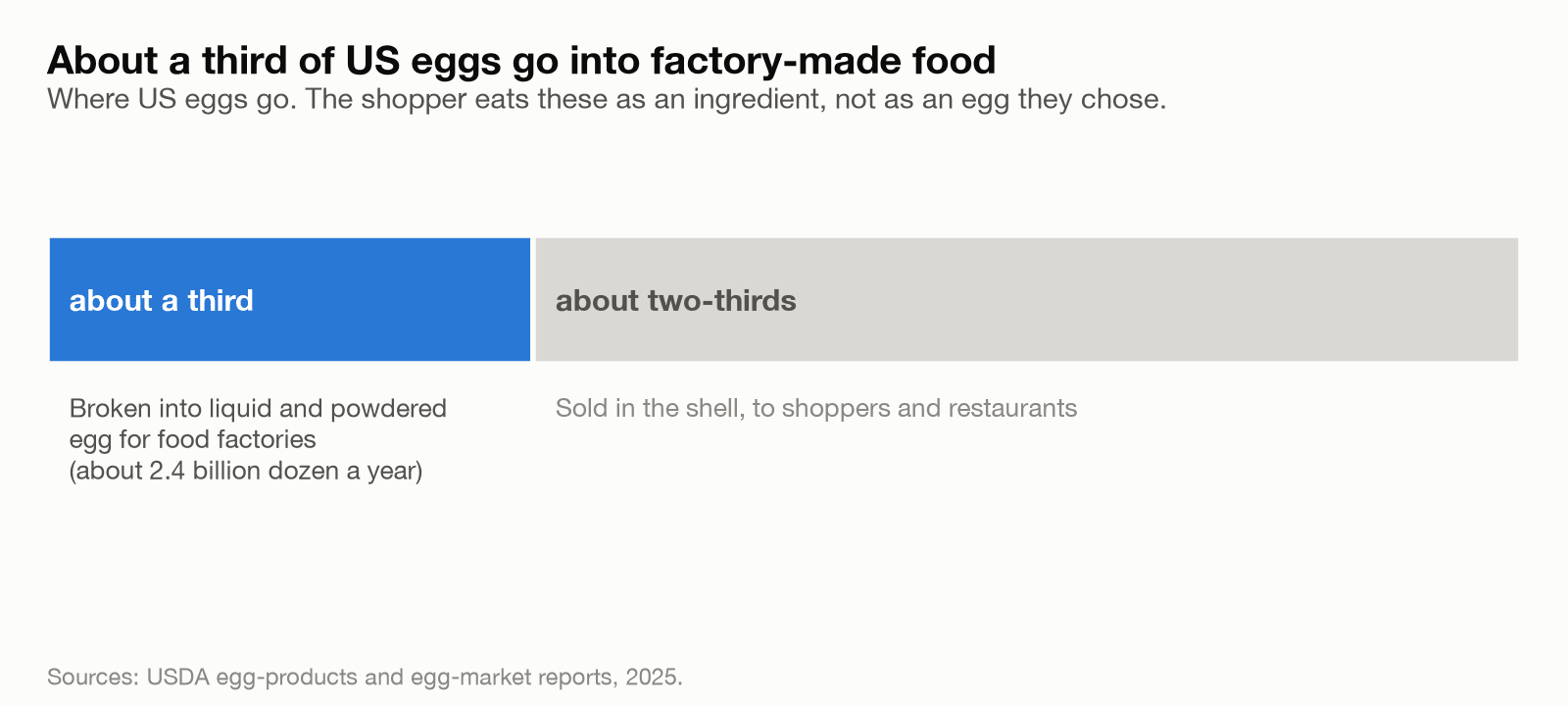
About a third of US eggs, roughly 2.4 billion dozen a year, are broken into liquid and powdered egg for food factories. They end up in cakes, cookies, pasta, dressings and batters.
Even when the ingredient is printed on the package, few people look. That makes these ingredients a good place to cut animal products. A swap inside a food company processing line is a financial calculation that the end consumer rarely thinks about. It has happened before: after Procter & Gamble launched Crisco in 1911, American baking moved from lard to shortening over the following decades, with little public notice.
Did bird flu push companies off egg?
Bird flu doubled egg prices in 2022 and 2023, and they hit $6.23 a dozen in March 2025. If companies were ever going to swap egg out, this was the time. A 2024 report for Ambitious Impact put advocacy for egg replacement at about two-thirds of its funding bar, and Rethink Priorities mapped which products could technically drop egg. A trade magazine concluded this September that the egg crisis didn't break manufacturers' reliance on eggs, but its evidence was mostly the egg industry's own statements.
I checked a USDA database which publishes the ingredient lists of about 440,000 US products, with fresh snapshots every six months. I followed each product by barcode through twelve snapshots, from April 2021 to October 2026, and noted whether it listed egg.
Almost nothing changed. The share of products listing egg went from 10.35% to 10.33%. Over five and a half years, about 167 products dropped egg and 84 added it, out of 40,000 to 48,000 that contained it.
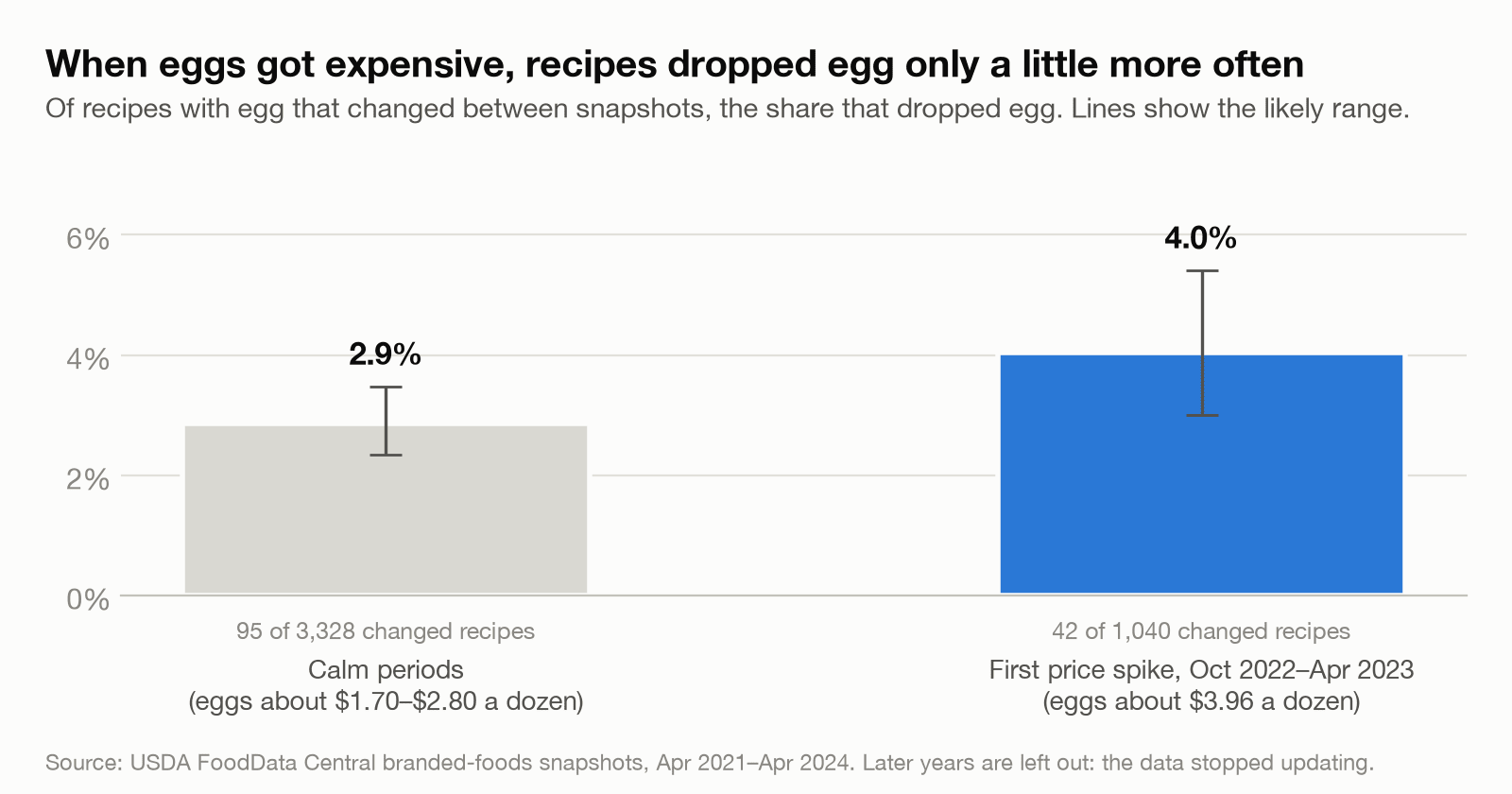
During the first price spike, recipes dropped egg slightly more often: about 4% changed recipes, against about 3% in calm periods. Meanwhile consumption overall continued to increase with US factories breaking more eggs every year, from 2,305 million dozen in 2022 to 2,411 million dozen in 2025.
Did they use less egg?
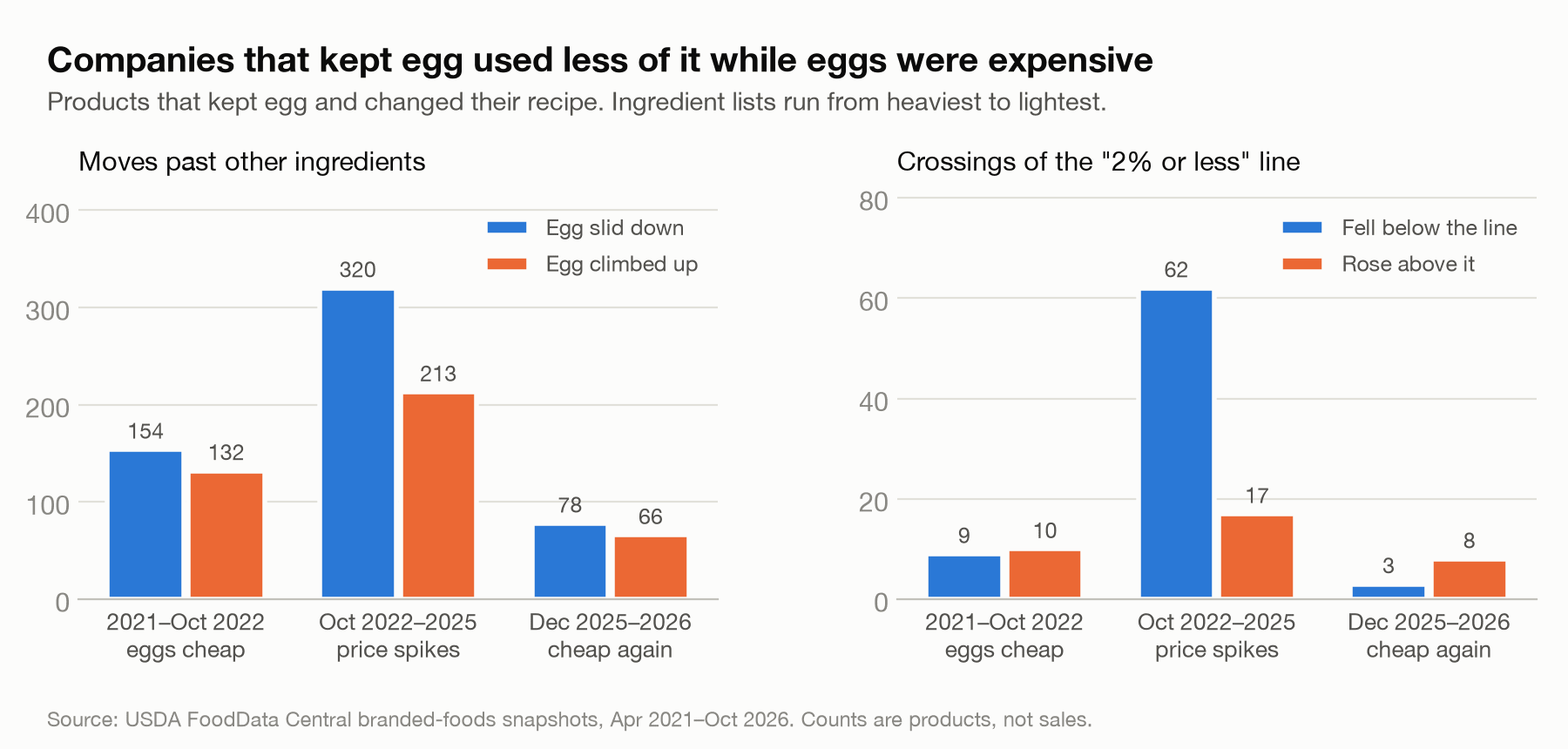
US ingredient lists run from heaviest to lightest, so when egg slides down the list, the recipe probably has less egg. Many labels also have a "contains 2% or less of" line.
Before 2022, egg moved down and up about equally often. During the price spikes and after, it slid down about one and a half times as often as it climbed, and it fell below the 2% line 62 times against 17 that went above. Big companies change whole product lines at once, so I also counted each company once: 80 leaned toward less egg and 55 toward more. A lean that size would appear by chance about one time in 26. The clearest case was Kellogg, which moved egg below the 2% line in about three dozen frozen waffle and pancake products in 2023.
Which ingredient swaps help animals?
Not every swap spares animals. The test is whether buying less of an ingredient means fewer animals are raised.
Ingredient
What contains it
Fewer animals if replaced?
Liquid and powdered egg
Cakes, cookies, pasta, mayonnaise, batters
Mostly yes
Milk powder, butter, cream
Chocolate, snacks, baked goods, sauces
Mostly yes
Gelatin, lard, tallow
Sweets, glazes, bread
Barely; they are slaughter leftovers
Carmine (red dye from insects)
Yogurt, sweets, drinks
Unclear; most is harvested from wild insects
Fishmeal and other animal feed
Fish, shrimp and chicken feed
Can backfire; cheaper feed means more farmed animals
Conclusion
Price shocks got companies to trim egg. Few replaced it. A shortage does make product developers reanalyze their recipes, so it may be the best moment to put a good replacement in front of them. That depends on having replacements that perform well. One new option is a protein from duckweed, which binds and foams much like egg white and was cleared by the FDA in February 2026.
The other things that would help are paying for the reformulation work itself, and doing studies into effective replacement. Companies want to maximize profits and if they aren't switching recipes during price shocks there are reasons. This may be inertia, risk-aversion, or other things research/advoacy can help with.
Prepping for future price surges and then funding timed advocacy/pressure campaigns could prove more cost effective.
Note: This post was crossposted from Planned Obsolescence by the Forum team, with the author's permission. The author may not see or respond to comments on this post.
Subtitle: If acceleration compounds, the naive extrapolation implies superintelligence within a year
This post discusses a public METR report on AI R&D acceler...
TL;DR:
* When we started Rethink Priorities (RP) in 2018, our mission was, simply put, to close the knowledge gaps that stopped people from improving the world as much as they could. That hasn’t changed much, but the landscape we’re doing it in is shifting.
* In 2027, we plan to grow our core GHD, Animal Welfare, and Worldview Investigations teams to take on emerging priorities across causes, including those that the forthcoming transformative AI is creating.
...
This was cross-posted from the Animal Charity Evaluators blog.
We update our list of recommendations annually. This year, we announced our recommendations on November 10.
Most people who care about animals arrive at the same impas...