Comments
Getting Started with Impact Evaluation Surveys: A Beginner's Guide

13 min readNov 13, 2023
60
In 2023, I provided research consulting services to help AI Safety Support evaluate their organisation’s impact through a survey[1]. This post outlines a) why you might evaluate impact through a survey and b) the process I followed to do this. Reach out to myself or Ready Research if you’d like more insight on this process, or are interested in collaborating on something similar.
This process is based on researching impact evaluation approaches and theory of change, reviewing what other organisations do, and extensive applied academic research and research consulting experience, including with online surveys (e.g., the SCRUB study). I would not call myself an impact evaluation expert, but thought outlining my approach could still be useful for others.
Individuals / organisations whose work aims to impact other people, and who want to evaluate that impact, potentially through a survey.
Examples of those who may find it useful include:
Evaluating the impact of your work can help determine whether you’re actually doing any good, inform strategic decisions, and attract funding. Surveys are sometimes (but not always) a good way to do this.
The broad steps I suggest to create an impact evaluation survey are:
There are two components to this: 1) why evaluate impact and 2) why use a survey to do it.
This is pretty obvious: to determine whether you’re doing good (or, at least, not doing bad), and how much good you’re doing. Impact evaluation can be used to:
Impact evaluation is not just about assessing whether you’re achieving your desired outcomes. It can also involve understanding why you’re achieving those outcomes, and evaluating different aspects of your process and delivery. For example, can people access your service? Do they feel comfortable throughout the process? Do your services work the way you expect them to?
There are several advantages of using surveys to evaluate impact:
Surveys are not the holy grail, and are not always appropriate. Here are just a couple of caveats:
Note that this post focuses on evaluating current services, not launching new ones. While surveys could aid decision-making for new initiatives (e.g., by polling your target audience on how useful they would find X new service), the emphasis here is on refining or enhancing existing offerings.
In my mind, there are eight key steps to creating an impact evaluation survey[2].
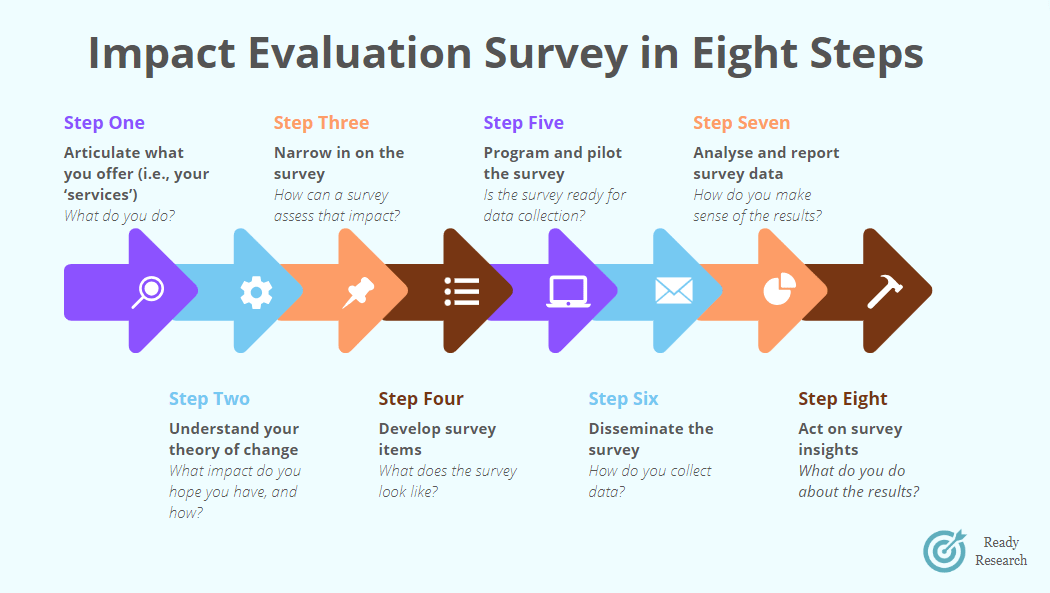
This process can take time, resources, and energy. To make the most of that, establish why you intend to collect data and evaluate your impact. Your intention shouldn’t just be, ‘to know if I’m having an impact’: make it more concrete. How do you see this process influencing decisions you’re trying to make? Who would do what with which information? Are there particular stakeholders or external parties that will benefit from this information (e.g., grantmakers)? Establishing this intention will help shape the whole process.
In addition to establishing your intention, consider scope and logistics. What's the time frame for this project? Which stakeholders do you need to involve so you can make sure you're capturing the right information? Who is ‘owning’ or leading this evaluation process (e.g., is it someone internal to the organisation, or external and independent?).
You need to understand what you offer in order to evaluate the impact of it. This step involves articulating all the types of things you do to (hopefully) create impact. I call this the ‘services’ you offer. For some people / organisations, this may be simple (e.g., “We just offer career coaching”). For others, like AI Safety Support, it may be more extensive (e.g., “We offer career coaching, but also seminars, fiscal support, and informal conversations”).
Be rigorous when listing these services. If you run events, for example, capture the different kinds of events (e.g., social events, unconferences, lectures).
To assess whether your services are having the desired impact, you need to know a) what impact is actually desired and b) what information you need to assess that. To do this, it’s useful to consider your assumed theory of change.
Theory of change encompasses your desired goal / outcome, and how you think you get there[3]. You can use theory of change to determine what you should do. For example, “I want to achieve X, so, working backwards, that means I should do Y and Z”. In this context though, the goal is to articulate your implied / assumed theory of change, in order to then test whether it holds up.
The basic gist is that you’re already doing a bunch of things (which you’ve articulated in Step 1), and you then think about a) why you’re doing those things and b) what information you need in order to keep doing them. To make this process more concrete, I’ll outline what I did with AI Safety Support.
With AI Safety Support, I ran a workshop where we recapped what their broader mission was, then went through each of their services and discussed three prompts:
These prompts spark ideas on how to assess your impact. During this stage, don’t confine your responses to what could be assessed in a survey: Step 3 is where you consider survey implementation.
Once you’ve articulated what you do, why you do it, and what evidence you need, it’s time to consider this in the context of a survey[4]. You want to translate the information you’ve generated in Step 2 into survey ideas.
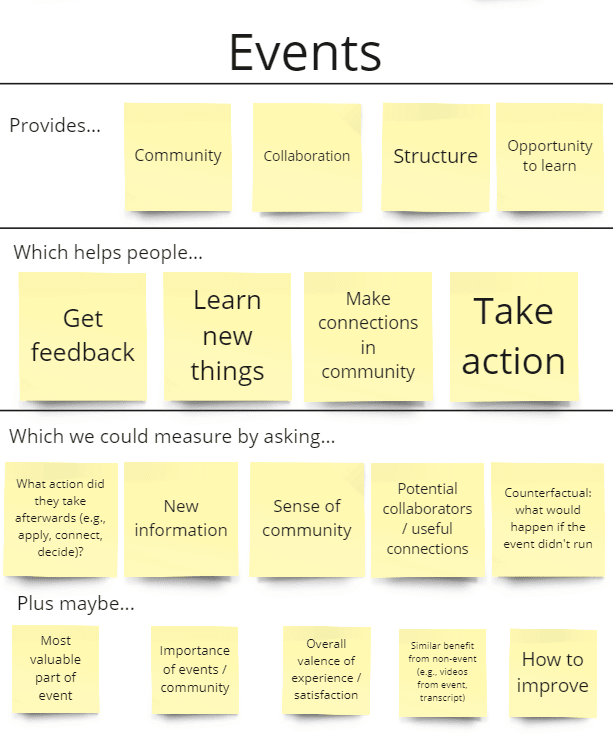
My process for doing this with AI Safety Support was as follows:
In this case, where AI Safety Support offered multiple services, the result was a list of what we wanted to ask for all services (e.g., the impact, how helpful / harmful it was, the counterfactual), plus what we wanted to ask for specific services.
Now you know the kinds of things you want to ask in your survey, you need to figure out how to ask them.
Many resources exist on developing survey items, so I’ll just highlight three tips here:
You can view a copy of the survey I developed with AI Safety Support here.
Next you’ll need to determine how participants are going to complete the survey (e.g., on what platform), prepare the survey so it can be completed (e.g., program it), then perform final checks (e.g., pilot it).
There are many platforms where you could host your survey, which I won’t summarise here[5]. Some considerations when choosing a platform include:
Piloting your survey involves testing it, before you distribute it. It’s most useful to do this once it’s programmed on the platform you’re using. The people you get to pilot it may include yourself, colleagues, and your target audience. Always indicate what people should be looking for when piloting. Examples include:
When asking others to pilot the survey, I will either a) send a google document for them to note feedback (see my template here) or b) offer for them to go through the survey with me on zoom, so they can provide verbal feedback in real-time (this is especially useful for time-poor people).
There’s no point to this survey, if no one ever fills it out. How are you going to collect responses? Will it be immediately after your event or call, or in monthly batches? Do you want to follow-up with participants longer term?
For AI Safety Support, we decided on two recruitment methods:
For each approach, we discussed the purpose and how we were going to reach those people. For example, I developed a list of places the survey would be advertised in the annual recruitment, in addition to template emails, forum posts, and social media posts.
Note that how you disseminate the survey may impact the survey itself, so this needs to be considered throughout the development process. For example, if you want the survey to collect feedback both immediately after the service, and one year later, you’ll need a survey item that collects data on when participants are completing it.
You can view the dissemination strategy I developed with AI Safety Support here.
You have the data, now it’s time to understand it, derive actionable insights, and communicate these to various stakeholders. Key considerations include:
Lastly, what actions will you take based on your results? This should link back with your reflections at the start on why you were doing a survey, and who would do what with the outputs.
Your results may suggest that you prioritise or de-prioritise specific services, or change the way you provide them. They may indicate that you should focus on particular audiences, or that you need to improve how you communicate about certain topics. They may provide information you can use to support future grant applications.
There are always caveats to your outputs, and it’s unlikely that your survey data is painting the full picture. Your results are less reliable if fewer people fill in the survey. They are influenced by the kind of person filling in the survey (e.g., people may be more likely to respond if they had a really good experience). You may benefit from additional information to aid your decision-making (e.g., interviews with people, feedback from key stakeholders). Plus, it’s always useful to consider the counterfactual – what would happen if you stopped doing what you’re doing (e.g., is there someone else / another organisation that people will go to?).
There you have it: a beginners guide to impact evaluation surveys. If you want more detail about this process, please feel free to reach out to me or Ready Research.
Here are some resources from my work with AI Safety Support, which could be used as templates:
Thank you to AI Safety Support for being a fantastic client to work with throughout this process. Thanks also to Alexander Saeri and Megan Weier for their valuable feedback on this post.
I was funded by the EA Infrastructure Fund to conduct the original project for AI Safety Support, but this writeup was not funded.
AI Safety Support shut down operations in 2023, for reasons unrelated to this project.
The scope of my work with AI Safety Support involved completing steps 1-5, then assisting with steps 6-7 (e.g., creating a detailed plan for dissemination, and developing R code to analyse data when it eventually came in).
Michael Aird’s workshop provides a good overview of theory of change.
Implied within this stage is the critical consideration of whether a survey is an appropriate choice for your evaluation. Consider the audience you’re trying to reach, the depth of feedback you’re seeking, possible alternatives, and the resources you have to design, implement, and analyse a survey.
My personal preference, if you have access to a paid account (e.g., through a university) or can fund one, is Qualtrics.

Thank you for creating such a wonderful resource. It's kind of a plug and play MEL system! I'll be sharing this around.
Thanks for the feedback Constance, that's great to know!