Comments

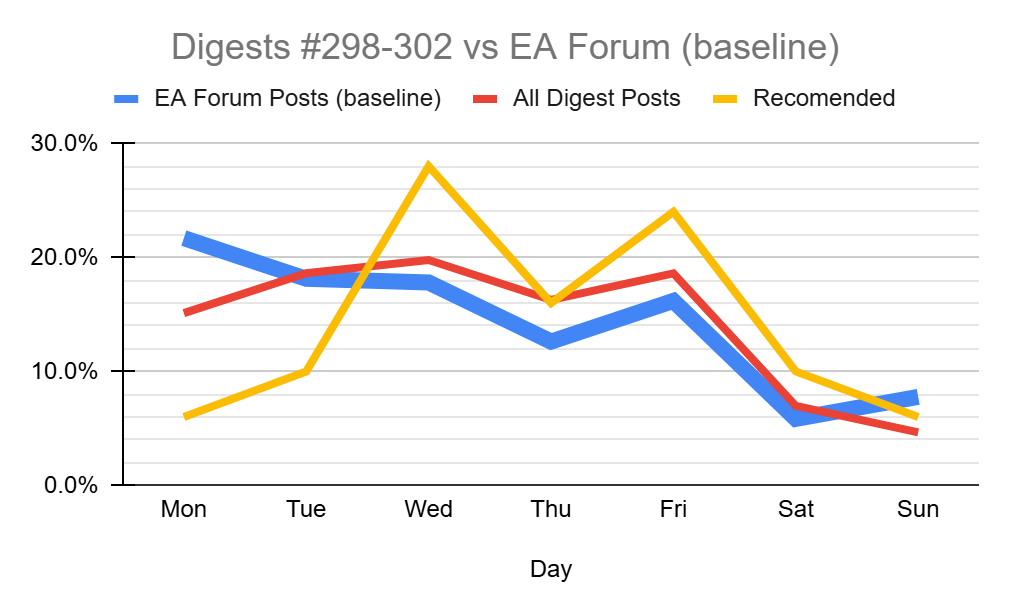
The EA Forum Digest might be biased toward posts made on certain days. Had an LLM gather dates for the posts inside Digest #298 through #302, and compare their weekday frequencies against EA Forum posts made within the same window. Probably not enough data (n=50 for Recommended; n=86 for all Digest Posts) to be meaningful.
(Got the idea to check because I was imagining if I was responsible for writing the Digest and thought, "hmmm I feel like if I were sending out emails every Wed, I would be biased toward posts made on certain days because of the availability heuristic and/or the configuration of my weekly reading/writing schedule")

More EA undergrads should do political volunteering. It's impactful AND fun.
Choose an election that's impactful (e.g. AI safety candidate) and neglected (e.g. primaries in always-blue/red places), couch-crash the weekend there, and volunteer with the campaign.
I say this after doing 15 hours of street canvassing myself. I was surprised by how anecdotally impactful and fun it was. If you like people-watching, talking to strangers, and/or joining passionate projects for a weekend, I think you'll also love this.
I wish I thought of this earlier.
Literature on the impact (Claude-generated): Kalla & Broockman's meta-analysis of 49 field experiments finds zero average persuasive effect in general elections, but effects do show up when voters lack a partisan cue (i.e. primaries and ballot measures). Mann & Haenschen (2024) find mobilization effects (e.g. canvassing) are 33-76% larger in low-attention races than in high-attention ones. Your marginal volunteer hour goes much further in a primary.
As someone who did this, and ended up actually working as a political staffer for years, strongly agree. Not just for the reasons you mentioned, but volunteering on a campaign for a weekend is a pretty easy/cheap test to see if you have aptitude and/or enjoyment in the realm of politics as a whole. If you do, even a short stint is a great way to learn some pretty handy transferable skills, and to meet people that might be handy to know if you’re trying to influence policy down the line. Campaigns love thoughtful, passionate people, and they can be convinced to give you more to take on if you show that you’re willing and trustworthy. And as long as you’re not too loud about it or take on any permanent paid roles, it’s fairly concealable, if you are worried about being visibly partisan negatively impacting you in the future.
I specified undergrads because I assume they're similar to me. This can of course apply to non-undergrads.
Also, I recommend checking prediction markets and prioritizing elections that are close calls (e.g. don't volunteer for a 90%-likely-to-win candidate, or a 10% one that is dwarfed by two other 40% candidates). Aim for 35-50% (judgement call)