The AGI & Animals debate focuses predominantly on values and alignment (will ASI care about animals, or lock in speciesist norms?)
More structural economic mechanisms seem less discussed
ASI-driven Precision Livestock Farming (PLF) might make animal production cheaper. Cheaper production means lower prices. Lower prices mean higher demand. More demand means more animals raised for meat.
This is the Jevons paradox in action - it’s devastatingly well-evidenced in the history of energy, transport, and food (amongst other places). The bottom line is that efficiency increases total consumption.
Suffering as a byproduct of efficiency could compound massively, leading to not-so-great outcomes for farmed animals, on aggregate.
Where the debate stands
This post is my attempt to add something to the ongoing AGI & Animals Debate Week and its central question: if AGI (or ASI) goes well for humans, will it probably go well for animals?
Base cases
The optimist case is, I think, fairly compelling. If ASI broadly reflects human values, and human values seem to be slowly expanding their moral circle, then maybe we get cultured meat, better welfare monitoring, reduced demand for factory-farmed products. I'd put maybe a 35% credence on some version of this going well for animals, conditional on ASI going well for humans at all.[1]
The pessimist case is also compelling, and probably where I'd lean if I had to pick. The core worry is that AI doesn't change the underlying incentive structure of animal agriculture, and instead makes it way more powerful. Value lock-in of current speciesist norms would amplify current treatment of animals with better infrastructure. ASI optimising a broken system just optimises the brokenness.
Both cases are strong in their own right, and importantly, neither requires much imagination to believe (which is probably why this debate has no obvious answer!)
A missing piece?
Both priors are essentially about values and alignment. Will ASI inherit or transcend our moral blind spots? But I think there's another channel that neither view fully accounts for, and it operates regardless of how the values question resolves.
I'm going to narrow my scope here: I'm talking specifically about farmed animals, not wild animal welfare (where the calculus might flip entirely).
Within that scope, even a perfectly benevolent ASI optimising food production for a hungry world would face a structural economic tension that has little to do with its values. That tension has a name: the Jevons paradox. This refers to the empirical pattern that when a technology makes production more efficient, total consumption tends to rise, not fall.[2]
Precision Livestock Farming in context
"AGI" is a term I'm not fond of. It gets applied to everything from slightly better chatbots to systems that could reshape civilisation, which makes it hard to reason about precisely. I'll use ASI instead in this post, although frankly, the distinction matters far less here than you'd expect, because the specific technology I'm concerned with is narrower than either: Precision Livestock Farming, or PLF.
PLF is the use of AI, real-time sensors, computer vision, and ML models to monitor and optimise livestock production at the level of individual animals. This entails tracking health, behaviour, feed intake, weight, and stress signals continuously, and feeding that information back to farmers (or automated systems) in real time.
The context in which PLF matters most for farm animal welfare is at Concentrated Animal Feeding Operations – CAFOs, the official EPA/USDA term for large-scale factory farms.[3] It is (roughly) estimated that 74% of the world's poultry, 43% of beef, and 68% of eggs are produced in CAFOs at any given time.
PLF is most naturally deployed at this scale – though it may also help smaller operations cross the threshold into CAFO territory (more on this later).
Currently, PLF is not a speculative technology. Some of it is already running in commercial farms:
Ceiling-mounted camera systems like eYeNamic use overhead video to monitor the distribution of birds across a broiler house
3D camera weight estimation systems can determine the weight of multiple broilers simultaneously without physical contact, replacing the need for manual sampling and enabling continuous growth tracking across an entire flock
Wearable sensors like SCR, Nedap, CowManager, and Smaxtec[4] (all primarily deployed in dairy) track individual animal health, fertility, and stress markers in real time, turning barns into what some call "continuous feedback systems."
Robotic feeding systems like the Kai Zen 5 robot calibrate feed delivery to individual genetics, breed, age, and demand using computer algorithms
With this, producers have reported revenue increases of up to 20% and return on investment in under a year
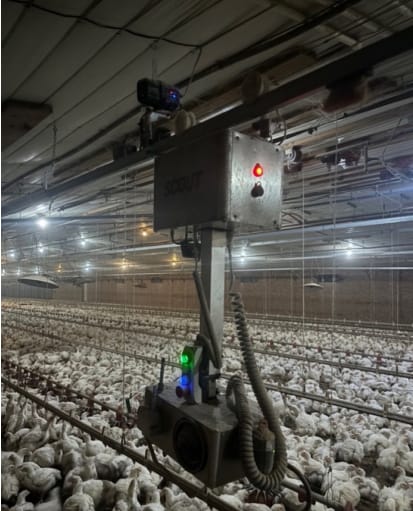
And there's more coming, including PLF technologies in R&D or limited deployment: mortality-removal robots (like SCOUT, which uses heat signatures to confirm whether a bird is alive before alerting the farmer); IoT-based wearables using accelerometers and gyroscopes to predict disease onset before visible symptoms appear; genomic selection tools that use high-throughput phenotypic data to optimise breeding for productivity traits; and environmental sensor arrays measuring ammonia, CO₂, and humidity to fine-tune living conditions at the flock level.[5]
SCOUT robot patrolling a commercial broiler house. Source
I'm convinced that PLF belongs in a conversation about ASI. This is precisely the kind of narrow, high-volume, data-rich optimisation task that more capable AI will be extraordinarily good at. The technologies delineated above are early versions of a much more automated and capable system.
As AI improves, PLF scales. And with it, so would animal agriculture in CAFOs and its ramifications on sentient beings.
Efficiency in animal agriculture didn’t start with AI
It's worth noting that not everything in that list above requires AI in any meaningful sense.
Several of the aforementioned technologies run on basic IoT sensors and threshold-based alerts that have been commercially available for decades. In fact, the drive to squeeze more output from fewer inputs in animal agriculture has a history that long predates machine learning, or computers, or even electricity in the barn.
It started with 500 chicks
In 1923, Cecile Long Steele, a farm wife in Ocean View, Delaware, ordered 50 chicks for egg production. The hatchery sent 500 by mistake. Rather than return them, she decided to keep and sell them at a discount, successfully raising 387 surviving birds to two pounds and selling them for 67 cents per pound.
Broilers, until then, had been a byproduct of the egg market; chickens were only eaten once they got too old to lay. Steele didn't set out to build an industry. She just made the most of an overdelivery.
Yet, the following year she raised 1,000 chicks, then 10,000, then 26,000 – this is an archetypal precedent of the aforementioned phenomenon wherein small farms could become CAFOs.
By 1928, 500 growers had joined Steele across Delmarva.By 1989, growers were producing birds of twice the weight in half the time.Today, US farmers raise 9.4 billion chickens per year, and chicken is considered to be the most affordable source of high-quality protein.
Cecile Steele had no intention of causing animal suffering. But the system she accidentally seeded (and that a century of efficiency gains then scaled) now produces conditions that are, by most welfare accounts, deeply grim.
Of course, suffering was not the goal. It was the byproduct.
What troubles me about PLF is the possibility that it repeats this dynamic, but faster and at a scale that dwarfs anything Steele could have imagined. What if the best-intentioned efficiency technology in the history of animal agriculture makes things worse, not better?
That might sound dramatic, but consider the trajectory. Between 2010 and 2020, the US chicken industry produced 21% more chicken by weight while achieving improvements in key sustainability metrics, efficiency and scale moving in lockstep. PLF accelerates this relationship. ASI would bring the ability to close the remaining gaps in production optimisation – to move from "mostly efficient" to something approaching the biological ceiling (or even beyond?) – and to do it across every farm that adopts the technology, simultaneously. A single farm could see a few million broilers in the near future.
Efficiency sounds like it should be good
If a technology reduces mortality, cuts disease, and improves feed conversion, surely that's just better for the animals?
The case that PLF is good for animals
The individual-level welfare case for PLF is real and worth taking seriously. Evaluated through the Five Domains model (a standard framework for assessing animal welfare across nutrition, environment, health, behaviour, and mental state), PLF technologies do appear to move animals from negative welfare states toward more neutral ones: better disease detection, earlier intervention, less chronic suffering from conditions that would otherwise go unnoticed for days.[6] Automated sound-based systems can monitor feeding behaviour continuously, 3D cameras track weight without physical handling, and welfare alerts can replace the twice-daily feeding and health checks currently mandated under EU regulation. If this is what ASI delivers to animal agriculture, the optimist has a point.
The devil lies in the aggregate
Per-animal welfare is not the only thing that matters, and arguably not the primary thing. What we’d actually want to minimise is the aggregate: how many animals exist in the system, multiplied by how much each one suffers.
A technology that halves suffering per bird but doubles the number of birds has achieved nothing. Ones that quadruple the number of birds makes things far worse. ASI-accelerated PLF might do this.
The paradox of cheaper things
If a coal engine becomes twice as efficient, would Britain use half as much coal? The intuition says yes. You get the same output for half the input, so total consumption should fall – right? William Stanley Jevons looked at exactly this question in The Coal Question (1865) and found the opposite. After James Watt's engine dramatically reduced coal required per unit of work, Britain's total coal use didn't fall; it increased roughly tenfold between 1800 and 1865. Cheaper energy made steam power viable across entirely new industries (textiles, transport, metallurgy), unlocking uses that simply hadn't existed before. This is the Jevons paradox: efficiency reduces the cost of doing something, which increases how much of it gets done.
The same mechanism could play out for animal agriculture, especially with ASI-enhanced PLF, which could overcome many existing bottlenecks:
Feed accounts for 60 to 70% of total production costs in broiler farming, and a similar proportion across pigs and cows.The feed conversion ratio (kilograms of feed per kilogram of live weight) is the single most important cost lever. Robotic feeding systems like the Kai-Zen 5 could unlock lower cost per kg of meat or milk produced, making operations viable at scales that were previously unprofitable.
Every animal that dies before slaughter or before the end of its productive life is a complete loss, with feed, labour, and space all unrecovered. Visible symptoms typically lag infection by days. Systems like SCOUT compress that detection window significantly, leading to more animals surviving to productive output per cycle.
No farm manager can physically assess every individual in a flock of 50,000 birds or a herd of 1,000 cattle. Wearable sensors and camera-based alert systems mean the same worker can manage more animals simultaneously, thus enabling lower labour cost per animal, making larger operations economically viable and existing operations scalable without proportional staffing increases.
Each bottleneck removed does two things simultaneously: it (possibly) improves conditions per animal, and it reduces the cost of producing each animal. The former means there could be a welfare gain. But the latter entails cost reduction, which is exactly what the Jevons paradox acts on.
What history tells us
The Jevons paradox has played out repeatedly, across domains that look very different from each other. I find the pattern to be consistent enough that the burden of proof should sit with anyone claiming it won't apply to animal agriculture.
Case #1
William Nordhaus tracked the cost of producing one lumen-hour of light from pre-industrial candles and whale oil through to modern electric lighting. The cost fell by a factor of somewhere between 1,000 and 10,000 times.
Did people use less light? Not at all.
Global per-capita light consumption increased by a similar order of magnitude. Entire categories of consumption appeared (things we take for granted, like 24-hour cities, illuminated streets, digital screens) that simply couldn't have existed when light was expensive.
This is perhaps the cleanest illustration of the paradox's mechanism: latent demand. When a good becomes cheap enough, new uses appear that weren't on the demand curve at all. For chicken, as an example, the analogues include ultra-processed convenience foods (like nuggets), institutional catering at scale, and the enormous and growing demand in lower-income countries where price is currently the primary barrier to higher meat consumption.
Yet, vehicle miles travelled in the US increased roughly threefold between 1970 and 2000. Cheaper driving per kilometre reshaped where people lived, how far they commuted, and what counted as a reasonable trip. A meta-analysis estimated direct short-run rebound effects (savings from efficiency, partially consumed by more use) of ~10-12%, with larger long-run effects as infrastructure adapted.[7]
It’s worth noting, though, that transport demand is unusually elastic because it ties into housing and spatial structure in ways that food doesn't. Meat consumption won't reshape cities, but the second-order effect, that cheaper meat could shift diet composition, increase processed products, and entrench animals as the default cheap protein in institutional food globally, is the relevant parallel.
Case #3
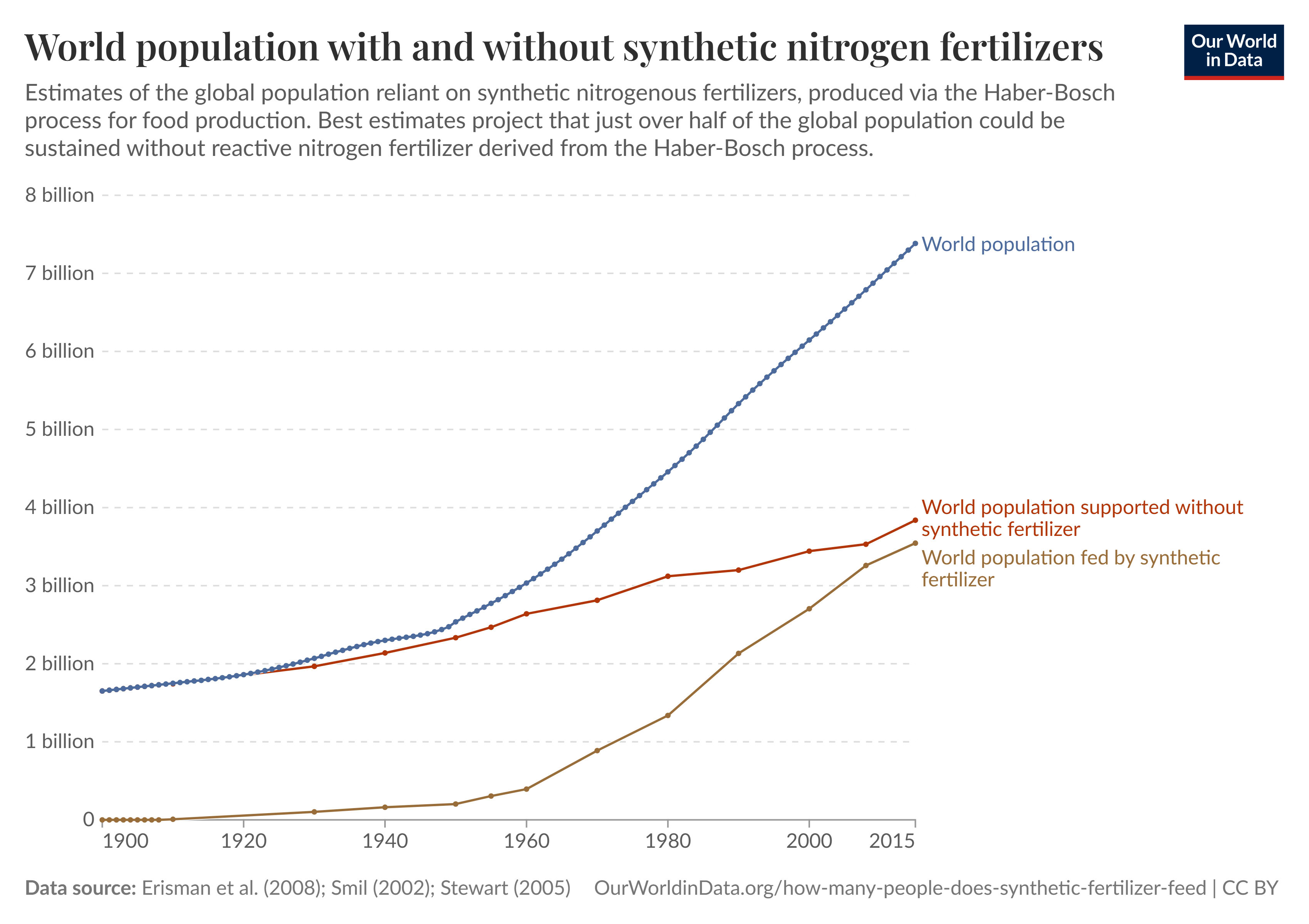
The Haber-Bosch process, developed in the early 20th century, dramatically reduced the cost of synthetic nitrogen fertiliser. Global consumption went from near-zero in 1900 to over 100 million tonnes annually today. Cheaper nitrogen enabled entirely new scales of agricultural production – including the feed-intensive livestock systems that underpin modern animal agriculture.
The parallel to PLF is more conspicuous here than in the other cases. Both target input costs within a production system; both reduce the marginal cost of expanding output; and both operate within food and agriculture specifically. Importantly, both have demonstrated the capacity to scale production beyond prior biological and economic constraints.[8]
We need efficiency
Feeding a world population of 9.1 billion in 2050 would require raising overall food production by roughly 70%, with annual meat production needing to rise by over 200 million tonnes.Demand for animal protein is growing the fastest in developing countries. Cheap protein is the difference between adequate nutrition and not, for hundreds of millions of people.
Efficiency is not the villain here, in PLF scenarios and otherwise (notice the 3.54 billion people fed thanks to synthetic nitrogen fertiliser efficiency gains in the graph above). For PLF, Röös et al. (2017) model scenarios where intensification – crucially, paired with demand constraints (so little to no Jevons) – actually reduces total land use and allows substantial carbon sequestration; this way, land released by high-efficiency farming can sequester 3 to 20 times more carbon than the farming activities themselves.
And as Berckmans (2017) notes, farmers aren't choosing this because they want to: “farmers would be happy to run their farm with fewer animals, but since the public will not pay more... they don't have a lot of choice."
Given all of this, I'd assign a >85% probability that PLF will be widely deployed across small farms and CAFOs alike over the coming decades because the economic pressures that drive adoption are overwhelming. And as PLF makes smaller operations more productive and profitable, I'd expect to see further metamorphosis of the former into the latter: more farms crossing CAFO thresholds, more consolidation, more cost reduction, and thus the full chain of events the Jevons paradox describes, culminating in explosive growth of animals farmed for human consumption.
The cheaper option (always) wins
Two assumptions underpin everything I've argued so far, and I want to name them explicitly because both are pretty contestable.
First: that at aggregate scale, humans choose the cheapest option.
Second: that animal-derived protein will remain cheaper than alternatives for the foreseeable future.[9]
For assumption #1, I'm not relying on moral philosophy (though I do think there’s a lot to say about the moral limits of markets, and also on morality’s limits within markets, but I’m ill-informed about either and not a big fan of value judgments based on individual dietary choice). Instead, I'm relying on the historical record. Coal got cheaper; Britain used more. Light got cheaper; we illuminated entire cities. Driving got cheaper; Americans tripled their vehicle miles. Nitrogen got cheaper; we built an entirely new scale of industrial production on top of it. In every case, the cheaper option won at scale. Sure, individual behaviour varies enormously, but aggregate market behaviour is stubborn.
So: if AGI/ASI goes well for humans, does it go well for animals?
My take is: not automatically, and possibly not at all, even under optimistic assumptions. The Jevons mechanism doesn't require misaligned ASI, or indifferent humans, or malicious actors. It requires only that ASI makes animal agriculture more efficient, that lower costs produce lower prices, and that lower prices increase demand. All three of those steps are already happening without ASI, and will likely be amplified by it.
I’m trying to underweight my optimism here, as I think it might be influenced by recency bias – recent-ish wins, such as Anthropic's new constitution mentioning “Welfare of animals and of all sentient beings” feel meaningful, but I'm genuinely unsure how durable that consideration will be in praxis as competitive pressures on frontier labs intensify.
Jevons paradox has gotten some attention in discussions of AI broadly and in its energy footprint. However, applying it specifically to farm animal welfare and PLF (which I'd argue is a distinct domain from what “AI” or “AGI” usually refers to) has received less attention. Perhaps because PLF is a narrow, embedded, production-optimisation technology; its welfare implications are specific to animal bodies and different demand elasticities that general AI commentary naturally ignores.
A large CAFO for broiler chickens, by regulatory definition, confines 30,000 or more birds under liquid manure systems, or 125,000 or more under dry litter systems; for cattle the threshold is 1,000 beef or 700 dairy cows; for hogs, 2,500.
Somewhat contradictory to the previous bit about PLF being most useful in CAFOs, it’s worth noting that Smaxtec explicitly markets its products to "dairy farms of all sizes" and states that it "helps protect small farms and increases their income by improving efficiency through technology." Almost all of the farms on their testimonials page are not CAFOs. This cuts both ways. PLF isn't solely a big-farm story, and the efficiency gains it delivers to such smaller operations might be (with high uncertainty) what nudges them toward CAFO scale over time.
Caveat: moving animals from negative to neutral is not the same as positive welfare. Positive welfare requires rewarding goal-directed behaviours, which PLF currently has almost no tools to deliver.
Note that this figure, and all the other considerations in this post, focus only on direct rebound – that is, the price-demand feedback within the animal agriculture market itself. Indirect and economy-wide rebound effects (e.g. freed capital reinvested in scaling other factory farming) would presumably amplify the picture further.
This theoretical paper explains why these patterns of massively increased consumption seen in all three cases are so hard to escape: Giampietro & Mayumi (2018) argue that major innovations don't just make a system faster; instead they change its identity entirely. They use the example of tractors vs. horses: "it makes no sense" to compare 30 horses with a 30-HP tractor using the same metrics, because the tractor doesn't replace horses, but it enables a fundamentally different system.
I'm setting aside the alt-proteins question almost entirely here, and I want to flag that as a significant omission. If cultivated meat or precision fermentation achieves price parity, or undercuts conventional animal protein, the second assumption breaks down, and the demand side of the Jevons mechanism changes materially. My pessimism about near-term price parity is based on the idea that ASI doesn’t automatically solve the cultivated meat problem.
Note: This post was crossposted from the Coefficient Giving Farm Animal Welfare Research Newsletter by the Forum team, with the author's permission. The author may not see or respond to comments on this post.
Subtitle: On vegan advocacy, effective altruism, and FIFA
I turn 40 today. Here are some hot takes.
On factory farming
1. Our biggest challenge is salience. If factory farming led the evening news, it wouldn’t last lo...