Throughout this post, we use "AGI" to refer to AI systems with broad generality and high capability—roughly levels 2 to 4 on Google DeepMind's Levels of AGI framework (p. 5).
This post seems to rely on the premise that there will be a large time gap between AGI and ASI, or DeepMind's capability levels 4 and 5 ("at least 99th percentile of skilled adults" vs. "outperforms 100% of humans"). Unless society deliberately decides to stop AI development, it seems unlikely that there would be large gap between AGI and ASI. ASI would render most/all of the identified bottlenecks irrelevant, e.g. "regulators" and "political opposition" become meaningless in the face of superintelligence.
Even if AI is "merely" as smart as the 99th percentile human, once AI has the ability to do 99th-percentile work for very cheap with arbitrarily many copies in parallel, it seems likely that the political and governmental system as we know it would cease to exist. At minimum, we'd see close to a 100% unemployment rate. It seems very hard to make claims like "political opposition would slow down cultivated meat" when you're talking about a world with 100% unemployment.
This report is not alone in taking this perspective. A big problem I see with a lot of these kinds of analyses (especially in the animal welfare space) is that they are trying to analyze a world where AI is better at everything than the majority of humans, and yet the political/social/economic environment is basically unchanged. I don't see how that would happen.
Thanks for your comment. I agree it's possible that ASI could come shortly after AGI, and I do caveat in the piece that if you believe this, most of the takeaways won't hold.
What I wanted to do with this post wasn’t necessarily persuade people of any one scenario, but instead describe the actual bottlenecks that cultivated meat faces so that people can calibrate their own views, whatever those views are, against the real landscape. For example, if someone came away from reading this more optimistic about cultivated meat under AGI, but also better able to articulate why (according to how they think AGI solves the bottlenecks), I think that's still a valuable outcome.
I used a narrow definition of AGI because I think that's where actionable analysis can be made [edit to add: and I think its not a completely implausible scenario, especially for consumer preferences – see my reply below], but I agree its not necessarily enough. If you have recommendations for how to reason about worlds where current baselines genuinely don't extrapolate at all, I'd really welcome them! It's a problem I find really hard, and I think a lot of others, especially those coming from cause areas outside of AI safety, do too.
I haven't figured out how to organize my thoughts well, so forgive me if this is unclear or disjointed.
I used a narrow definition of AGI because I think that's where actionable analysis can be made
Even assuming AI reaches your narrow definition of AGI and then stops advancing, AGI would still radically change the economic and political environment. The bits in this post about behavior of regulators become irrelevant if regulators are replaced by AI.
I don't think it's fair to say (e.g.) "it's hard to predict how politics/government will change, so I'll just assume they won't." Predicting that nothing will change is still a prediction! If you're going to take the route of not making predictions where the future is especially fuzzy, then I think that's more defensible, in which case the answers on "Regulators speed up", "Political opposition reverses", and "Consumers accept cultivated meat" should all be something like "it's too difficult to predict because AGI will radically change the political and cultural environment".
If you write an analysis that only makes sense in an implausible world—the one where AGI accelerates technology, but nothing else happens—then that still has some positive value as long as that world has a non-zero chance of obtaining. But the framing of the piece directs animal activists to focus their attention on that world, and I think that's the wrong world to focus on because it's so improbable. At minimum, the piece doesn't make it clear that this is an assumption.
If you have recommendations for how to reason about worlds where current baselines genuinely don't extrapolate at all, I'd really welcome them!
Here's what I would say: Yes, some things, like how society will be structured post-AGI, are very hard to predict. But other things about AGI are predictable. I can predict that it speeds up almost all kinds of work. I can predict that AGI will control the shape of the future—either because it has explicit control, or because humans retain control but still rely on AGI to do most of the work (because AGI is better than humans at almost all tasks). I can predict that, on our current trajectory, ASI will follow shortly after AGI (see AI As Profoundly Abnormal Technology). I can predict that if ASI is misaligned, then it will wipe out all life on earth.
There is an argument that animal activists should advocate to pause AI development because (1) probably after AGI and certainly after ASI, animal activists will have no power; and (2) it is too difficult to predict whether AGI/ASI would be good for animals, so we need to buy more time to figure out how to make it good. This is an argument from conservatism rather than an argument from expected value; I still think AI pause advocacy has high expected value, but that argument is harder to make. (I'm currently writing something longer about why pausing AI is a good idea even setting aside the alignment problem, although my argument isn't just about animal welfare.)
Another important question is how to shape the values of AGI (about half the ideas in this list are some version of that). There are things we can do now to influence the direction of AI development.
Another way to reason about post-AGI worlds is to think about AI alignment. e.g. I have three recent posts about what forms of alignment are more likely to be good for animals (1, 2, 3). A big thing that I think is under-appreciated by animal activists is that the way AI is aligned—if it's aligned—could have a big effect. I don't just mean "will care-for-animals be built in to its values", but that there are differences between how different types of alignment are supposed to work, e.g. constitutional AI vs. agent foundations (see 1).
Speaking of "if it's aligned", maybe the best thing to do is to work directly on AI alignment. I wrote a relevant post here. I believe a good number of AI safety researchers think that solving the alignment problem is the best way to help animals, although I can't recall any piece of writing where someone clearly articulated this position.
ETA: More on this bit:
[W]e don’t address scenarios in which AGI drastically reshapes institutional and political dynamics. [...] [W]e focus on existing institutional structures because they allow actionable analysis, but we acknowledge this is a limitation.
Rather than predicting that AGI won't change institutional structures, to allow actionable analysis I could instead say:
My assumption is that first AGI will become a world government singleton, and its values will be determined by its constitution.
This scenario is both easier to analyze (you can ignore political and regulatory factors and just focus on the text content of the AI constitution) and more likely to actually happen (although I still think it's pretty unlikely).
I definitely take your point about "I used a narrow definition of AGI because I think that's where actionable analysis can be made, but I agree its not necessarily enough." – I think I could have worded that better.
What I meant was that I think the world I discuss is plausible and we can get some actionable analysis from it, which can get us some way to identifying what actions may be more robust across different scenarios. (I agree we wouldn't want to discuss scenarios that are impossible.)
It seems the difference in our views here is that I think it's possible institutions and consumer preferences are quite sticky, at least for a little while; e.g. society imposes that humans have to be final decision-makers for longer than you'd expect (perhaps because legacy rules persist or people strongly prefer slower human-in-the-loop processes, or something else), or consumers really want 'traditional' food that they know, like, and trust regardless of their economic position. If you think there's a 0% chance that can happen, then it makes sense not to agree with what I describe above.
I probably won't carry on replying here, but I do appreciate you taking the time to explain your view, it made me think about the framing of my post and my viewpoint a lot more.
I think you've made a lot of good points. But solutions to factory farming are broader than just cultivated meat. Plant-based meat is already much closer in cost and more acceptable to consumers. And the source of protein could come from fungus, bacteria, leaf protein, seaweed, etc., though those are probably not as acceptable as regular plants. It's also possible that AGI could help engineer a meat substitute that actually tastes better than animal meat, perhaps by triggering sweet taste buds without actually having appreciable sugar.
AGI-powered persuasion tools are equally available to the well-resourced conventional meat industry.
As Bruce Friedrich mentions in its book Meat, I think this is unlikely to be the case. While I expect opposition from farmers, I think the large companies are more likely to be supportive, because (i) it is plausible that cultivated meat could become much cheaper than animal produced one, the floor is lower, (ii) they could create larger barriers to entry, using eg IP, and (iii) they do not have large sunk costs in their conventional animal farming facilities, and (iv) it likely allows them faster market reactions to demand and more stability (no avian flu, say). Bruce sometimes feels a bit too optimistic in its book, but I tentatively agree with those points.
Let's say that AGI solves cultivated meat for us. Cultivated meat is already illegal in seven[5] US states. It might soon be illegal in the entire European Union. By the time we get AGI, will they even be able to sell it anywhere?
I am not well calibrated on this, but I would argue the likelihood of the full EU making cultivated meat illegal is low. I think many countries in the EU have been able to ban GMOs or nuclear power because there was little push from the pro-GMO or pro-nuclear side, and there were easy environmental arguments to be made from the anti side, even if misguided. I don't think that is likely to be the case for cultivated meat. It is more likely to resemble what happened with coal phase-outs.
I think the most likely scenario is:
There are farmers' protests.
The EU makes it harder but not illegal to sell cultivated meat, perhaps delaying some approvals.
At some point, it becomes easier to subsidise animal farming than to ban cultivated meat outright, because spending money is always easier, and they are doing it already anyway.
This gradually stops except for the highest welfare farming conditions, as old and nasty factory farms become places nobody wants to work in, and thus no individual farmers rely on them for a living.
It is also worth noting that if one cultivated meat product is approved for sale in the EU, one could, with time and patience, probably strike a single market case to bring down laws forbidding its sale in other EU countries. I agree, though, with the statement that "current trajectories in the US and EU point toward more restrictions before the likely arrival of AGI."
Existing evidence points toward low acceptance driven by food and food technology neophobia.
Throughout the draft there seems to be a question on whether cultivated meat would achieve the same taste. In practice, I think the consumers won't really wonder too much if it looks, tastes and is otherwise exactly the same as what they typically buy. This is, in fact, perhaps the biggest difference between cultivated vs plant-based food: plant-based can taste just as good, but an individual product may not offer the original culinary flexibility. For example, literally from today, blind tasting of Aleph Farms cultivated meat did confirm this source here.
But there are some plausible worlds where AGI capability is more concentrated—controlled by a small number of governments, corporations, or platforms.
I think it is likely that from the purely scientific point of view, someone will pay for that to happen, be it Jeff Bezos (who has research centres for the matter), Bill Gates (who is quite worried about climate change) or Dario Amodei (who thinks AI for biotechnology is the best application of AI).
consumers are unlikely to switch to cultivated meat unless it is substantially cheaper than conventional meat.
Again, how rooted is this in actual data? It would seem to me that if you go to the supermarket and you find two exactly equivalent products (package included) with a $0.25 price difference, people will typically buy the cheap one. Especially if they try it and they like it, which they should, since it is the same. In fact, what confuses me about comments like this is how a product can cause neophobia if it looks and is perceived as exactly equivalent to the old one. You'd have to flag something about "labs" for it to be even perceived as a different product in the first place.
Even if you grant generous odds at each stage, a chain of individually plausible steps can still produce an unlikely outcome.
I think this may not be the right way to look at this, not just because they may be correlated, but also because it is not a 1-shot event. There will likely be a back and forth of events with bans and reversals, say, until some stable equilibrium is achieved. I think a more useful question to ask is how to stack the probabilities in favour of a given equilibrium.
Just commenting in the likelihood of a full-EU ban being low. FWIW I don't think it is currently more likely to happen than not, but I think you are underestimate the risk.
To block a regulation or legislation in the European Union under qualified majority voting rules, a "blocking minority" must be formed by at least four member states and represent more than 35% of the EU population.
Italy and Hungary have already banned cultivated meat. The Romanian Senate has also approved a ban (although I don't think it has been implemented). France and Austria have also called for moratoriums or greater regulation, and these countries could plausibly tip over into a ban. These five countries alone would lead to a ban at the EU level. Or if some other countries abstain rather than voting in favour of cultivated meat, it becomes even easier for fewer than these five countries to secure a ban.
Those are great points, thanks, I think you are right. On the other hand, I think my argument was that if the "science is solved" and cultivated meat became cheaper and more environmentally friendly, I don't see the current state of factory farming as a stable equilibrium situation: I don't think it is reasonable to expect an indefinite protection of a more expensive, more polluting and less worker friendly economic sector in favour of another. Eg, a ban might be feasible, but it may not be sustainable in decade-long time horizons.
I agree that many of the barriers to cultivated meat could be overcome post AGI, although I worry that scaling alt proteins isn't the path of least resistance to solving climate change (which i think is the most politically salient argument for trasitioning away from factory farming) or a number of other problems (health concerns, food security, biosecurity, and of course animal welfare)
In particular, it is plausible to me that AGI could rapidly reduce our reliance on fossils fuels and or mitigate the impacts of climate change. For example, we could rapidly scale up renewable energy supplies, more efficiently utilise the energy we already etc.
The effects of factory farming on the environment, the welfare of animals, the health effects etc hasn't been enough of an incentive to encourage investment and deregulation. Even if cultivated meat becomes easier to scale, if the incentives for doing so diminish at a similar rate we might be no more likely to do so than we are right now.
I think if I'm right than it might make sense to focus on problems alt proteins will be uniquely well suited to solve. I think food security might be in this category, although I'm less sure.
Many arguments that AGI will benefit animals assume that AGI would solve cultivated meat. Building on otherwriting on this topic, in this post I try to lay out the underlying assumptions behind that claim. I don't try to predict which scenario will play out, but identify some patterns relevant to assessing whether AGI would solve each bottleneck.
To believe that AGI would solve cultivated meat, you would need to believe all of the following:
Cultivated meat or animal welfare is prioritised and adequately resourced
AGI solves the remaining scientific problems in cultivated meat development, such as producing whole-cut equivalents
AGI solves the manufacturing scale-up problem
AGI drastically speeds up regulatory pathways or removes them altogether
Cultivated meat bans are reversed
Consumers accept and choose cultivated meat
All of the above happen in coordination, quickly enough to help animals and prevent undesired lock-ins
You might believe that AGI directly solves these bottlenecks, or that they get solved by other means—through other societal or technological changes that AGI may or may not bring about.
What kind of AGI future you predict will influence whether you think AGI makes progress on these bottlenecks. For example,if you believe that the arrival of AGI leads quickly to the arrival of ASI that drastically reshapes society, then you might think all of the barriers are removed. If you think AGI is less influential on human behaviour and preferences, then some barriers may remain.
A note on scope:
This piece is a rough draft. Our views and takeaways are subject to change as a result of the additional research time spent on the topic.
We focus on cultivated meat primarily, but many of the barriersand patterns discussed may apply to other alternative proteins.
Note that we don’t provide much of a primer on alternative proteins here. If you need additional background, you may find readings from the Good Food Institute helpful.
Throughout this post, we use "AGI" to refer to AI systems with broad generality and high capability—roughly levels 2 to 4 on Google DeepMind'sLevels of AGI framework (p. 5). These are systems that can perform competent-to-expert–level work across a wide range of domains, including scientific research, engineering, and strategic reasoning. We think this is the range most relevant to near-term funding decisions. We consider both situations where AGI systems remain clearly human-directed, and where AGIs are able to straightforwardly make their own decisions in many environments without overly deferring to human intent.
We do not address scenarios involving misaligned or uncontrollable superintelligence, which raise a different set of questions…
For AGI to solve cultivated meat, all of the following must hold
Cultivated meat (or animal welfare) is prioritized
Even if AGI can solve cultivated meat problems, its efforts have to be pointed there to ensure it does. This is a resource allocation question, and it seems uncertain regardless of how autonomous the AGI is.
How much this matters depends on how accessible AGI is. In a world of abundant compute where AGI-level tools are widely available, prioritisation is less of a constraint. Millions of agents could work on millions of problems simultaneously. In that world, alt protein companies, researchers, and advocates could direct AGI at cultivated meat challenges themselves, without needing to compete for access. In this scenario, the prioritisation concern largely dissolves.
But there are some plausible worlds where AGI capability is more concentrated—controlled by a small number of governments, corporations, or platforms. In those worlds, cultivated meat might compete for AGI attention with cancer, climate change, poverty, national security, and profit-making (like making factory farming even more efficient). If today’s patterns hold, the sector has modest near-term commercial returns, and active political opposition in multiple jurisdictions. It is unclear if cultivated meat would rank highly on the priority list of those directing AGI.
Under more autonomous or less human-constrained AGI, the question is whether the system would choose to prioritize cultivated meat itself. There are multiple reasons an AGI might find cultivated meat to be beneficial, including food security, climate change, and animal welfare. Whether it would act on those reasons depends on how it weighs competing interventions, how heavily it weighs non-human welfare, and whether it models cultivated meat as the most effective lever among many.
Whether an autonomous system would weigh non-human welfare also depends on how it reasons about morality, and whether it inherits current human values or reasons from first principles. Currently, animal welfare is not well-represented in AI alignment frameworks, and the variation in views of animals across models (which could influence the views of future AGIs) could suggest there is not a particularly strong basis for assuming an AGI would prioritize helping animals.
Overall, in some post-AGI worlds, cultivated meat could get attention without any special effort. In others, advocates may need to actively steer AGI resources toward alt proteins.
The remaining science is solved
There are several key open scientific problems in producing cultivated meat. A non-exhaustive list includes: Optimising animal-free cell culture media (previously fetal bovine serum was widely used), producing whole-cut meat analogues via scaffolding,[1] and making cell lines and bioprocesses perform consistently at industrial-scale volumes. While these remain constraints, they are increasingly well-characterized and progress is happening.
A few years ago, key questions remained open: whether animal cells could proliferate reliably in animal-free growth media, whether the resulting product could match the taste and texture of conventional meat, and whether any of this could work outside tightly controlled lab conditions. Speakers at a recent sustainable protein conference noted that most of these basic feasibility questions now have affirmative answers. The challenge has shifted to scaling—producing cultivated meat not in grams, but in tonnes. The science side of scale-up[2] also seems like an AGI-tractable problem.
Current AI tools in the biosciences can already accelerate parts of this work—predicting scale-up dynamics, reducing wet-lab trial-and-error, and shortening validation cycles. The main constraint for today’s AI tools is training data: companies guard cell line data, media formulations, and process parameters as intellectual property, and the large-scale datasets that would power breakthrough models largely do not exist yet (though some work exists to make progress here).
But AGI-level systems could plausibly generate their own data through cycles of hypothesis, experiment, and refinement, or be so capable of generalisation that limited domain-specific data is not a hindrance. If the bottleneck in cultivated meat development were purely scientific, the case for "just waiting for AGI" could be strong.
Manufacturing scales affordably
Even if AGI solves the underlying science, cultivated meat must still be manufactured at scale. Producing enough to meaningfully displace conventional meat requires physical infrastructure—bioreactors, purification systems, supply chains—that is not yet widely available. One analysis estimated that producing around 0.3% of projected 2030 global meat production would require about 11 to 44 times the current bioreactor capacity of the pharmaceutical industry, at current levels of cell-culture productivity. AGI-driven advances in bioprocess engineering could substantially improve cell density, media efficiency, and bioreactor throughput, lessening this gap. But even a several-fold improvement in productivity could still leave the industry requiring a massive physical build-out from today’s very low baseline.
AGI could help here by designing more efficient production facilities, optimizing supply chains, and, through advances in materials science, reducing the cost of some inputs.
But even with perfect designs, the physical work of building out facilities could still take some time. How long depends in part on how quickly AGI transforms physical industries. Some expect AGI-directed robotics and construction to dramatically compress build-out timelines. Others may think that real-world frictions will keep physical building slow. Either way, there is at least an initial lag between the arrival of AGI and any physical transformation it enables.
Infrastructure also costs money. Better science and better-optimized facility designs could derisk investment in cultivated meat, which could attract more private capital. And if AGI drives broad economic growth, both philanthropic and private funders would have more resources available. Whether that money flows toward cultivated meat depends on the priorities of those funders—and, possibly, the AI systems advising them.
On balance, AGI likely improves the economics of cultivated meat manufacturing and could accelerate physical build-out, but it cannot change the fact that the industry is starting from almost nothing.
Regulators speed up, maybe by adopting AI
Regulatory approval is one of the largest bottlenecks cultivated meat faces today. At a panel at the Bezos Centre for Sustainable Protein Conference 2026, panellists were given a hypothetical choice between fast-track regulatory approval, a 100,000L bioreactor, or a massive drop in media cost. Most chose regulatory approval—because it unlocks revenue, investor confidence, consumer feedback, and it's the thing most outside of their control. Several cultivated meat leaders report similar views.
The crux is not whether companies can produce better dossiers. AGI could help substantially on that side by digesting regulatory guidance, ensuring compliance, conducting literature reviews, and designing and analysing toxicology and safety studies. Some companies are likely already using frontier LLMs for operational tasks like these (here's some evidence). Better dossiers reduce back-and-forth with regulators, and an AGI system could model approval pathways across jurisdictions, identifying which safety data satisfy multiple processes at once.
But the primary cause of long wait times sits on the regulator side. The question is then whether AGI would be integrated into review processes. There are some early signs that AI tools might be used.
The US FDA is reportedly deploying AI tools across the agency and said it completed its first AI-assisted scientific review in mid-2025. The UK FSA contracted AI firm Aiimi under a two-year contract to help staff process new product applications and identify food safety risks, and reportedly uses generative AI to clean and categorize data from food alert systems. While it's unclear if any of these examples apply directly to the novel foods regulatory process that cultivated meat would face, they suggest some willingness to use AI tools within regulatory bodies.
Even so, some constraints limit how much this matters. First, food safety determinations may still require a human decision-maker (e.g. see here and here)—both as a matter of legal accountability and because agencies carry significant reputational risk if an AI-cleared product later causes harm. Second, if AGI dramatically accelerates the science and manufacturing of cultivated meat, the number of products seeking approval could increase substantially, potentially overwhelming existing review capacity even if each individual review is faster.[3] Finally, whether existing regulatory approval frameworks would apply to cultivated meat produced via AGI-optimized methods is unclear.
A more pessimistic view is that processes would only be allowed to be sped up so far because regulators have strong incentives to move cautiously on novel foods. Even if AGI produced a technically flawless safety dossier, agencies may still impose somewhat long review timelines to manage reputational risk.
The net result is that AGI can accelerate background tasks—literature synthesis, data processing, cross-jurisdictional mapping—but the human decision-maker at the end of the review process could remain. And because approval is jurisdiction-by-jurisdiction, the overall picture depends on the slowest-moving markets. For cultivated meat to reach a scale that meaningfully affects farmed animal welfare, it needs approval across many jurisdictions. Even in an optimistic scenario where a handful of regulators move faster, slower moving one could reduce the impact.
The above discussion relies on current regulatory instutions and processes persisting under AGI. You might predict that this bottleneck is solved if you think AGI shapes regulatory pathways beyond recognition or removes regulatory institutions.
Political opposition reverses
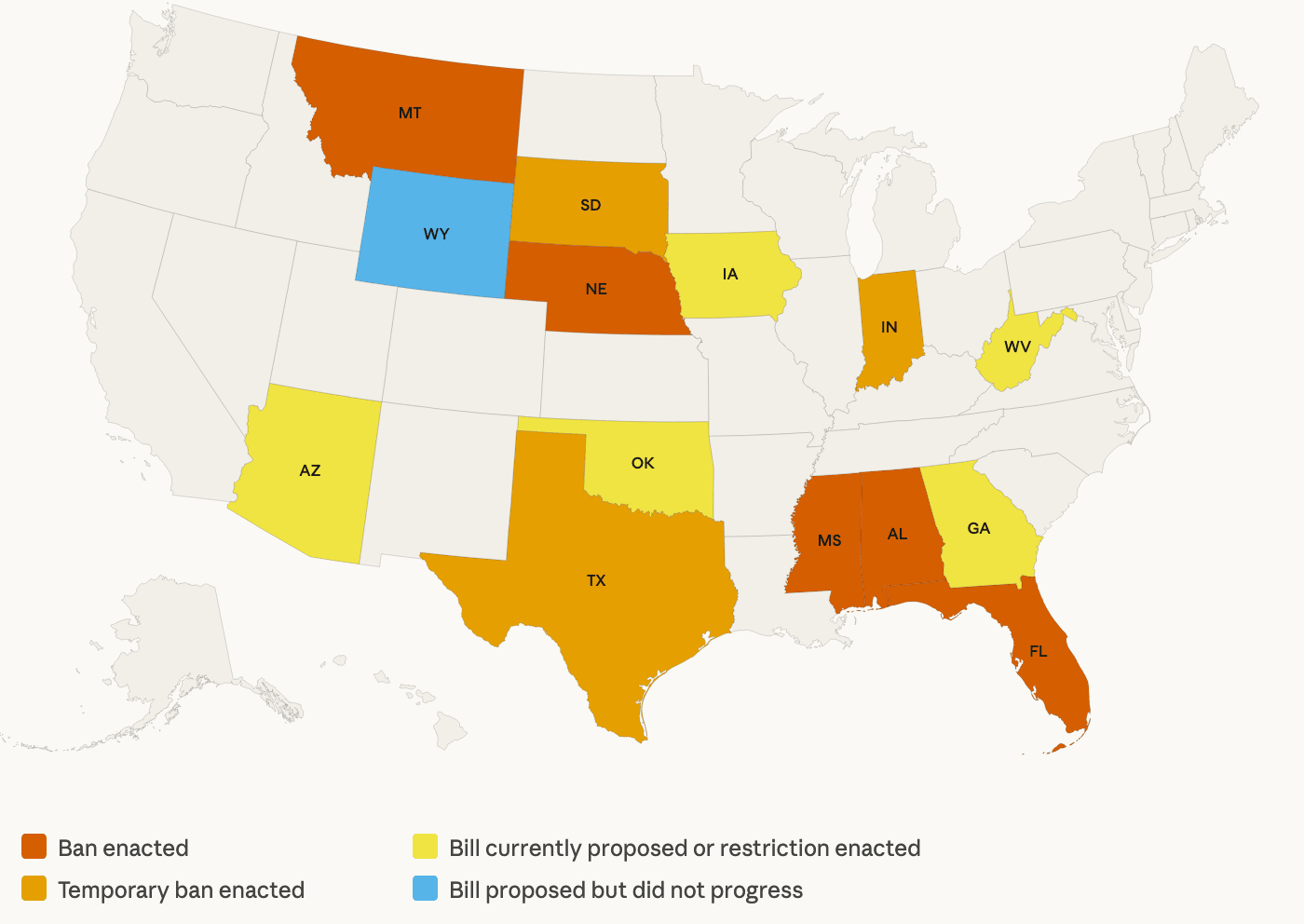
Multiple US states (Alabama, Florida, Mississippi, Montana, Nebraska, and others) and EU countries (Italy, Hungary) have banned or restricted cultivated meat production and sale. Several more have proposed bans. Here’s what the landscape in the US currently looks like:
The EU recently banned the use of multiple meat-related terms for the sale of plant-based proteins and cultivated meat (while ‘burger,’ ‘mince,’ ‘sausage,’ and ‘nuggets’ are allowed, terms like ‘chicken,’ ‘beef,’ ‘pork,’ and ‘bacon’ are not).
Let's say that AGI solves cultivated meat for us. Cultivated meat is already illegal in seven[4] US states. It might soon be illegal in the entire European Union. By the time we get AGI, will they even be able to sell it anywhere?
These bans are primarily driven by agricultural lobby pressure. There is no obvious mechanism by which AGI reverses these political dynamics directly. If anything, if cultivated meat becomes more viable and widely produced, you could just as reasonably expect greater pushback from the agricultural lobby.[5]
That said, if AGI makes cultivated meat commercially successful in jurisdictions where it remains legal, the opportunity cost of maintaining bans rises. States or countries that permit cultivated meat could attract industry investment, jobs, and tax revenue that non-permitting jurisdictions forgo, and food distributors operating across borders may push back against a patchwork of restrictions.
How fast this economic pressure translates into political change is unclear, and current trajectories in the US and EU point toward more restrictions before the likely arrival of AGI.
Consumers accept cultivated meat
For this section, we assume that AGI solves taste parity by producing cultivated meat that matches or exceeds conventional meat on flavour and texture (see above). We discuss other factors relevant to food purchasing habits: price, familiarity, and trust.
The answer to the price question depends on what kind of world AGI produces. In a world where incomes remain broadly comparable to today, consumers are unlikely to switch to cultivated meat unless it is substantially cheaper than conventional meat. This is a high bar, and it becomes harder to clear if AGI also improves conventional animal agriculture, driving down the cost of factory-farmed meat.
Some AGI proponents envision dramatic income growth. Even in a scenario where conventional meat is much more expensive than cultivated meat, sufficiently high incomes could render the difference irrelevant—in a post-AGI world with very high incomes, a steak costing even hundreds of dollars could be negligible. In either case (both very cheap, or conventional meat more expensive), the question shifts from price to preference, and we have no strong reason to think preference favours cultivated meat by default.
Only a handful of cultivated meat products are currently available on the market, so we do not yet have good evidence of how consumers feel about cultivated meat once it's available and they can actually try it. The limited evidence available suggests a low acceptance of cultivated meat, with food neophobia, perceived unnaturalness, and food safety concerns playing a role (see here for a review). A recent meta-analysis found that food technology neophobia—resistance stemming specifically from the technological nature of cultivated meat rather than simple unfamiliarity with novel foods—was a strong predictor of rejection.
There is also a growing headwind in the form of concern about ultra-processed foods. Cultivated meat is vulnerable to being categorized alongside heavily processed products that consumers increasingly report trying to avoid. The GMO analogy is frequently invoked in alternative protein circles. A technology that is scientifically defensible can still face lasting consumer rejection if a food safety scare, a wave of bad press, or a durable public misunderstanding takes hold. If AGI compresses the supply side and cultivated meat products appear widely in supermarkets before the relatively slow normalisation process has played out, sceptics could gain an easy argument along the lines of "this is being pushed on us before anyone knows the long-term effects." As the GMO precedent shows, that argument does not need to be scientifically valid to be politically effective.
A potential antidote to this is that AGI could meaningfully improve how cultivated meat companies communicate with consumers—identifying resonant framings across cultural contexts, running rapid message testing, and creating personalized advertising. But AGI would be equally available to the conventional meat industry, which could have far greater resources (as it does currently). Hyper-persuasive marketing is not a one-sided advantage for cultivated meat.
While AGI could remove the price and taste barriers, how it influences social normalisation is uncertain. AGI may even work against it if supply outpaces trust.
All of the above happen in coordination, on a timeline that matters for animals
Science, manufacturing, regulatory and political approval, and consumer acceptance are broadly sequential bottlenecks. AGI arriving in 2030 does not mean that alternative proteins displace animal agriculture in 2031.
AGI could solve the science quickly, but manufacturing takes time to build out, regulatory approval is jurisdiction-by-jurisdiction and slow, political opposition may be hard to counteract or intensify rather than fade, and consumer normalisation plausibly cannot be rushed without risking backlash.
Even if you grant generous odds at each stage, a chain of individually plausible steps can still produce an unlikely outcome. Say there is a 95% chance that AGI solves the science, an 85% chance manufacturing scales affordably, a 50% chance regulators speed up meaningfully, a 40% chance political opposition eases, and a 70% chance consumers accept the product—the probability that all of these resolve in coordination drops quickly. Under those assumptions (treating them as roughly independent), the combined probability is around 11%[6].
There is also a lock-in risk. If AGI makes people richer before cultivated meat is widely available and familiar, higher incomes could increase meat consumption before alternatives are ready to capture that demand. We already expect the number of farmed animals to grow substantially over the next decade. A post-AGI income boom without available alternative proteins could accelerate that growth further, entrenching conventional agriculture and making displacement harder.
Even granting that AGI could eventually help overcome each bottleneck, the time it takes to work through them means years of continued and potentially increased animal suffering.[7]
The bottlenecks that AGI seems least likely to help with—regulation, politics, and consumer trust—could be the ones that take the longest to resolve. If we want highly competitive alternative proteins to be ready when AGI-level capabilities arrive, those bottlenecks could warrant attention now.
Caveats:
Most of the conclusions drawn here about what is and isn't AGI-tractable are based on current trends. One might reasonably object that the patterns of AI capabilities and deployment we observe today are unlikely to hold in a post-AGI world. We focus on worlds where political and regulatory institutions and consumer preferences persist because we think it's one plausible scenario among many, and because doing so can contribute to identifying which actions might be robust across a range of futures, even if we do not survey that full range here.
Similarly, we don’t address scenarios in which AGI drastically reshapes institutional and political dynamics. A sufficiently capable AI might find creative strategies for regulatory reform or public persuasion that we can't currently foresee. Governments and agencies could be restructured, approval frameworks could be overhauled, and entirely new institutional designs could emerge that bear little resemblance to current processes. If you think thats the most plausible path forward, much of what we describe may not be relevant.
Some readers may think we're drawing the boundary of "AGI" too narrowly. We're happy to discuss what level of capability would change our conclusions.
If you believe that the arrival of AGI means ASI arrives soon after, most of our takeaways probably don’t hold.
AI usage note:
All research and reading were conducted by me.
Claude helped draft various sections of text after I provided a detailed structure. All Claude-written text was thoroughly reviewed and edited by me.
Claude made the map graphic.
Edits:
(28th March)
The original version of this post opened with a summary table describing different potential bottlenecks to solving cultivated meat that could remain in a world with AGI. I have removed the table since it made the post read like it was about my own predictions about how the world will go. Instead, my main aim is to describe the bottlenecks that would likely need to be solved to achieve widespread cultivated meat adoption.
I made minor edits to the caveats section to better describe what scenarios the post does and doesn't cover, and why
(31st March)
I added a new summary that I think better descibes my intentions with the post, and removed the intro which became duplicative
By “science side” we’re referring specifically to the technical problems associated with going from lab-scale to commercial-scale production. Biology, fluid dynamics, and thermal physics do not scale linearly, which means cells and other inputs do not behave the same in small and larger bioreactors.
Agencies could of course adopt more AIs to handle this increased volume, but they can only reduce backlog so much if humans are still required to make the ultimate decisions.
These are example numbers only, not my prediction. This calculation treats the steps as roughly independent, which is imperfect. Some bottlenecks are positively correlated. For example, if the science works well, manufacturing becomes easier. But others may be negatively correlated—if manufacturing scales fast and cultivated meat becomes a credible threat, political opposition could intensify. On balance, accounting for these dependencies does not obviously result in a high overall probability.
This assumes that AGI does not substantially improve the welfare of animals on conventional farms through other means (e.g. vastly better monitoring, welfare enforcement, or shifts in moral attitudes). That is a separate and important question, but beyond the scope of this post.
TL;DR
* GOAL 3 is a social enterprise that created IMPALA, a patient monitoring and digital platform system for low-resource settings. There is also a GOAL 3 foundation that raises funds to ensure underserved communities will be reached.
* A recently completed report from Rethink Priorities calculated IMPALA to have a cost per DALY averted of $7–17 in paediatr...
This month effective altruism has gotten lots of attention, including a cover story in The Economist. It feels pretty surreal to be on the receiving end of it. But I feel grateful these ideas have caught on, and even more grateful for the drive, earnestness, and compassion of so many people who took strange but well-argued ideas seriously and then actually acted on them....
Note: This post was crossposted from the Coefficient Giving Farm Animal Welfare Research Newsletter by the Forum team, with the author's permission. The author may not see or respond to comments on this post.
Subtitle: On vegan advocacy, effective altruism, and FIFA
I turn 40 today. Here are some hot takes.
On factory farming
1. Our biggest challenge is salience. If factory farming led the evening news, it wouldn’t last lo...

This post seems to rely on the premise that there will be a large time gap between AGI and ASI, or DeepMind's capability levels 4 and 5 ("at least 99th percentile of skilled adults" vs. "outperforms 100% of humans"). Unless society deliberately decides to stop AI development, it seems unlikely that there would be large gap between AGI and ASI. ASI would render most/all of the identified bottlenecks irrelevant, e.g. "regulators" and "political opposition" become meaningless in the face of superintelligence.
Even if AI is "merely" as smart as the 99th percentile human, once AI has the ability to do 99th-percentile work for very cheap with arbitrarily many copies in parallel, it seems likely that the political and governmental system as we know it would cease to exist. At minimum, we'd see close to a 100% unemployment rate. It seems very hard to make claims like "political opposition would slow down cultivated meat" when you're talking about a world with 100% unemployment.
This report is not alone in taking this perspective. A big problem I see with a lot of these kinds of analyses (especially in the animal welfare space) is that they are trying to analyze a world where AI is better at everything than the majority of humans, and yet the political/social/economic environment is basically unchanged. I don't see how that would happen.
Thanks for your comment. I agree it's possible that ASI could come shortly after AGI, and I do caveat in the piece that if you believe this, most of the takeaways won't hold.
What I wanted to do with this post wasn’t necessarily persuade people of any one scenario, but instead describe the actual bottlenecks that cultivated meat faces so that people can calibrate their own views, whatever those views are, against the real landscape. For example, if someone came away from reading this more optimistic about cultivated meat under AGI, but also better able to articulate why (according to how they think AGI solves the bottlenecks), I think that's still a valuable outcome.
I used a narrow definition of AGI because I think that's where actionable analysis can be made [edit to add: and I think its not a completely implausible scenario, especially for consumer preferences – see my reply below], but I agree its not necessarily enough. If you have recommendations for how to reason about worlds where current baselines genuinely don't extrapolate at all, I'd really welcome them! It's a problem I find really hard, and I think a lot of others, especially those coming from cause areas outside of AI safety, do too.
I haven't figured out how to organize my thoughts well, so forgive me if this is unclear or disjointed.
Even assuming AI reaches your narrow definition of AGI and then stops advancing, AGI would still radically change the economic and political environment. The bits in this post about behavior of regulators become irrelevant if regulators are replaced by AI.
I don't think it's fair to say (e.g.) "it's hard to predict how politics/government will change, so I'll just assume they won't." Predicting that nothing will change is still a prediction! If you're going to take the route of not making predictions where the future is especially fuzzy, then I think that's more defensible, in which case the answers on "Regulators speed up", "Political opposition reverses", and "Consumers accept cultivated meat" should all be something like "it's too difficult to predict because AGI will radically change the political and cultural environment".
If you write an analysis that only makes sense in an implausible world—the one where AGI accelerates technology, but nothing else happens—then that still has some positive value as long as that world has a non-zero chance of obtaining. But the framing of the piece directs animal activists to focus their attention on that world, and I think that's the wrong world to focus on because it's so improbable. At minimum, the piece doesn't make it clear that this is an assumption.
Here's what I would say: Yes, some things, like how society will be structured post-AGI, are very hard to predict. But other things about AGI are predictable. I can predict that it speeds up almost all kinds of work. I can predict that AGI will control the shape of the future—either because it has explicit control, or because humans retain control but still rely on AGI to do most of the work (because AGI is better than humans at almost all tasks). I can predict that, on our current trajectory, ASI will follow shortly after AGI (see AI As Profoundly Abnormal Technology). I can predict that if ASI is misaligned, then it will wipe out all life on earth.
There is an argument that animal activists should advocate to pause AI development because (1) probably after AGI and certainly after ASI, animal activists will have no power; and (2) it is too difficult to predict whether AGI/ASI would be good for animals, so we need to buy more time to figure out how to make it good. This is an argument from conservatism rather than an argument from expected value; I still think AI pause advocacy has high expected value, but that argument is harder to make. (I'm currently writing something longer about why pausing AI is a good idea even setting aside the alignment problem, although my argument isn't just about animal welfare.)
Another important question is how to shape the values of AGI (about half the ideas in this list are some version of that). There are things we can do now to influence the direction of AI development.
Another way to reason about post-AGI worlds is to think about AI alignment. e.g. I have three recent posts about what forms of alignment are more likely to be good for animals (1, 2, 3). A big thing that I think is under-appreciated by animal activists is that the way AI is aligned—if it's aligned—could have a big effect. I don't just mean "will care-for-animals be built in to its values", but that there are differences between how different types of alignment are supposed to work, e.g. constitutional AI vs. agent foundations (see 1).
Speaking of "if it's aligned", maybe the best thing to do is to work directly on AI alignment. I wrote a relevant post here. I believe a good number of AI safety researchers think that solving the alignment problem is the best way to help animals, although I can't recall any piece of writing where someone clearly articulated this position.
ETA: More on this bit:
Rather than predicting that AGI won't change institutional structures, to allow actionable analysis I could instead say:
This scenario is both easier to analyze (you can ignore political and regulatory factors and just focus on the text content of the AI constitution) and more likely to actually happen (although I still think it's pretty unlikely).
Thanks for your reply!
I definitely take your point about "I used a narrow definition of AGI because I think that's where actionable analysis can be made, but I agree its not necessarily enough." – I think I could have worded that better.
What I meant was that I think the world I discuss is plausible and we can get some actionable analysis from it, which can get us some way to identifying what actions may be more robust across different scenarios. (I agree we wouldn't want to discuss scenarios that are impossible.)
It seems the difference in our views here is that I think it's possible institutions and consumer preferences are quite sticky, at least for a little while; e.g. society imposes that humans have to be final decision-makers for longer than you'd expect (perhaps because legacy rules persist or people strongly prefer slower human-in-the-loop processes, or something else), or consumers really want 'traditional' food that they know, like, and trust regardless of their economic position. If you think there's a 0% chance that can happen, then it makes sense not to agree with what I describe above.
I probably won't carry on replying here, but I do appreciate you taking the time to explain your view, it made me think about the framing of my post and my viewpoint a lot more.