
TLDR
Upcoming Unjournal.org online workshop focused on the cost of producing cultivated meat, linked to our Pivotal Question. Seeking participants (researchers, stakeholders, funders, practitioners) and feedback and suggestions.
Event format: Online live + Async, tightly scheduled (drop-in permitted)
Date: TBD (April–May 2026)
Links: Workshop page (draft), apply/schedule/feedback, modeling/research resources
Overview
The Unjournal is organizing a small-group online workshop on the cost trajectory of cultivated meat (and what it means for animal welfare funding decisions). This links to Is Cultured Meat Commercially Viable? Unjournal’s first proposed ‘Pivotal Question’ (& request for feedback).
What will cultivated meat actually cost to produce? If costs fall close to conventional meat, CM might eventually spare billions of animals.[1] If costs remain invariably high, AW funding directed at CM may be poorly allocated relative to interventions like corporate campaigns.
New techno-economic analyses and forecasts seem to have widened the range of estimates dramatically.
We're bringing together a small group of TEA researchers, evaluators, and animal welfare funders/stakeholders to work through this evidence together, including structured belief elicitation (~Delphi) on operationalized questions. This follows our Wellbeing Measurement workshop (March 2026), with a similar format (which we're learning from)
Focal (interrelated) questions
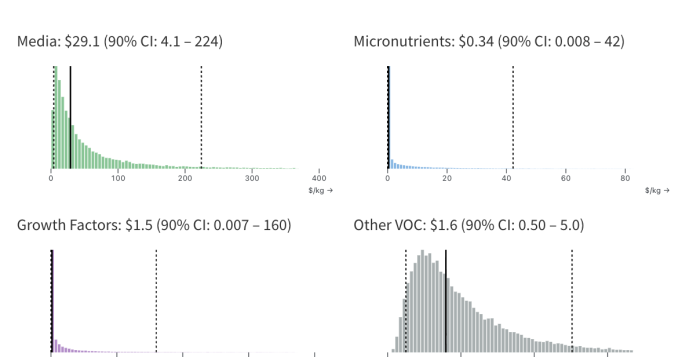
- What will CM cost in 2036 and beyond? Key cruxes include: media costs, cell density, growth factor types and pricing, bioreactor scale, cost of capital.
- What does the TEA evidence tell us? Positive vs negative analyses: what explains the gap? Which assumptions/evidence is most contested?
- How does CM compare to proven AW interventions? E.g., would $100K for CM development yield more animal welfare benefit than $100K for The Humane League's corporate campaigns?
What should funders do now? What evidence would change the calculus? What research has the highest value of information?
Format
- ~3 hours of live sessions over 4 hours, fully online, in modular segments you can join only the parts you're interested in
- Asynchronous participation — submit beliefs and comments before or after the live event
- Structured beliefs elicitation on our operationalized pivotal questions (several of which are also on Metaculus), with possible Delphi approaches
We plan to record and share transcripts (with participant consent)
Proposed segments could include
- Stakeholder Context: Why CM cost matters for AW funding decisions
- TEA Evidence Review: Landscape of analyses, evaluator findings, key disagreements
- Cost Trajectory Discussion + Beliefs: Expert discussion on CM_01, subquestions on media, growth factors, bioreactors
- Animal Welfare ROI & Practitioner Panel: CM funding vs alternatives, funder perspectives
Who we're looking for
We're aiming for a focused discussion among people deeply involved in this question:
- TEA researchers and modelers (cost modeling, bioprocess engineering, cell culture scale-up)
- Animal welfare funders and practitioners making allocation decisions that involve CM
- Forecasters with experience in technology cost trajectories or animal welfare metrics
- Evaluators with expertise in assessing techno-economic evidence
This is a small-group workshop, and we want substantive interaction. Anyone is welcome to express interest, let us know your schedule, and make suggestions here. We'll invite a core discussion group and provide participation opportunities (async contributions, beliefs elicitation, annotating materials) for a broader set of contributors.
Date
TBD — we're gathering availability now and will confirm a date that works for key participants. Targeting late April to early May 2026.
How to participate
→ Express interest & indicate availability (~2 min form — even partial responses help)
→ Share your beliefs on the pivotal questions (you can do this anytime, regardless of whether you attend live)
→ Offer feedback or ask questions using the hypothes.is tool on any materials on the workshop page and associated pages
Resources/related
- Interactive cost model (WIP; informed by major TEAs; feedback welcome; not strongly credible atm, presented to focus ideas and discussion )
- Our evaluation of Rethink Priorities' CM forecasting work
- Pivotal Questions on Coda (full operationalized question specifications)
- EA Forum: Is cultured meat commercially viable? (background on this PQ project)
- Metaculus questions (forecast on CM_01, CM_04, CM_10/11)
- Animal Forecasting Tournament (in collaboration with Metaculus)
Context
This is part of The Unjournal's Pivotal Questions initiative: working with impact-focused organizations to identify their highest-value research questions, connect them to evidence, and commission expert evaluations that inform real decisions. We're currently commissioning evaluations of the key TEAs through our PQ project, and this workshop is designed to bring the evidence and the people together.
Even if you can't attend live, we'd welcome your beliefs on the pivotal questions, your feedback on the workshop materials (you can annotate any page via Hypothes.is), or suggestions for people we should invite.
The Unjournal provides open, journal-independent evaluation of quantitative research informing global priorities. unjournal.org
- ^
This seems like a necessary condition, but it may be far from sufficient; e.g., see Cultivated meat isn’t necessarily a solved problem under AGI ; consumer acceptance and regulation also seem important.