Comments
Thank you for a very important forum post! Have you read the article "Income inequality and the erosion of democracy in the twenty-first century"? I just wanted to put it here in case you have missed it.
Thank you for a very important forum post! Have you read the article "Income inequality and the erosion of democracy in the twenty-first century"? I just wanted to put it here in case you have missed it.
First of all I agree: it is not only preservation, but also modernization. We need institutional progress, and a general understanding of how dangerous "winners takes all" political systems are.
My posts: 1) On parlamentarianism and proportional representation, 2) PolScience 101, 3) Post American Europe, 3) (No) Political Philosophy.
Now, I shall recognize that for the time being I have not been very sucessful here. Fortunantely in Europe we are lucky that we do not have to fight authoritarianism, but conserve our system.
A lot of people seem to conflate 'democracy' with 'status quo institutions and center-left parties', but in many cases these are deeply illiberal and undemocratic. I think you would benefit from considering institutional / center-left threats to democracy, which quite glossed over in this essay.
When I think about threats to democracy, I think of things like:
None of these violations of individual rights or the ability of the people to affect policy through political change were enacted by populist or extremist parties - they were enacted by generally respected and left-wing incumbents.
I agree to the extent that measures like these can be harmful to democracy, that some of them are, and that this topic needs to be discussed seriously. At the same time, I think it’s too simplistic to say that all such measures are per se anti-democratic.
In the article, I mentioned Germany’s law against incitement to hatred (Volksverhetzung) and noted that it is controversial for exactly this reason. The goal of the law is a “militant democracy” (wehrhafte Demokratie), a democratic system that can defend itself against extremist political movements. The reason for this approach lies in our historical experience with National Socialism. The same applies to Germany’s law that allows extremist parties to be banned under very specific conditions.
That said, the legitimacy of such laws is controversial for good reasons. They can be — and occasionally are — misused, including by center and center-left political actors. This might be a good topic for a follow-up article in the future.
Democracy is in danger. This post examines how we can protect it.
It provides an overview of the global state of democracy, explains current threats to democracy and their causes, presents effective countermeasures against autocratization, and explores what role this issue should (or should not) play within effective altruism.
What this post does not include are concrete comparative figures on the effectiveness of different interventions, or a quantitative analysis of possible strategies. Nor does it aim to offer a one-size-fits-all set of recommendations.
Instead, my goal is to provide a broad first overview of the topic, drawing both on activist experience and on political-science research. I hope that every politically interested reader will find something in it that is relevant to them. If you feel that a part of the article is not relevant to you, you can simply skip it.
The post is based on a talk that I prepared for the German-speaking EA community. Accordingly, the post focuses primarily on developments in Germany, Western Europe and the United States. However, many of the trends and strategies discussed are also relevant to other parts of the world. The reason I do not cover them in the post is not that they are not important, but that they fall outside my area of expertise.
This post is largely based on lectures and seminars from my political science studies, as well as on personal political experience. Searching for additional references would have delayed publication by several more weeks or months, which I did not want to do given the time-sensitive nature of the topic. A short bibliography of sources that informed this post is included at the end.
Together with other people from the EA movement and the rationalist community, I have founded the Initiative for Safeguarding Democracy (ISD). Our goal is to offer a space to discuss and develop strategies for how we, both individually and collectively, can help protect and strengthen our democracies. As we are currently still in the early stages, more detailed information will be provided in an upcoming announcement post that we will publish in the near future.
If you would like to get in touch with other people interested in the topic, you can email us at [email protected] or write me a message here on the forum.
Before we examine the current state of democracy, it is helpful to consider what democracy actually means. The answer is complex. Democracy is not a uniform political system, but rather a spectrum of different concepts and manifestations that are not always compatible with one another in theory or in practice.
Two particularly important concepts of democracy in political science are electoral democracy and liberal democracy. An electoral democracy is a political system that meets the minimal conditions of democracy: free and fair multiparty elections with universal suffrage. A liberal democracy includes these electoral requirements as well, but adds core constraints on the exercise of power: the rule of law, the separation of powers, and the protection of individual rights.
While it is often assumed that liberal democracy is “more democratic” or “better” than electoral democracy, this is not necessarily the case. Liberal democracy places special emphasis on protecting individual freedoms against the state. But the price of this is a limitation of the electorate’s decision-making power. In a liberal democracy, the majority cannot simply do whatever it wants. If government decisions violate fundamental civil rights, courts can overturn them — even if those decisions reflect the will of the majority and were reached through proper democratic procedures. Not everyone agrees with this. Still, this article considers liberal democracy to be the ideal.
Political systems that are not democracies are called autocracies. Autocracies, too, can differ greatly from one another. What they share is that their citizens are governed by people who did not come to power in accordance with democracy’s minimal principles.
Many autocracies hold elections, but these elections do not meet democratic standards. Instead, they serve in different ways to stabilize the regime, for example by making the rulers’ authority appear legitimate to citizens or foreign audiences, or by providing the rulers with information about citizens’ political preferences. Genuine, fair political competition does not exist in such systems.
Typical features of autocracies include the banning and persecution of opposition groups, manipulation of election results, unequal access to media or resources, and repression through police and courts.
When the democratic qualities of a political system decline, we speak of autocratization. Autocratization can occur both in democracies and in autocracies: democracies become less democratic, and autocracies become even more authoritarian. Autocratization of an autocracy is called autocratic deepening, while autocratization of a democracy is called democratic backsliding.
If the autocratization of a democracy is not stopped in time, it can lead to democratic breakdown — the democracy turns into an autocracy. The opposite development of autocratization, an increase in democratic qualities, is called democratization.
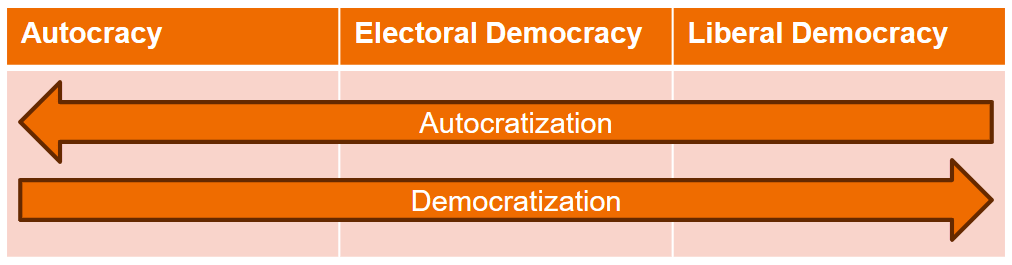
So there are three types of autocratization:
Once a process of democratic backsliding has begun, it often ends in a downward spiral toward autocracy. Still, a full descent into autocracy can be averted if citizens and the judiciary intervene in time. Once a democracy has become an autocracy, reversal remains possible, but it is far more difficult.
A particularly striking example of autocratization is the United States. In a remarkably short period of time, it has experienced severe democratic backsliding. Most political scientists still agree that it remains, at minimum, an electoral democracy. But if the backsliding continues and is not stopped, the United States is at risk of becoming an autocracy in the near future.
Many people feel that democracy is under pressure worldwide. Unfortunately, this is not just a gut feeling, but empirically measurable. This is shown, for example, by research from the V-Dem Institute, widely regarded as the world’s leading research center for measuring democracy.
Large-scale democratic setbacks are not a historical novelty. Since Samuel Huntington, political scientists have often described democratic development as unfolding in waves — historical periods in which many countries simultaneously make democratic gains, usually triggered by major political upheavals. Historically, each wave of autocratization was preceded by a wave of democratization. What we are currently witnessing is the third wave of autocratization.
The first wave of democracy began in the early 19th century when the right to vote was granted to the majority of white men in the United States. It was followed by democratization in several other countries, among them France, Germany and Britain. The first wave of autocratization took place in the 1920s and 1930s, when many of the still young Western democracies collapsed again and fascism rose to power.
After World War II, democratic systems were (re)established in West Germany, Italy, and Japan, and decolonization later led to the creation of many new (and often fragile) democracies. From the late 1950s and especially the 1960s onward, many of these regimes experienced coups, civil wars, or authoritarian reversals, for example in Latin America, parts of Asia, and Africa.
Beginning in 1974 with the Carnation Revolution in Portugal, democracy spread from Southern Europe to Latin America, to Eastern Europe after 1989, and to parts of Africa and Asia. This third wave of democratization was the largest and most global to date.
Nevertheless, we should not lull ourselves into believing that the current wave of autocratization will necessarily be followed by a fourth wave of democratization. What is distinctive about this wave is that it does not affect only young and fragile democracies, but also countries whose democracies long seemed stable and well consolidated. This is unexpected, and the fact that their survival is no longer certain is cause for great concern.
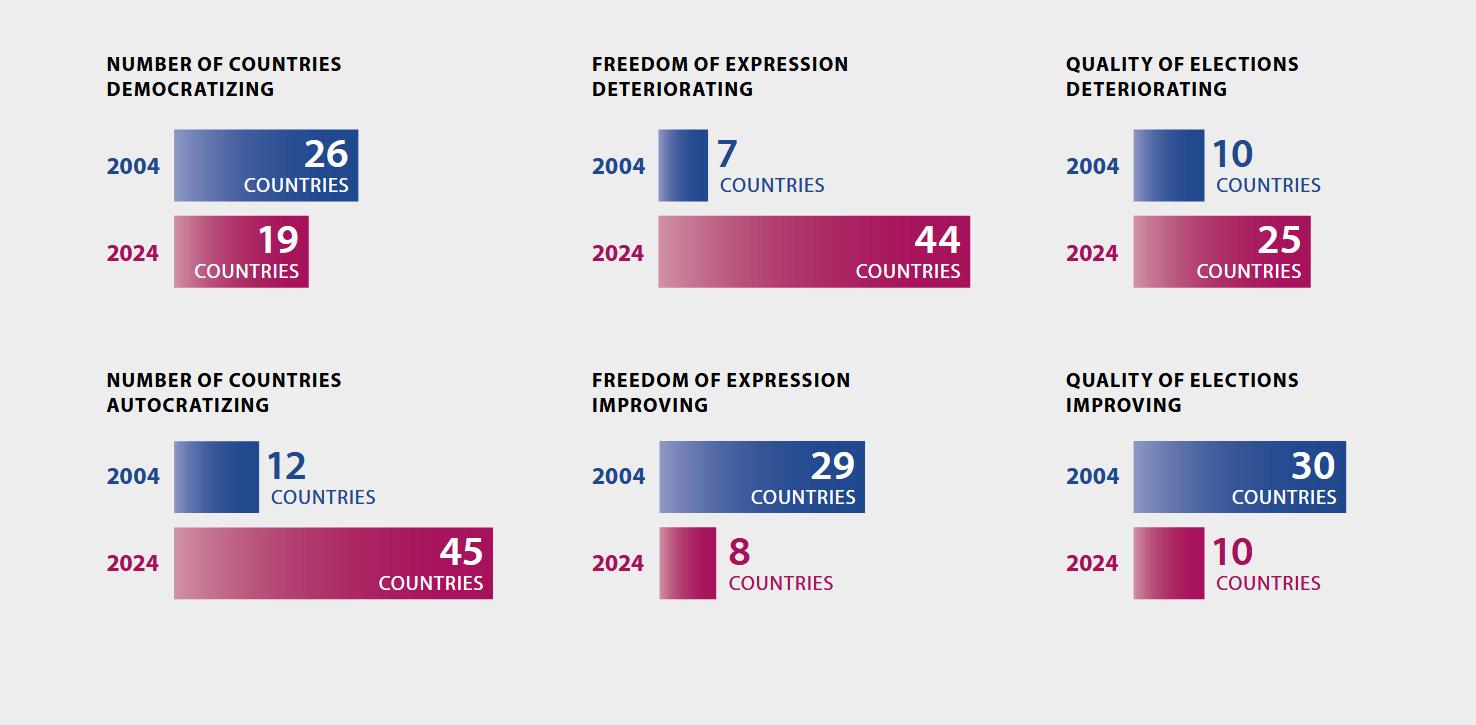
As mentioned above, the most influential democracy measurements in political science are the democracy indices produced by the V-Dem Institute, which are published in an annual report. The V-Dem Democracy Report 2025 is titled “25 Years of Autocratization – Democracy Trumped?”, and it paints a clear and very unsettling picture of democracy's situation. All images below are taken from this report.
Comparing 2024 with 2004, we see a significant decline in the number of democratizing countries, from 26 to 19. Over the same period, the number of autocratizing countries rose from 12 to 45. The same trend can be observed for freedom of expression and for the quality of elections.
But this tendency is visible not only in the number of countries, but also in the number of people affected. In 2004, 13% of the world’s population lived in democratizing countries; by 2024, that figure had fallen to just 6%. The share of the global population living in autocratizing countries increased from 7% to 38%. In 2004, 49% of people lived in autocracies and 51% in democracies. By 2024, these numbers had shifted dramatically: only 28% of people lived in democracies, while 72% lived in autocracies. Two especially populous countries, India and Brazil, had a major influence on these figures. For 2025, developments in the United States will have a major impact on the measurements.
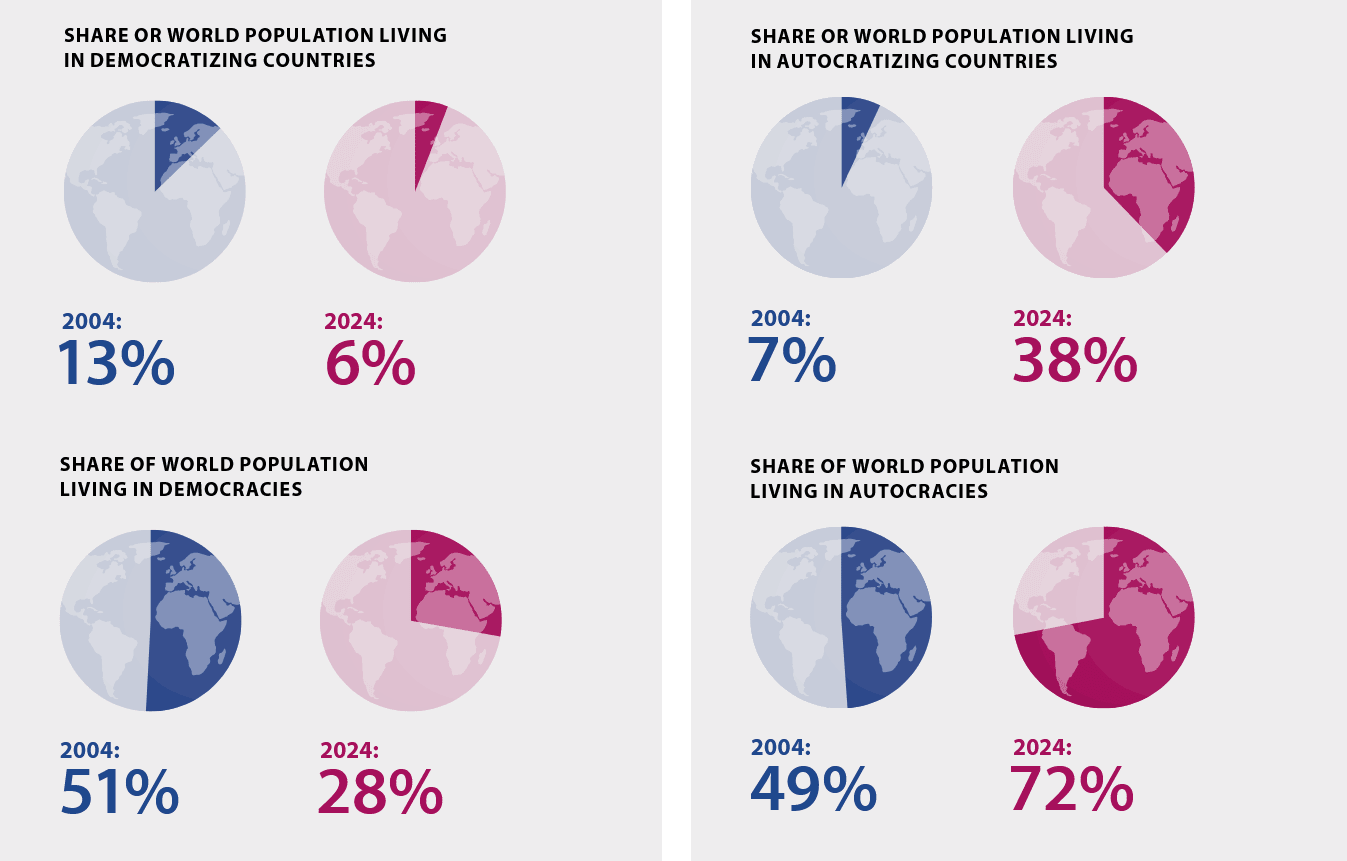
From the V-Dem report, we can conclude that warnings about the state of democracy are not detached, alarmist panic, but reflect a measurable phenomenon. If we want to counter this threat, we need to engage with it actively.
Democracy is not threatened from just one side, but from multiple political directions, whose forms and severity can vary greatly from country to country. Anti-democratic forces can be roughly grouped into four categories: right-wing extremism, left-wing extremism, religious extremism, and foreign influence. In addition, recent years have seen troubling currents within libertarianism, represented, for example, by Argentina’s president Javier Milei or the German-American philosopher Hans-Hermann Hoppe.
It is important to note that a political movement does not have to be violent or openly anti-democratic in order to harm liberal democracy. Being an anti-democrat does not begin with bombings, but with the ideological rejection of fundamental democratic values. In addition, not all opponents of liberal democracy see themselves as anti-democrats, let alone as advocates of autocracy. On the contrary: they often view themselves as representatives of true democracy, something they believe must be reclaimed from the pseudo-democratic rulers in power. They portray themselves as the voice of “the people,” oppressed by ruling elites. Once in power, they tend to attack above all the liberal elements of the democratic system. But the electoral elements often suffer under their government as well.
Right-wing extremism: In the United States and across Europe, right-wing populism and right-wing extremism are a major problem in particular. This is because their representatives wield parliamentary influence and, thanks to rising vote shares, are increasingly gaining access to government. Examples include the MAGA movement in the USA, the AfD in Germany, the FPÖ in Austria, Viktor Orbán in Hungary and PiS in Poland. Beyond political parties, there are also extra-parliamentary far-right groups. These include neo-Nazi networks, such as those that are widespread in parts of eastern Germany, and the Identitarian Movement, which has significant influence on the political landscape in Europe and beyond.
Left-wing extremism: Left-wing extremism can also be represented by political parties, but in many Western countries these tend to play a comparatively smaller role since their vote shares are often relatively low. The situation is different in parts of South America, for example, where far-left parties often have strong political influence. In Europe, left-wing extremism is most visible in parts of the Antifa spectrum which reject the current political system and, in some cases, are willing to use violence. Important: Antifa is not a unified political movement, and this criticism applies only to certain factions, not to all people and groups who identify with it.
Religious extremism: In the West today, religious extremism is often visible in the media through Islamist groups such as the Muslim Brotherhood and Hamas. It is, however, not tied to any particular religion. In the United States, for example, Christian influences also play a non-negligible role in autocratization trends, and in India, Hindu influences do as well. Religious extremism can range from peaceful religious communities that reject fundamental elements of liberal democracy to terrorist organizations. It is not always clearly separable from far-right extremism, since the two often overlap. A notorious example of this is the Ku Klux Klan.
Foreign influence: Foreign influence refers to autocratic states that exert political influence through legal or illegal means within democratic countries. Almost everyone has heard of Russian bot farms that manipulate social media and thereby shape political discourse in the West. But other autocracies such as China, Turkey, Iran, Saudi Arabia, and Qatar, to name just a few, also seek to influence politics internationally. Particularly relevant mechanisms include not only the manipulation of social media but also traditional media (e.g., Al Jazeera, Russia Today), cultural and religious organizations (e.g., DITIB, Confucius Institutes), the creation of economic and infrastructural dependencies, and the ideological and financial support of anti-democratic parties and organizations. Which autocracy poses the greatest threat varies by world region. In most cases, autocracies exert the strongest influence in countries that are geographically close to them.
Why people become opponents of liberal democracy can only be explained in a multi-causal way, through the interaction of several factors. In particular, cultural change, economic problems, political crises, and social media play a major role.
Social change: Over the past decades, Western countries have undergone profound social change, and this process is still ongoing. This includes, for example, the expansion of women’s rights and the resulting shifts in family dynamics, growing acceptance of non-traditional sexual and gender identities, as well as globalization and substantial migration. For people with more conservative outlooks, such changes can trigger feelings of uprootedness and insecurity, which may prompt backlash. In the social sciences, this dynamic is discussed, for example, within the framework of David Goodhart’s concept of the “Somewheres” and the “Anywheres.”
Economic pressures: Although overall global prosperity continues to rise, many people are under severe financial pressure due to inflation, housing crises, and international competition in labor markets. The drivers are not only objectively precarious situations, but also real and perceived economic injustices, as well as fear of downward mobility.
Political crises: Real or perceived crises can create the impression that liberal democracy has failed and that systemic change is needed to address them. Key examples include the COVID-19 pandemic, the European refugee crisis since 2015, and climate change. Different crises do not affect all parts of the population in the same way. Their political effects depend on people’s prior beliefs, perceived threats, and social position. For instance, climate politics tends to mobilize and radicalize segments of the left, while migration-related crises have more often fueled mobilization and radicalization on the right.
Propaganda on social media: Social media enables anti-democratic actors to spread propaganda on an unprecedented scale. Empirical data suggest that populist content performs better on social platforms than other kinds of content. Nowadays, radicalization therefore often happens online, especially among young people, but also among older users. Which platforms matter most varies by demographic group: for older generations it is often Facebook, while teenagers are frequently radicalized primarily via TikTok. It is also worth mentioning that many social media platforms are owned by tech giants who are skeptical or openly hostile toward liberal democracy.
When talking about safeguarding democracy, we have to distinguish between the period before and after an autocratization process begins. Once such a process is underway, political activism changes fundamentally. Through political repression, the erosion of the rule of law, and the undermining of free and fair elections, autocratizers move against their opponents. If they are not stopped early, autocratization becomes a downward spiral. The longer it continues, the more difficult and dangerous it becomes to engage in pro-democracy resistance.
The foundations of a resilient democracy need to be in place before democratic backsliding begins. The stronger democratic institutions are, and the more deeply democratic norms are rooted in citizens’ political values, the harder it is for would-be autocrats to undermine democracy. Ideally, we should not wait to work on safeguarding democracy until authoritarian leaders are already in power.
To understand what we can do against autocratization, it is helpful to first look at how autocrats typically operate. Their approach can be divided into three steps:
Step 1 — Heating up the political atmosphere: Autocratizers often try to shift the “temperature” of politics by energizing supporters and intimidating opponents. This can pressure parts of the population, the press, and public officials to behave in ways the autocratizers want — whether out of enthusiasm, fear, or opportunism. People who had secretly supported the autocratizers even before they came to power may now feel emboldened to express that support more openly. Those who spoke out against them before their rise may fall silent or even switch sides. In this way, political discourse and public perception can shift dramatically even before autocratizers change any policies. In the worst case, this can escalate into violent unrest and pogroms.
Step 2 — Using existing laws and institutions: Autocratizers often rely on the legal and administrative tools that are already in place. By cutting and/or reallocating public funding, they can deprive opponents of financial resources and redirect those resources to loyal supporters. By firing and replacing allegedly “disloyal” public employees, they can bring state agencies into line. Initiating legal proceedings against opponents can also be an effective way to silence them without even needing to win in court. Such proceedings are often so expensive and time-consuming that they drain opponents’ capacity for activism and, ideally, intimidate them into giving up. Another interesting tactic is to ensure that demonstrations against the government are not authorized, so that opponents can protest only if they are willing to accept the risk of repression. This can be achieved by pressuring sympathetic officials within the relevant authorities. And of course, autocratizers may also simply break existing laws. As mentioned, legal challenges are slow and costly, so it can take years for courts to stop illegal practices — if a lawsuit is filed at all, which may not happen if opponents lack the resources to pursue one.
Step 3 — Changing the rules of the game: At this stage, rulers can become “creative” and, in practice, do almost whatever they want, especially if they have already dismantled the rule of law enough so that the judiciary can no longer meaningfully constrain them. Far-right extremists might, for example, use existing legal provisions to expand the grounds for revoking citizenship for dual nationals, thereby getting rid of both unpopular minorities and opposition voters. Other common moves include restricting press freedom and changing electoral laws. The range of possible measures is vast. At the beginning of an autocratization process, there are still many legal constraints, but as autocratization advances, these constraints weaken, and autocratizers gain more room to maneuver.
Now that we know how opponents of democracy operate, we can develop our counterstrategy. I have also divided it into three steps.
Step 1 — Be loud and present: Showing public dissent is essential for every kind of political protest. It can happen in high-visibility ways such as demonstrations, but it can also take smaller forms, like TikTok posts or stickers on a university bathroom door. The point is to encourage other democrats and to show autocratizers that their actions will meet resistance. You can mobilize others by asking your friends, family members, and neighbors whether they want to join you at a protest (only pets should stay at home). Depending on the severity of the political situation, you can consider using civil disobedience. Many theorists regard civil disobedience as a legitimate democratic tool when other democratic means are no longer sufficient to prevent serious harm. The Social Change Lab offers an empirical perspective on the effectiveness of such forms of protest. Important: Civil disobedience is contested, must always remain nonviolent, and can carry serious legal consequences.
Step 2 — Use the legal system and the administration: What autocratizers can do, democrats can do as well. By challenging unlawful actions in court whenever possible, we can stop illegal measures and, additionally, impose costs in time and resources. If you work in public administration, you can use your discretionary powers to advocate for compliance with constitutional and democratic principles. If you are pressured to carry out questionable instructions, seek advice from counseling centers and, if necessary, from legal counsel or a whistleblower protection agency. If that is no longer possible and you are forced to do what the autocratizers want, you can still slow things down in creative ways. Perhaps you have bureaucratic means at your disposal. If not, you may find yourself calling in sick more often than before or extending your smoking breaks by a few minutes.
Step 3 — Build alliances and stay persistent: Defending democracy only works if we can sustain it over time. In all likelihood, we will need years of consistent activism to stop or at least slow autocratization. That is why it matters to build bridges across political camps. Autocrats thrive on division; if we stand together, it becomes harder to marginalize or repress us. By supporting watchdogs, journalists, and civil-society groups, especially financially, we can make sure that experts can continue to do their work. They are the backbone of democracy and do indispensable work. And finally: Don’t normalize. Call out anti-democratic behavior, even when it is “just talk.” We cannot allow anti-democrats to dominate the public discourse, and we need to keep making that clear, even in small everyday situations. The battle for public opinion will likely determine the fate of democracy.
All individual and collective measures must be tailored to the specific situation and its level of escalation. For example, a takeover by an anti-democratic party that is still constrained by a functioning rule of law calls for different responses than the takeover of a fascist regime that immediately begins systematically murdering people. Resorting to drastic measures too early can be a grave mistake, one that may itself contribute to weakening democracy.
When people think about political activism, most initially think of the “classics”: joining a party or activist group, talking to passers-by at information stands, and taking part in demonstrations. And for good reason—this kind of activism is the backbone of mass political mobilization. If you want to get involved in this way, you have a range of different options:
Pro-democracy organizations: There are many organizations which have the explicit goal of defending and strengthening democracy and its institutions. Good examples are the US organization Bridge Alliance and the German organization FragDenStaat ("AskTheState"). Sometimes these organizations are not solely concerned with safeguarding democracy, and it is always worth taking a closer look at their specific projects.
Against the (far-)right: In many cities and regions, there are groups that focus specifically on combating far-right extremism or “the right” more broadly. The spectrum ranges from broad civic alliances that also include moderate groups and organizations to left-wing Antifa groups. It is therefore worth taking a closer look at which group aligns best with your own values and convictions. Of course, right-wing politics is not inherently anti-democratic, and if you consider yourself to be a conservative, a group targeting right-wing politics in general is most likely not a good fit for you. Important: Every democrat opposes far-right extremism, but not everyone who opposes far-right extremism is a democrat. The fact that Stalinists or Islamists dislike the MAGA movement does not make them allies of liberal democrats.
Parties: Political parties are the foundation of parliamentary democracy, and they depend on the active engagement of their members. While the options in majoritarian electoral systems like the United States are fairly limited, countries with proportional representation offer a wide range of parties, both parliamentary and extra-parliamentary, as well as their youth wings and affiliated organizations.
“Single-issue” organizations: These are activist groups that focus on one issue, or a small set of closely related issues. Examples include organizations that advocate for the rights of refugees, ethnic minorities, or queer people. Here, too, there is a broad range of options.
“Broad-issue” organizations: These are political organizations that, somewhat like parties, work on a fairly wide range of issues. A good example is the Union of European Federalists, which advocates for strengthening European cooperation. Broad-issue organizations are not always clearly separable from single-issue organizations, since they often emphasize a particular “core issue” as well. What distinguishes them is that their core issue tends to be framed more broadly. Some of them have a main focus on strengthening democracy.
Beyond the forms of activism mentioned above, there are additional, less traditional options. If you're not a big fan of going to protests or talking to strangers at an info table, online activism could be an interesting alternative for you.
Just as anti-democratic actors use the internet for their purposes, we can use it for ours. Commenting, sharing, liking, or creating your own content helps ensure that democratic views are more visible on social media. This will rarely change the minds of committed anti-democrats, but it can reach undecided people who have not yet formed a settled opinion, and it can also encourage and motivate other democrats. This kind of online activism can be made more effective through coordination, for example by using shared resources such as pre-written messages and group chats, so that people can respond quickly and consistently to anti-democratic content.
Less immediate, but equally important, is editing Wikipedia. Wikipedia is not only an encyclopedia; it is also a politically contested space. With some time and care, you can help ensure that articles remain evidence-based rather than being distorted for political purposes.
Sometimes extremist incidents are relevant for democratic law enforcement authorities. This can be the case, for example, if you witness a hate crime or if a member of a state institution, such as the police or the military, expresses extremist views in your presence. Which incidents are relevant to state authorities, and which are not, depends heavily on the legal framework of the country in question.
In some liberal democracies, there are laws that criminalize certain extremist public statements or actions. One example is the German law that criminalizes “Volksverhetzung”, roughly translatable to incitement to hatred. Such incidents can be reported to the police. If you file a report in person, the person you report may be able to learn your name through access to the case file, so it is important to consider whether you are comfortable with that. Alternatively, you may be able to file anonymously by letter or, in some areas, via an online reporting system. Important: Such laws are contested because they restrict freedom of speech and can therefore be argued to be anti-democratic.
This would not be an EA post if it did not also include a section on donations. And in fact, there is now some empirical evidence on which organizations are particularly effective in this area. We owe this to the still fairly young research organization Power for Democracies, which compared different interventions across a range of countries and published its first three recommendations a few months ago:
On their website, you can read about the evidence base behind their recommendations. Donations can be made, for example, via Effektiv Spenden, the German equivalent to Giving What We Can. You can also donate directly to the organizations, especially if you live in the same country.
Unfortunately, comparable research on effective career options does not yet exist, to my knowledge. Still, based on activist experience, there are a few career paths that may be interesting for some people:
In times of autocratization, it is important to protect yourself without lapsing into pre-emptive compliance. Finding the right balance is not always easy. Autocratization makes activism risky, and the further the process of autocratization advances, the greater those risks become. Safety has to be balanced with visibility; risks must be weighed carefully.
If you engage politically, it is worth making sure you know your rights: understand what you are legally allowed to say, do, and refuse. If you take part in protests that could bring you into conflict with the police, it is important to plan ahead before the worst case occurs. Going with a trusted affinity group can help, and having the contact details of a lawyer or a legal support organization is useful as well.
Digital communication channels and social media should be used with particular attention to security and privacy. Consider using privacy-preserving tools and secure communication (for example Signal, Firefox, and VPNs). If photos from protests are shared online, it may be important to avoid exposing identifiable faces. In some countries it is also legal to cover your face at demonstrations, but this is not allowed everywhere, and in places like Germany it can lead to conflict with the police. Having your phone with you can make it easy to track your location and listen in on your conversations. Sometimes it's better to leave it at home and ask others to do the same.
Above all, don't forget to take care of your mental health and build resilience, ideally together with others. Resistance to autocratization is not a sprint, but a marathon. Anyone who sacrifices their psychological well-being “for the cause” will struggle to stay engaged effectively in the long run.
Autocratization does not affect all citizens of a country to the same extent. Large parts of the population may still feel largely unaffected, while particularly exposed groups may already be facing serious threats to their safety and even their lives. The reason is that autocrats do not target everyone equally.
Especially in the early stages of an autocratization process, autocratizers often rely on targeted repression and selective restrictions. These measures are aimed at people who are politically or ideologically undesirable. In Western countries, groups that are often affected include—though not exclusively:
Even within these groups, vulnerability can vary greatly. Among ethnic and religious minorities, for example, those who are not citizens and especially those without a valid residence permit are often at highest risk. People who depend on medical care and/or welfare support can also be in a particularly precarious position. This includes, for example, trans people who rely on hormone therapy, as well as chronically ill and disabled people for whom the loss of adequate support often means homelessness or even death.
Repression and persecution do not necessarily have to come from the state and its institutions. It can be enough for a hostile political climate to embolden parts of the population to commit hate crimes. Harassment and violence can therefore also come from private actors and can become dangerous long before similar actions are visible at the level of government. Such acts can take many forms: from everyday microaggressions and discriminatory online campaigns to lynch mobs and armed militias murdering people in their homes.
If governments or parts of the population begin targeting especially vulnerable people, we need to be there to support those who are most affected. As with activism more broadly, the forms of solidarity required and appropriate depend strongly on the political situation and its level of escalation.
Emotional and social support: The simplest and at the same time most fundamental way to help members of vulnerable groups is to offer emotional and social support. This includes expressing solidarity in private and in public, being willing to listen to fears and concerns, and showing consistent care. In the long run, it is necessary to build safe spaces and trustworthy communities. If you're not a member of a vulnerable group, please don't look away. Some of your friends, family members or colleagues might be terrified at the moment.
Political and legal advocacy: Political campaigns and legal support are crucial for protecting affected people as effectively as possible from attacks and rights violations. People who know their rights and can enforce them in court if necessary are less helpless in the face of hostile actors. Public awareness and visibility campaigns can help build broad support and increase pressure on the government.
Practical protection: Practical forms of assistance can play a crucial role in guaranteeing the physical safety of vulnerable people. If they lose essential welfare benefits or are fired for discriminatory or repressive reasons, we can offer financial support to help secure their basic livelihood. If they are politically active, for example as journalists, this can also help them continue their pro-democracy work. As the political situation escalates, it might become necessary to offer accompaniment in public and emergency accommodation. Do you have a spare room? Offer it to friends who are at higher risk. It might mean a lot to them. In the worst case, relocation options should be considered. This could mean moving to a safer area within a country, but also moving abroad. International contacts and networks help a lot to make this possible and should be built even before this degree of escalation is reached.
Digital security: Finally, digital security should not be neglected. If we rely on insecure digital infrastructure, for example services provided by Meta or Google, we make ourselves vulnerable. These platforms can allow data about our communication to be collected without any need for intelligence agencies or secret police. At first glance, it may not seem worth the effort to switch to safer alternatives such as Firefox, Signal, or the Fediverse. But doing so protects not only ourselves, but also friends and acquaintances who may be far more at risk. By normalizing secure alternatives, we make it easier for others to protect themselves as well.
The EA movement already is political, and it cannot be completely apolitical. Cause areas like animal welfare, climate protection, and AI safety cannot be meaningfully addressed without engaging with politics. Becoming too political, on the other hand, carries serious risks.
Scientific standards and empiricism often decline as ideological polarization increases. Destructive infighting can make constructive cooperation difficult or impossible. Excluding or alienating those who do not align with the dominant political stance would not only reduce the EA movement’s capacity, but also have negative epistemic consequences.
I can’t give a definitive answer to this question, but I can offer my perspective as someone who has been involved for years both in the EA movement and in various political groups and organizations, some of them not mainstream within the EA community.
At first glance, safeguarding democracy does not seem neglected at all. In most — if not all — democratic countries, there are countless NGOs and activist groups working on this issue. Therefore, one might argue that this is not an area the EA community should focus on.
At the same time, there is a major gap: the link between empirical political science research and real-world practice is often missing. Activists frequently have to rely on intuition and personal experience when deciding what to do and which strategies to choose.
Rigorous giving recommendations for high-impact organizations have only emerged recently, with Power for Democracies, an evaluation organization that likely would not exist without the EA community. It is precisely this niche, connecting science and activism within the cause area, that remains neglected, and where EA can add real value.
As a social movement, EA depends heavily on liberal-democratic institutions. Democracy protects freedom of speech, association, and assembly, as well as academic freedom and freedom of movement, without which the EA community could not exist in anything like its current form.
Beyond that, core features of liberal democracy — individual rights, the rule of law, and meaningful constraints on state power — are central ingredients of a life worth living. As a movement committed to improving well-being of all people, we cannot treat the erosion of these foundations as a problem not relevant to our cause. And we cannot ignore that members of our movement need our solidarity and support because they are being targeted by anti-liberal actors.
EA has distinctive strengths that most political movements lack. Precisely because EA is not primarily a political movement, it can reach across ideological and party lines. It can foster cooperation where political organizations often default to hostility and populism. Even more importantly, EA has a robust culture of evidence-based thinking and critical reasoning. In a polarized society, it is extremely valuable to have a community that, however imperfectly, tries to stay open-minded and update in the light of new information. This epistemic orientation is one of EA’s most valuable assets, and it is easy to lose.
My suggestion, then, for an EA approach to politics, is to protect and deploy EA’s unique strengths rather than imitating traditional political movements. EA can affirm core political values such as democracy, pluralism, and basic human rights, while trying to stay agnostic on political issues that are more controversial and empirically disputed. In times of autocratization and polarization, we can offer a place where people can feel safe and respected, no matter their identity or political orientation, as long as it is compatible with basic democratic standards.
EA is not a political movement. But it can be a movement that helps politics become less tribal, more truth-tracking, and more focused on what actually works. And that may be the most important contribution we can make.
For their valuable feedback, I want to thank Birk Källberg, Manuel Kick and the other members of the Initiative for Safeguarding Democracy who prefer not to be named here. You were a great help in improving the post.
An Opinionated Guide to Privacy Despite Authoritarianism by TurnTrout
Machtübernahme: Was passiert, wenn Rechtsextremisten regieren. Eine Anleitung zum Widerstand by Arne Semsrott, 2026
The Anti-Autocracy Handbook. A Scholars’ Guide to Navigating Democratic Backsliding by Stephan Lewandowsky et al., 2025
The Third Wave: Democratization in the Late Twentieth Century by Samuel P. Huntington, 1991
The Righteous Mind: Why Good People are Divided by Politics and Religion by Jonathan Haidt, 2013



Thanks for writing this up!
Agree that effective (data-driven, ...) democracy interventions are probably still neglected. Curious if you or anyone else here has specific initiatives they'd recommend people donate to, volunteer or work for.
For my home country Germany, some things that come to mind:
- making government more effective (better comms, less bureaucracy, tax reform, ..) --> citizens trust their government more (like in Norway) --> less susceptible to anti-democratic forces
- making institutions to safeguard democracy more effective, like the Bundesverfassungsschutz (German equivalent to FBI, domestic intelligence service to protect the constitution)
- investigative journalism like correctiv.org
- campaigning and movement building
- maybe also election campaigns & comms work for specific pro-democratic parties, if that's your comparative advantage (Greens, Volt, Linke, SPD, ...)
- social media regulation to reduce polarization, maybe?
- fundraising for all the above - most of them seem funding constrained, and democracy is a "hot topic", that could reach many more potential donors
For international democracy promotion, I would stick to the recommendations from Power for Democracies. To my knowledge, they are currently the only ones that are sufficiently empirically grounded. Unfortunately, Power for Democracies doesn’t have recommendations for Germany and, as far as I know, they also won’t publish any, because compared to many other countries, the German democracy is still quite stable at the moment.
However, before Power for Democracies published their recommendations, there was a beta donation fund by Effektiv Spenden with recommendations that didn’t have quite as strong an evidence base, but were still selected based on expert judgment. They supported the following organizations, all of them in Germany:
I haven’t looked into all of them in detail, and there are a few I’m not a big fan of, but I think they’re worth considering if you want to support democracy work in Germany through donations. In general, when it comes to political causes, I’d always recommend looking into organizations yourself and not relying only on recommendations, because your own political orientation will inevitably shape your perspective on them.
If I had to make an intuitive call about what matters most in Germany, democracy support in Eastern Germany and engagement for social media regulation would be at the top of my list. Democracy work in the East because a right-wing extremist hegemony seems at risk of developing there. Social media regulation because, in my view, (1) the issue has a massive impact on how democracy will develop, and (2) it is still heavily neglected. As far as I know, none of the major German parties is currently pushing for it.
When it comes to volunteering, I find it very hard to give general recommendations, because it depends strongly on personal preferences. One thing I would always recommend considering when choosing an organization is what personal impact you can realistically have there. Especially in small political groups or organizations, one additional person can sometimes make a huge difference. If you volunteer for an organization that is already very well staffed, on the other hand, there may be only limited additional value you can add. This includes political parties.