Edit: The match seems to now be over - the funds were expended in around 35 minutes. But many of these charities are great and should be supported regardless!
***
On October 22nd starting at 10:00am Pacific Time, Every.org is matching donations to select animal welfare organizations at a 2:1 rate, up to $2,000 per donor per nonprofit (so if you give up to $2,000, they will contribute up to $4,000 and the nonprofit will get up to $6,000). The first donation a donor makes to each el...
Crossposted to Less Wrong
‘Like most of life’s dangers, the dangers of artificial intelligence are not easily identified from the armchair.’
J Dmitri Gallow
Epistemic status
I’m not an expert in this field, and herein I make some sweeping generalisations educated guesses about the overall...
People v. Hsiung demonstrates our judicial system's reluctance to reckon with industrial animal agriculture.
“Counsel, is it true that 800,000 hens reside on this farm?”1
Justice Jackson of the California Court of Appeal began today’s oral argument with this very question. The case before her is People v. Hsiung—an appeal of Wayne Hsiung’s conviction for organizing the rescue of hens from an industrial egg farm. The central question considered by the court is whether the common law doctrine of “necessity” extends to animals in distress. The real kicker, however, is that our case concerns not just one animal in distress, but 800,000. Per industry standard, each hen was confined to a wired cage, never to see the sun.
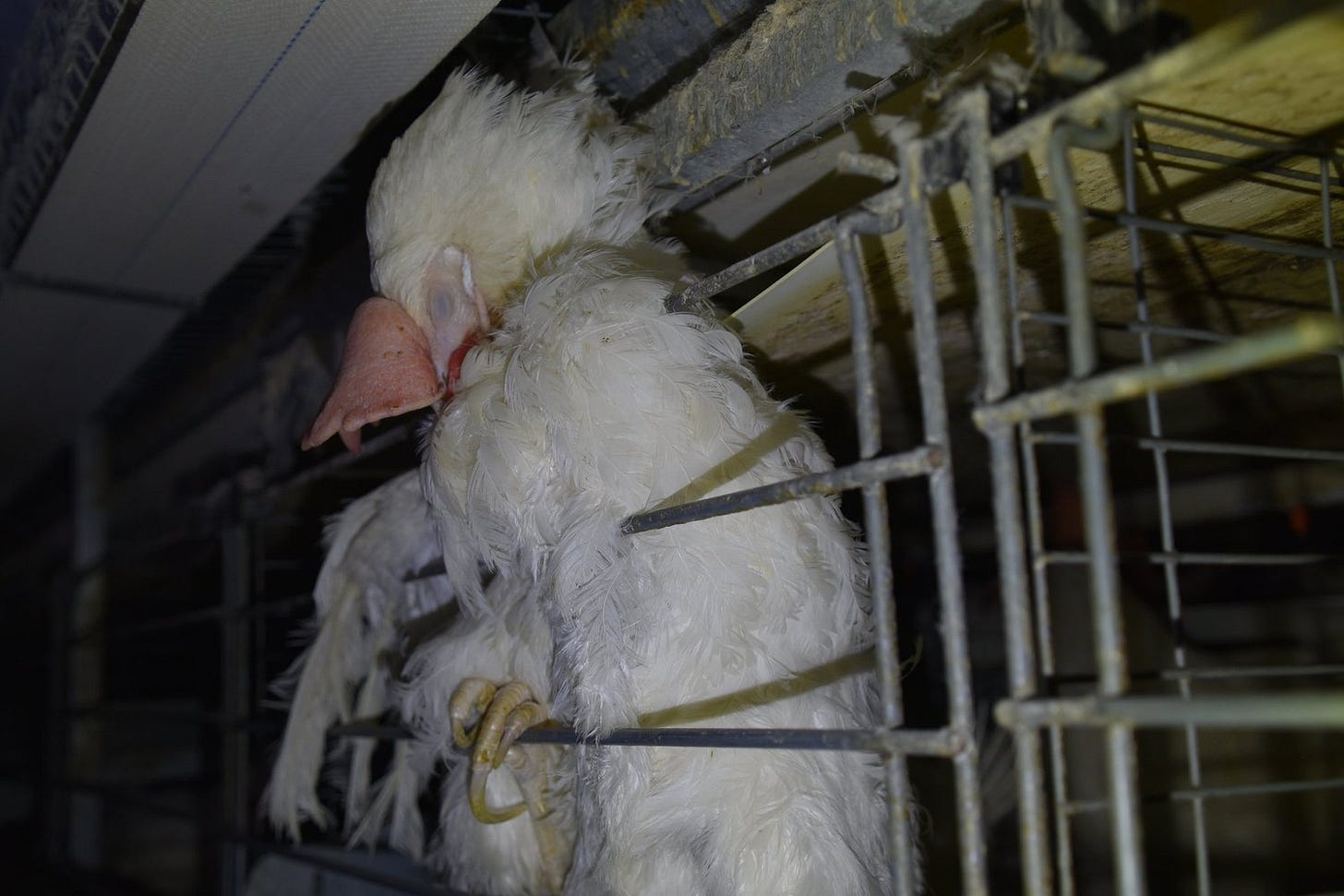
One of 800,000 hens at Sunrise Farms—the farm in question.
For context, the necessity defense is an ancient legal doctrine that justifies otherwise illegal conduct if the conduct prevents a greater harm. For example, trespassing upon private property is usually a crime. However, if the purpose of trespassing is to rescue a child from a house fire, then the conduct is legally justified under the necessity defense.2
Here, the trial court denied Wayne Hsiung the necessity defense, even though his trespassing resulted in the rescue of tortured hens. In denying Wayne the necessity defense, the trial court reasoned that animals are categorically excluded from necessity’s purview. No matter how egregious an animal’s suffering, her interests are never a justification to trespass.
This legal reasoning is, of course, preposterous. Already, numerous bodies of law recognize exceptions for the great evil that is animal suffering. For example, the criminal law creates an “exigent circumstances” exception for animals in need, permitting law enforcement to enter private property without a search warrant.3 The law increasingly recognizes this need to differentiate animals from standard forms of property. And future generations will decry the trial court’s rationale alongside the other shamefuldecisions of our nation’s past.
Thankfully, our appellate justices resonated with these arguments, signaling a reluctance to adopt the trial court’s narrow reading of the necessity defense. Justice Burns, in particular, pressed our opposing counsel, “You’re asking us to create a bright-line rule that the necessity defense does not apply to animals. Why must we make that ruling? The common law evolves.”
At the same time, our justices indicated a reluctance to fully grant the necessity defense. Their first concern was the necessity defense’s “imminency” requirement—the requirement that the harm sought to be prevented is of an emergency status. “Doesn’t Mr. Hsiung’s months-long planning of the rescue undermine the imminency requirement?” asked Justice Simons.
Truthfully, Justice Simons’ question reveals a profound misunderstanding of California’s food system. At any given moment, millions of this system’s factory-farmed victims are subject to imminent harm and suffering. They are confined to disease-ridden sheds, genetically altered to grow painfully large, castrated without painkillers, and suffocated to death in CO2 gas chambers. Their suffering represents not a child in a house fire, but a nation enveloped by an inferno. Their emergency is ongoing.
The justices’ second—and more fundamental—concern was opening the floodgates of change—or, as Supreme Court Justice William Brennan wrote nearly 40 years ago, the "fear of too much justice." Justice Burns expressly articulated this fear, anticipating how activists might use an appellate opinion extending necessity to farmed animals. “Wouldn’t activists go waving our opinion at future, factory farm rescues?” Yes. Yes we would.
Our attorney, Professor Justin Marceau, tried limiting the court’s floodgate concern by asserting that the necessity defense would be restricted to instances where animals are subject to criminal animal abuse. Justin’s reply, however, is flawed in the same manner as the justices’ discussion of the imminency requirement. As I write these words, millions of animals across California are subject to criminal animal abuse. That is the only logical conclusion of California’s anti-cruelty statute, California Penal Code 597, which creates criminal liability for anyone who “subjects an animal to needless suffering.” This needless suffering describes, quite literally, the entire apparatus of factory farming. Indeed, factory farming is the canonical example of needless suffering. It doesn’t improve our health; it doesn’t cure disease. It does, however, provide an abundance of cheap meat. Thus, profit and palliative pleasure are the industry’s strongest justifications for its torrential onslaught of the animal kingdom. These justifications are laughably weak.
So, as it turns out, the justices of the California Court of Appeal are faced with the same moral dilemma as us commonfolk. We want to be a merciful and compassionate people—people who condemn the abuse of power—people who protect the innocent and vulnerable. At the same time, we are afraid to truly abide by these principles, as true adherence requires the restructuring of our habits, economies, cultures, and identities. This is the great moral contradiction of our lifetimes. We love animals; we protect animals; we slaughter animals; we swallow animals.
This contradiction currently sits within the halls of justice. In their attempt to resolve it, I pray that our justices act with moral courage, like the Hawaii Supreme Court that first approved gay marriage, like the Warren Supreme Court that pronounced Brown v. Board. Regardless of their decision, however, I know the animal rights movement will prevail. It is as Dr. King once pronounced: truth crushed to earth will rise again.
6
More posts like this
86
Egregious Cruelty: Humboldt Farm Sued for Putting Salt in Cows’ Eyes, Starving Cattle