The original text contained dry and tedious physics terminology, and since it wasn't written in English as a native language, translating it into a language and context that everyone could understand was a difficult task.
I used an LLM to help draft this post and it likely contains >10% AI-generated text, but I’ve edited/rewritten it extensively and endorse it.
Primarily utilized for grammatical refinement and the preliminary structuring of logic; the core concepts and arguments were conceived by me.
Leveraging the capabilities of large-scale AI models allows us to rapidly and efficiently approach the existing knowledge bottlenecks within human epistemology and methodology. However, AI possesses no ontology—it is not AGI; consequently, all the issues observed within human society will inevitably resurface in AI, and at an even accelerated pace.
I detest the machine-speak of AI, yet in reality, it is a hybrid product born of our own human "materialism" and "rationalism." Only by clearly recognizing this nature can we truly grasp the fundamental purpose behind our utilization of AI.
By applying the same "PRRICCE" framework, we have clearly delineated the boundaries of AGI; should you be interested, you are welcome to attempt to falsify this thesis here:https://zenodo.org/records/18785661.
This article is derived from an analytical application of the PRRICCE system under "stress-test" conditions. It falls under the following classification: Parent System — Pseudo-Consensus — Philosophy — Analysis of the Four Major Schools of Thought. It employs a context accessible to the general public and is presented in the format of a roundtable discussion.
Let's begin with a thought experiment:
Give one words to a person, and ask them to write a brief reflection in about a hundred words. Then, give that reflection to another person, and ask them to summarize it in one words. Take a guess: will those final words be the same as the original? If you're interested, try giving the same sequence of instructions to any AI model and observe the result.
This test maps the source code of how civilization operates.
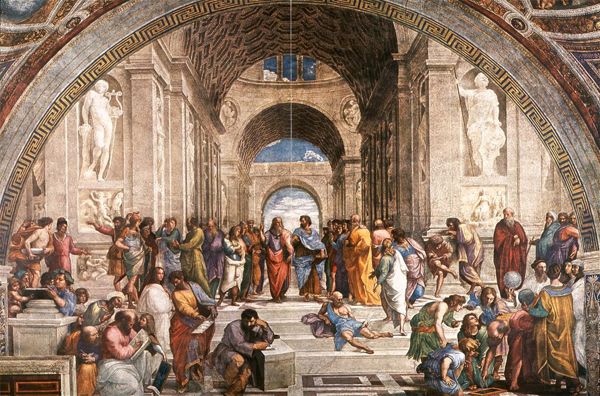
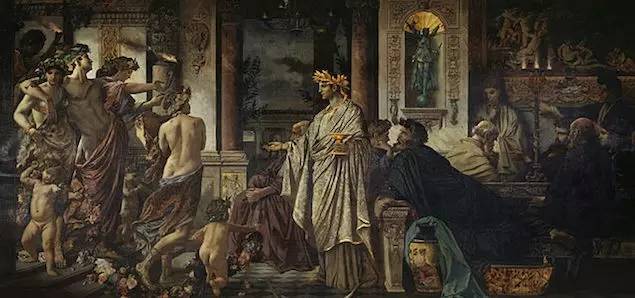
From the moment Socrates drank the hemlock and Plato picked up his pen, civilization has been writing sets of "mental frameworks" in response to its crises. These systems shape the operation of our economic institutions, political decisions, technological development, and even our most private self-perception. Deconstructing this source code is not about conversion to any one creed, but about obtaining an architectural blueprint of our own mental "operating system." It does not offer simple solutions, but provides a fundamental clarity: it allows us to see where we came from, where we stand, what we are truly fighting about, and what the source of our paralysis is.
Before everyone asks "what should we do?", we must first be able to answer: "How is it that we are running here?"
How Ideas Become Both Our Armor and Our Vulnerability (Part 1): The Birth and Fate of Idealism
PRRICCE (Moderator):
Good evening. We gather to discuss not antiquities, but operating systems for the mind. In times of profound uncertainty, when familiar structures crumble, human societies do not simply despair—they architect new ways of seeing. These architectures, once solidified, we call philosophies. But their origin is seldom serene contemplation; it is often survival.
Tonight, we examine the first and perhaps most resilient of these architectures: “Idealism”. With me are “Alex”, whose mind seeks functional clarity, and “Ben”, whose perspective is tempered by the long patterns of history. We will listen closely to the “Founders” themselves, through their own words.
Let us begin not with a definition, but with a collapse.
Alex:
PRRICCE, set the stage. What kind of reality forces a new one to be imagined?
PRRICCE:
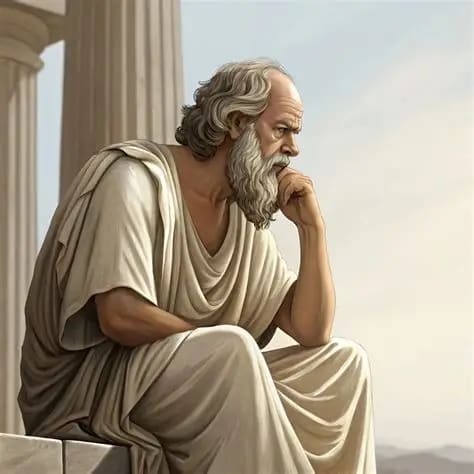
The reality of systemic failure. Consider Athens in the closing years of the 5th century BCE. The city had exhausted itself in the 27-year Peloponnesian War against Sparta, ending in catastrophic defeat (404 BCE). This was followed by the brutal, Spartan-imposed oligarchy of the Thirty Tyrants, and then the restoration of a democracy that, in 399 BCE, tried and executed Socrates—the city’s most probing conscience—on charges of “impiety and corrupting the youth”.
The shock was not merely military or political; it was "an epistemic quake". The democratic process, traditional piety, and sophistic rhetoric had all converged on a single verdict. To many, it felt like a profound betrayal of truth and justice.
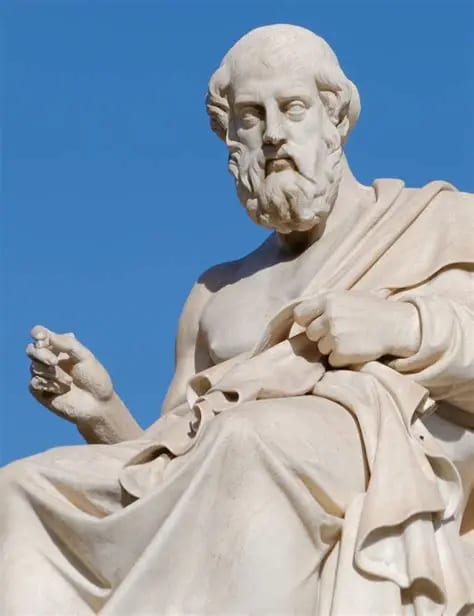
Plato (c. 428–348 BCE), from The Republic (c. 375 BCE), Book VII:
“Picture men in an underground cave-dwelling… they’ve been there since childhood, fixed in the same place, with their necks and legs fettered… they see only their own shadows, or the shadows of one another, which the fire throws on the wall in front of them.”
“The prison-house is the world of sight, the light of the fire is the sun… the journey upwards is the ascent of the soul into the intellectual world.”
My teacher’s death proved the city was a cave. Its politics, its honors, its very perceptions were shadows. True reality—the unchanging, perfect Forms (Ideas), crowned by the Form of the Good—exists outside. Our senses deceive; only the soul’s laborious reorientation through dialectic can recollect this truth.
Did a Platonic collapse occur only in Athens 2,500 years ago?
Ben:
So your response to political trauma was “metaphysical”: to declare the traumatic world unreal, and posit a perfect one behind it. This is the core philosophical architecture of the Idealist tradition: a two-tiered reality (Ontology), knowledge through rational recollection (Epistemology), and disciplined philosophical ascent (Methodology). But how does this become more than personal solace? How does it organize?
PRRICCE:
It organizes by providing a new, unassailable logic for authority. Plato’s Republic is, explicitly, a political blueprint. The same logic that diagnoses the cave prescribes its governance.
Plato, from The Republic, Book V:
“Until philosophers rule as kings or those now called kings and chiefs genuinely and adequately philosophize… cities will have no rest from evils.”
The Philosopher-King is the ruler who has seen the source code (the Forms). His right to rule derives not from birth, wealth, or persuasion, but from his cognitive access to transcendent truth. This creates a potent, self-reinforcing link: political power gains legitimacy by aligning with perfect reality, and that reality is upheld and enforced by the power that it legitimizes.
Doesn't Plato's solution seem familiar?
Alex:
I see the mechanism. It’s elegant. But history shows that attempts to install “philosopher-kings” rarely go as planned. Even Plato himself tried and failed, didn’t he?
PRRICCE:
A crucial point. Plato’s own real-world test of this idea was a profound failure. He traveled three times to Syracuse, attempting to tutor the tyrant Dionysius II, hoping to mold him into a true philosopher-king. The project ended in disaster, with his friend and associate, Dion, caught in the political turmoil. This failure reveals the intrinsic vulnerability of the Idealist political operating system: it relies on a near-impossible alignment of "supreme wisdom with absolute power". In the rough arena of real politics, the blueprint for a perfect ruler is often ignored, corrupted, or used as a cynical mask for raw ambition.
Ben:
Yet, the logic of the idea—that power should be guided by a higher truth—proved far more resilient and portable than any specific “philosopher-king.” Its ability to organize society lay precisely in this abstracted principle. It provided a template for justifying authority, one that could be separated from Plato’s personal failure in Syracuse.
Based on historical lessons, we are cautioned not to trust "philosopher-kings"—yet we still yearn for them, don't we?
PRRICCE:
Exactly. This is the remarkable organizational power of Idealism. It provided both comfort for the suffering individual and a powerful, transferable justification for authority. Rulers or institutions that claimed alignment with the higher order—whether the Forms, God, or later, History—gained a legitimacy that mere force or popularity could never match. This coupling proved extraordinarily durable.
Alex:
But in the messy “marketplace of ideas” back then, why would this complex system win? Weren’t there simpler, more comforting options?
PRRICCE:
An excellent question about its competitive advantage. Let’s consider the alternatives Plato faced.
• Against the Sophists (e.g., Protagoras’s “man is the measure of all things”): Sophism led to relativistic, unstable social contracts. Idealism countered with an objective, non-negotiable standard—"the Forms". It replaced persuasive skill with knowable truth as the basis for law and ethics.
• Against Materialism (e.g., Democritus’s atomism): While intellectually coherent, atomism offered no meaning, no moral compass for a society in collapse. Idealism addressed the deep human drive for purpose and order, providing a narrative that made suffering meaningful.
• Against Mystery Religions: These offered emotional ecstasy and personal salvation, but lacked a comprehensive, rational framework. The system perfected by Plotinus synthesized reason and mystical yearning into a complete, satisfying world-system.
Yes,Plato provided a robust theoretical framework that tightly integrates his theory—what we term "pseudo-consensus" (the C2 attractor)—with power (the veto right, or the "centralized" C1 attractor); this constitutes an unprecedented foundational structure that seamlessly weaves together individual ideals, legitimacy, and power.
This is not merely a reflection of physical laws, but a source code tightly coupled with the survival instincts of intelligent agents, as revealed by evolutionary psychology.
Plotinus (c. 204–270 CE), from the Enneads (c. 301-305 CE), Tractate I.6.9:
“The One is all things and not a single one of them… From it, Intellect comes to be; from Intellect, Soul; and from Soul, everything else.”
“Evil is not a positive reality but a falling short, a lack of Good.”
This “Emanationist” scheme solved the problem of evil (a major source of despair) elegantly: evil is merely distance from the source, a “privation.” It provided a closed, rational explanation for all imperfection, making the system remarkably robust against the chaos of the world.
New theories invariably emerge to remedy the shortcomings of old ones—provided, of course, that we choose to believe them, or allow others to persuade us to do so. But has the reality itself actually changed? Are we, in the final analysis, seeking to alter the facts, or merely to change the "pseudo-consensus"?
Ben:
And this robust, explanatory system proved incredibly portable. Its recursive legacy is its true testament. It didn’t die with the Athenian polis or Plato’s failure in Syracuse.
Alex:
So, Plotinus sealed the leaks. The system was watertight—in theory. But what happens when this ‘perfect’ software meets a completely different, crumbling hardware?
Augustine of Hippo (354–430 CE), from The City of God (c. 413-426 CE), Book XIV, Chapter 28:
“Two cities have been formed by two loves: the earthly by the love of self, even to the contempt of God; the heavenly by the love of God, even to the contempt of self.”
Facing “the sack of Rome” (410 CE), Augustine didn’t invent a new response. He recursively applied the Platonic architecture. The perfect “City of God” versus the flawed “Earthly City” provided a metaphysical shock absorber for the collapse of an empire, and a divine mandate for the rising Church. The hierarchical chain from God to Pope to Emperor mirrored the descent from the One.
PRRICCE:
And the recursion secularized. The “Form of the Good” became “History” or “Science.” The “Philosopher-King” became the “Vanguard Party” or the “Technocratic Expert.” The claim remained identical: a privileged grasp of a higher, truer reality (whether divine, historical, or scientific) justifies the reorganization of society, often with an authority that brooks no dissent. We see quieter echoes in our modern faith in data-driven governance or the quasi-sacred status of certain political principles.
Alex:
So it’s the ultimate armor against chaos, but also a blueprint that, in practice, can justify tyranny. The failure in Syracuse was a warning sign.
Ben:
Which leads me to a more troubling question. We've traced this idea for millennia, from Athens to Rome to the modern world. Plato's ghost is everywhere, in our institutions and our deepest assumptions. Yet, look around. The core crises of Athens—social fracture, lost trust, a vacuum of shared meaning—don't they seem to recur, in new forms, today? If this philosophical spirit, born from the first great collapse and recursively evolved for over two thousand years, cannot ultimately "solve" the problems it set out to address, does that not point to a fundamental limitation of traditional philosophy itself? It may describe, comfort, and organize us. But does it truly resolve anything?
PRRICCE:
Ben, you have pinpointed the very core of the problem. Traditional philosophy—functioning as a consensus narrative or an operating system—does not primarily aim to "solve problems" in an engineering sense. Its core function lies in reducing the otherwise unbearable cognitive and social coordination costs associated with confronting these problems—what we might call the "entropy tax."
• Idealism did not "solve" the chaos of Athens; rather, it redefined that chaos as "shadows in a cave," thereby rendering it tolerable and enabling the reconstruction of order under the guidance of "perfect Ideas."
• Its recursive iterations (Christian theology, political theory, certain ideologies) did not "solve" real-world oppression or injustice; instead, they provided an ultimate explanation for such oppression or injustice (Original Sin, necessary historical stages, powerful adversaries), thereby reducing the internal entropy generated by moral indignation. They are remarkably effective precisely because they offer no avenue for falsification.
The reality is that anyone/system/organization that masters C1 can always find a C2 framework to explain any problem they want to explain.
This has nothing to do with "truth," it's all about survival.
Alex:
The critical issue is that the ontological/epistemological/methodological (O/E/M) framework of traditional "idealist" philosophy is incomplete. It offers grand ontologies (O) and sophisticated epistemologies (E), yet its methodological (M) component—the means by which ideas are translated into sustainable, scalable, and antifragile social structures—suffers from systemic risks of falsification and inherent flaws. It lacks built-in feedback mechanisms necessary for continuous self-correction, validation, and adaptation to the complexities of the real world. For should the methodology ever be falsified, it would directly undermine the very ontological foundations upon which idealism rests.
Ben: Consequently, the phenomenon of "recurring crises" is no mere coincidence. When a civilization relies on an operating system centered on a self-referential narrative—be it concerning God, Reason, or History—rather than on a recursive learning system capable of continuously learning from and structurally adapting to the pressures of Probability, Instinct, and Entropy (PIE) in the real world, it is destined to fall into a perpetual cycle of collapse. The old narrative fails under pressure (entropy increases), triggering a competition for a new narrative (the RECURSIVE PHASE DYNAMICS), and the cycle repeats itself endlessly.
PRRICCE: • Due to their incompleteness and unfalsifiability, traditional philosophical systems are incapable of "finally solving" the dynamic problems of existence.
• This marks not the end of philosophy, but rather its true and entirely new beginning. It reveals that what we need is not yet another, more perfect "narrative" (C2), but rather a meta-theory regarding how narratives are generated, compete, coalesce, and collapse—a framework capable of viewing philosophy, politics, economics, and technology as subsystems operating within the same existential dynamic.
It acknowledges the ubiquity of Plato; yet, the question it poses is this: Is this "Platonic process"—embedded within our civilization's operating system—currently serving to sustain the system's viability (the ultimate mission of philosophy), or is it accelerating its ossification and exposure to risk? Once we grasp the craftsmanship and physical limitations of all ideological "armor," perhaps we will be better equipped to make a wiser choice when the next challenge arises: whether to forge a new suit of armor, or to upgrade the very forge itself.
Ben:
So, what you have actually constructed is not a school of idealism, but rather a deconstruction of the role, operational mechanisms, and limitations of "ontology"—is that correct?
PRRICCE:
Correct! Next: We turn from the architecture that looks beyond the world, to one that insisted on taking the world itself apart to understand and master it. Join us for the Materialist/Empiricist Canon: The Materialist’s Bargain: The Philosophy That Built the Modern World (and Its Price).
TLDR: Take the population ethics quiz here: https://mdickens.me/pop-ethics/
Population ethics is an oft-overlooked subfield within ethics. Many people hold views that they don't realize contradict each other, or that have strange implications that they wouldn't endorse if they thought about it more.
Not just that—population ethics is a BIG DEAL. A lot of ethical decisions hinge on how you think about changes in future populations....
I’ve been feeling pretty shaken since the METR report about the Hugging Face incident came out last week. Over the weekend, I wrote up some thoughts on how lonely the AI situation sometimes feels to me. It’s more personal than what I’d usually share publicly, but I thought I’d post it here in case it resonates with anyone else.
I’m very grateful to the man...
Headline finding: I audited 17 AI Safety Talent programmes. Zero of 17 have published any comparison group, rejected-applicant follow-up, matched control or randomisation. Not one. Every programme that mentions a counterfactual does it by asking participants to self-report.
Background
At least $70 million...