Comments
[Subtitle.] My paper "Beyond the Expanding Circle: Towards a Pluralist Account of Moral Progress" is out in Ethical Theory and Moral Practice
This is a crosspost for My first paper is out! by Rafael Ruiz, which was originally published on The Moral Circle on 17 July 2026, and summarises the paper mentioned just above.
My first paper in a big journal is out today, in Ethical Theory and Moral Practice! It is Open Access, so you can read it even without academic credentials (thanks to LSE for that!) It’s basically half of Chapter 2 of my PhD thesis, so hopefully several more papers will be coming out soon! :)
Here is the paper: https://link.springer.com/article/10.1007/s10677-026-10576-6
Summary
The “expanding moral circle”, or moral inclusion, is the dominant view of moral progress. The idea is that, over time, we extend moral concern beyond ourselves and our tribe towards other nations, women and other races, and eventually all of humanity, nonhuman animals, and so on.
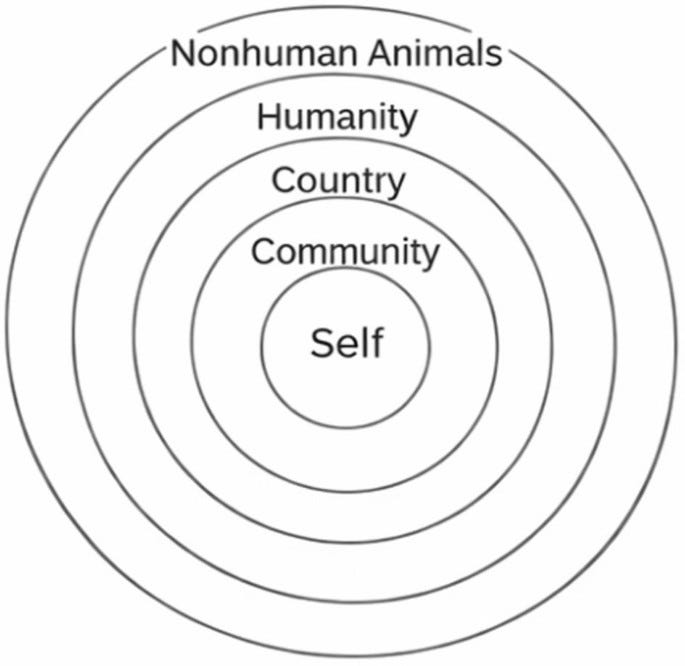
My paper offers a partial criticism of this view. It argues that this picture is historically very important, but seriously incomplete, and that it overshadows other kinds of moral improvement when we write about moral progress.
I focus on two problems. The expanding circle theory is internally too coarse and externally too narrow. Let’s start with the internal problem.
Internal Criticism
The expanding circle is too coarse because it conflates two questions:
- Which beings receive any moral standing?
- How much weight should their interests receive?
Keeping the geometric analogy, I call these the “width” and “depth” of the moral circle. Distinguishing width and depth shows that two views can include exactly the same number of beings while treating them very differently.
Peter Singer’s view is a “Moral Cylinder”, where comparable interests receive equal weight, regardless of whose interests they are.

But a hierarchical view, defended by Shelly Kagan (but also held by most laypeople) discounts the interests of foreigners or nonhuman animals, resembles a “Moral Cone” instead, where everyone may count, but moral weight declines as we move away from ourselves and our families towards strangers, animals, or other beings. So inclusion in the circle does not entail equal consideration.
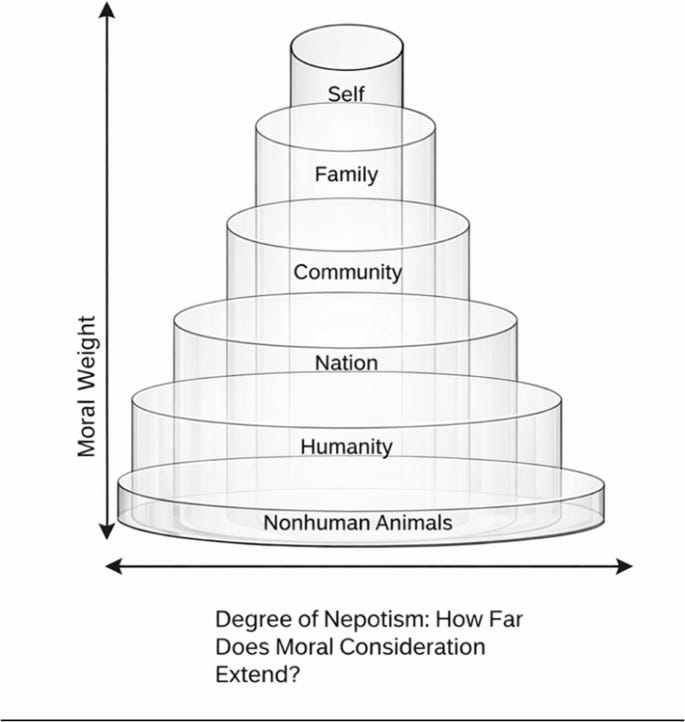
These two circles might include the same number of beings inside them, but they are clearly not the same! Viewing both as a moral circle hides a huge difference in treatment.
This distinction also changes how we might describe historical moral progress. Women, for example, were rarely treated as having literally zero moral standing, like a rock. So moral progress often involved increasing the weight, or depth, of people already within the circle.
I also think some beings have historically been assigned negative moral weight. Plagues of insects or enemy combatants in war have sometimes been treated as beings whose destruction was positively good.
External Criticism
The second part is more devastating, I think, and concerns the moral circle being too narrow as a complete theory of moral progress:
- First, moral circle expansion is not always progress. Moral concern can be overextended, perhaps towards entities with no welfare or interests. As Gwern argued about ten years ago, in some cases reducing the moral weight assigned to respecting the interests of our ancestors, sacred objects, tribes, or nations may be morally progressive. That is, contracting the moral circle can be good.
- Also, some moral progress concerns actions rather than moral patients. Interracial relationships and homosexuality were unjustly moralized. Conversely, casual sexual harassment, sweatshop labour, and factory farming were often treated as non-moral until recently. So moral progress can involve both the moralization and demoralization of actions, which is something also discussed in this article.
Other forms of moral progress include:
- Improving moral concepts: For example, societies can develop more adequate understandings of autonomy and consent, or move from purely retributive ideas of justice towards restorative ones. Progress can also involve getting clearer about whether an action is obligatory, merely permissible, forbidden, or supererogatory.
- Better methods of moral reflection: For example, wider democratic participation may reveal blindspots that dominant groups miss. Also, perhaps social “experiments in living” can test alternative ways of organizing institutions and relationships before mainstream society adopts them.
- Value reprioritization: Societies may come to place less weight on honor, purity, sanctity, or tradition, and more on harm, freedom, and self-expression. Moral attention can also be redirected from relatively minor wrongs towards much larger neglected harms, such as factory farming.
- Distinguishing moral patients from moral agents: A being may matter morally without being capable of culpable wrongdoing. Moral progress can therefore involve revising who we hold responsible, as in the reduced responsibility attributed to some people with severe mental disorders, or the abandonment of criminal trials of animals.
- Building institutions that make moral conduct reliable rather than heroic: Anti-discrimination law, whistleblower protections, and enforcement mechanisms reduce the need to rely on exceptional individuals acting heroically.
- I also mention anticipatory moral governance: In cases involving future generations, invertebrates, animals whose sentience is uncertain, and possibly digital minds, we may need provisional protections before we have complete certainty about moral status, and before large-scale harms occur.
This all presents a dilemma for defenders who try to stretch the expanding circle metaphor as their whole theory of moral progress.
On a narrow interpretation, “expanding the circle” means extending moral standing to previously excluded beings. But then the theory leaves out many other plausible forms of progress, including demoralization, conceptual refinement, value reprioritization, institutional reform, and anticipatory governance.
On a broad interpretation, the metaphor is stretched to cover all of these cases. But then “expanding the circle” simply becomes another name for “moral progress”. It no longer identifies a distinctive mechanism or explains what these different changes have in common.
The way out is simple, I think. The better conclusion is that moral circle expansion is one important form of moral progress, but not the whole of it. A satisfactory theory should treat inclusion as one part of a broader, pluralist account of moral progress. Our philosophical theorizing on moral progress should zoom out and consider other cases besides moral inclusion.
That’s all! More of my papers, adapted from chapters of my PhD thesis, will likely be coming out later this year or next year.

Thanks for sharing it, Vasco! :)
Hi Rafael. You are welcome. Thanks for the great post.