Comments
Being in the Right Place at the Right Time (When You Are Looking for Opportunities or a Job)

8 min readMar 3
9
When people say they got an opportunity by being “in the right place at the right time,” the timing itself was usually outside their control. But there are things you can do that make it more likely you are visible, legible, and reachable when timing happens to line up.
Last year I wrote a post about building your surface area for serendipity to secure opportunities. It got many comments and DMs from people sharing how they had experienced this themselves. Across those stories, a few patterns came up repeatedly:
In this post, I try to organise these patterns into a simple framework and illustrate each layer with real stories from the comments, DMs, and cases we have seen at Hive. None of these guarantees outcomes, but together these steps can improve your odds without needing to be everywhere or perfectly timed.
Acknowledgements: Thank you to Kevin Xia for reviewing this post!
AI use note: I drafted the core ideas myself, then used Claude to help clarify and organise them and to produce an initial draft. I then heavily edited, fact-checked, and rewrote the piece. Any stories and viewpoints come from my work at Hive, from responses to my previous post about this topic and the EA Forum.
Very often, when you ask people how they got a role, a project, or a major opportunity, they say something like:
“I was at the right place at the right time.”
This is a deeply frustrating answer. Most of the time, you cannot simply choose to be in the right place at the right time. And when you are early or mid-career, hearing this can easily turn into self-blame. If only I had gone to that event. If only I had met that person. If only I had been paying attention earlier.
The problem is that “right place, right time” often does too much explanatory work. It makes outcomes sound random, or worse, like personal failure if they did not happen to you.
I think there is a more useful way to look at this.
You cannot control timing. You cannot control when roles open, when funding appears, or when someone happens to be looking for exactly what you offer. But you can do things that increase the chances that, when those moments arise, you are visible, legible, and reachable.
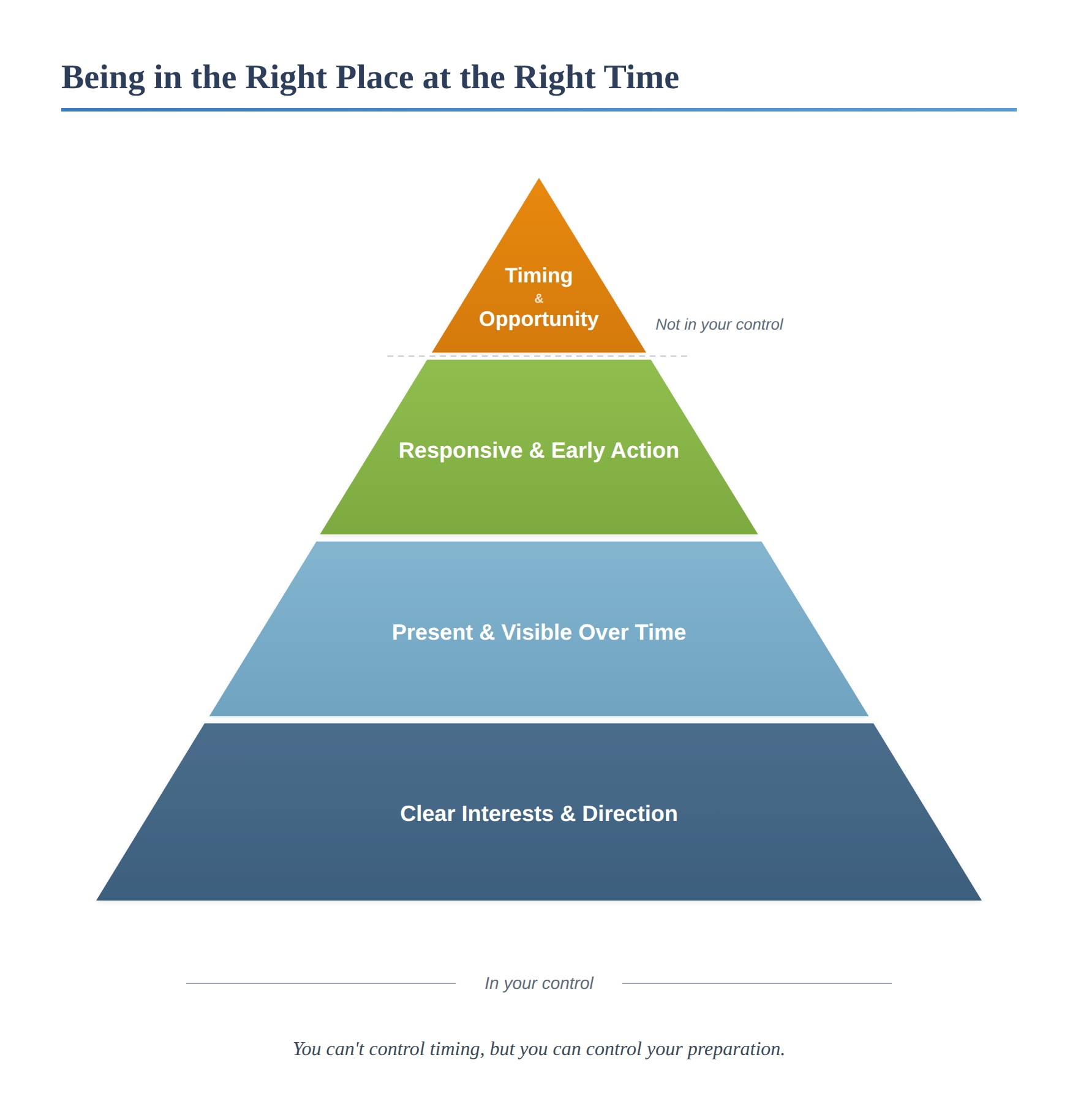
I find it helpful to think about this as a set of layers. Some layers are largely in your control. Others are not. The diagram below captures this idea.
This post builds on my earlier post about unofficial work and building your surface area for serendipity and on the concrete examples people shared in the comments, as well as some examples from our work at Hive. It is not a promise that you will get a job or an opportunity if you follow these steps. You can do all of this and still wait a long time. This is a long-game strategy that improves odds, not certainty.
At the base of the pyramid is clarity.
Across many of the examples people shared, others had a reasonably clear sense of what that person was interested in or working on. Not because they were famous or highly visible, but because they were legible.
In several cases, someone was remembered or recommended because a third party could easily place them:
“This sounds like the person who’s been working on X.” “They’re the one who’s interested in Y.”
A practical way to think about this: if someone encountered you once, what would they associate you with? Is that association close to what you want to be doing next?
This clarity often comes from simple actions: being explicit about your interests when introducing yourself, filling out onboarding or interest forms thoughtfully, describing what you are exploring in plain language, and keeping in touch with people regularly, especially if you have updates.
In many communities, this information persists even if you are not highly active. People can later find and contact you based on what you shared. You do not need to constantly engage for this to be useful.
The next layer is about showing up in the right places often enough that others can observe you over time, and leaving traces that persist beyond those interactions.
This has two dimensions. The first is direct participation: volunteering, contributing, attending conferences and being part of communities where relevant work happens. The second is creating context that works asynchronously, such as sharing your work, reflections, or updates so that people can find and understand you even when you are not in the room.
On the participation side, many of the examples people shared involved volunteering (linking to comments where possible).
@gergo shared that when he was trying to get into the EA mental health space, he volunteered with SoGive. While there, a mental health project came up, which led to a call with the director of StrongMinds, despite him having only discovered EA a few months earlier.
@Angelina Li described volunteering at EA events as a way to gain experience and demonstrate competence, especially for operations roles. In her case, volunteering at an EA Global years earlier meant that when a role later opened at CEA, the head of events reached out and encouraged her to apply. She was remembered from volunteering, applied, got the job, and later moved internally.
@Rowan Clements 🔸 described spending about a year volunteering for EA New Zealand before transitioning into a paid role, first part-time and then full-time. After interning with FEM as a research assistant, Rowan was encouraged to apply for an operations manager role when it opened, and was hired over candidates with more formal experience.
@Jonah Woodward joined the Hive Slack and attended our Hive Community Conversations. At this online event, he was told about an opportunity to volunteer for an upcoming Sentient Futures conference. That volunteering later led to a paid role organising conferences at the same org.
@Dim Sum wrote recently about getting a job after the employer reached out upon seeing their details in the High Impact Professionals database.
In my previous post, I told the story of my colleague @Kevin Xia 🔸 , who got his current job at Hive through being visible in the community and volunteering. He has since given a talk about this at EA Connect 2025 which many people found useful.
Many people ask me if attending many conferences is the only way to be present. I think conferences can be very effective, not just to find opportunities, but as an easier opportunity to get involved yourself as a volunteer (as volunteer opportunities can be hard to find as well).
However, I don’t think it’s strictly necessary to attend many conferences to find a volunteer opportunity. What is more important is creating settings where people can observe contribution, follow-through, and judgment over time. That is possible to do online, but meeting people in person can certainly speed up the process.
On the traces side, I often hear about people securing opportunities after sharing their work, reflections, or updates publicly. Importantly, these examples did not suggest that posting immediately led to opportunities. Instead, sharing work created context. When conversations or opportunities arose later, other people already had some sense of what the person cared about or had been thinking about.
One illustrative example came from @Seth Ariel Green 🔸 , who described spearheading a project he cared about in his free time and sharing it with experts mid-way to get feedback. Over time, this work connected with people who already knew his earlier projects, which eventually helped lead to his current role.
What stands out here is sustained engagement with a problem that genuinely held his attention, rather than optimising for visibility.
Both of these dimensions, participating directly and sharing work over time, serve the same function. They make later interactions easier when timing happens to line up, because people already have some sense of who you are and what you can do.
A top tip in this layer is figure out who the superconnectors are in your community and keep in touch with them. They are usually community builders, funders, recruiters and people with a large network.
As you move higher up the pyramid, timing starts to matter more.
Opportunities can come through various channels: it could be a social media post about a job opening, a referral from your colleague or a meeting at a conference where you’re invited to apply for a role. To maximise your chances of seeing these roles, make sure you follow the people who may advertise the kind of opportunities you’re interested in on the platforms where they are most active.
Some opportunities do not stay open for long, especially when teams are looking to move quickly.
A concrete example came from @Becca Rogers , who applied for a role at New Roots Institute. She shared that she regularly checked general job boards, but she saw the opportunity posted in the Hive community earlier and applied immediately. The team was moving fast, and by her account, if she had only seen the role a few weeks later, she likely would not have been considered.
A related point is being reachable.
Sometimes opportunities arise and people simply do not respond in time. From the hiring side, I have seen cases where we reached out to several promising people to ask whether they were interested in exploring a role. Some replied quickly. Others responded much later. By the time the later replies came in, we were already deep into the process, and it no longer made sense to reopen it.
Practical considerations here: make sure the contact details you leave in communities point to inboxes you actually monitor, check those inboxes at least weekly, respond promptly when someone reaches out (even if only to acknowledge and follow up later), and identify a number of channels where relevant opportunities are posted and check them regularly.
Responding quickly does not guarantee anything. But not responding, or responding late, can remove you from consideration altogether.
At the top of all of this is timing.
A role opens. A project needs help. Someone asks, “Who should we involve?” They send a link to their trusted contacts and ask for referrals. This is especially relevant when the role is a closed hiring round.
This is the least controllable part of the system, which is why outcomes often look random in hindsight.
The earlier layers do not create opportunities on their own. They make it more likely that when timing does matter, you are visible, legible, and reachable.
None of this guarantees outcomes.
Several people who commented described long stretches where they were volunteering, sharing work, joining communities, monitoring opportunities, and nothing obvious happened. Then, later, something did.
This approach compounds slowly and unevenly. Its value is not control, but optionality. You become easier to find, easier to place, and easier to reach when timing happens to line up.
Sometimes being in the right place at the right time just means having left enough traces that, when the moment arrives, someone knows how to contact you. Or monitoring the right channels, so that you apply for the opportunity right when it’s available.
Have you ever gotten an opportunity through one of these layers? Which layer made the biggest difference? I’d love to hear from you!
Hi, I’m Sofia Balderson. I lead Hive, a global community for people working to end factory farming. This is a link post from my Substack, Notes from the Margin to share the messier, more personal reflections that don’t fit in formal updates. If you care about leading, belonging, or building something that matters (especially from the edges), feel free to subscribe here.


This post speaks directly to where I am right now and I truly enjoy your content. I am pivoting careers which is, honestly, a scary place to be. So, I keep showing up to EA events such as happy hours and women's gatherings. I am usually the oldest person in the room, which isn't always easy. However it is starting to pay off.
I attended an EA Women's event recently, met someone and within a week she had already opened two doors for me. I didn't plan on that and I am still working on describing what role I want to play in the AI Safety space. However, I am glad I attended that event.
A few months ago, at an EA Happy Hour I met someone in the same generation as me, also searching, pivoting careers and trying to figure it out. We now share resources and support each other and yes, joke that we are always the elders in the room. That connection alone has made the journey feel less lonely and I have someone I can reach out to and find community.
Sofia's framework captures something I'm living in real time. The layers and serendipity are real. I am learning greater patience and believe in the power of compounding. I am looking forward to the day I can stop saying I'm pivoting and finally say I've arrived. Until then, I'll keep showing up.