Today the Buddhism & AI Initiative goes public, a collaborative effort to bring together Buddhist communities, technologists, and contemplative researchers worldwide to help shape the future of artificial intelligence.
This initial effort is support by FLI and being led by:
Me, Chris Scammell (recently COO of Conjecture)
Peter Hershock (director of the Asia Studies Program at the East-West Center)
Alex Sarkissian (divinity school grad and Buddhist chaplain)
Ryan Stagg (was a technologist at Mind & Life)
Austin Pick (was an administrator at Naropa University)
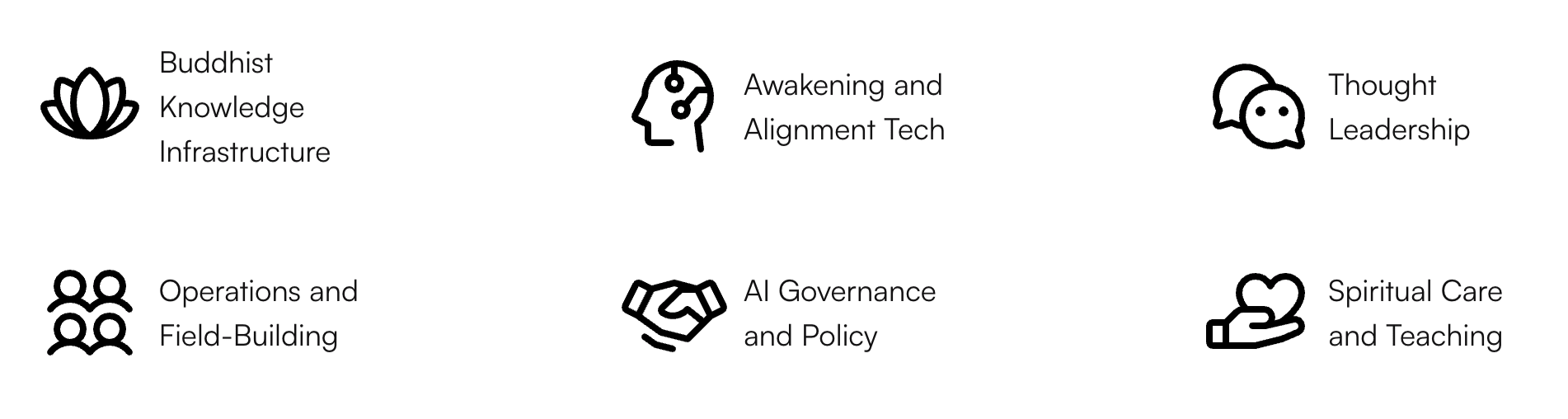
You can think of this project as an attempt to get Buddhism as a stakeholder group "up to speed" with what's going on in AI, and capable of contributing across multiple domains:
Buddhism is a highly decentralized religion, not particularly tech-oriented (outside of Silicon Valley), and concentrated primarily in Asia--with about half of the world's 600 million Buddhists living in China. Engaging Buddhism "as a group" with the challenges of AI is therefore not straightforward, but we believe it is valuable for several reasons:
Contributing to frontier questions: Buddhism is a wisdom tradition with a 2600-year history of studying the mind. From this history has emerged a rich philosophical perspective on intelligence, consciousness, and ethics - all of which are central questions to AI. Beyond philosophy, the emerging field of contemplative nueroscience is trying to formalize some of these insights and apply them to areas ranging from personalized psychological interventions to neurotechnology to AI alignment.
Peacemaking: Buddhism is a recognized global moral authority, with figures such as the Dalai Lama taken seriously on the world stage. At present, however, Buddhism is not well-equipped to participate in global conversations on AI governance and peacebuilding to the extent that, for example, the Catholic Church is. We'd like to help get it in a better position to do this.
Mental Stabalization: We expect the future to be increasingly difficult as AI contributes to unprecedented societal change, and believe that Buddhist practice can offer helpful tools. For members of our group, meditation has been an indispensable source of grounding and meaning-making, and we really think that "there's a 'there', there" in dharma. We're interested in helping Buddhist communities talk to their populations about AI and the future, help their members understand what's going on, and find practices that stabalize them in difficult times.
Right now we're in our networking phase, and have spoken with 50+ Buddhist leaders, AI professionals, and social innovators about current projects at the intersection of AI and Buddhism.
Note: This post was crossposted from the Coefficient Giving Farm Animal Welfare Research Newsletter by the Forum team, with the author's permission. The author may not see or respond to comments on this post.
Subtitle: On vegan advocacy, effective altruism, and FIFA
I turn 40 today. Here are some hot takes.
On factory farming
1. Our biggest challenge is salience. If factory farming led the evening news, it wouldn’t last lo...
When speaking to candidates who are considering working with us at 80,000 Hours, I often hear people worry about replaceability.
The familiar version of the worry is about whether the organisation will hire someone else in your place. If it will, then the difference you make by taking the job is only the difference between you and them.
There are a couple of well-known answers to that. The person hired in your place probably cares about the world too, and would go on to do somethi...
> TL;DR: No, but you might, if you leave it too late: We’re hiring for seven roles, and the people who join now will shape what a much bigger AIM becomes. The first step is cheap -- an expression of interest form.
My worry
I rejoined...